

Why Training Volume Is King For Ultrarunning Performance

Updated On
August 26, 2026
CHOOSE YOUR FORMAT
►WATCH THE VIDEO
►LISTEN TO THE PODCAST
►READ THE ARTICLE
Why Training Volume Is King For Ultrarunning Performance
Ultrarunners need to accept an inescapable truth: Training volume is the biggest determinant of performance in ultrarunning. That doesn’t mean the person who runs the most runs the best or the fastest. Nor does it mean that interval workouts, nutrition, recovery habits, and other components of training aren’t important. What it does mean, though, is that accumulating hours and miles of running is the clearest path to success in ultramarathons.
Here’s the problem: Running more hours than your body is ready for is also the clearest path to injury. So, how do we plan and structure training to leverage the benefits of training volume without overloading athletes and causing overuse injuries? To answer this fundamental question, let’s look at the physiological effects of training volume and then the training architecture that lets athletes optimize volume while minimizing injury risk.
Optimal Volume Doesn’t Always Mean Maximal Volume
A dangerous misconception about training volume is that “more” actually means “as much as possible”. It doesn’t, and confusing them is what gets people hurt or burned out.
- Maximizing volume means piling on miles without regard for recovery, intensity control, or your individual capacity. That’s a one-way ticket to injury.
- Optimizing volume means building the largest dose of low-intensity aerobic work your body can absorb and adapt to. It means structuring training correctly and recovering properly for your current fitness level and the distance you’re training for.
Why Volume Matters For Ultrarunners
Training volume is so important for ultrarunners because of the inverse relationship between intensity and duration. Your total workload is the product of intensity and duration. The harder you go, the less time you can accumulate at that intensity. The converse is true, as well. If you run easy you can run longer. Or, put another way, if you want to run longer you must run easier, relatively speaking.
Running is a primarily aerobic sport. Even for races as short as a single mile, 70-80% of the energy comes from aerobic metabolism. This percentage grows as distance increases and ultramarathons are about as far to the aerobic end of the spectrum as endurance sport gets. So, a large volume of time and miles run at an easy, aerobic pace is important because that low intensity stimulates adaptations that specifically address the demands of a sport characterized by sustained hours-long efforts at low to moderate aerobic intensity.
It’s important to note, though, that there is always an anaerobic component to energy production, too. And high-intensity efforts during long races call upon anaerobic metabolism for shorts bursts of speed and effort. In addition, strategically incorporating high-intensity efforts into training stimulates some adaptations that raise your aerobic ceiling.
What High Training Volume Does To Your Body
Many people are familiar with the basic adaptations to endurance training: increased mitochondrial density, increased muscle capillarization, and increased fat oxidation at low to moderate exercise intensities. But to understand the influence of training volume, it helps to dig a little deeper:
- Increased mitochondrial density: Sustained low-intensity effort creates a specific metabolic stress inside muscle fibers that stimulates changes in calcium flux and energy status. These changes activate a signaling pathway built around a protein called AMPK. AMPK, in turn, upregulates a master regulator called PGC-1alpha, often called the “master switch” for mitochondrial biogenesis. It’s the signal that tells your cells to build more mitochondria and improve the efficiency of the ones you already have.
- Increased muscle capillarization: Long, low-intensity exercise sessions stimulate angiogenesis, which is the growth of new capillaries around muscles. More capillaries means more blood flow and faster oxygen deliver to working muscles. Getting more oxygen into more and better functioning mitochondria increases your ability to break down fuel into usable energy.
- Increased fat oxidation: To burn more fat you must deliver more fat to the mitochondria that break it down for energy. Sustained low-intensity training stimulates the development of enzymes used to mobilize fat. This allows you to increase the percentage of total energy output that comes from fat at a given pace, which spares carbohydrate stores.
The Timeline Matters
The adaptions above don’t happen overnight or after one epic long run. Some enzymatic changes and early aerobic adaptations (like increased plasma volume) start showing up after just a couple of weeks of consistent training. More structural changes, like mitochondrial density and capillary growth, take longer. It generally takes six to eight weeks or more of consistent training stimulus before you see meaningful improvements.
Then there’s the issue of diminishing returns. Training adaptations do not build in a constant and linear fashion. Your current training load must be high enough to overload your systems. But continuing to apply the same training load will yield a diminishing training stimulus as time goes on. You must rest and recover, let your body establish a new baseline, and then apply the next level of appropriate training load.
This is why meaningful improvements in endurance performance take months to manifest and years to compound.
What About Intensity?
Since we’re going into detail about how training intensities stimulate adaptations to exercise, let’s be precise about what high-intensity work does to your body.
High-intensity work activates a different signaling environment than low-intensity aerobic work, one centered more on calcium release patterns and pathways like calcineurin. These signals drive different adaptations: improvements in VO2max, increased ability to buffer hydrogen ions and process lactate, and an increase in the amount work you can perform above threshold before you rapidly fatigue. Those are real benefits for endurance performance, and I’m not telling you to abandon them.
What I am telling you is that sequencing and proportion matter:
► Free Ultrarunning Training Assessment Quiz
Take our free 2-minute quiz to discover how effective your training is and get recommendations for how you can improve.
- Early in a training year, when you’re further from race day, VO2max and threshold work increase your capacity to accumulate more aerobic volume as your training becomes more event specific. When incorporating harder efforts, volume comes down to accommodate the recovery cost of that intensity.
- As you move into the 8 to 12 weeks before an ultra, your training should more closely resemble the demands of your event. That doesn’t mean zero intensity, but rather that interval work shifts toward steady-state work (i.e., Zone 3). This is a challenging aerobic effort, below threshold, where you’ll spend meaningful time on race day. Overall volume during this period will increase, with much of it being in Zones 1-2 and including hiking and time on terrain similar to your goal race.
How to Build Volume Without Injury
The practical question many runners have is how to optimize training hours so their volume of low- to moderate-intensity running is high enough to optimize aerobic development? Blindly piling on hours of running is not the answer.
I use two principles to optimize training volume with the athletes I work with:
- Training Density: I use moderately-long runs close together, sometimes even back to back, to accumulate fatigue similar to a super long run without the single-session duration of that super long run. Athletes focus on good nutrition and recovery between the closely-scheduled endurance sessions, and then we follow these blocks with structured recovery.
- Intensity Control: If your easy runs stay easy (and I mean truly easy, not drifting into that gray zone in the middle) then you free up recovery capacity to handle more total volume. Most athletes who think they’re doing too much volume are actually doing too much intensity, and they could handle their current volume or even more if they were more disciplined about intensity control.
Put those two things together — density and intensity control — and you can train more, safely, than most athletes believe is possible.
How Low-Intensity Volume Makes You Faster
It seems inconceivable that running slowly in training will make you faster on race day. However, speed during an ultramarathon depends on the percentage of your aerobic capacity you can sustain hour after hour. And that speed is determined by your aerobic threshold or LT1 (first lactate threshold). Aerobic volume is what improves sustainable pace at LT1, and hard intervals are what improve your overall aerobic capacity, or performance ceiling.
An athlete with a robust aerobic base built on high amounts of low-intensity volume can sustain up to 80 percent of their aerobic capacity for hours on end. An athlete chases speed work might have a higher ceiling (VO2 max) in isolation, but may only be able to operate at a much smaller percentage of that capacity for long periods of time.
For ultramarathon runners, over the distances you’re training for, the volume-built athlete is faster.
How To Track Your Training Volume
Total number of weekly running hours is part of the picture, but not the whole story. Here’s how I monitor training volume for my athletes:
Enjoying This Article? Get More Free Running Training Tips
Get our coaches' best training advice, delivered straight to your inbox weekly.
- CTL (Chronic Training Load): CTL in TrainingPeaks is the closest single number we have to tracking accumulated aerobic fitness over time. I watch that number in the context of the entire Performance Management Chart, noting the relationships between CTL and Acute Training Load (ATL) and Training Stress Balance (TSB) to evaluate how the athlete is managing fatigue.
- Total weekly volume: Always in hours because the terrain variability in trail running makes mileage less relevant. I’m looking for consistent weeks, well within the athlete’s capabilities. Dramatic increases in weekly volume or hero sessions that are way harder or longer than the norm are red flags for me. You don’t need to be aggressive with volume, just consistent and conservative.
- Performance inside long runs. Pace-to-heart-rate decoupling (Pa:Hr) tells me whether an athlete is holding form and aerobic efficiency deep into a long effort or falling apart. Intensity factor and normalized graded pace tell me what the effort actually cost relative to what it should have.
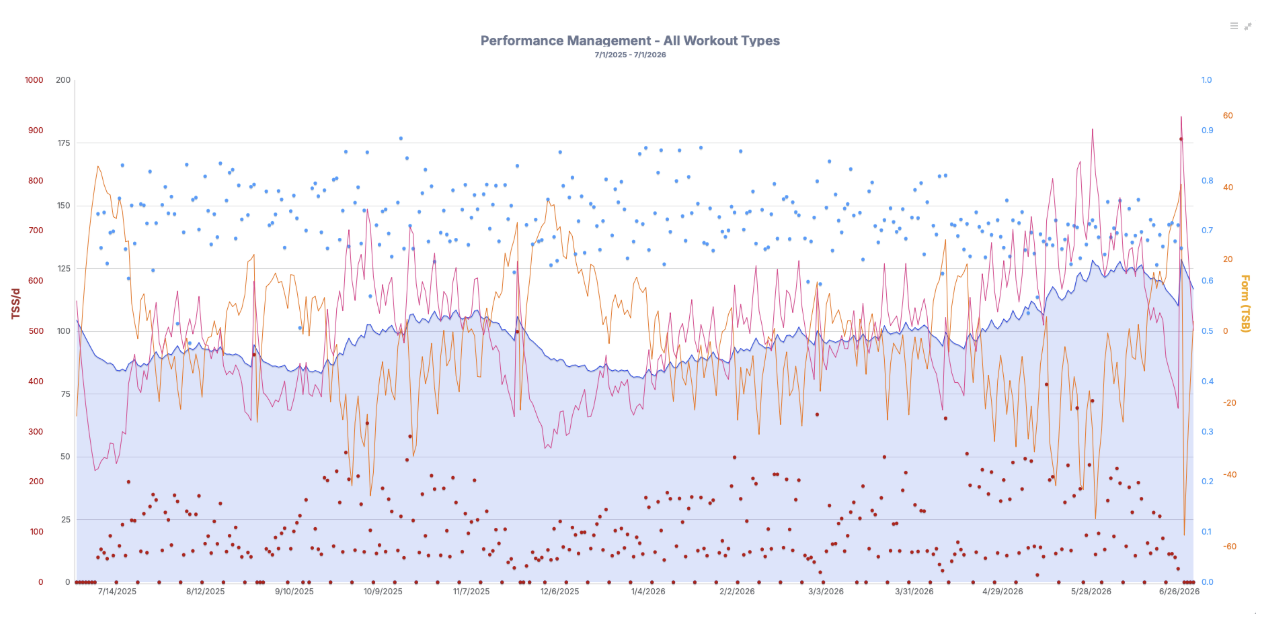
Before and more important than any of those metrics, I value the athlete’s subjective feedback about training sessions. The data tells me what happened. The athlete tells me about the physical and emotional effort required to produce the data.
A Word on Time-Crunched Athletes
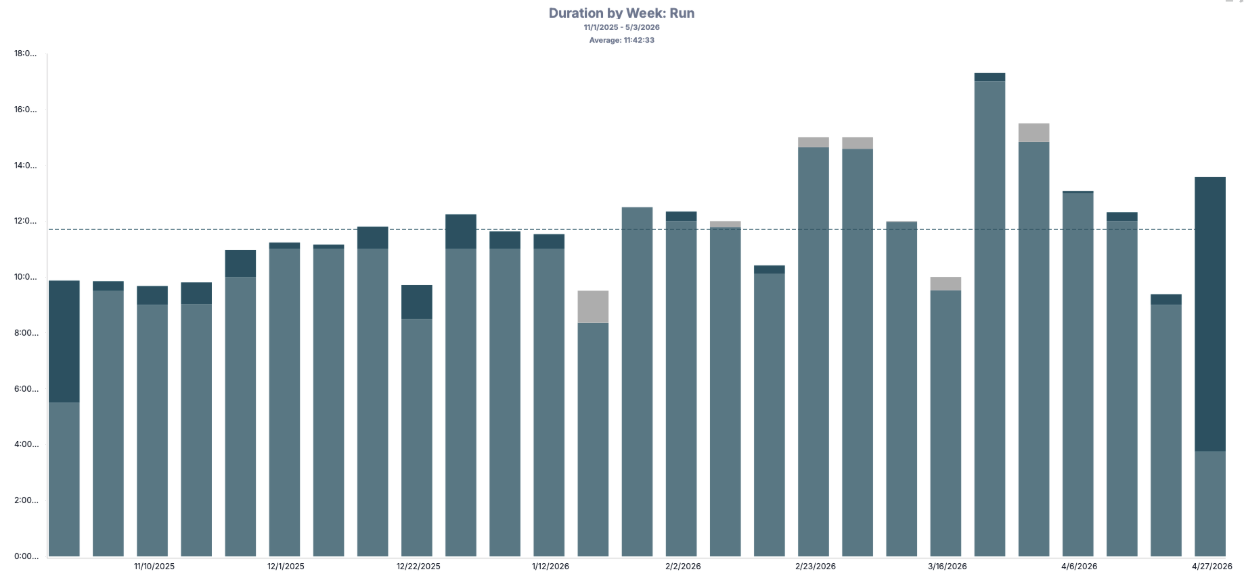
On average, the age-group ultrarunners coached by CTS train between 8-10 hours per week for most of the year. During a highly focused period of endurance blocks, that may increase to 12+ hours for about 4-6 weeks. However, not everyone has the time to build volume the way I’m describing.
If you’re genuinely time-crunched all the time, not just having a busy month, then leaning more into intensity can be a time-efficient way to build fitness. But understand that prioritizing intensity to build aerobic fitness has some drawbacks, mostly in terms of durability. An athlete with more training availability or a longer training history has access to a performance ceiling and a level of durability that a Time-Crunched Athlete struggles to achieve.
The Bottom Line
Consistent aerobic stress, accumulated correctly and balanced with adequate recovery, produces the fitness that directly addresses the key demands of ultrarunning.
We say this within the CTS coaching staff all the time: Volume is our biggest hammer. Not because there’s anything magical about running more. It’s because nothing else in the toolbox (not intervals, supplements, heat training, altitude training, a special diet, etc.) produces adaptations as specific and meaningful for performance in ultramarathons.
Resources:
About the Author
Cliff Pittman
CTS Pro Ultrarunning Coach
Cliff Pittman is the Coaching Development Director for CTS, where he expertly leads the Ultrarunning and Cycling Coaching teams. A passionate ultrarunner and active competitor, Cliff specializes in simplifying complex training concepts into actionable strategies, ensuring athletes at all levels—from beginners to elite competitors—can achieve their goals in prestigious events like the Western States 100 and Leadville 100.