
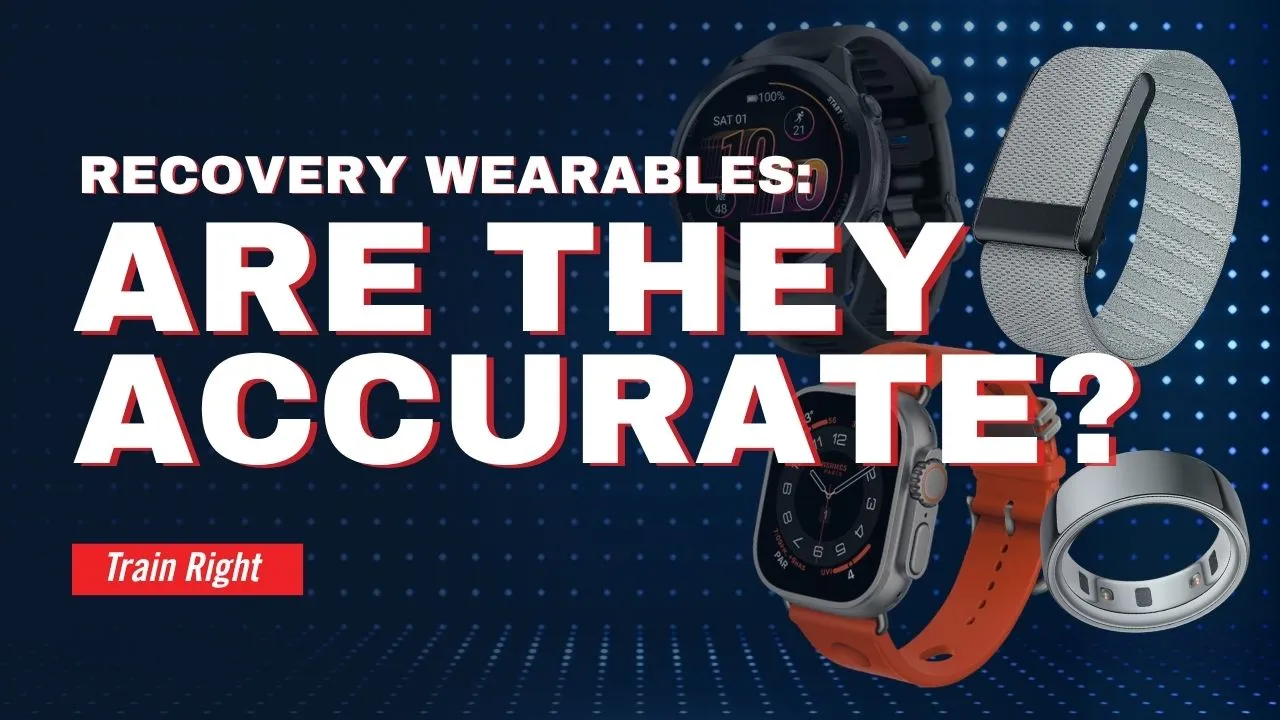
Should You Trust The “Recovery Score” From Your Wearable Device?

Updated On
September 28, 2026
CHOOSE YOUR FORMAT
►WATCH THE VIDEO
►LISTEN TO THE PODCAST
►READ THE ARTICLE
Should You Trust The “Recovery Score” From Your Wearable Device?
Should you trust your training plan or the “recovery score” on your Oura, WHOOP, or Garmin to tell you whether you are ready to train today? I’ve been coaching endurance athletes for more than 20 years and I’ve worn an Oura ring since they first came out. Neither the training plan nore the recovery score tells the whole story. The best decisions come from pairing qualitative data (how you feel) with quantitative data (measurements from power meters, heart rate monitors, and wearable sensors). Here’s the training readiness framework I teach the athletes I work with, including the information I pay attention to, what I mostly ignore, and a simple warm-up test to help you determine whether to continue with a workout or take it easy.
A Good Program Solves 90% of Recovery Problems
A wisely designed training program with appropriate volume, intensity, and frequency is the most important factor for recovery. If I design a comprehensive training program – not just a workout plan – I can solve up to 90% of the fatigue and recovery problems for the athletes I work with.
When athletes come to CTS looking for a new coach, the story is often the same. They’re tired and not getting the results they want. When we go back through their training, it’s common to find lots of intensity, not much rest, and a structure that’s doesn’t allow for adequate recovery between sessions.
That doesn’t mean there’s a one-size-fits-all formula for training. It takes me some time to gather feedback from athletes so I can gauge their response to training and judge their training readiness. That’s the question I’m trying to answer: Are you ready to complete the intended training for today?
What Matters for Judging Training Readiness
Good coaches want a mix of measurable numbers and subjective human information. Here’s what I and most coaches I know rely on, in no particular order.
- Subjective Feedback. How you feel. “How do the legs feel today?” “How’s your energy?” “What’s the real feel?” I ask my athletes these questions constantly, usually by text or conversation rather than a perfectly structured data field. Early in a coaching relationship, that dialogue helps me learn their typical responses and habits. Gathering this information also teaches athletes to recognize their own cues. When we’re more organized, athletes log feelings and perceptions in TrainingPeaks after each session.
- Life context vs. training goals. It’s important to weigh life stress against the training stress prescribed for the day. If both are high, can you absorb it all? Is it necessary to do so, or would it work better to move the workout? For athletes whose life stress is always high, we need tools to bring it down or training goals that are appropriate for your reality.
- Current training load. TrainingPeaks has a lot of this data right in the Performance Management Chart. Markers I look for include the Training Stress Score and Intensity Factor from the previous day, your Acute Training Load (ATL), and Training Stress Balance (TSB). Together, these markers are good indicators of how you’re likely to feel today and how much fatigue you’re carrying from recent training.
- Total sleep last night. You should roughly know how many hours you slept last night (or in recent nights) relative to how much sleep you typically get. Based on research and experience, total sleep time is (currently) as valuable or more valuable than sleep data from a wearable sensor.
- Resting heart rate. Can be measured upon waking or using a wearable sensor through the night. It’s old school but very effective. Establish a baseline over a few weeks, then track it so you know what’s high, low, and normal for you. Both the daily value and the trend matter.
- Perceived sleep quality. I coach athletes to rate their sleep before they look at any app in the morning. The results are often different. Relying on a device to tell you how you feel is a slippery slope.
- Heart rate variability (HRV). HRV can be captured overnight or on waking. Based on the research I’ve reviewed, the experts I’ve interviewed, and my own athletes, a morning measurement paired with subjective feedback gives a better net outcome. That comes down to how the autonomic nervous system works, how wearables measure HRV, and athlete habits. For a deeper dive, read anything by Marco Altini of HRV4Training (links at the end).
Training Readiness Data You Can Mostly Ignore
My coaching colleagues and I have tried monitoring all kinds of training readiness and sleep scores from a wide range of devices. Here are some of the data points from wearable sensors we have learned to ignore:
- Time spent in each sleep stage
- Proprietary recovery scores
- Proprietary readiness scores
- Number of times woken
- Total time awake
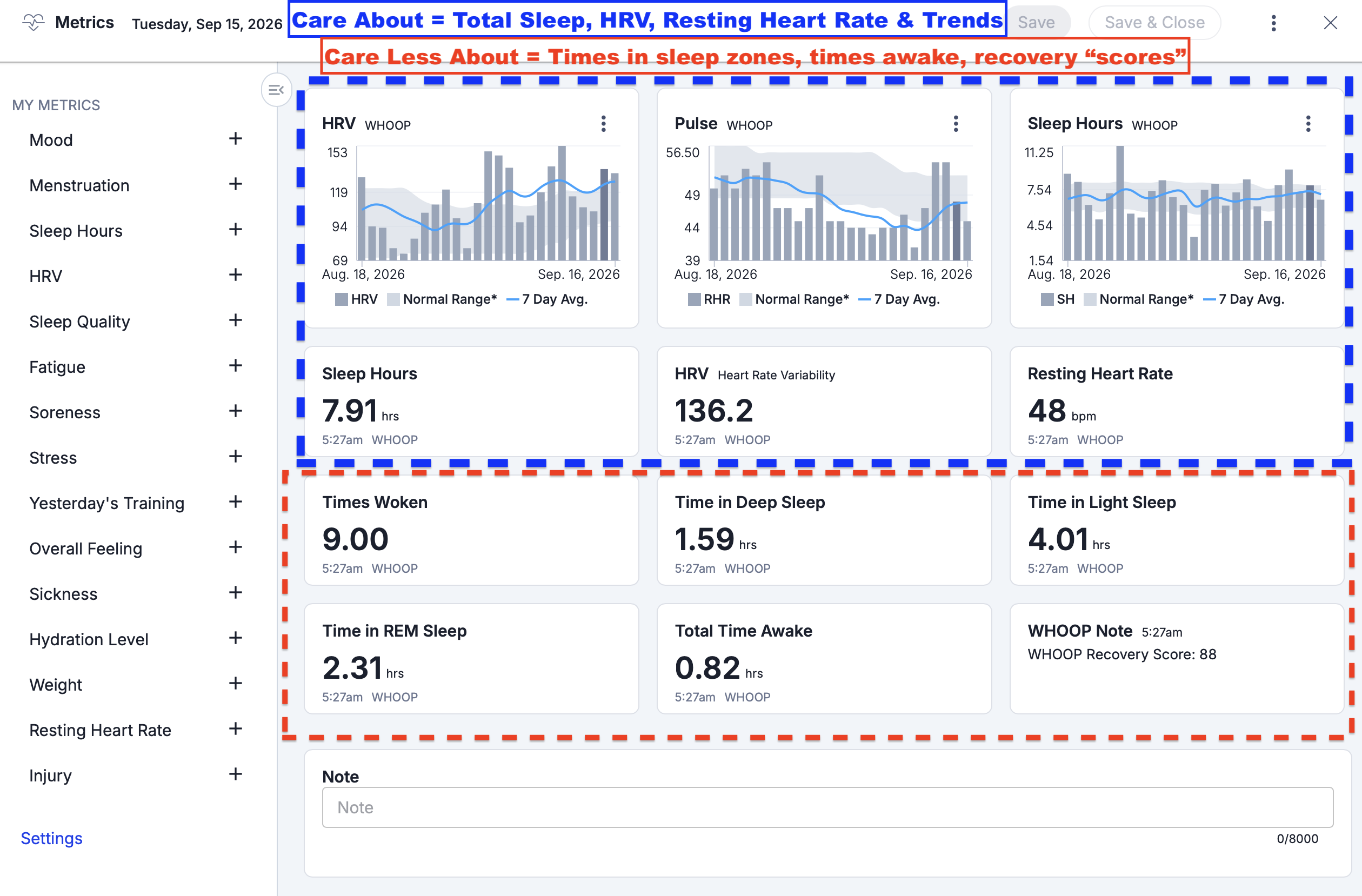
If something looks truly strange in an athlete’s data, I flag it and discuss it with the athlete. Otherwise, I ignore it.
Why You Should Ignore Sleep Details From Wearable Sensors
Wearable sensors that attempt to measure sleep behaviors are not yet accurate enough. Compared with polysomnography, the lab standard for measuring sleep, consumer wearables aren’t there yet. A wearable infers sleep from peripheral signals like movement and heart rate; it doesn’t measure sleep itself. The data are consistent night to night and do a reasonable job with the big picture (i.e., total hours of sleep) but not the fine detail, like time spent in specific sleep stages.
We know that high-quality sleep is the most important component of recovery, which is why it’s so tempting to optimize sleep stages and minute details of overnight behaviors. Unless and until the data becomes more accurate, though, the information isn’t reliable enough to influence today’s training.
Practical Advice: Using The Warm-Up Rule To Judge Training Readiness
Most athletes are trying to resolve some version of this:
- My training plan says X.
- My WHOOP (or whatever device) says Y.
- My body says… maybe? I don’t know?
This is where logging subjective data pays off. The more familiar you become with your physical and mental response to training, the better you can recognize when it’s time to push through versus hold back.
► Free Cycling Training Assessment Quiz
Take our free 2-minute quiz to discover how effective your training is and get recommendations for how you can improve.
When in doubt (or even if there’s no doubt), I recommend The Warm-Up Rule. Here’show it works:
- Complete your normal routine. Use the criteria above to judge your training readiness. If it looks good, plan for your training session. If you’re unsure about your readiness and a hard workout is on the schedule, don’t decide anything yet. Proceed with your day as if you’re doing the workout.
- Get on the bike for a structured warmup. The idea is to use a structured warmup to get your blood flowing and body moving before making a go/no go decision on today’s training session. As you can see in the example below, I typically follow a pattern of progressive aerobic overload with cadence drills, openers, and short recovery periods to increase core temperature, activate all energy systems and muscle groups needed for the efforts. This usually pulls back the veil masking any confusing feelings of the body and you can then make better decisions.
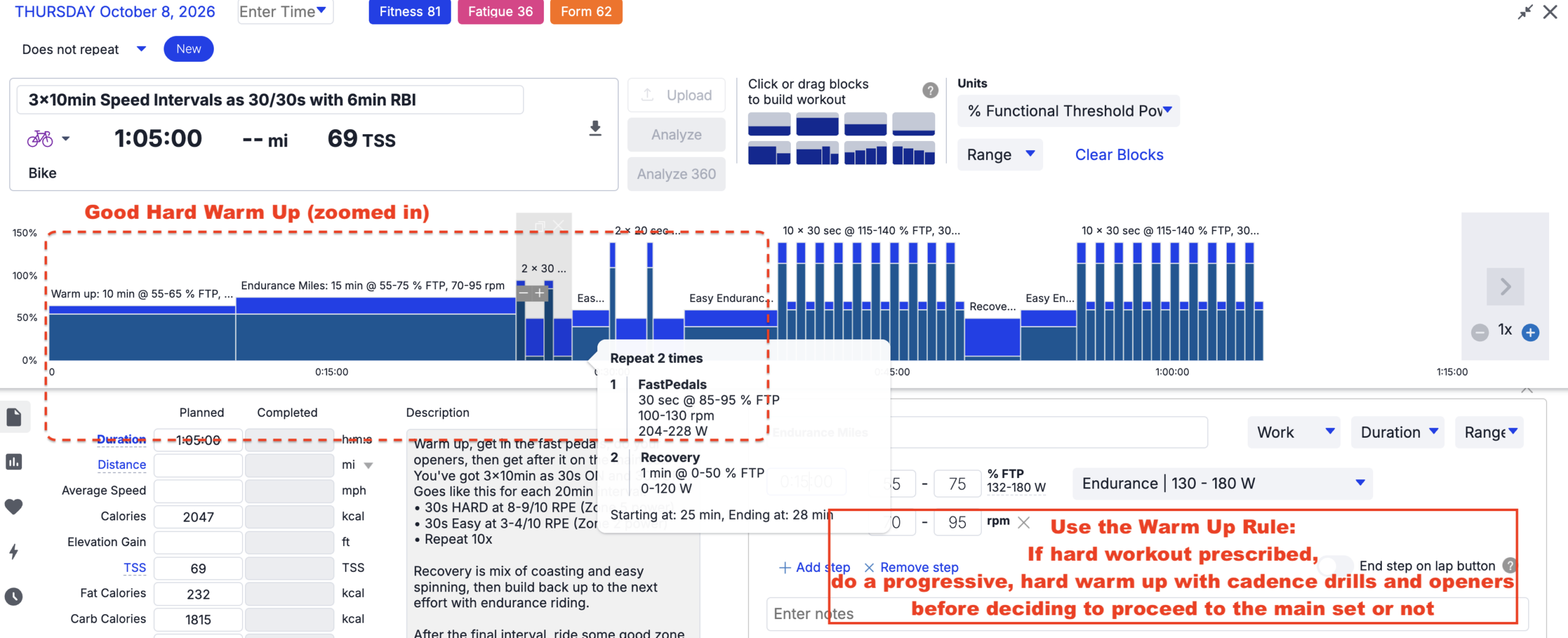
- Following the warmup, evaluate training readiness. Here’s how to make the decision to continue with a focused training session or take it easy:
- Still tired/lethargic after warmup: The legs aren’t there, heart rate is sluggish to respond to efforts, RPE is out of sync with efforts, etc. DON’T PROCEED. Ride endurance if you want the Zone 2 hours, or just go home.
- Feel normal after warmup: Maybe you’re not feeling overly enthusiastic, but your body is responding normally. PROCEED. This is often the scenario when an athlete is deep in a training block. There’s still good work to be done, but the fatigue is building and it’s a little tough to get started.
- Feel great after warmup: Sometimes you just need to get out the door and a little separation from real life for things to click. Your warmup can do just that.
I have yet to see a device or a score that does a better job than the Warm-Up Rule for evaluating today’s readiness to train. The Warm-Up Rule requires athletes to be self-aware, which means it takes some practice, but it also reinforces good habits like getting out there instead of just staying on the couch. Even if you just complete the warm-up, that can be a good activity for the day.
Identifying Value From Wearable Sensors
Of everything a wearable sensor collects, Heart Rate Variability, resting heart rate, and total sleep time are probably the most valuable. Even so, they’re minor influences when it comes to deciding today’s training. The biggest influences on training are program design, subjective feedback, and acute changes (e.g., getting sick, mood changes, etc.). Those change my plan for an athlete far sooner than a suppressed HRV or a slightly elevated resting heart rate.
Is a wearable worth the cost and effort?
Wearable sensors can increase your awareness of how your body is responding to your behaviors and environment, but it’s important to keep the information in perspective and take the long view. For the athletes I work with who use them, here’s how I advise them to get the most from their devices:
- Put your data in one place. Sync your device automatically to TrainingPeaks or whatever software you use to aggregate training and nutrition data.
- Value trends over daily scores. The “readiness score” for today that is pushed to your phone is less useful than the trend over time. I advise gathering months of data to establish baselines, then overlay that with training and performance data to obtain reasonable insights.
- Be skeptical of do-everything claims. Many trackers promise to handle movement, training, sleep, readiness, and recovery. If it sounds too good to be true, it probably is.
A Cause for Optimism: The devices are getting better
I’ve worn an Oura Ring since it first launched. Honestly, it wasn’t great at first, and it’s gotten much better. The same goes for WHOOP. Future software or hardware improvements may eventually give a better answer to “should I train hard today?” We’re just not there yet.
If there’s a case to be made for wearing a sensor and not relying on the data right now, it’s that you may be collecting information we don’t yet know how to use.
Low-tech Recovery Tracking
Whether you use a wearable sensor or not, I recommend recording the following information every day. I like a 5-point scale for each, and it’s even better if you add a sentence or two description.
- Mood
- Fatigue
- Sleep quality
- Muscle soreness
- How hard yesterday’s training was
- Perceived life stress
Spending 30 to 60 seconds a day logging these builds awareness of how you feel today and how you should approach training. Combined with measurable data from a device, either now or in the future, it gives a fuller picture of readiness. That helps prevent excessive fatigue, burnout, staleness, and injury, and puts you in a better position to perform on hard days and race days.
Further reading and listening
Research
- Miller, Sargent & Roach, 2022 — Validation of six wearable devices
- Dial et al., 2025 — Nocturnal RHR and HRV validation
- Schyvens et al., 2024 — Systematic review of wearable sleep accuracy
- Manresa-Rocamora et al., 2021 — HRV-guided training meta-analysis
Practical coaching perspectives
- Jason Koop, CTS: Practical Heart Rate Variability Recommendations for Ultrarunners
- Marco Altini: Trusting the Right Tool for the Job
- TrainingPeaks: WHOOP and Oura integration documentation
Podcasts
- The Time-Crunched Cyclist Podcast: HRV with Jason Koop
- Koopcast Ep. 155: Using Subjective Feedback to Drive Performance, with Natàlia Balagué and Lluc Montull
- Koopcast: The Case for HRV, with Marco Altini
► FREE Mini-Course: Learn How to Maximize Your Limited Training Time
Learn step-by-step how to overcome limited training time and get faster. Walk away with a personalized plan to increase your performance.
"*" indicates required fields
About the Author
Adam Pulford
CTS Head Cycling Coach
Adam Pulford is a dedicated coach at CTS with a passion for elevating athletic performance through tailored, measurable strategies and a deep understanding of the “why” behind each athlete's goals. With nearly two decades of experience, a degree in Exercise Physiology, and a successful track record managing professional cycling teams, Adam also shares his expertise as the host of the Time-Crunched Cyclist podcast, providing actionable insights for endurance athletes.