
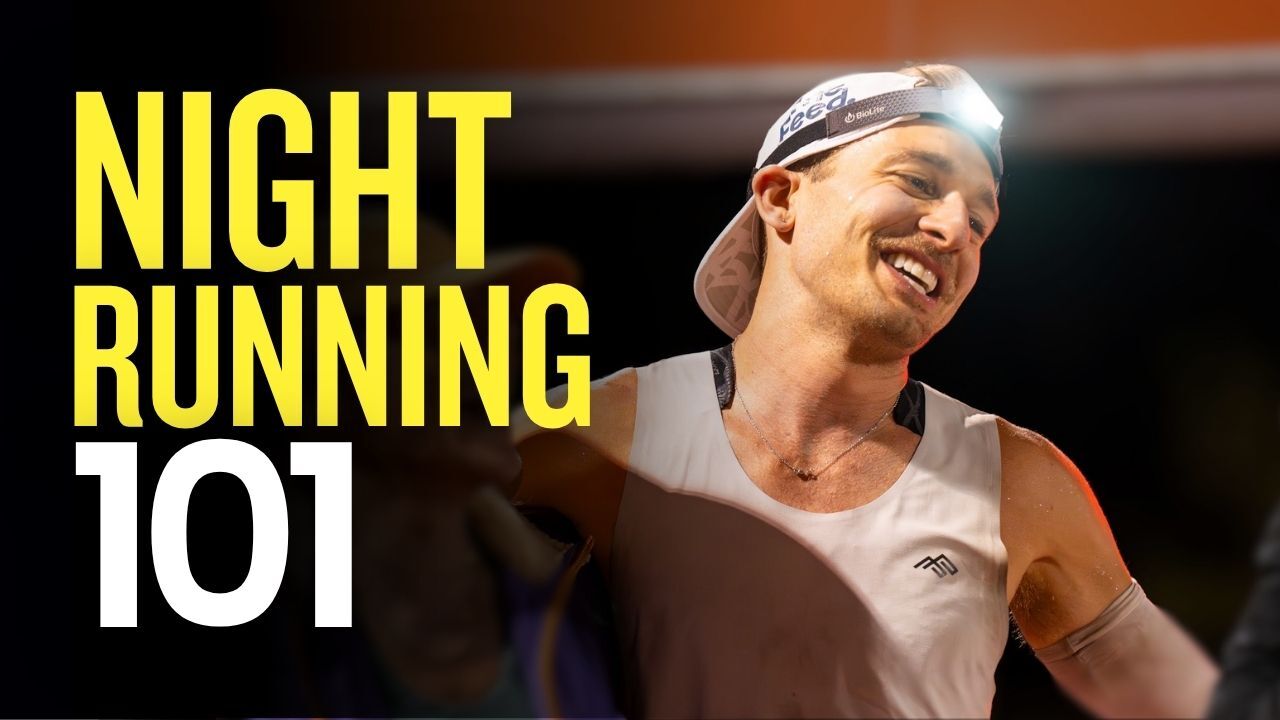
How to Prepare for Running at Night in an Ultramarathon
Updated On
October 22, 2026
CHOOSE YOUR FORMAT
►WATCH THE VIDEO
►LISTEN TO THE PODCAST
►READ THE ARTICLE
How to Prepare for Running at Night in an Ultramarathon
Many ultrarunners are nervous about running through the night, which is reasonable, but most age-groupers in 100-mile ultramarathons must run through the night during their events. I’ve coached beginner and elite ultramarathon runners for more than 10 years. I was also in the military, where we conducted innumerable nighttime missions. It’s important to understand what changes when the sun goes down, where runners tend to get into trouble, how to fit night running into a training build without disrupting the rest of your training, and how to set up your race plan so you aren’t solving problems at three in the morning.
What Changes Running At Night
It’s dark, stupid. No, seriously, people don’t practice running at night because it costs you sleep, it’s awkward to schedule around work and family, and there are more risks. It’s also colder, which can be an advantage in the heat of the summer and highly unappealing in winter. As a result, many athletes go into their first ultra with little night running time and a lot of uncertainty about how to handle the darkness.
Your muscles and cardiovascular system do the same work at night or at noon, but your brain and senses must work overtime to process a trail you know by heart now that it’s illuminated only by a headlamp or waist light.
A headlamp gives you a narrow cone of light that flattens the terrain, so roots, rocks, and drop-offs are harder to read. Your brain spends more effort processing a trail you could run comfortably in daylight. This manifests as a slower pace and a higher perceived effort at the same fitness level.
Then there’s your circadian rhythm, which bottoms out in the early morning hours, regardless of how fit you are. A 2018 study in Research in Sports Medicine tested 92 runners at checkpoints during a 168-kilometer mountain ultra. Both sleepiness and cognitive performance got worse as the race went on, with the worst readings in the early morning (Hurdiel et al. 2018). If you start a hundred-miler at six in the morning, you reach that low after roughly a full day awake.
The Cost of Staying Awake
Wakefulness itself has a cost. A 2022 meta-analysis in Sports Medicine pooled 69 publications on sleep loss and exercise performance. For endurance tasks, which came from 20 of those studies, performance dropped about 5.5 percent on average (Craven et al, 2024). Those tasks were things like time to exhaustion and a 3-kilometer time trial after a single night of lost sleep. These are shorter than the duration of an ultra, so treat the number as a rough guide to which way the effect goes.
Field data from ultras shows what that those findings look like in real life. A 2024 survey in Sports Medicine Open of over 1,000 finishers from two mountain ultras on Réunion Island found that 80 percent reported at least one symptom they attributed to sleep deprivation (Kishi et al, 2024). About a third reported hallucinations and roughly 15 percent reported a fall. Overall symptoms and hallucinations became more common with each additional night on course. Most of those runners spent two or three nights out, so the survey can’t tell us much about a single night. And it’s self-reported data, which limits what you can conclude.
Getting Ready To Run At Night
The good news is that the adaptations you need to make, what you need to learn, comes from experience rather than physiological stress. You don’t need months of night runs or specific workouts to get ready. A small amount of exposure goes a long way.
Consider Recovery First
Before you start scheduling night runs, I always recommend considering the recovery side of the equation first. Sacrificing sleep to run through the night can compromise recovery, so you want to minimize or eliminate that overnight piece.
I get athletes into the dark in two ways. One is an early start, where you get up well before sunrise and get a few hours of running done before the sun comes up. Mentally, this is a good entry point for beginners because you have the sunrise to look forward to. The other is the reverse, where you run into the night after sunset and then go home to sleep. Either way you get the experience of the dark without the sleep loss.
Let confidence set the frequency
How much exposure an athlete needs varies, and the psychology is what sets the dose. Some athletes run in the dark once, feel confident, and check the box. Others are anxious about it, so we spend more time focused on night runs to get to the point where the dark feels ordinary. I put night running into the plan on purpose, the same way I’d schedule hill work for a mountain race, because the night is a feature of the race and I want you to meet it in training first.
Progress from familiar to race-specific
How you progress matters as much as how often you go. Start on trails you know well, ideally with a training partner, because familiar terrain removes most of the uncertainty and lets you pay attention to how your light and your body behave. Once that feels ordinary, move to less familiar terrain. Include a dress rehearsal with your race pack, your lights, and the fueling you plan to use, and make it look as much like race night as you can without costing yourself sleep. Use these sessions to learn your headlamp as well, including the brightness you prefer on climbs and descents and how long a charge lasts at that setting.
If wildlife or being alone is what worries an athlete, I build the plan around that. Familiar trails and a partner come first, and you can reduce both gradually as your confidence grows.
Preparing for Sleep Deprivation In Ultramarathon Training
Let’s start with the idea of training while sleep deprived, since some athletes try it on purpose to toughen up for the race. The 2024 survey I mentioned found that about 18 percent of runners had trained that way before the race. Training sleep deprived wasn’t associated with faster finish times. That’s a single survey, but I’ve found no good evidence that training sleep deprived improves performance. Sleep loss can interfere with recovery, and recovery is how training turns into adaptation, so you’d be paying a cost in training for a benefit nobody has demonstrated.
► Free Ultrarunning Training Assessment Quiz
Take our free 2-minute quiz to discover how effective your training is and get recommendations for how you can improve.
Banking sleep makes far more sense. In the week or two before the race, stay in bed an extra hour each morning, because it’s much easier to control when you get up than how quickly you fall asleep. The survey found that runners who increased their sleep in the week before the race reported fewer falls they attributed to sleep deprivation. However, the added pre-race sleep didn’t improve finish times. That means the case for banking rests on alertness and safety, and the finish-time question is still open.
Your Nighttime Plan for an Ultramarathon
A good plan makes running at night less stressful, more safe, and more fun. Make sure your headlamp is waiting with your crew or in a drop bag well ahead of it getting dark. You don’t want it to get dark before you get to your light. Put it on before you need it so you aren’t fumbling with it in the dark. Have warmer clothing layers available at the same aid station where you pick up your light, since your pace and the temperature will both drop after sunset.
Plan your nighttime logistics before the race. Decide where your spare batteries, your warm layers, the food you’ll want at night, and your caffeine will be. Plan when you’ll pick up each one. Writing a short night plan and keeping it with your crew or in your drop bag removes a lot of thinking later.
Pace and navigation in the dark
Expect a slower pace. Run by effort, not by the splits you’d hold in daylight; chasing them on technical ground spends energy you’ll need late in the race.
- Consider two lights, one on your head and one at your waist. The lower angle throws shadows that give the trail depth, and you have a backup if one fails.
- Carry spare batteries.
- Download the course file and learn how the course is marked.
- Slow down at junctions. That’s where a tired runner with a small circle of light is most likely to go the wrong way.
Stay warm before you get cold
As the night cools, your pace drops at the same time the air does, so you produce less heat just as you lose more of it to the environment. It doesn’t take a cold night to cause trouble: temperatures in the 50s and 60s (°F) can lead to hypothermia when you’re under-fueled and moving slowly, especially if it’s windy or you’re wet. Put the extra layer on before you’re cold. It’s easier to stay warm than to get warm again.
Adjust fueling and hydration
It’s cooler and you’re moving more slowly, so you sweat less, and your fluid and sodium replacement should come down accordingly. Individual carbohydrate recommendations depend so much on conditions (pace, tolerance, etc.) that I won’t give you a number, but I recommend staying close to what you rehearsed and letting your appetite and gut tolerance guide the adjustments. Sweet or cold food can lose its appeal at night, so plan to have something savory or warm available.
Caffeine and the Witching Hour
Somewhere in the early morning you’ll hit a notable low. The “witching hour” is often around 3:00AM. In the 2018 study that’s when sleepiness and cognitive performance were at their worst, and in the 2024 survey about four in five of the naps runners took fell between midnight and five in the morning, so the timing holds up across both.
This is where your caffeine strategy matters. On race morning, before the start, stick to your routine if you have coffee or caffeinated tea. Start supplementing with caffeine when you get sleepy (not necessarily when you’re fatigued, but sleepy). Alertness is the desired outcome, not energy (that comes from food).
Enjoying This Article? Get More Free Running Training Tips
Get our coaches' best training advice, delivered straight to your inbox weekly.
The witching hour can be brutal on your will to continue. Don’t interpret how you feel at 3:00AM as a verdict on your race performance or chances of finishing. Create witching hour strategies before the race, whether that’s a pacer or a stretch of walking while you eat, or something else. Planning ahead is much more effective than trying to call an audible when you’re at your most tired.
Welcome the Rising Sun
The sunrise provides a reset. Once it’s light, reassess your fueling and adjust your pace by effort again.
The Bottom Line
Learning to run at night is an important skill for ultramarathon success. It doesn’t typically take too many repetitions or exposures for a runner to get reasonably comfortable running at night, so take the process seriously but don’t overthink it. Invest in high-quality gear, especially your lights and the clothing layers you’re going to use to stay warm. And when the going gets tough, remember that the sun always rises. There’s nothing more energizing than running into the brightening sky.
References:
Craven, J., McCartney, D., Desbrow, B., Sabapathy, S., Bellinger, P., Roberts, L., & Irwin, C. (2022). Effects of Acute Sleep Loss on Physical Performance: A Systematic and Meta-Analytical Review. Sports medicine (Auckland, N.Z.), 52(11), 2669–2690.
Hurdiel, R., Riedy, S. M., Millet, G. P., Mauvieux, B., Pezé, T., Elsworth-Edelsten, C., Martin, D., Zunquin, G., & Dupont, G. (2018). Cognitive performance and self-reported sleepiness are modulated by time-of-day during a mountain ultramarathon. Research in sports medicine (Print), 26(4), 482–489.
Kishi, Anthony et al. “Sleep and Ultramarathon: Exploring Patterns, Strategies, and Repercussions of 1,154 Mountain Ultramarathons Finishers.” Sports medicine – open vol. 10,1 34. 8 Apr. 2024.
About the Author
Cliff Pittman
CTS Pro Ultrarunning Coach
Cliff Pittman is the Coaching Development Director for CTS, where he expertly leads the Ultrarunning and Cycling Coaching teams. A passionate ultrarunner and active competitor, Cliff specializes in simplifying complex training concepts into actionable strategies, ensuring athletes at all levels—from beginners to elite competitors—can achieve their goals in prestigious events like the Western States 100 and Leadville 100.