
Black Canyon 100K: Course Guide, Training Plan, and Race Strategy
Updated On
November 18, 2026
CHOOSE YOUR FORMAT
►WATCH THE VIDEO
►LISTEN TO THE PODCAST
►READ THE ARTICLE
Black Canyon 100K: Course Guide, Training Plan, and Race Strategy
The Black Canyon Ultras 100K looks like one of the fastest courses on the ultramarathon calendar. It’s a net downhill course and looks very runnable, but it delivers serious surprises. The middle canyons take a toll on the field, and the climbing nobody trained for shows up around Mile 40, with hours of fatigue already in the legs. And overall, the technical demands of the course sneak up on runners. In this guide, I’ll walk through the physical demands of the course, how to build a training plan around those demands, and how to turn that preparation into a race day plan that survives the last third of the race.

Part 1: The Course and Its Demands
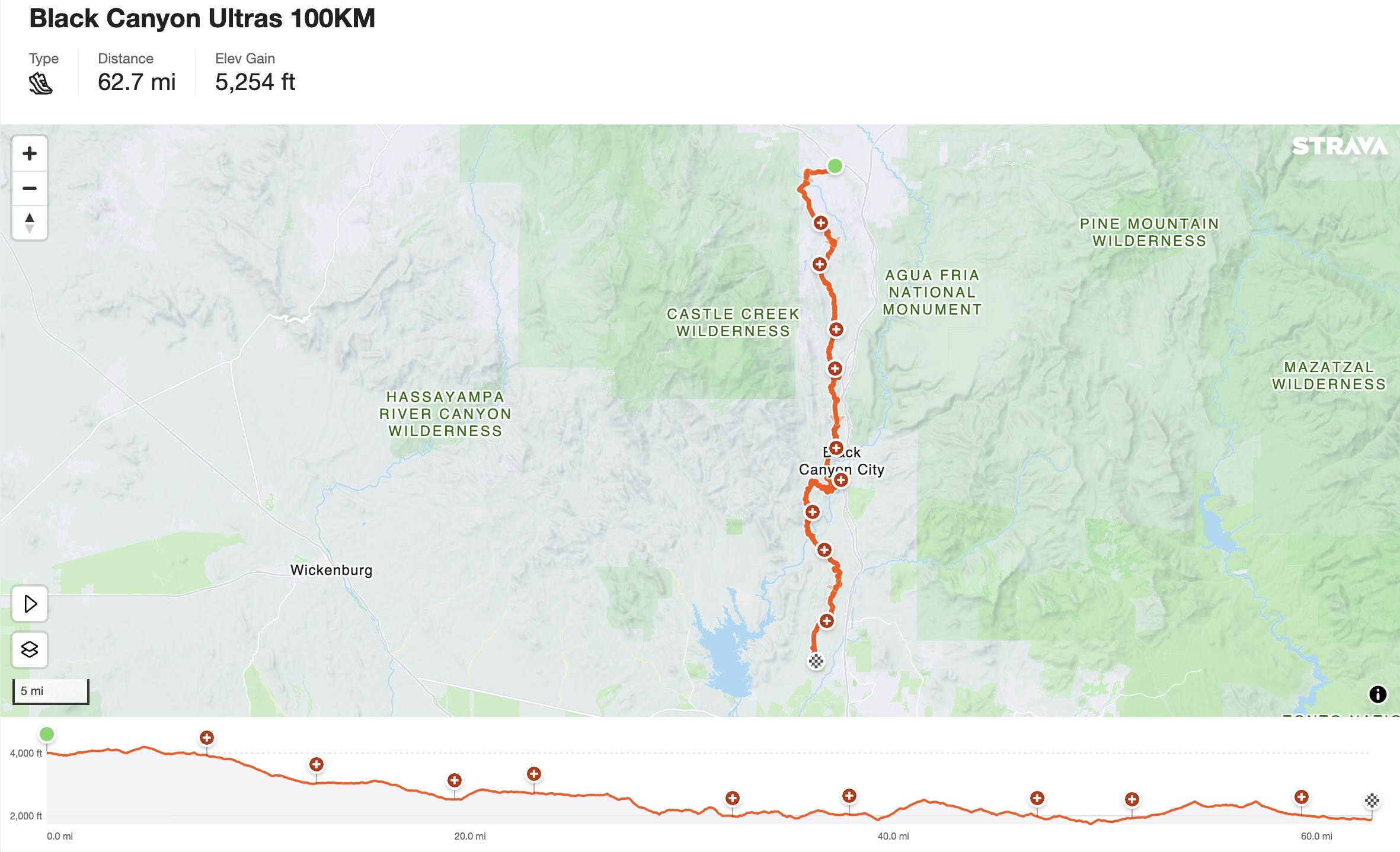
The Black Canyon 100K (62 miles) is an annual ultramarathon held in mid-February that starts near Cordes Lakes, Arizona (southeast of Prescott) and roughly parallels Interstate 17 southbound to the Emery Henderson Trailhead just outside of Anthem, Arizona. See TrailForks for an interactive course map. The race is point-to-point rather than loops or out-and-back. That becomes a challenge for support crews. And although it’s a net downhill, there are still 5,219 feet of elevation gain set against 7,337 feet of loss. The high point on the course is only about 4200 feet above sea level, so altitude is not a significant factor for athletes coming from sea level.

The downhill start
After a couple of bumps in the first few miles, the majority of the first 20 miles are downhill, fast, and runnable, on a mix of jeep road and smooth single track. That’s exactly what makes the start of Black Canyon 100K so misleading. You feel strong and maintaining your goal pace (or faster) feels easy, but those first 20 miles can really set you up for failure later in the race.
The technical canyon crossings
Starting at Mile 28, the course crosses the Black Canyon repeatedly over the course of several miles. This section of the course features short climbs and technical, rocky descents. The biggest single creek crossing sits around Mile 34, and depending on rainfall that year, there’s a marked rock-hop alternate if the water is high.
The challenging climbs
After the canyon crossing section, runners face the two biggest climbs on the entire course. Runners reach the summit of the first at Mile 41. The descent from this climb is 8 miles long, but it is punctuated by short uphills along the way. Just after reaching the start of the next climb, runners must be careful not to miss the turn onto the out-and-back pathway to the Table Mesa Aid Station at Mile 51. This is required part of the course! After the Table Mesa Aid Station, runners continue climbing to the summit at 53.7 miles. Be careful, though, because the climbing isn’t quite over. There’s a short descent, some traversing, and then a short climb before the course tips downhill at Mile 56 for the descent to the finish.
Screenshot
Terrain and Weather
The terrain changes as the race progresses. The first 20 miles are relatively smooth and fast. The canyons section and the climbs get technical, with loose, rocky single track that requires good foot placement. Your legs need to be ready for both surfaces, not just the one that shows up first.
The weather at Black Canyon 100K can be highly variable. The race is held in mid-February in the Arizona desert, which means runners should expect a cold morning start. There are three start waves (7:00AM, 7:30AM, 8:00AM). The table below of historical temperatures at Black Canyon 100K was created by John Sugden from Over the Ridgeline. His Substack does a good job of presenting weather previews and overviews of ultramarathons.

As you can see, cold morning start, generally warming to the 60s-70s by afternoon. Keep in mind, there is almost no shade on the course. Rain and snow are not common during Black Canyon 100K, but are possible. In 2024, the start was delayed and there was snow on the northern portion of the course. In 2017 and 2019, flooding along the Agua Fria River caused muddy conditions and some reroutes.
Aid Stations and Crew Support Logistics
There are nine aid stations, spaced anywhere from about four to nine miles apart. The longest gap on the whole course, nine miles, sits between Black Canyon City at mile 37 and Cottonwood Gulch at Mile 46. That’s not an easy early stretch where a long gap barely matters. That’s deep into the race, in some of the hardest terrain on the course, when you’re most likely to be slow and already depleted between stations.
Crew access and drop bags are only available at a handful of points, roughly Mile 19, Mile 32, and Mile 51, plus the finish. Pacers can join you at Mile 32 and switch at Mile 51. Everywhere else, you’re carrying what you need. Know which stations those are before race week, because they’re also your natural checkpoints for everything we’ll build in Part 3.
Special note about the Table Mesa Aid Station at Mile 51. It’s different. Bumble Bee and Deep Canyon Ranch aid stations give your crew room to post up comfortably for hours. Table Mesa doesn’t offer that. The access road runs through a shooting range, which catches some crews off guard the first time through, and standing room at the aid station itself is tight. Tell your crew to expect to wait in line. As you – the runner – come up the hill, your crew moves to the front, handles what you need in a minute or two, and clears out for the next runner behind you. That’s a conversation to have before race week, not a surprise your crew should work out in real time while you’re standing there needing calories and fluids.
Finishing Times and Cutoffs
The overall cutoff for an official finish is 20 hours from your own start. A sub-17-hour finish qualifies for the Western States lottery. Those are two very different races inside the same event, and which one you’re running changes almost everything about your race plan.
Sunset in Arizona in February is around 6:12PM. The winning time in 2026 was about 7hrs and 20 minutes, or about 2:20PM. According to TrailMath, The median finish time in 2026 was 14hrs and 52 minutes, which means half the runners finished after 9:52PM. All but the fastest runners should expect to finish in the dark after a few to several hours of running with lights.
► Free Ultrarunning Training Assessment Quiz
Take our free 2-minute quiz to discover how effective your training is and get recommendations for how you can improve.
Summary of Physical Demands
Put all of that together and here’s the actual demand profile. The Black Canyon 100K course rewards patience early on and punishes impatient runners who go out too fast. That downhill start is not ‘free speed’, you will pay for it later if you run it too hard. The race rewards durability on technical, fatigue-inducing descents more than it rewards climbing power, because you lose more vertical than you gain across the whole route. And it asks you to manage a long, exposed, aid-sparse stretch in the hardest terrain on the course, when your decision-making ability is already compromised. That’s the blueprint for everything in Part 2.
Part 2: Long Range Plan for Black Canyon 100K
In Part 2, I’ll describe how to focus your training to meet the physical demands of the Black Canyon 100K race. This assumes you are already following a sound ultramarathon training plan or have experience training for ultramarathons.
What are we specifically preparing for? Along with a robust aerobic engine and all the normal aspects of trail and ultramarathon training, Black Canyon 100K training should focus on: downhill running tolerance, durability, and heat training.
Downhill Running Tolerance
Well, the elevation loss outweighs the elevation gain on the course, so the dominant stress on your legs will come from eccentric contractions (muscle under tension as it lengthens) on descents. You will still need a robust aerobic engine and the ability to climb, but the descending is a major course feature to prepare for.
Build downhill running into your plan deliberately, not as an accident of whatever trail you happen to run this week. Aim for progressively longer repeats on technical, loose terrain if you have access to it, run at a pace that asks your legs to absorb impact under some fatigue. No need to run these fast or for hard efforts, just make sure you’re running enough downhill at your anticipated race pace.
Durability
Structure your long runs to address the demands of the second half of the Black Canyon 100K course, not the first half. Anyone can run the first 20 miles of Black Canyon because you have fresh legs on easy terrain. The actual preparation is learning to move well on technical, up-and-down terrain after you’re already tired. That’s exactly the situation you’ll be in after Mile 40 at Black Canyon 100K.
The sequence of long runs matters more than any single run. Far out from Black Canyon, the training focus should be higher intensity and lower volume, general work that isn’t yet specific to this course. The specific work, including higher volume training and long runs on technical terrain, should come in the final eight to twelve weeks, paired with long steady-state efforts rather than more intensity. The idea is to arrive at that final block with your tissue already capable of handling load and then build those course-specific aspects of fitness in that block.
Heat Training
The heat at Black Canyon 100K is not usually extreme, but it can be a shock to runners training in cold weather at home. Black Canyon 100K runs in February, so depending on where you live, you may be building fitness in the cold and racing into real afternoon desert heat with almost no shade. If that’s your situation, a deliberate heat training protocol in the weeks leading up to the race is a smart idea. To learn more about how to scheduled and execute a heat training protocol for an ultramarathon, read this article.
None of this is a week-by-week prescription, because your training age, your current fitness, and how much runway you have before race day all change what the actual weeks look like. What doesn’t change is the target. Build durability on specific terrain and respect the heat.
Part 3: Race Day Strategy for Black Canyon 100K
We have a complete article on the essentials of creating a race day strategy. In this article, I’m applying those principles to Black Canyon 100K.
Enjoying This Article? Get More Free Running Training Tips
Get our coaches' best training advice, delivered straight to your inbox weekly.
Name Your Goal
A sub-17-hour Western States qualifying attempt is a completely different race than getting under the 20-hour cutoff. To finish with a qualifying time, you need to be disciplined with early pacing and minimize time lost at aid stations all day. Runners hoping to finish within the 20-hour cutoff need to build in margin everywhere, especially across that nine-mile gap between Black Canyon City and Cottonwood Gulch, because that’s exactly where a slow patch costs you the most time relative to the clock.
Know Your Own Psychology
Knowing your own psychology will be most important heading into the hardest stretch on the course. The climb at Mile 40 shows up after you’ve already banked real fatigue, and that’s exactly where a plan that doesn’t match how your brain handles pressure starts to come apart. If you need firm numbers (pacing, RPE values, etc.) to stay calm, have them ready for that stretch. If you run better on feel, decide that now, not when you’re already in it.
Pace the first 20 miles like the trap that it is. Downhill, runnable, and fast is exactly the formula for unearned confidence that costs you at Mile 40. Focus on effort, not pace, through that opening stretch, and treat anyone passing you there as information, not pressure.
Fueling and Hydration
Fuel and hydrate for three different sets of conditions in one race. Cold start, hot exposed afternoon, and possible storms. Write down your hourly carbohydrate and sodium targets before race week based on what’s worked for you in training. Adjust your fluid plan based on the temperature you’re experiencing, not the forecast you saw a week out.
Contingency Planning
Build your contingency plans around the course’s real checkpoints. Crew and drop bag access sits at Bumblebee, roughly Mile 19, Deep Canyon Ranch at Mile 32, and Table Mesa at Mile 51. Remember that the last two are also where a pacer can join or switch. Use them as your Plan A, Plan B, and Plan C decision points and it’s a great way to compartmentalize the race. Plan A, you’re on pace and feeling strong at Deep Canyon Ranch, so keep executing. Plan B, you’ve lost real time by Table Mesa, so shift and protect the finish instead of chasing the clock. Plan C, something is mechanically wrong by that same point, not just uncomfortable, and the goal becomes finishing inside the cutoff, not finishing fast.
Handle your lights deliberately instead of guessing. Sunset is a little after six. If you’re projecting an 18- to 20-hour finish, your light needs to be in your bag by Bumble Bee at Mile 19. If you’re projected finish time is 14-18 hours, then lights must be available at Deep Canyon Ranch at Mile 32. And if you’re likely finishing in 11-14 hours, have lights available at Table Mesa at Mile 51. Get this wrong and you’re troubleshooting a headlamp in the dark on technical terrain instead of running it.
Putting It All Together
Put all three parts together and here’s what race morning looks like. You know the course rewards patience in the first 20 miles and demands durability on tired, technical terrain in the back half. Your training targeted that exact demand instead of generic volume. And your race day plan has planned triggers at specific points on this specific course, not vague ideas about adjusting if things go sideways. That’s the difference between hoping the course cooperates and being ready no matter what the course, the weather, or your body throws you.
About the Author
Cliff Pittman
CTS Pro Ultrarunning Coach
Cliff Pittman is the Coaching Development Director for CTS, where he expertly leads the Ultrarunning and Cycling Coaching teams. A passionate ultrarunner and active competitor, Cliff specializes in simplifying complex training concepts into actionable strategies, ensuring athletes at all levels—from beginners to elite competitors—can achieve their goals in prestigious events like the Western States 100 and Leadville 100.