
Endurance Training Through Perimenopause: Adapting to a Changing Body

Updated On
November 11, 2026
As a woman firmly in the process of perimenopause, I’m thankful more researchers, doctors, and coaches are busting myths and providing realistic guidance for women. I have been a running coach and a strength training professional for more than 20 years, and I’m honored to work with many perimenopausal female athletes. In my experience, perimenopause looks a little different for performance-oriented female athletes (i.e., women who train year-round to compete or participate in goal events) compared to generally active women (i.e., work out for general health and fitness 2-3 times per week) and sedentary folks. For my performance-oriented group, here’s some of what I observe with the athletes I work with, and the solutions I’ve used to guide athletes through the transition to menopause.
What is Perimenopause
Perimenopause is the gradual transition toward menopause. Although it typically starts in our 40s, it can begin in our 30s or 50s, and the average age for menopause is 51. The duration of perimenopause also varies greatly, from several months up to a decade. During perimenopause, levels of estrogen and progesterone fluctuate and generally decline over time. These hormonal changes lead to physiological changes, but because everyone proceeds through perimenopause their own way, it is difficult to predict exactly how individual women will experience these shifts. It’s more of a hormone rollercoaster than a gentle downhill ride.
Typical Effects of Perimenopause
Here, we need to break the effects of perimenopause into common language and physiological information. In terms of common language (most of which you’ll already be familiar with), here are some of the effects to expect with perimenopause:
- Irregular menstruation: The length of your cycle may change or become inconsistent. Your periods may become heavier or lighter, and you may miss periods entirely, sometimes. Missing periods for perimenopausal female athletes can cause additional anxiety because missed periods can also be a symptom of RED-s.
- Hot flashes and night sweats: These symptoms are caused by vasomotor disruptions that temporarily dilate or constrict blood vessels. According to a 2023 article in the International Journal of Women’s Health, fluctuating estrogen levels affect the hypothalamus, causing the body to misinterpret normal core temperatures (Kahn et al. 2023).
- Sleep and Mood disruptions: Fluctuations in estrogen and progesterone impact levels of other brain chemicals that regulate mood and sleep, including serotonin, dopamine and melatonin. This can lead to trouble falling asleep or staying asleep, along with increased irritability and mood swings, sometimes anxiety or sadness.
- Brain fog and cognitive function: Yes, the perimenopause brain is real. The same hormone fluctuations that affect everything else can also impact your attention span, memory recall, and… I forget what else.
- Physical changes: Vaginal dryness from thinning tissues is common. You may experience a stronger or more frequent need to urinate. Some women report thinning or drier hair, skin, and nails.
- Weight gain and bloating: Some women experiencing perimenopause report stubborn weight gain, particularly in the torso/abdomen. Hormonal changes likely play a role but the entire mechanism is still elusive. In my experience with athletes, this weight gain is not as simple to explain as either slowing metabolism, reduced activity level, or a shift in eating habits.
Physiological Effects of Perimenopause
From a training and exercise standpoint, it is important to understand some of the underlying changes that affect aging women. Rothschild and Collingwood summarized these effects very well in a 2023 paper published in the Journal of Women’s & Pelvic Health Physical Therapy (Rothschild and Collingwood, 2023). The charts below were reproduced from their work:
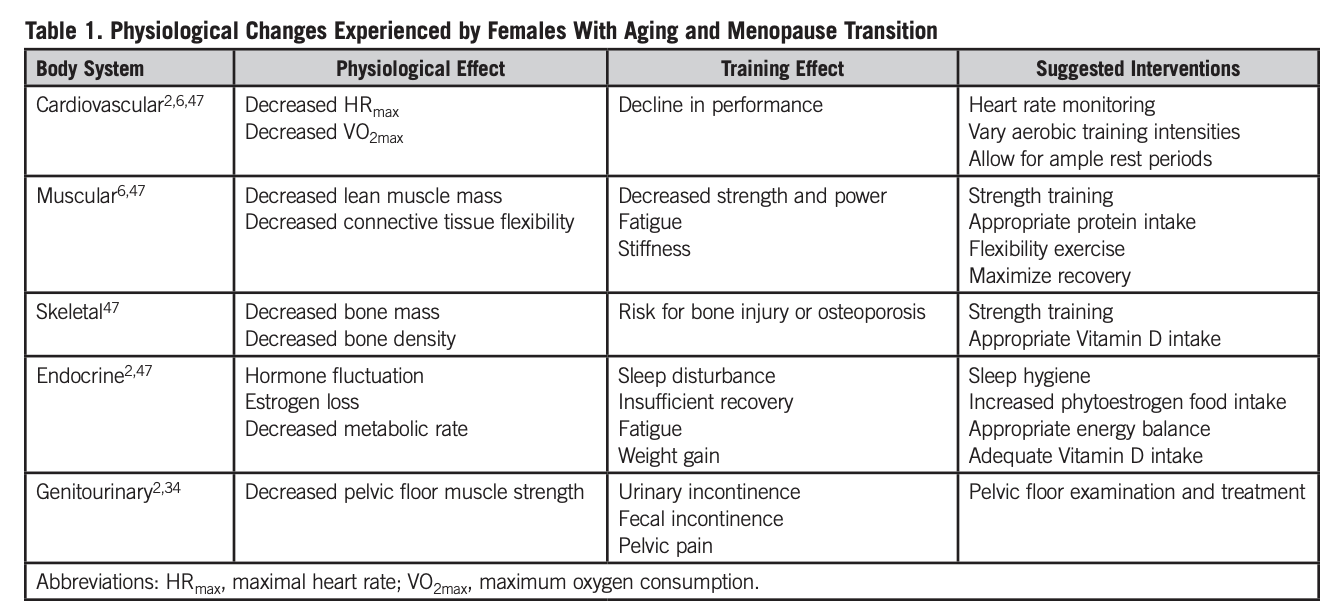

Source: Rothschild and Collingswood, 2023
Why is Perimenopause Particularly Difficult for Athletes?
Perimenopause often arrives during peak endurance training years. A quick look at the entry list or results sheets from marathons, trail runs, and ultramarathons shows the 40+ female age groups are some of the biggest. Women in these age groups – my age groups – are training with purpose, focused on performance, and pursuing valuable personal goals.
At the same time, these athletes may be struggling with erratic energy levels, disturbed and unpredictable sleep patterns, challenges to their ability to tolerate heat, and hindered or erratic recovery. What worked last month doesn’t seem to work this month, or even this week.
What I see every day is that women often take these unpredictable changes personally. Rather than see them as the result of uncontrollable hormonal shifts, they view them as personal failings. You feel sluggish because you’re weak and unmotivated, not because of perimenopausal symptoms. You feel guilty for being exhausted and stopping a run early rather than accepting it was the right choice after a terrible night of sleep. I see female athletes beating themselves up and tearing themselves down.
How I Help Female Athletes Succeed Through Perimenopause
I am not the perimenopause whisperer, I struggle right along with the athletes I coach. However, there are several strategies that consistently help the women I coach achieve their performance goals. When they – and I – get the following things right, we experience higher quality workouts, improved recovery, fewer missed training sessions, and consistent training progress.
► Free Cycling Training Assessment Quiz
Take our free 2-minute quiz to discover how effective your training is and get recommendations for how you can improve.
- Stop with the shaming
Comparison is the thief of joy and the fountainhead of shame. You are on your own journey through perimenopause and training, and comparing your workouts, pacing, energy level, diet, or put-togetherness to other women – or yourself last week! – is a waste of time and effort. You do the best you can with the tools you have right now. What I see from athletes is that consistency evens out the highs and lows, but self-shaming can destroy a person’s willingness and desire to keep training. - Stick with heavy lifting
I preface this by saying that I am a strength and conditioning coach, so I’m biased towards heavy lifting. I love it and I enthusiastically introduce it to the women I coach. At the same time, I recognize that there’s more to healthy aging in perimenopausal women than lifting heavy weights. And there are women who can’t or don’t want to lift heavy, for a variety of reasons. That’s all fine. What I won’t compromise on is that strength training is a necessary component of training for female athletes older than 40 (and really any age).
The primary benefit of strength training for perimenopausal athletes is maintenance of lean body mass (muscle). More muscle makes you more capable, meaning you can perform more exercise, stay more active in your everyday life, avoid many of the injuries that come from suddenly straining yourself in an unfamiliar position or with unanticipated resistance (e.g., lifting furniture, catching a falling kid, hanging christmas lights (ask me how I know…)). Yes, there is some benefit for maintaining bone density, but that requires specific exercise conditions – not all strength exercises build bone mass!
Here’s the caveat I think some women need to hear. The benefits of strength training can be achieved with heavy weights and low repetitions, or with moderate weights and more repetitions. Research into strength programming and hypertrophy (muscle growth) shows that effort is the stimulus that matters, not heaviness. Professor Stuart Philips summarized this argument well in this Instagram post, and the references hold up. The important takeaway for athletes is that 12-20 reps of a moderate weight can be as effective as 5-8 reps of a heavy weight, as long as you push yourself to near failure by the end of the set. “Near failure” means one rep in reserve, or finishing the set with good form and technique and the ability to do one more rep if you had to. - Fuel for your activity level, not your jeans.
The weight fluctuations that come with perimenopause can be bewildering and infuriating. It’s not that I’m overly concerned about my pants size, nor that I care what the bathroom scale says, but I’d just like a little consistency so I can figure out what I can wear today. What I have learned, however, and what I preach to the athletes I coach, is that we absolutely must eat to fuel our activity level first, because everything else extends from that.
The worst mistake I see in perimenopausal female athletes is underfueling as a response to weight gain. I encourage athletes to take a longer view. Properly fueled, you will have high quality workouts, better sleep, and improved recovery. The hormonal fluctuations that are impacting body weight (much of it being varying levels of fluid retention) even out over the long term. Chasing bodyweight goals by increasing and decreasing calorie intake or exercise energy expenditure is the proverbial tail wagging the dog. Exercise for the purpose of making positive physiological adaptations (not just burning calories), fuel appropriately to support your activity level, and let bodyweight fluctuate naturally.
Are there exceptions? Yes. I have referred several perimenopausal female athletes to registered dietitians when their bodyweight response was misaligned with their exercise and dietary habits. If you consult a registered dietitian, I recommend working with someone who specializes in female athletes, not just perimenopausal women. - Get Fanatical About Sleep
The most successful perimenopausal athletes I work with are the women who organize their lives around sleep. These are the women who do not miss their bedtime for anything, who have a nighttime routine carved in stone, and who do not apologize for either. Good sleep begets good sleep, because the process of going to sleep involves cyclical shifts in hormone levels. Perimenopause can be disruptive to sleep because of hormone fluctuations, but those potential disruptions get worse when your behaviors don’t support the natural hormone cycles that support healthy sleep.
There are several key components to establishing great sleep hygiene:- Cool room: Try to get the bedroom down to 62-67 degrees Fahrenheit. Sleep researchers have found the combination of a cool room and warm blankets to be superior to a warmer room and lighter or no blankets.
- Make it dark: As dark as possible. Blackout shades, eliminating gaps around window shades, even eliminating the light from alarm clocks and chargers.
- No screens for at least an hour before bedtime: Read a book, snuggle, have sex, take a shower, drink some tea, but don’t doomscroll on your phone or watch television in the hour before turning off the lights.
- Maintain consistent bed times and wakeup times: The wakeup time is just as important as the bedtime. That doesn’t mean you can never sleep in on a weekend morning again, it just means that consistency is your friend.
- Stop listening to people who would never go training with you
Athletes view the world through a different lens than sedentary people. Sedentary people and casual exercisers take comfort in thinking that increased fatigue, aches and pains, or reduced performance are just inevitable consequences of hitting 40, or 50, or whatever age. If that’s true, there’s nothing they can do about it, so why bother trying?
The athletes I coach know differently, because we’re living differently. Everyone experiences perimenopause in their own way and no two journeys are entirely identical. But I firmly believe female athletes perform best when we surround ourselves with women who have similar goals, a desire to learn, and a commitment to living our best lives.
References:
Khan, Saira J et al. “Vasomotor Symptoms During Menopause: A Practical Guide on Current Treatments and Future Perspectives.” International journal of women’s health vol. 15 273-287. 14 Feb. 2023, doi:10.2147/IJWH.S365808
Rothschild, Carey E., and Tara Gidus Collingwood. “Maximizing Running Participation and Performance Through Menopause.” Journal of Women’s & Pelvic Health Physical Therapy, vol. 47, no. 2, Apr. 2023, pp. 133–43, doi:10.1097/JWH.0000000000000276.
► FREE Mini-Course: Learn How to Maximize Your Limited Training Time
Learn step-by-step how to overcome limited training time and get faster. Walk away with a personalized plan to increase your performance.
"*" indicates required fields
About the Author
Sarah Scozzaro
CTS Pro Ultrarunning Coach
Sarah Scozzaro is a dedicated coach specializing in personalized training plans that empower runners to achieve their personal bests, rekindle their passion for the sport, and overcome injuries. With a rich background in competitive running and an M.S. in Exercise Science, she combines her own journey of resilience with expertise in performance enhancement to uniquely support athletes at every level, including experience with an NFL team on injury prevention and recovery.