
How to Build an Ultramarathon Race Strategy

Updated On
October 28, 2026
CHOOSE YOUR FORMAT
►WATCH THE VIDEO
►LISTEN TO THE PODCAST
►READ THE ARTICLE
How to Build an Ultramarathon Race Strategy
A well-planned ultramarathon race strategy can be the difference between a great race and DNF. However, a successful race day strategy must be more than a pacing chart, a drop bag, and a buddy to meet you at an aid station. There are five decisions you must make before the race. When you make good choices, you set yourself up for a successful race.
5 Critical Pre-Race Questions
- What are you racing for?
- How does your psychology hold up under fatigue?
- Have you accurately analyzed the demands of the course?
- Have you created pacing and fueling expectations that will survive real fatigue instead of falling apart at Mile 40?
- Do you have contingency plans if race day doesn’t go as you planned?
Let’s go through the questions one at a time.
1. Name Your Goal
To run the race you trained for, it’s essential to define what success looks like. You could be running to reach the finish line inside the time limit. Or, you could have a specific finish time goal, like a sub-24-hour finish. You could be racing to win or place in your age group. Or, you might have a process goal, like a clean execution of a pacing and fueling plan.
Your goal sets the tone for your strategy. The image below compares two athletes with identical fitness racing the same 100-mile course. One is chasing a sub-24-hour finish. For the other, success will be reaching the finish line before the cutoff.
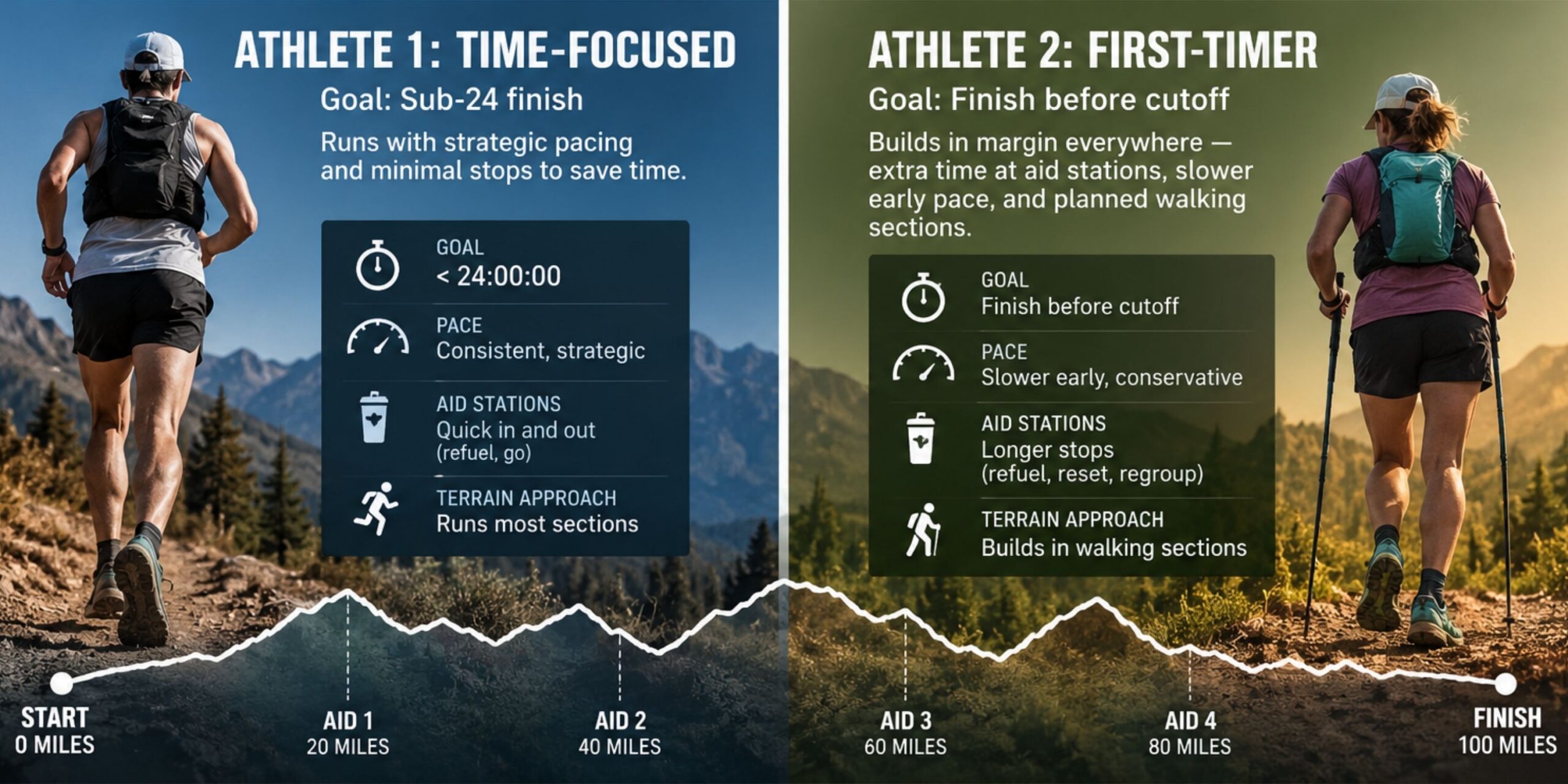
The time-focused athlete runs with strategic pacing and barely stops at aid stations. The first timer builds in margin everywhere: extra time at aid stations, a slower early pace, and room to walk sections they could technically run.
2. Know Your Psychology Under Fatigue
It’s one thing to understand how your body (physiology) responds to fatigue. It’s another thing to understand how your brain (psychology) responds to fatigue. Your brain runs the show, so a race day plan that doesn’t reflect or respect your psychology is doomed to failure.
Here are some of the psychological traits or types I’ve encountered in my years as a coach:
- The Accountant: Wants quantified information on splits, pace targets, and grams of carbohydrates. Can only feel comfortable if the numbers are on target.
- The List Checker: Needs to follow a sequence, like a clearly ordered list of tasks to complete at each aid station and during the miles between aid stations.
- The Conductor: Anchors performance on a fixed time schedule. Falling behind the schedule creates anxiety even if every other performance indicator is positive.
- The Switcher: Wants to boil decisions down to “if-then” rules, often to avoid overthinking in the moment.
- The Mystic: Runs on feel and treats the pre-race plan as a suggestion.
This holds true even at the professional level. None of these approaches is better or more successful than the others. Failures more often result from building a plan that doesn’t match your psychology.
What does a mismatch look like? You see a pro’s spreadsheet online, with all the time splits and carbohydrate grams. You copy it even though you’ve always run best by feel rather than by your watch. Thirty miles into your race, you’ve focused on numbers rather than effort and perception, and your performance starts falling apart because you didn’t listen to your body’s signals that your pace was too high.
► Free Ultrarunning Training Assessment Quiz
Take our free 2-minute quiz to discover how effective your training is and get recommendations for how you can improve.
3. Analyze the Course
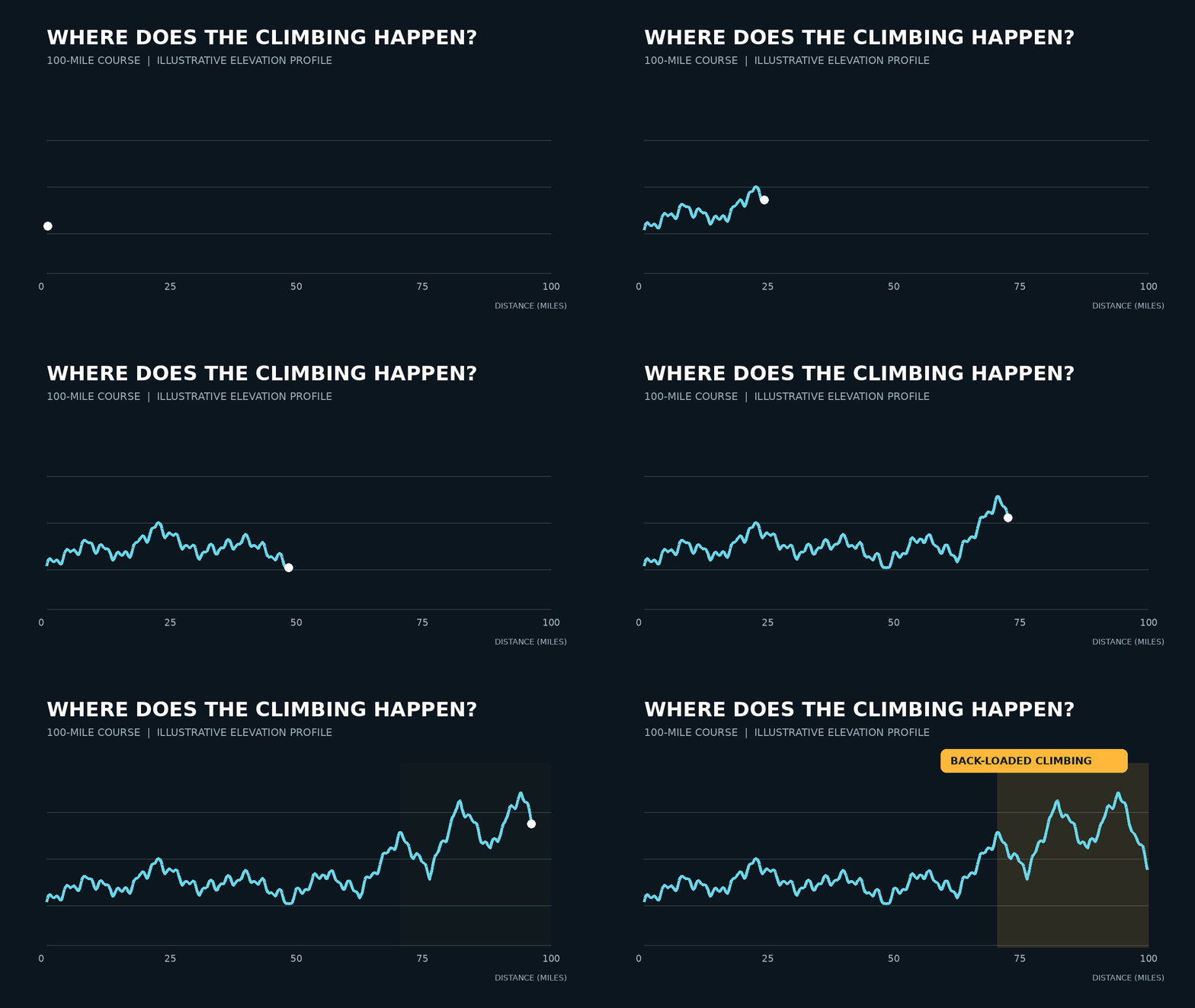
You cannot build honest race day expectations and plans without an intimate understanding of the course. Here are couple of key course features to analyze:
- Climbing Details vs. Total Vert: Examine the elevation profile to learn where the climbs are, rather than just focusing on total climbing/descending. Your 100-mile race plan will change if the major climbs are front-loaded (first 30 miles) or back-loaded (last 30 miles). Also, take note of how the vertical gain accumulates. Is it a series of shorter, steeper climbs or a smaller number of very long ascents.
- Note The Terrain Type: Technical and rocky trails ask something different of your legs than smooth, runnable trail. Your pace in technical terrain will likely be slower, which extends the elapsed time between aid stations, etc. Leadville is a classic example where there are very smooth and flat sections and then you experience a stark contrast in Hope Pass.
- Understand Aid Station Spacing and Cutoffs: Look at the typical conditions for the race, including heat, altitude, the anticipated weather. Better yet, look up race reports and split times from runners you typically compete against, if possible. Check the historical finish-time distribution too, if it’s published. The winner’s time tells you what’s possible at the front of the field. The full distribution tells you what’s realistic for someone at your level.
4. Build Honest Pacing and Fueling Expectations
This is where most plans fail. What you hope to do may be different than what you’re likely to do. Don’t build a plan around best case scenarios, a pace you’ve never run before, or a fueling strategy that’s way more aggressive than you’ve executed in training.
One principle matters more than any formula: The back half of an ultramarathon will be slower than the front half, every time, for every athlete, regardless of fitness level. You’re not going to negative split an ultramarathon. This is because muscle damage and neuromuscular fatigue will hinder performance even if your aerobic engine could support a faster pace.
Pace by an effort you can sustain, not a pace you hope to hold. That means letting your perceived exertion stay roughly constant and letting the minutes per mile drift on climbs and technical descents. Don’t force a number that ignores the terrain. Pace can be a reference point for your effort. A sustainable effort should correspond to the pace you’ve held on recent long run leading into the race. On race day, expect to run even slower that pace, depending on how much farther the race goes past your longest training run.
And fuel based your real consumption data from training. Your hourly carbohydrate target and sodium target should be based on what’s worked for you in training, not what you saw an elite runner post online. Remember to split your food and fluid consumption into “aid station” and “between aid stations” so you know you’re carrying enough. Running dry between aid stations will end your race faster than almost anything else on this list. On the other side of the coin, some athletes overload their gut by hitting their hourly target between aid stations and then piling on more food when they see their crew.
Enjoying This Article? Get More Free Running Training Tips
Get our coaches' best training advice, delivered straight to your inbox weekly.
5. Build Contingency Plans
Don’t but into the superstition that planning for a bad day brings on bad day vibes. Ultramarathons are so long that it’s almost impossible for everything to go exactly right. If you plan for adversity, you can overcome it.
Build a Plan A, a Plan B, and a Plan C. Name the specific trigger that moves you from one to the next. Here’s what that could look like. Plan A, you’re on pace and feeling strong, you keep executing the plan as written. Plan B, you’ve fallen more than fifteen minutes behind your pacing band by halfway, so you shift to a conservative, effort-based pace that protects the finish rather than chasing the clock. Plan C, you’re exhibiting real warning signs of something like serious GI distress or a joint that’s gone from sore to mechanically off, so you walk it in and finish rather than risk a DNF or an injury that costs you the next three months. Three plans, three specific triggers, decided beforehand so you’re not influenced by emotion in the moment.
Putting Your Ultramarathon Race Strategy Together
Your race day strategy needs to be shared and known by your crew and pacers (if applicable). They need to be on the same page with you, sometimes literally. A written plan can be helpful, especially if there are multiple people in your support crew. As a coach, I often lead pre-race meetings for my athlete’s crew because I believe they are that important to successful execution.
Verbalize your plan. Say it all out loud, to yourself at least, but better yet to your crew. If you can’t explain the whole thing succinctly, you haven’t committed to it or you’ve made it too complicated. Ideally, a race strategy should simplify your approach and enhance your ability to execute.
Here’s what race day looks like when your strategy is on point: You know exactly what you’re racing for, so every decision on course has a clear rationale. You know which kind of athlete you are, so the plan calms you rather than adding stress or anxiety. You’ve studied the course, so nothing about the terrain surprises you. You’re pacing to effort and fueling on personal, practiced numbers, so the back half doesn’t catch you off guard. And you’ve already decided what moves you from Plan A to Plan B to Plan C, so a bad patch becomes a decision point rather than a crisis.
About the Author
Cliff Pittman
CTS Pro Ultrarunning Coach
Cliff Pittman is the Coaching Development Director for CTS, where he expertly leads the Ultrarunning and Cycling Coaching teams. A passionate ultrarunner and active competitor, Cliff specializes in simplifying complex training concepts into actionable strategies, ensuring athletes at all levels—from beginners to elite competitors—can achieve their goals in prestigious events like the Western States 100 and Leadville 100.