
Periodizing Strength Training for Cyclists: How to Integrate Lifting Year-Round
Updated On
September 21, 2026
CHOOSE YOUR FORMAT
►WATCH THE VIDEO
►LISTEN TO THE PODCAST
►READ THE ARTICLE
Periodizing Strength Training for Cyclists: How to Integrate Lifting Year-Round
Strength training is an essential component of a comprehensive training plan for cyclists. Strength training for cyclists may have been a controversial topic years ago, but both sports science and practical experience have shown that endurance athletes get faster and more durable when they get stronger in the weight room. So, the real question is how should endurance cyclists integrate strength training into their overall program? How do you organize, or periodize, your strength training throughout the year?
The framework below is what I use with the athletes I coach, and it’s remarkably similar for the three main athlete profiles I come across:
- Beginner/novice: New to the weight room. Motivated, but unfamiliar with movements.
- Advanced lifter with gym access: Two-plus years of consistent weight training, comfortable under load.
- Advanced endurance athlete without regular gym access: Strong endurance training background, but limited or inconsistent strength training access (travel, home setups, minimal gear).
No matter your profile, athletes progress through the same phases. The difference is how long you might spend in a specific phase before moving on to the next.
The Six Phases of Strength Training for Cyclists
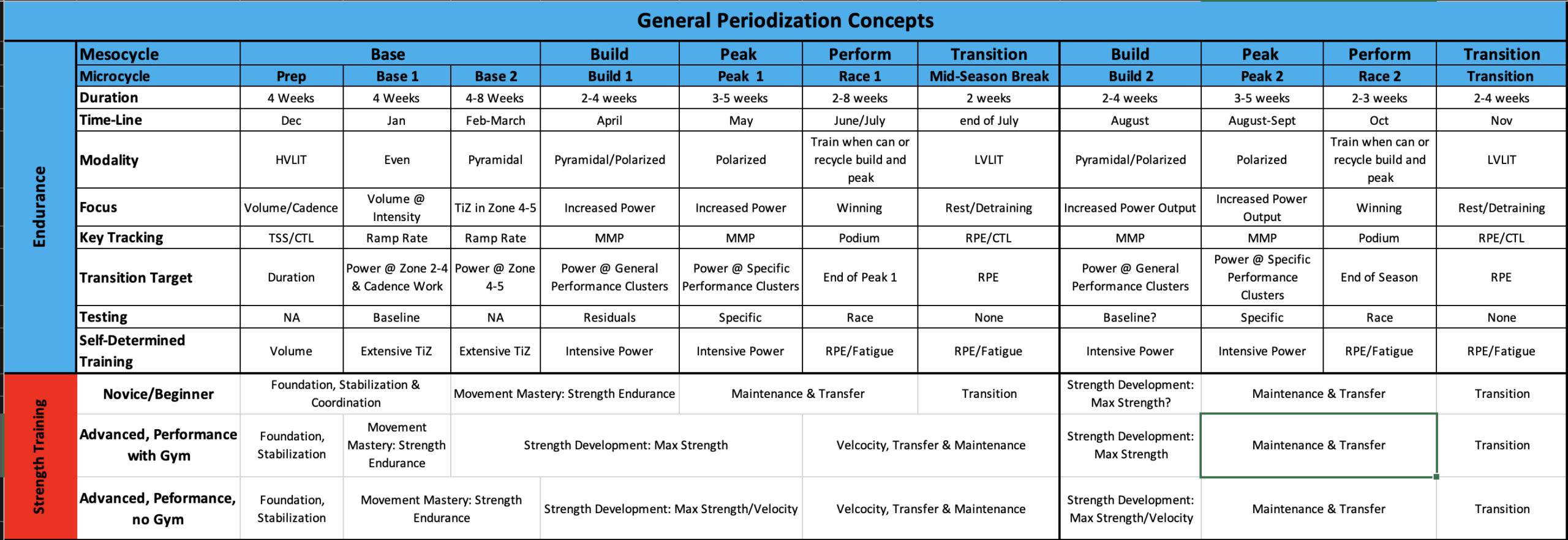
The six phases of strength training are described below. You can also see how the strength training phases align with endurance training periods in the image below.
1. Foundation, Stabilization & Coordination
Every athlete starts here. This phase may last 3-4 weeks for an advanced lifter returning from an off-season versus several months for a true beginner. The goal is learning, completing, and repeating quality movements. You should not be lifting heavy weights during this phase, but rather completing squats, lunges, and presses with controlled movements at an RPE of 6–7/10, 8–12 reps.
This phase matters more for cyclists than people realize. Pedaling is almost entirely concentric muscle contractions (muscle under tension while it’s shortening). The eccentric loading (muscle under tension as it’s lengthening) during a back squat or leg press is unfamiliar territory for a cyclist. Skipping straight to heavy weight leads to massive muscle soreness and is the reason you’ll be walking down stairs sideways or struggling to lower yourself onto the toilet for a week. Learning or reintroducing your muscles to these movement patterns with low resistance minimizes the soreness and gets you ready for more tension in the next phases.
2. Movement Mastery (Strength-Endurance)
The second phase includes the same core movements with added weight. The perceived exertion should increase to 7-9/10. For an endurance athlete, the goal of the strength endurance phase is to prepare your body to safely handle heavier loads in Phase 3. High-rep, moderate-load training conditions muscles, tendons, and the nervous system to tolerate more resistance over more repetitions so you can safely progress to Phase 3. This is important because muscles can show meaningful strength gains in a few weeks, but tendons remodel more slowly. Several weeks of moderate-load training with higher rep counts (8-10 reps) prepares tendons, establishes motor unit recruitment patterns, and increases general work capacity for the heavier loads coming next.
Expect this to be the most fatiguing block in the gym. This phase is typically completed while endurance training volume on the bike is also high.
3. Maximum Strength
Phases 1 and 2 are essential for making the most of Phase 3, the Maximum Strength phase. This is where you increase force production and make gains that will transfer to the bike. To increase strength you must produce maximum force, so the rep counts go down (2-6 reps) and the resistance goes up (perceived exertion 8-10/10).
How heavy should you go in Phase 3? This is where “reps-in-reserve” becomes a useful gauge. “One rep in reserve” means adjusting the resistance so you can maintain good form and complete the set with one more rep left in the tank. For instance, if you’re goal is a classic 5 sets of 5 repetitions of squats, you should aim to finish each set thinking you could have cleanly completed one more rep. If you can barely finish the fifth rep, the weight is too heavy.
► Free Cycling Training Assessment Quiz
Take our free 2-minute quiz to discover how effective your training is and get recommendations for how you can improve.
This block typically starts roughly six weeks out from a key event for less experienced athletes. Advanced lifters who can handle the overall workload should start earlier and spend more time in Phase 3.
4. Velocity/Power (Transfer to the Bike)
During Phase 4, load or resistance comes down but the speed of movements goes up. Medicine ball throws, jumps, plyometrics, and Olympic-style lifts (hang cleans, power cleans) develop the neuromuscular snap that translates force production from the weight room to usable, sport-specific power and leg speed on the bike. Pair this phase with cadence work on the bike (both low and high cadence) to reinforce the transfer.
5. Maintenance/Transfer
During the racing season, gym volume drops sharply, but it’s important to maintain some strength training. You’re going to want the adaptations you’ve built over several months during key moments in competitions. If you stop lifting entirely, you’ll lose the adaptations just when you need them most. Fortunately, it takes a lot less work to maintain your gains than it took to create them in the first place.
How much strength training is enough during the maintenance phase and while they’re racing? I have athletes reduce the frequency to one or two sessions per week, continue with speed/velocity work and lighten the resistance. This helps athletes retain most of the strength adaptations they built earlier in the season while reducing the recovery demands from strength training activities.\
6. Transition/Off-Season
After the high volume and high intensity parts of the season are over, take real time away from structured lifting. That doesn’t mean total inactivity. It means shifting focus to core work, activation drills, yoga, or Pilates keep the body moving and limber. This is especially useful for athletes with desk jobs who are sitting most of the day. Think “away from the bike, low-key movement” rather than a full program.
Athletes Without Consistent Gym Access
Not everyone has access to a gym that accommodates classic barbell lifts or a wide range of machines and free weights. If you have inconsistent access to a weight room or you’re doing your strength training at home, the phases stay the same, but the timing shifts. Because you can’t always load the body as comprehensively with resistance bands, kettlebells, and suspension trainers, we often extend the movement mastery phase. We then push the true strength development phase closer to the event, sometimes finishing the max strength phase around four weeks before your event.
How to Design Your Strength Training Sessions
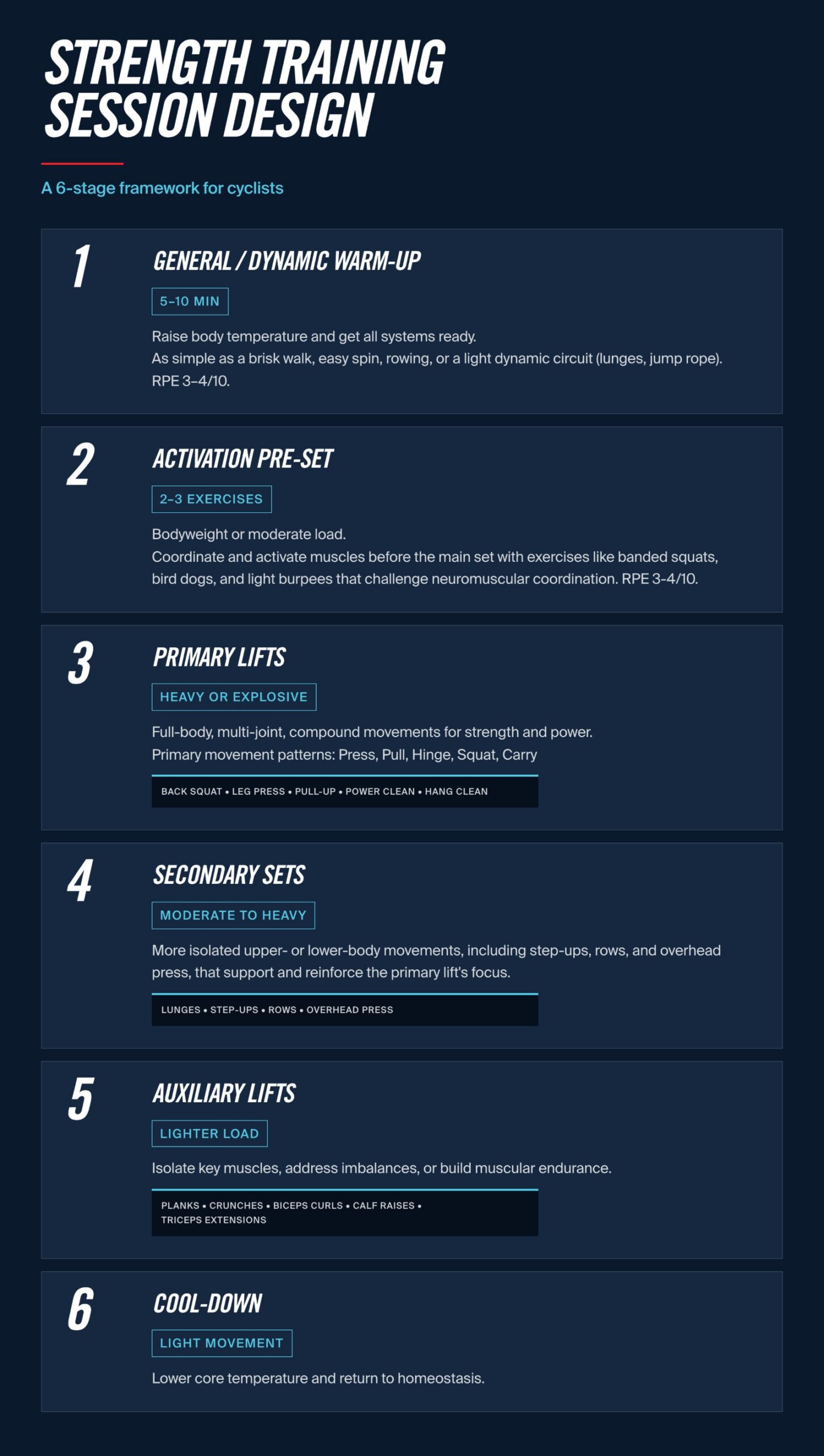
Regardless of the phase, every great strength training session should follow a predictable pattern:
- General/Dynamic Warm-up: Raise core temperature and heart rate: a brisk walk, easy spin, rowing, or a light dynamic circuit (lunges, jump rope). RPE 3–4/10.
- Activation/Prep: More targeted movements like banded squats, bird dogs, and light burpees that challenge neuromuscular coordination without raising intensity much (still RPE 3–4).
- Primary Lifts: These are your full-body, multi-joint, compound movements, like back squat, leg press, pull-up, bench press, power/hang cleans. This is the main strength or power stimulus of the session.
- Secondary Lifts: More isolated upper- or lower-body movements are included next, like step-ups, rows, and overhead press, that support and reinforce the primary lift’s focus.
- Auxiliary Lifts: This is the lighter, targeted work aimed at correcting imbalances and addressing muscular endurance (planks, ab work).
- Cool-down: Bring core temperature back down deliberately. Cool downs include an easy spin or walk, and/or light mobility work.
Tracking Strength Training for Cyclists
Strength work deserves the same level of analysis as your cycling power files. Whether you use TrainingPeaks, TrainHeroic, or a simple spreadsheet, it’s important to log load (weight or resistance), reps, and RPE consistently. Over months, that history lets you see genuine progress in specific lifts and gives you confidence heading into the next phase. Tracking is fun during the strength endurance and max strength phases, but it’s crucial during the race season when strength training volume decreases and every session and every lift needs to count.
The Takeaway
Strength training isn’t optional and it’s not an off-season activity. It’s a year-round component of training, and therefore it needs to be periodized as deliberately as your cycling training. Coordinate your strength training goals with your on-bike goals, structure individual strength sessions consistently, and maintain strength training even during the race season. You’ll notice the difference in a few months, and if you stick with it, strength training can transform your cycling over the course of several months to several years.
► FREE Mini-Course: Learn How to Maximize Your Limited Training Time
Learn step-by-step how to overcome limited training time and get faster. Walk away with a personalized plan to increase your performance.
"*" indicates required fields
About the Author
Adam Pulford
CTS Head Cycling Coach
Adam Pulford is a dedicated coach at CTS with a passion for elevating athletic performance through tailored, measurable strategies and a deep understanding of the “why” behind each athlete's goals. With nearly two decades of experience, a degree in Exercise Physiology, and a successful track record managing professional cycling teams, Adam also shares his expertise as the host of the Time-Crunched Cyclist podcast, providing actionable insights for endurance athletes.
Comments 2
Pingback: Carefully Curated Triathlon News for September 24, 2026 - TriathlonWire
Adam I am at 72 yrs old started riding 13 yrs ago I really haven’t trained in any way other than going out for a ride and I do have a pretty complete area in the basement with both free weights and a hoist cable machine, winters are long in iowa and we have been very wet and I still work doing weatherization for non profit companies in iowa, I train alone a lot due to my hours and my bike is equipped with garmin power meter pedals, heart monitor and a 1040 head set so I can see if I’m getting ahead or behind the game, my power is not very high average 165 on a 2 hour ride longer ride like a century I keep my heart rate around 120 and power about 125 what do you think I really want to be able to ride with the fast kids who ride in the mid 20 range and I can hold on for maybe 10 to 15 miles but then I drift back to 15 to 16 and get to ride home by myself