

The 10% Running Rule Is Misunderstood. Here’s What the Research Says

Updated On
September 23, 2026
CHOOSE YOUR FORMAT
►WATCH THE VIDEO
►LISTEN TO THE PODCAST
►READ THE ARTICLE
The 10% Running Rule Is Misunderstood. Here’s What the Research Says
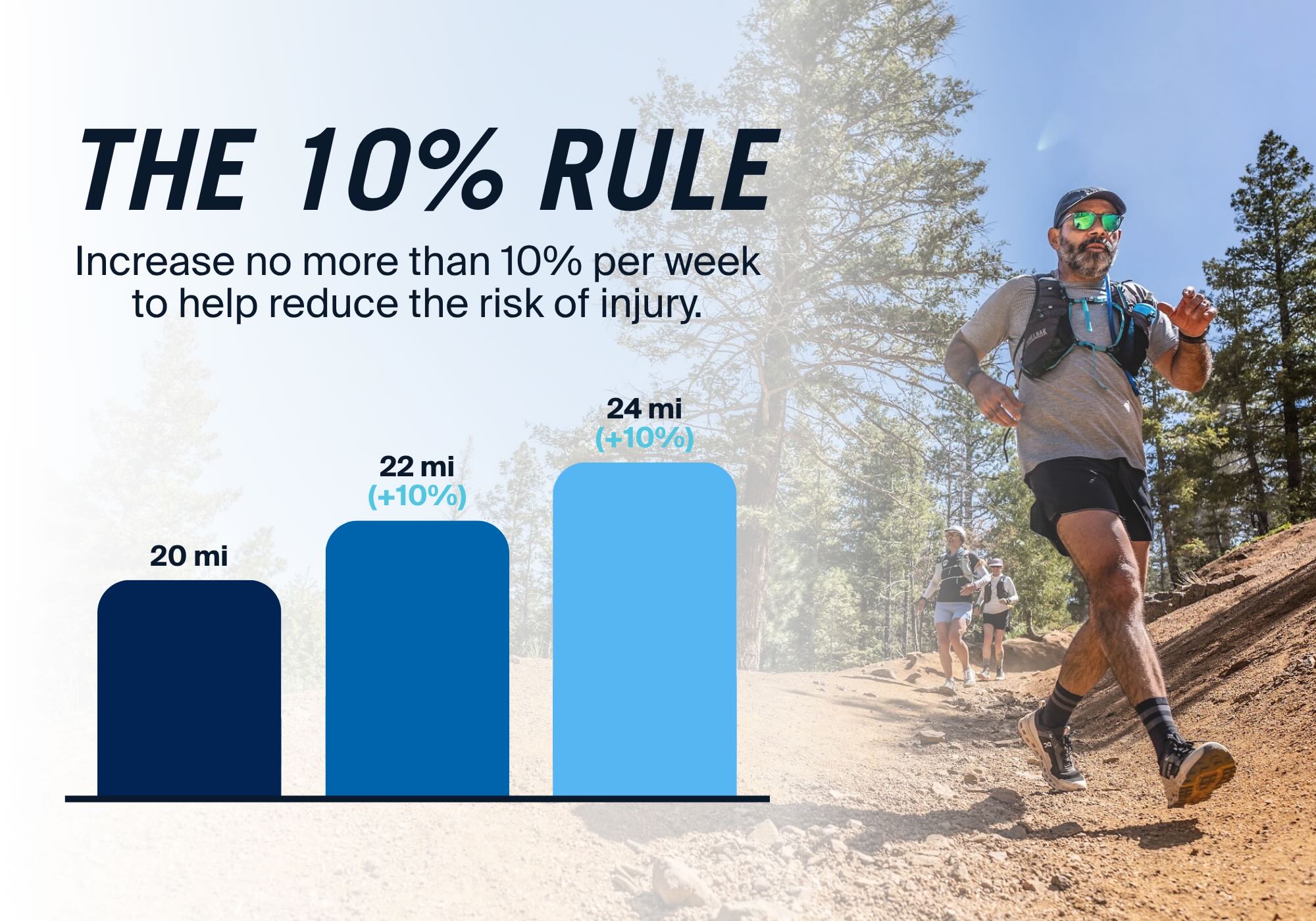
Nearly every runner has heard the myth about the 10% Running Rule. It’s the one that says increasing your running volume (miles or hours) by more than 10% per week dramatically increases your injury risk. The problem is, the rule has never been validated in a controlled study. That doesn’t mean the 10% Rule is wrong, but it may mean the 10% is aimed at the wrong target.
What Science Says About the 10% Rule
In 2008, researchers ran a randomized controlled trial on novice runners (532 total, 226 men, 306 women, randomized into two groups) (Buist et al, 2008). One group progressed their mileage by 10.5 percent a week. The other group progressed by 23.7 percent a week. If the 10% Rule were true, the group that progressed by 23.7% should have experienced more injuries. However, the injury rates between the two groups were nearly identical: 20.3% for the 10.5-hour group and 20.8% for the 23.7% group.
A larger study of more than 5,000 runners tracked data from wearable sensors over an 18-month period (JSB Frandsen et al, 2025). Runners’ data was examined across three metrics:
- Session-specific running distance relative to the longest distance run in the past 30 days
- 1-week period relative to the preceding 3 weeks using the acute:chronic workload ratio (ACWR)
- 1-week period using a week-to-week ratio.
Week-to-week percentage increases showed almost no relationship to injury risk. Neither did the acute:chronic workload ratio.
What the Frandsen study found, however, was that the biggest predictor of injury was when a single long run exceeded the longest run from the previous month by more than 10%. The problem wasn’t that weekly volume, compiled of short- and medium-duration runs, increased by more than 10% week over week, but rather that individual long runs progressed too aggressively.
Why Progressing Long Runs Too Quickly is Dangerous
The traditional 10% Running Rule sounded good because it was conservative and simple. It was intended to keep runners from ramping up their weekly mileage too quickly. And even if research indicates you can increase overall weekly training volume faster than 10%, that doesn’t mean it’s automatically safe to increase weekly volume by 20% or 30%. Conservative is still safe and still effective.
As an ultrarunner, if your long run right now is three hours (180 minutes), an increase of 10% is 18 minutes. An increase of 20% is 36 minutes. And a lot of runners would naturally go from 3:00 to 3:30 because those are nice, round numbers.
The reason it’s more dangerous to increase the length or duration of your long runs by more than 10% month over month is because long runs are harder on your body. The strain of a 60-minute weekday run is less than an 180-minute weekend long run. Hour three of your long run is more stressful on your body than hour one, even if the pace is the same or slower. The work done in the first two hours causes fatigue and muscle damage, along with strain on tendons and ligaments, that you are working with in hour three.
► Free Ultrarunning Training Assessment Quiz
Take our free 2-minute quiz to discover how effective your training is and get recommendations for how you can improve.
Root Cause: Adaptation Is Not Linear
Exercise creates training stress, which sets off signals throughout your body that lead to adaptations in your cardiovascular, circulatory, pulmonary, skeletal, muscular, nervous, and endocrine systems (among others). Some of these changes happen faster than others.
Your cardiovascular and metabolic systems adapt fast. Plasma volume expands within days. Mitochondrial density and capillarization start improving within a couple of weeks. These are noticeable to runners, you feel fitter within about a month.
Muscle adapts on a slightly slower timeline. You build strength and local endurance over several weeks to a couple of months of consistent training. Tendons, ligaments, and bones are relatively slow to adapt. Connective tissue and bone remodels over the course of several months.
This non-linear progression is what sets you up for injury. Your cardiovascular system improves quickly enough that you feel ready for more volume than your muscles, connective tissues, and bones are actually prepared for. Shorter runs, even if they add up to a volume progression greater than 10% per week, are easier to recover from… as long as you give yourself adequate time to recover! Long runs that are too long are where you’re more likely to exceed your body’s ability to handle the stress without getting injured.
Enjoying This Article? Get More Free Running Training Tips
Get our coaches' best training advice, delivered straight to your inbox weekly.
The Safer Framework To Increase Running Volume
So, how do you increase your running workload so you can continue making progress, but do it in a way that won’t sideline you with a running injury? Here’s the framework I use with the athletes I coach:
- Long Runs: This is where the 10% Rule holds up. Take the longest run you’ve done in the past 30 days (in hours, not miles). On a monthly basis, your longest long run should not increase by more than 10%. If you have a goal for a longest long run prior to your goal event, work backwards so you can create a progression that gets you to your long run safely.
- Week-to-Week Volume: Stop thinking about your progression in terms of a set percentage of running hours or miles. Instead, track your recovery response. Pain or stiffness that doesn’t clear in 24 to 48 hours matters more than any number on a training log. When you are healthy (eating well, sleeping well, low lifestyle stress, taking adequate recovery time), you’ll be able to handle more running volume without feeling like it’s a struggle. When your recovery response is slower, be more conservative with adding training hours (or don’t add any for a while).
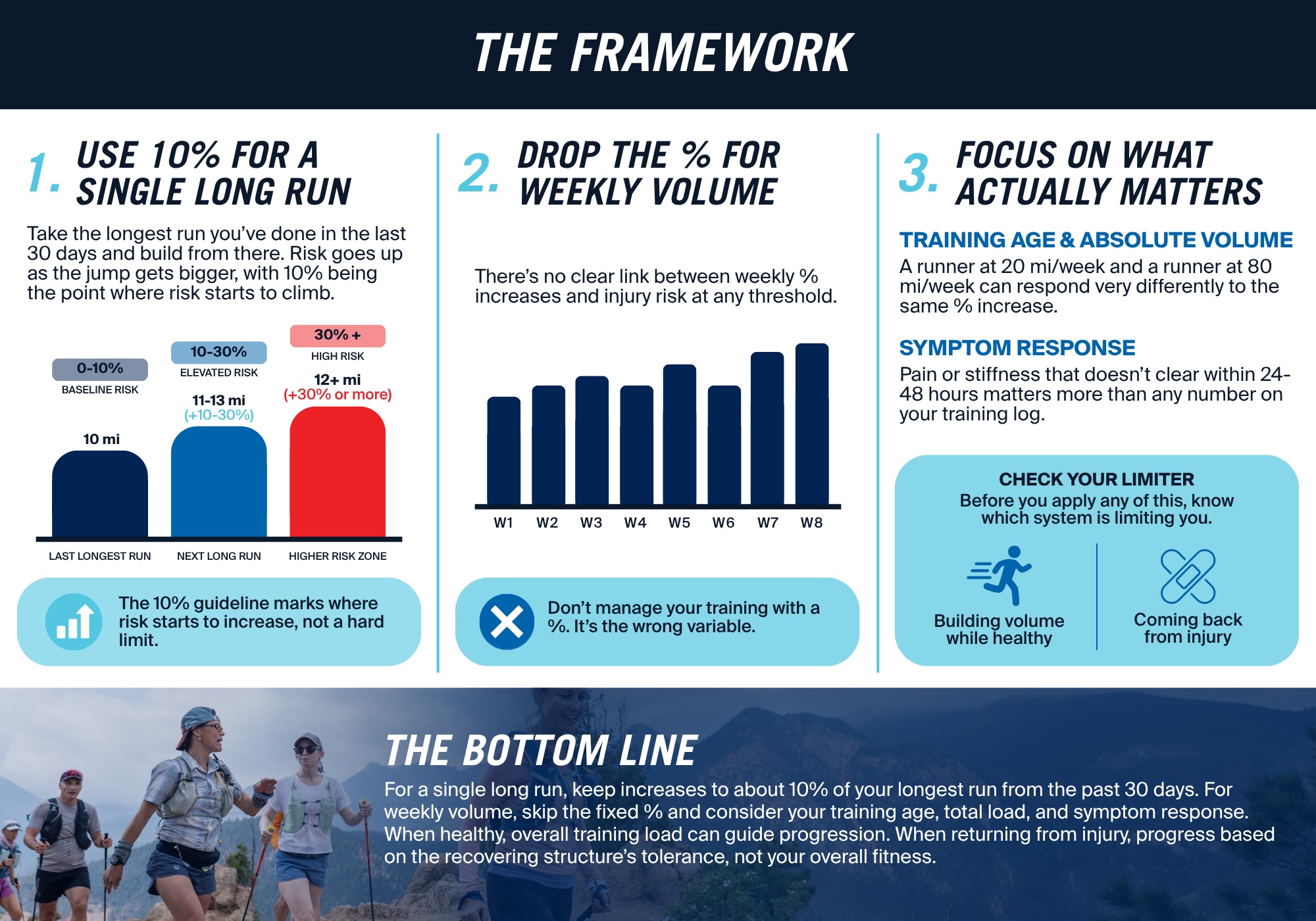
I recognize that the framework for increasing week-to-week running volume is vague. The 10% Running Rule is a simpler way to tell runners how to increase their running volume, and from a performance standpoint it’s a good starting point. From an injury prevention standpoint, the most important part, though, is to limit the progression of your longest long runs to a maximum of 10%.
References:
Buist, I., Bredeweg, S. W., van Mechelen, W., Lemmink, K. A., Pepping, G. J., & Diercks, R. L. (2008). No effect of a graded training program on the number of running-related injuries in novice runners: a randomized controlled trial. The American journal of sports medicine, 36(1), 33–39.
Schuster Brandt Frandsen, J., Hulme, A., Parner, E. T., Møller, M., Lindman, I., Abrahamson, J., Sjørup Simonsen, N., Sandell Jacobsen, J., Ramskov, D., Skejø, S., Malisoux, L., Bertelsen, M. L., & Nielsen, R. O. (2025). How much running is too much? Identifying high-risk running sessions in a 5200-person cohort study. British journal of sports medicine, 59(17), 1203–1210.
About the Author
Cliff Pittman
CTS Pro Ultrarunning Coach
Cliff Pittman is the Coaching Development Director for CTS, where he expertly leads the Ultrarunning and Cycling Coaching teams. A passionate ultrarunner and active competitor, Cliff specializes in simplifying complex training concepts into actionable strategies, ensuring athletes at all levels—from beginners to elite competitors—can achieve their goals in prestigious events like the Western States 100 and Leadville 100.