

Rate My Training: Advice For A 67-Year-Old Gravel Racer Wanting To Go an Hour Faster at Unbound
CHOOSE YOUR FORMAT
►WATCH THE VIDEO
►LISTEN TO THE PODCAST
►READ THE ARTICLE
Rate My Training: Advice For A 67-Year-Old Gravel Racer Wanting To Go an Hour Faster at Unbound
Here’s the Rate My Training setup: We asked self-coached athletes in our audience to share their TrainingPeaks data so we could rate their training, figure out what they’re doing right and identify places where they could make improvements. We received far more submissions than expected, so this may become a regular feature.
Our first athlete is Willie B., a 67-year-old gravel racer focused on events like the Traka 200 in Spain, Heathland Gravel in Belgium, and Unbound Gravel in Kansas. His goal for 2027 is clear: go back to Unbound and finish before the sun sets. Here’s what his data says, and what I’d change if he were a CTS athlete.
A note before we start: I haven’t spoken with Willie. Everything below comes from his data and the short survey he filled out about his goals, hours and racing experience.
Training History: What 616 hours of training data showed
I pulled Willie’s last 365 days into WKO5: 616 hours of riding. Three views told most of the story.
The power duration curve
The mean maximal power curve plots Willie’s best average power for every duration, from one second to his longest ride (yellow area). WKO5 fits a model curve over it (red line), which shows how real efforts compare with the model.
Willie’s actual performance exceeds the model at 24 seconds and 17 minutes. There are a few places (at a couple of minutes and around 40 minutes), where the modeled curve is above the recorded data, indicating he may have more to give at those durations. His best 17-minute, 20-minute and 5-minute powers all came on the same day: December 20, 2025. It may have been a test, a hard group ride or a race.
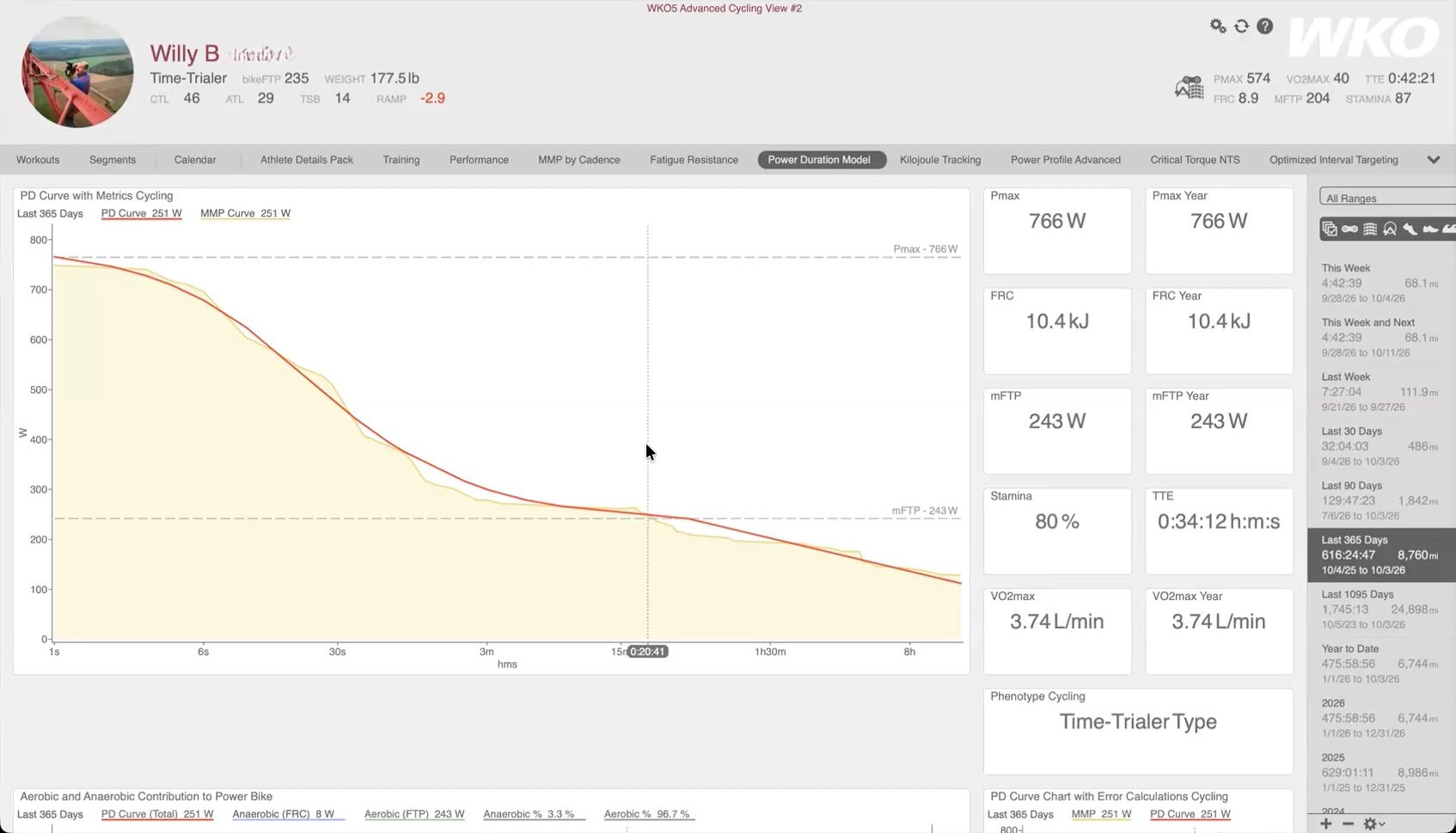
What else does the Power Duration Model screen show for Willie? Here’s what the information boxes to the right of the graph mean:
- Pmax: This is the highest recorded power for one rotation of the crank. Think of it as peak neuromuscular power, for the time period (last 30 days and last 365 days).
- FRC: Functional Reserve Capacity is the number of kilojoules of anaerobic work Willie can do, above Functional Threshold Power (FTP) for a one-time effort. Typically, these efforts are 40-70 seconds.
- mFTP: This is Willie’s modeled FTP based on the data in the graph, representing the maximum power he can sustain for a steady, long-ish period (35-75 minutes, depending on the person).
- TTE: Time to Exhaustion is how long you can sustain your FTP.
- Stamina: This looks at the slope of the line after TTE. If it’s steeper down, you have less stamina. If it’s less steep of a decline, you have more stamina.
- VO2 max: Here, maximum aerobic capacity is expressed in total liters per minute. At the top right of the image you can find VO2 max expressed as milliliters of oxygen per kilogram per minute.
The model put his FTP anywhere from 204 W (in the upper right of the image, artificially low today, from lack of hard efforts) to a 243 W high for the year (a little high). My read is that his true FTP sits around 230–235 W. I’ve set that as his FTP in the upper left area of the image.
The lesson for self-coached athletes: the model is only as good as the data. If one fresh 20-minute effort is all you feed it, it will inflate FTP. It’s better to feed it maximal efforts at 20 seconds, 1 minute, 5 minutes and 20 minutes. I also use longer efforts of 35, 45 or even 60 minutes to pin down where FTP really sits.
The Performance Management Chart
Next, the Performance Management Chart. As a quick refresher:
- CTL (chronic training load, blue area, “fitness”) is a 42-day weighted average of daily TSS. The nature of weighted averages means the net effect is times two. So, effectively describes the past 90 days of work.
- ATL (acute training load, pink line, “fatigue”) is a 7-day weighted average. It spikes after a hard week or two and drops quickly with rest.
- TSB (training stress balance, yellow line, “form”) is the difference between CTL and ATL. When TSB is more negative, it indicates recent training is piling on fatigue. When TSB is near zero or positive, you’re more rested and likely performing better.
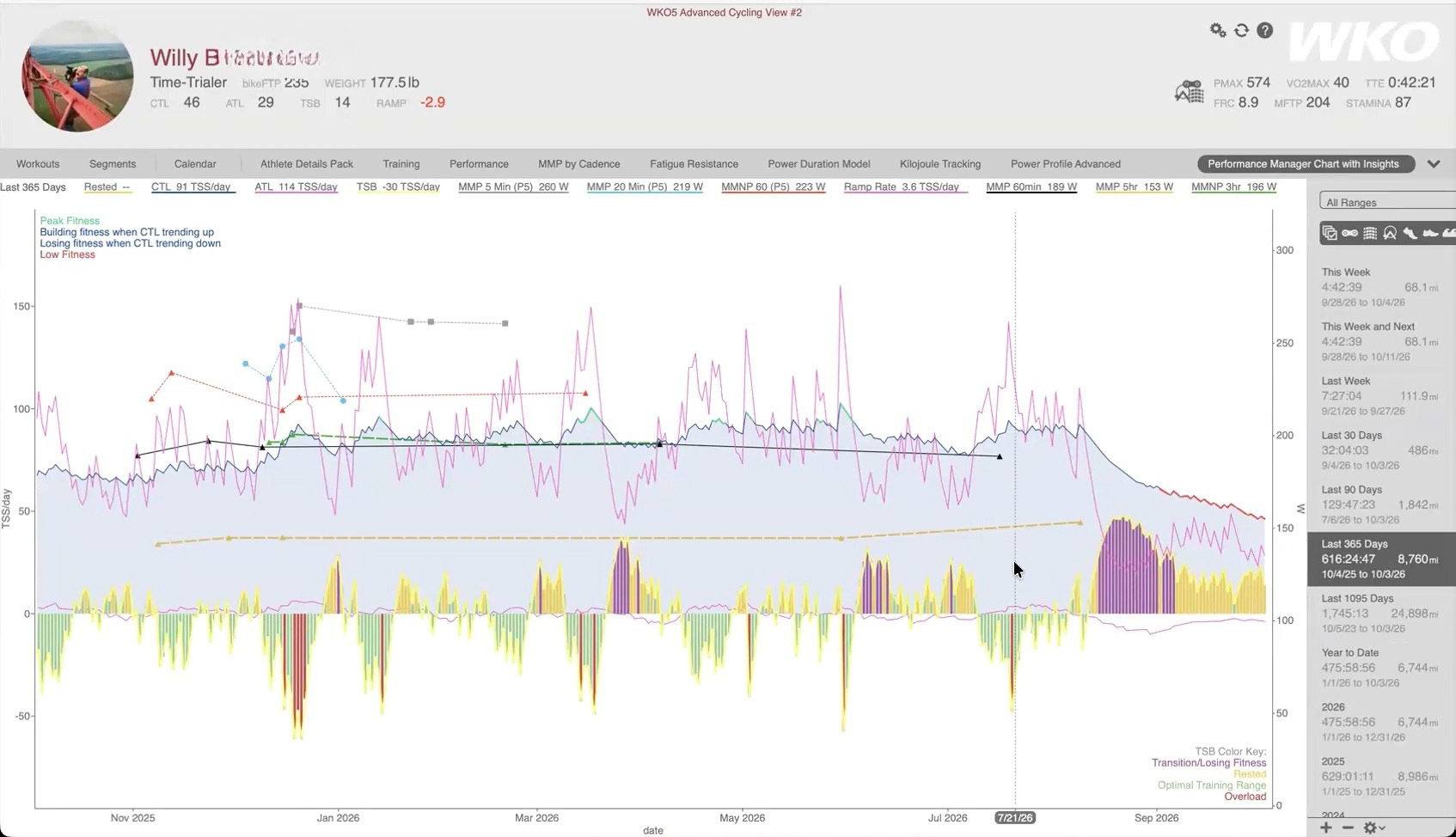
Willie built CTL steadily through late 2025 and sustained strong training into early 2026. Training was disrupted or he took a break in March/April 2026, then he built back steadily through May. That big ATL spike in June was Unbound Gravel. He took a break after Unbound, let CTL gradually come down a bit, trained steadily through August, and has trained lightly since August 2026.
To see when Willie was performing his best at various power durations, I also overlayed each of Willie’s top-five mean max powers at 5, 20 and 60 minutes, normalized and average powers at 60 minutes, plus 3- and 5-hour power outputs. Willie’s best 5-, 20- and 60-minute powers all cluster in late 2025 and early 2026. Nothing comes close from March or April onward. His long-duration power held up through Unbound, but perhaps his top-end fitness peaked months too early.
FTP vs FRC
FTP is the high aerobic marker: the power you can hold fairly steadily for a long-ish period (35–75 minutes for most people). Functional reserve capacity (FRC) is the high anaerobic marker: the kilojoules of work you can do above FTP in one all-out effort of roughly 40–70 seconds before you fatigue. The chart below shows FTP in orange, FRC in purple, and Time to Exhaustion in black.
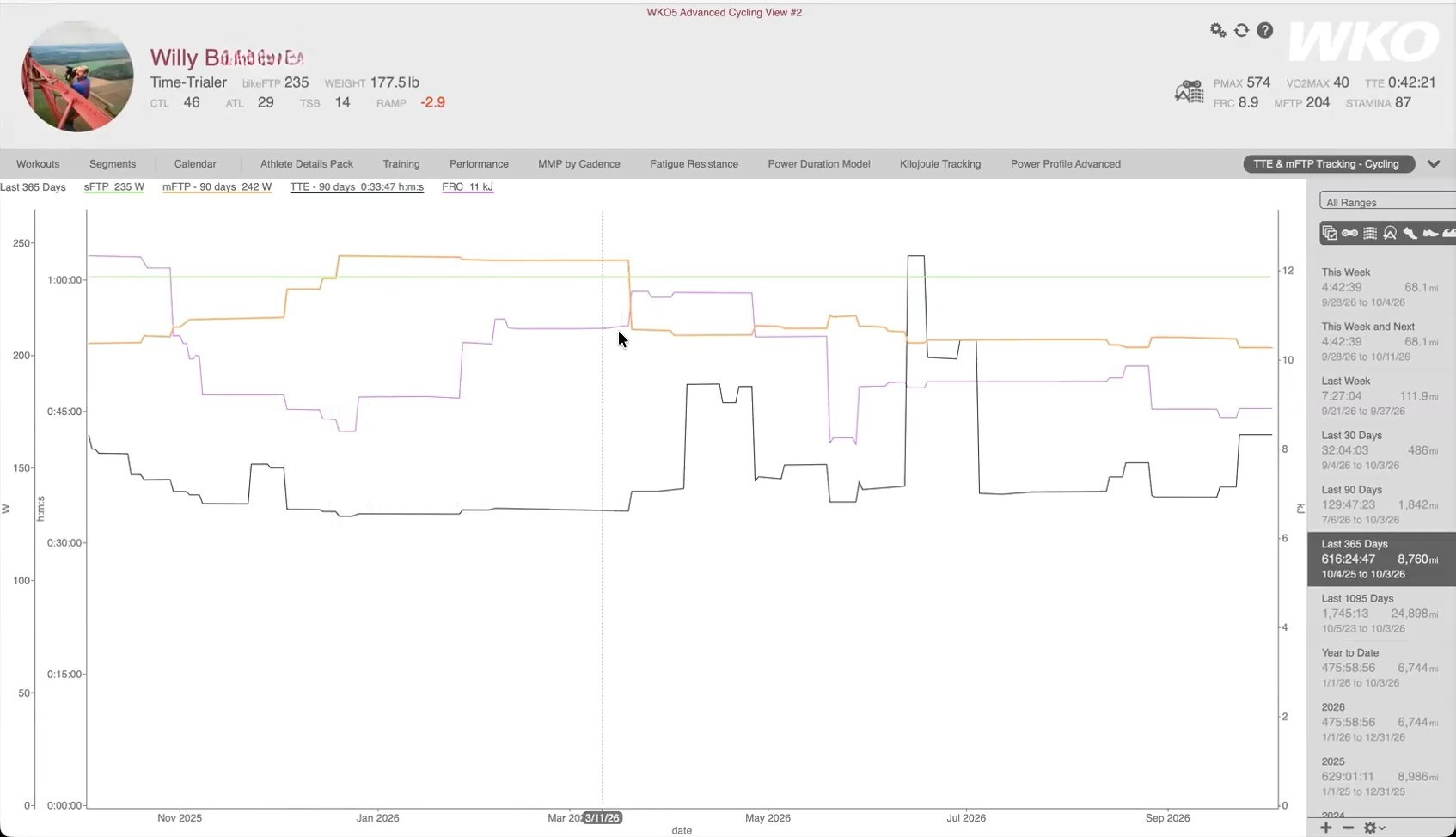
The two lines to note are the orange (mFTP) and purple (FRC) lines. In the model they move inversely: when modeled FTP rises, FRC falls. In real training it works similarly. Willie had his high aerobic power durations in early 2026, which raised his FTP in the mathematical models, which reduced his FRC. In the real world, when you focus on aerobic and threshold work, anaerobic capacity can be suppressed.
FRC is important for staying in a fast group because it’s what enables you to punch over short climbs and respond to accelerations and attacks. Willie’s FRC is low enough to be a limiter, and in his survey he said he got dropped from groups, including at Unbound.
Event Review: How Unbound 2026 Went
Unbound 2027 is a major goal for Willie, so I looked at his 2026 Unbound file in the context of his training history.
► Free Cycling Training Assessment Quiz
Take our free 2-minute quiz to discover how effective your training is and get recommendations for how you can improve.
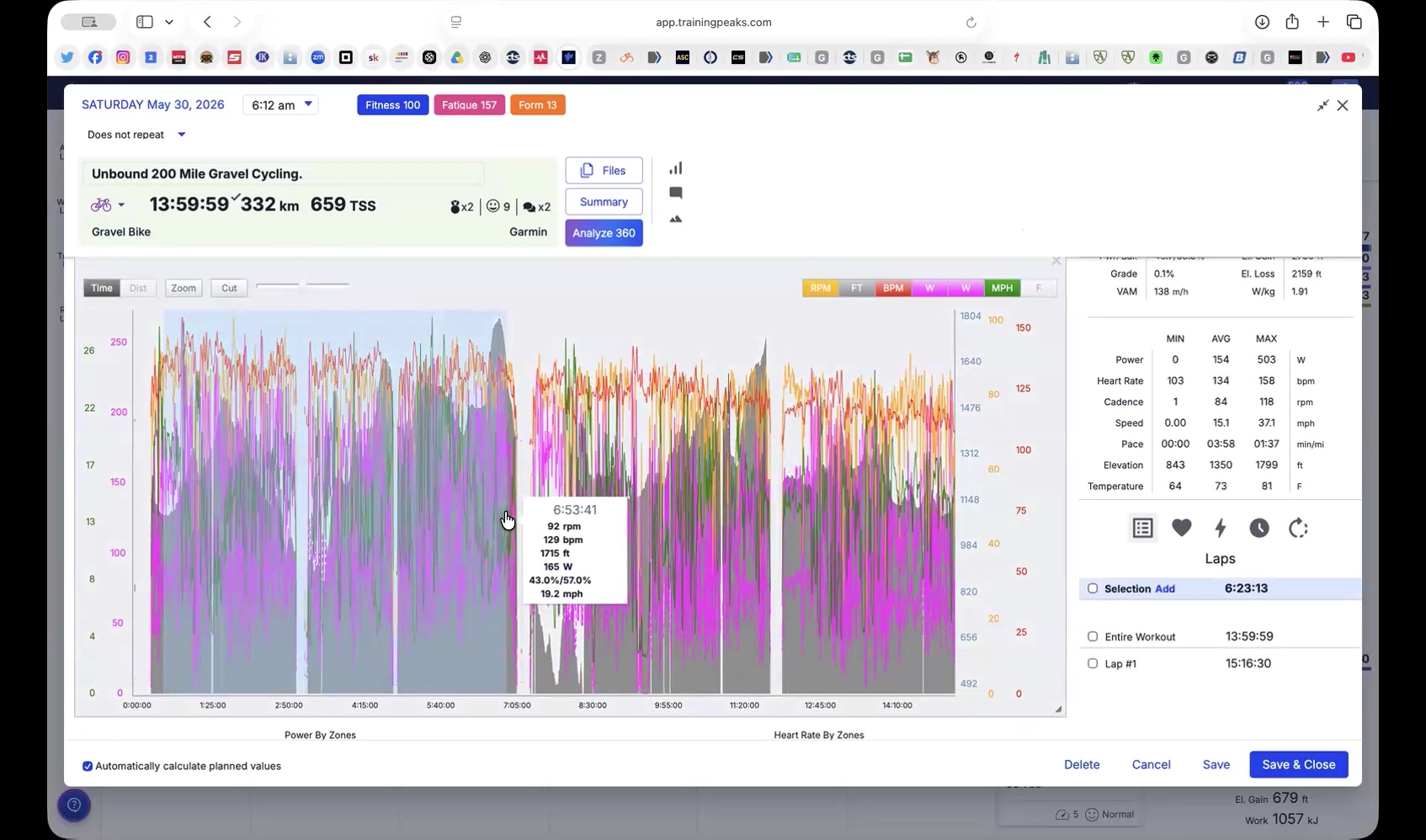
The pattern is clear. Power, heart rate and speed were high through the first half (highlighted above). In the second half to two-thirds, the pace dropped and stayed down. That fade could come from losing the group, from overall fatigue, or from poor fueling, or from all three. You can see these downward trends in power, heart rate, and speed even more clearly in the TrainingPeaks Analyze 360 dashboard below.
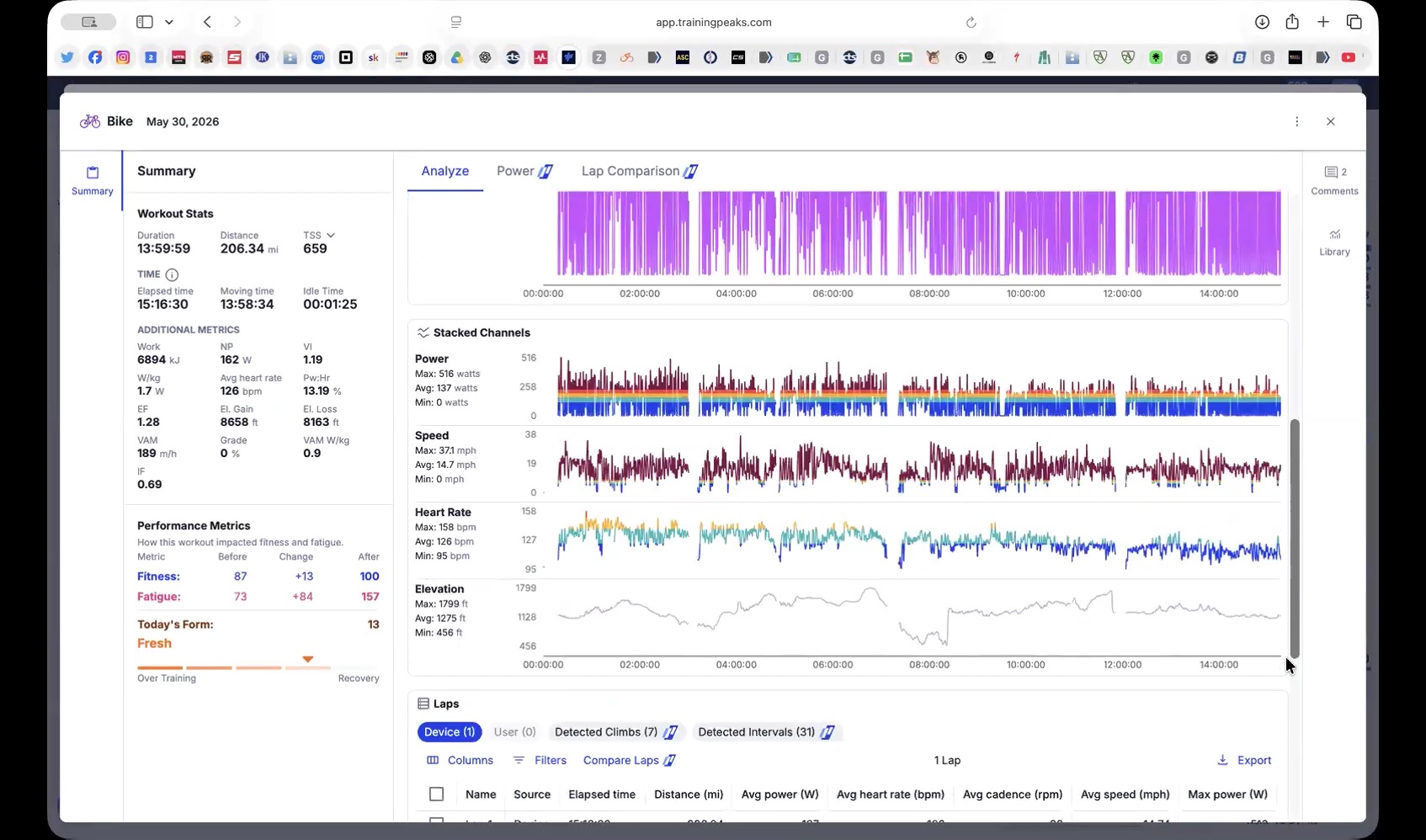
There was some aerobic decoupling (power dropping more quickly than heart rate in this case), but it was within reason. His heart rate came down with his power, which tells me he settled into a slower pace rather than blowing up. It was a wise move, but for 2027 we want greater durability so he doesn’t fade as much, along with a combination of higher FTP and higher FRC so the first half doesn’t take so much out of him and he has the punch to stay with a fast group all day.
The Biggest Opportunity: Reducing Paused Time
I used software to create a visual review of Willie’s 2026 Unbound 200. One of the biggest things to note is the nearly 59 minutes paused or not moving during event. The 2026 Unbound 200 was a mudfest, so the paused time likely reflects aid station stops (3) and some stoppage time for clearing mud from the bike. The weather could also contribute to reduced power and pace in the second half.
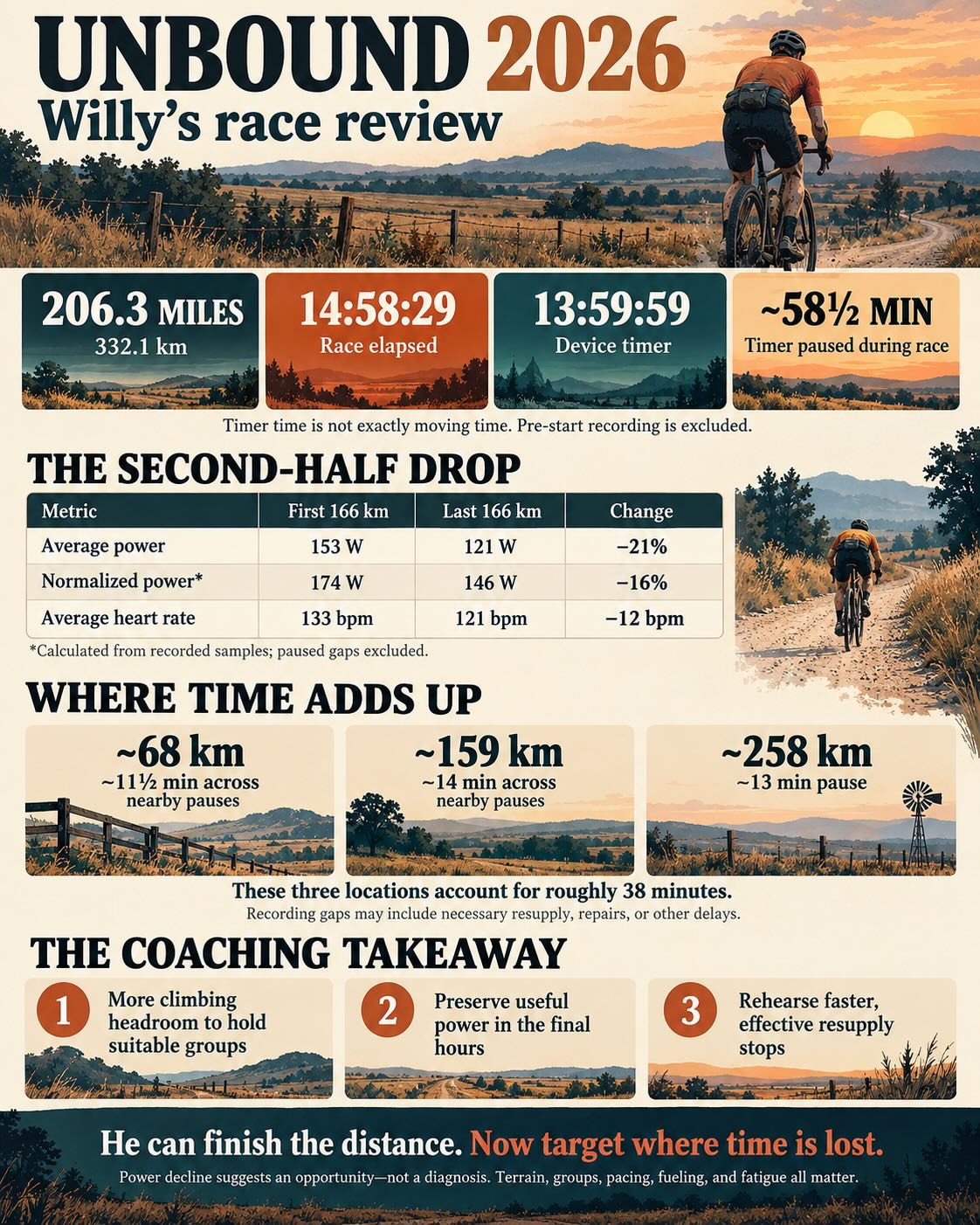
In principle, a better aid station plan could save elapsed time, and it can decide whether you stay in a good group. If you roll into an aid station, sit down and move slow, you lose track of the riders you came in with and they’ll leave without you. Once that group is gone, there are only slower groups to join after that. If you’re ready first, you have options. Wait a minute or two and recharge or roll out easy at endurance pace and let them catch you. Either way, play the group.
Willie’s 2027 Unbound 200 Plan to Chase the Sunset
The Unbound 200 has a special prize for riders who finish before sunset. I believe going an hour faster is a doable goal for Willie in 2027 with some planning for shorter aid station stops, hopefully better weather, and training that delivers him to the start line with a higher FTP and higher FRC.
Race-day plan
- Cut stop time. This is the easiest way to go faster. Have a system so every stop is efficient and organized. Whether you have helpers or you’re self-supported, plan how you’ll get in and out of aid stations quickly.
- Ride in a group and stay in it. Willie said he was in a good group but lost contact. Settle in early and find a group that matches your pace. For most amateurs the first hour is the most intense hour of any gravel race, so you need the FRC to survive it and make the selection.
- Fuel all day. Fueling is your best asset on race day. Dial it in during training, then stay on it so you have power left for the final third, when durability is everything. Fueled and fit, the back half is a steady upper Zone 2 effort. Unfueled, you’re fading and pedaling squares in the dark.
- Build climbing headroom. Kansas has no 20- or 40-minute climbs like Colorado, California or Europe. It’s death by a thousand cuts, and you must repeat hard efforts all day. That takes high-FTP and high-FRC training.
Training Changes for Next Season
Willie did a lot right in 2026. The fundamentals of his training look good. He stayed fit all year and built Unbound-specific endurance with plenty of long riding. For 2027 he needs to raise both markers: FTP first, FRC close behind, with both higher at the start line than they were in 2026.
A higher FTP means he’ll still be aerobic (Zone 2 and 3) at a higher pace during the race. That speed will take less out of him. A higher FRC adds matches (capacity for hard efforts) to the matchbook. Not only will he have the repeatability to handle more efforts, but each effort will either be less costly (more manageable) or more effective (higher max power).
Riders over 60 tend to skip anaerobic work. It’s hard, it’s a little scary, or they don’t believe it helps. But they need it. I program more strength training and anaerobic work for my 55+ athletes now than I did 10 years ago. Because Willie’s FRC is so low, I’d include anaerobic work in his base phase: once or twice a week while volume is lower and he can recover and adapt.
Testing Week in December 2026
Willie’s last real benchmark was December 20, 2025, and he’s detraining now. I’d have him ride for a few weeks first, then run baseline tests in December. Here’s a version of the testing week I use with athletes riding 10–15 hours a week:
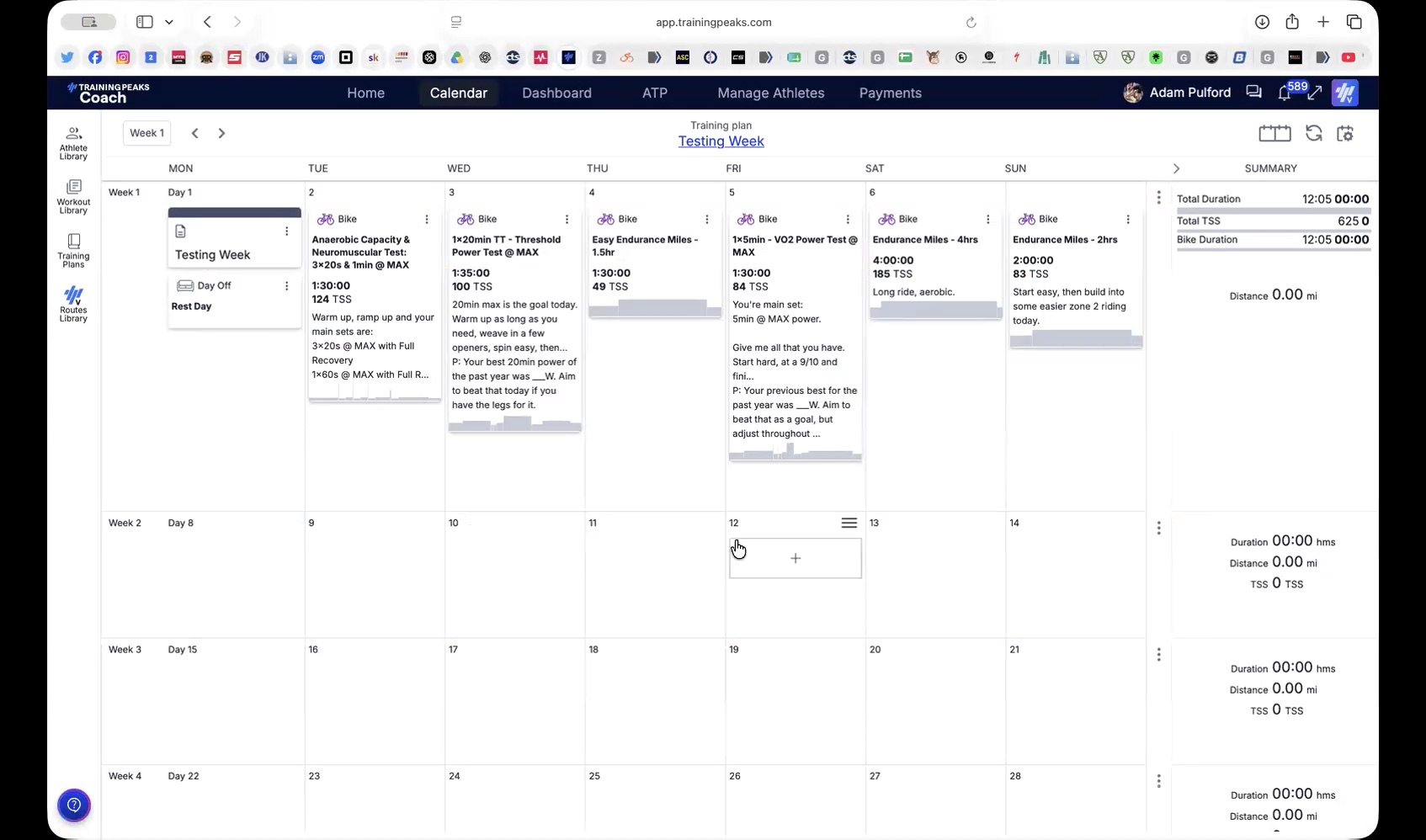
I sometimes swap the 20-second efforts for 10- or 30-second efforts depending on what the athlete’s data shows.
If you’re time-crunched, the classic protocol works well for most self-coached athletes. Do a 5-minute max effort, recover fully, then do a 20-minute max effort. Do the sprint tests on the weekend. That 5-minute effort burns off anaerobic energy, so the 20-minute effort that follows reflects your aerobic engine more accurately. Take 95% of that 20-minute power to set your zones. A fresh 20-minute test on its own, like Willie’s December 2025 effort, inflates your zones. In that case use 91–92% instead.
Long Range Plan Recommendation: Willie’s Road to Unbound 2027
What would I do if I were coaching Willie? Well, we start with laying out long range plans, whether they are several months, a full calendar year, or even a multiyear progression. Starting in December before a June gravel race, here’s what I’d plan for Willie.
- December: testing, base, and a little anaerobic work. Mostly aerobic riding with one or two anaerobic sessions a week, and the Testing Week above.
- January–February: base and build. Raise the aerobic ceiling and gradually extend the long rides.
- March: modest intensification. Build aerobic power with Zone 3 and some Zone 4 work. Finish with an easy week and repeat the testing week.
- April–early May: durability and volume. This is the highest-volume block. Do hard efforts late in 4–5-hour rides, then keep riding. In April, run a fatigue test: ride 2,500 kJ, then do a 20-minute max effort. Practice fueling, pacing and aid station stops. Get them down to 5 minutes or shorter. Ride the gravel bike you’ll race.
- Pre-taper: bike prep. Take the bike to the shop for new tires and a waxed chain, and have the bottom bracket bearings and drivetrain checked.
- Taper: reduce training volume by 50% starting 10-14 days out from the race, but maintain frequency of rides and keep some high intensity.
- Unbound: execute. Deploy the race-day plan above.
- After: rest, then go again. Take a couple of weeks off, then return to base and build for a second peak.
I’d encourage Willie to put a second big event later in the season. If you build the first peak correctly, the second often goes even better. It also keeps you engaged late in the year and takes some of the emotional weight off a single race.
Training Considerations at 68 Years Old
We’re working with more and more athletes in Willie’s age group. Athletes of any age can still make impressive progress, but there are some considerations that gain importance for athletes in their 60s and older. There’s still a lot of easy aerobic work, but what changes is the focus on anaerobic work and how it’s organized around recovery:
- Start with one hard interval day and one long ride per week. Endurance riding fills the days between.
- Add strength training. Remember that it’s a stressor too, alongside the intervals and the long ride.
- Use two interval days while volume is lower, with a focus on high power anaerobic work. Drop to one as volume climbs.
- Join group rides. The unplanned surges are exactly the specificity Unbound and other gravel and road events demand.
- Adjust to adaptation. At this age recovery is paramount. If you’re not adapting, dial it back. If you are, push a little more.
Lessons for everyone
- Feed your model good data. One fresh 20-minute effort will overstate your FTP. Test across several durations, and retest after each block.
- Peak for your goal, not for December. If your best powers all come several months before your A race, your timing is off.
- Durability is more than long rides. A higher FTP, more FRC and good group riding skills preserve power and energy for the second half of a long event.
- Short stops are the cheapest way to go faster. Rehearse your stops in training. Thinking about how hard it would be to ride five minutes faster over 20 miles will make you reluctant to waste five minutes standing still.
Thanks to Willie for being a great data guinea pig, and to everyone who volunteered their training. We’re sending Willie this full breakdown along with an annual training plan like the ones I build for my athletes.
► FREE Mini-Course: Learn How to Maximize Your Limited Training Time
Learn step-by-step how to overcome limited training time and get faster. Walk away with a personalized plan to increase your performance.
"*" indicates required fields