
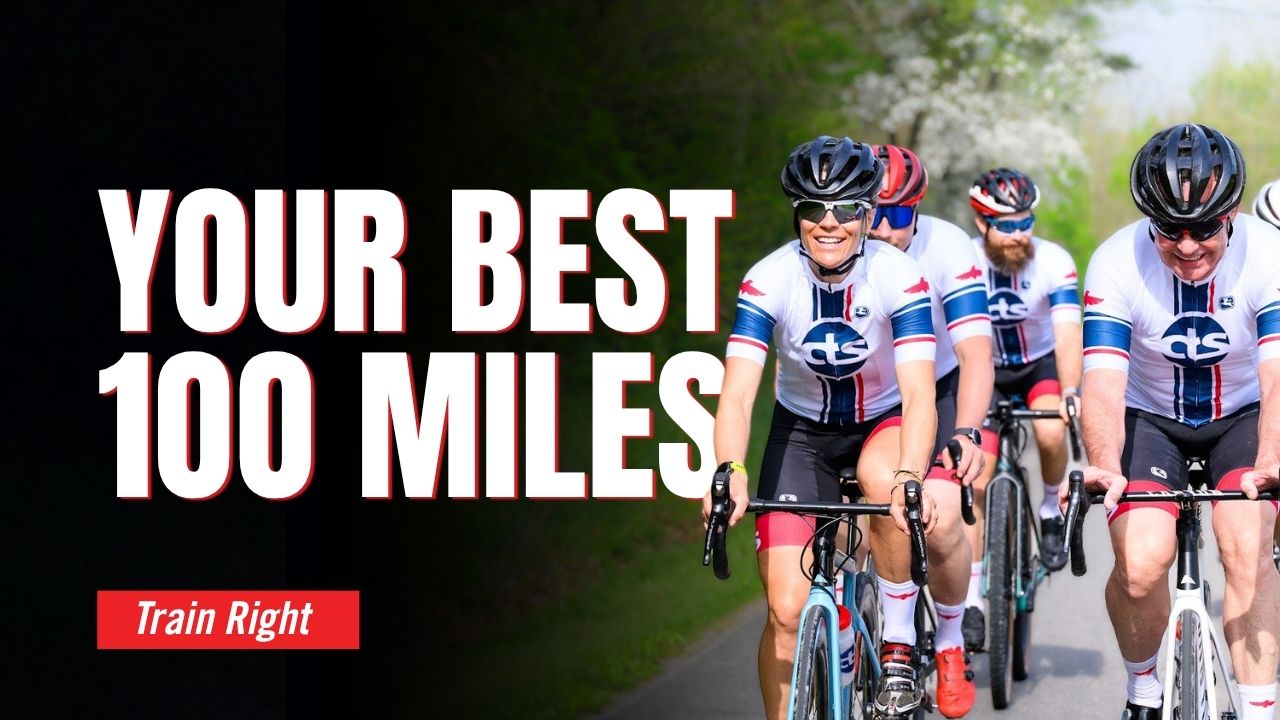
How to Nail Your Next 100-Mile Bike Ride
Updated On
September 16, 2026
CHOOSE YOUR FORMAT
►WATCH THE VIDEO
►LISTEN TO THE PODCAST
►READ THE ARTICLE
How to Nail Your Next 100-Mile Bike Ride
A century ride, or 100-mile bike ride, is a right of passage for cyclists. In a world that sometimes normalizes extremes, like 200-mile gravel races and 100-mile high-altitude mountain bike races, you could mistakenly believe a 100-mile road or gravel ride is normal or even quaint. It’s not. It’s an epic ride, a big deal, and a meaningful accomplishment. Whether you’ve done just a couple of them or have dozens of century rides under your belt, there are four key components to having a great day during your next 100-mile ride.
Now, if you arrived on this page before you’ve done your first 100-mile ride, go to this article to learn everything you need to know about preparing for your first century ride.
Training for a 100-mile bike ride
Your short and long term training habits will obviously have a huge impact on your performance in your next 100-mile ride. The biggest piece of advice I can give someone with a 100-mile ride on the horizon is to avoid “cramming for the exam”. Your physiological adaptation to training does not accelerate just because you have a goal event coming up soon. If you’re underprepared on fitness, you can still have a good day on a 100-mile ride by following the pacing, fueling, and companionship guidance later in this article.
If you have at least 6-8 weeks before your next 100-mile ride, you have enough time to meaningfully improve your fitness and performance capabilities. Here’s what you should consider:
- Weekly long ride: This doesn’t need to be a specific percentage of the goal event distance. (See “How long should my longest long ride be?). Rather, schedule a long ride each week or every two weeks based on your schedule, and have those rides get progressively longer. Aim to reach 4+ hours a few weeks before your next century, with your final 4+hour ride at least a week before your goal ride.
- Threshold training: Aerobic volume is not going to be enough to have a strong ride during a century. You need some intensity, and threshold training (prolonged efforts near FTP or lactate threshold) provide the best bang for your buck. In my experience, and based on available evidence, in about 6 weeks a moderately trained cyclist can increase FTP by about 8%. This percentage increase goes DOWN for more highly trained cyclists because of the rule of diminishing returns.So, if your training has been kind of hit-and-miss or you’re feeling like you need a boost before your next 100-mile ride, from up to 10 weeks to 6 weeks out from your event, add some Zone 4 intervals (e.g., 3 x 10-20 minutes around FTP, recovery times 50% of interval time) once or twice a week, along with that weekly long ride.
- VO2 max training: This is a lower priority, but over a period of six weeks a moderately trained cyclist can increase VO2 max by 5-8%. If you already have a robust aerobic system and you’re a strong, steady time-trial-esque rider with a good FTP, then a VO2 max tune-up may be more beneficial than piling on more threshold work.
Free 100-Mile Training Plans
If you want to see how these concepts come together in a century ride training plan, I have two 6-week training plans available on TrainingPeaks that you can have for free. Just click on the links below and use code: CTS to add them to your TrainingPeaks calendar for free. You can either use one for six weeks, or use them back-to-back to create a 12-week plan (start with the threshold plan in that case).
- Adam Pulford’s 6-Week Threshold-Focused 100-Mile Training Plan
- Adam Pulford’s 6-Week VO2 max-Focused 100-Mile Training Plan
Pacing for a 100-mile bike ride
No matter how much training you do and how much fitness you bring to the start line, your success in a 100-mile ride comes down to pacing. If you go out too hard you will pay for those early efforts, slow down considerably in the final two hours, and probably finish feeling pretty wasted. On the other hand, if you pace correctly for your fitness level, your first few hours may feel somewhat easier than you think they should be, but you’ll finish feeling strong and happy.
► Free Cycling Training Assessment Quiz
Take our free 2-minute quiz to discover how effective your training is and get recommendations for how you can improve.
So, how do get your pacing right for a century? Typically, a 100-mile ride for a moderately trained cyclist takes 5-6 hours. Obviously, centuries with significant climbing will take longer. And many factors – outside of your fitness – influence 100-mile pace, including heat, humidity, wind direction and speed, drafting, the size and caliber of the group. Nevertheless, here are some guidelines for pacing a strong and speedy century ride:
- Start easier than you think you should. Don’t get caught up in the adrenaline of the start line and burn a ton of energy in the first hour. That said, it is worth expending a little extra energy to get into a group that is as fast or a little faster than you. They’ll help you click off miles more quickly and you’ll be around people who can help you – and who you can help – in the middle and later miles.
- Aim for RPE 5-6 in the first half. Avoid burning matches with hard efforts above threshold if you can, but stay steady in Zones 2-3 for the first half. In the second half, your power may not increase, but your effort level will likely rise to 7-8 as fatigue sets in.
- Use previous ride data as reference. Before your next century, look back at past long rides for power and heart rate data. Review recent long rides with the goal of roughly matching normalized power and average heart rate from those rides on your century day. Ride with Normalized Power displayed on your device, along with heart rate and kilojoules. Monitor these in the context of your RPE and ride conservatively in the first half.
- Stop at aid stations or convenience stores. Stopping during a 100-mile ride isn’t a sin or sign of weakness. It’s part of a successful plan. If you’re aiming for a specific pace or elapsed time (as opposed to moving time), then keep the stops short, but understand that proper fueling and hydration over 100-miles and 5+ hours can save time compared to the time “lost” to brief stops.
Fueling for a 100-mile bike ride
If your training prepared you for the demands of your 100-mile ride and you’re smart about pacing, then proper fueling and hydration strategies can power you to a strong finish. However, if you have the best fitness of your entire life and the perfect pacing plan, screwing up your fueling and hydration strategy will absolutely derail your 100-mile ride. So, how do you get it right? This is a massive topic that we’ve covered in several videos and blog posts, but I’m going to boil it down to some essential principles for 100-mile rides:
- Consume 40-50% of your hourly kilojoule output in carbohydrate calories every hour. I’ve written about “scalable carbohydrate fueling” before, and the idea is that on short and easy days you probably only need to replenish 25-35% of hour hourly kilojoule workload with carbohydrates during the ride. On strenuous days, carbohydrate intake should scale up to 40-50% of hourly workload. This is a more personalized and appropriate approach than blindly aiming piling on the carbohydrate to reach an arbitrary amount like 90 or 100 grams/hour. Remember, carbohydrate is good, but consuming more than you need doesn’t continue to improve performance and does increase your chances of gastric distress. Experiment with various foods in training so you know what works for you, meaning foods your gut can tolerate and that you’ll be willing to eat after several hours on the bike.
- Aim to consume 2 bottles (500ml each) of fluid per hour. If it’s cold or you’re not going very hard, this could reduce to 1-2 bottles. If it’s hot and you’re working hard, you may increase to 3+ bottles per hour. Before your big event, it’s wise to learn how your sweat rate changes in various environmental conditions so you know how to adjust fluid intake for hot days or cooler rides. Use our Sweat Rate Calculator to see how your sweat rate is affected by temperature, humidity, ride duration, and exercise intensity.
- Separate calories from fluids. Carbohydrate-rich sports drinks can be very useful when you’re trying to consume large amounts of carbohydrate each hour. However, combining calories with water makes it difficult to independently adjust your fluid intake based on sweat rate, ambient temperature and humidity, and intensity. I recommend at least one bottle of plain water or low- to no-calorie electrolyte drink on the bike at all times to give yourself more flexibility.
- Aim for 300-800mg of sodium per hour. Electrolyte replenishment is a lower priority than overall fluid volume and carbohydrate intake, but it’s also easier to get as much as you need. Most carbohydrate-rich sports drinks contain sodium. Electrolyte drinks are an obvious source, and most carbohydrate sports nutrition products (gels, chewables, etc.) contain sodium. Unless you’re at an extreme end of the spectrum (low-sodium sweater or a very salty sweater), you’ll probably be fine with sodium from these combined sources without giving it much thought. If you’re curious about your sodium needs or you’re struggling with nausea, bloating, low motivation to drink during events, or other stomach issues, consider a sweat sodium test and then see if personalizing your hourly sodium intake makes a difference.
Friends
My final piece of advice for cyclists aiming to nail their next 100-mile ride is to do the ride with friends. Gather your tribe, sign up for the same event or agree to meet at the park or coffee shop at a specific date and time. Friends make the miles go by more quickly, not just because you can share the pace making at the front of the group, but because of the camaraderie, laughter, and stories shared along the way.
What if everyone is busy and you’re showing up to a century ride or fondo on your own? Just be friendly and open. Remember, we’re all part of the same tribe and everyone is there to have a good day and a strong ride. After the initial sorting out in the first few miles, find a group that’s riding a pace you’re comfortable with (or that will challenge you a bit), and start rotating through the paceline or sharing some pacemaking at the front. The fastest way to be accepted into a group is proving you know how to ride in a group safely and constructively. And talk to the people around you! I’ve met some of my best friends by randomly joining them in a paceline and chatting for a few miles or few hours.
The Last Word
There is something special about watching your odometer click over to three digits near the end of a long day in the saddle. It was a right of passage the first time you did it, and whether you’ve repeated it a handful or times or you have the fitness and experience to do it at will, riding 100 miles in a single ride will always be a significant accomplishment. You can add all sorts of additional elements, from pacing goals (i.e., the sub-5-hour century) to climbing challenges or competitive aspirations. You can do it as a reason to get your best riding buddies together, or to spend some quality time on your own. But whatever variation you choose, remember that the capacity to ride 100 miles in a single day is a privilege earned through hard work, and yet it’s an ability that will, for all of us, eventually and gradually disappear. So, while you have the legs and the lungs, the time and the friends, get out there and ride a century!
Resources:
► FREE Mini-Course: Learn How to Maximize Your Limited Training Time
Learn step-by-step how to overcome limited training time and get faster. Walk away with a personalized plan to increase your performance.
"*" indicates required fields
About the Author
Adam Pulford
CTS Head Cycling Coach
Adam Pulford is a dedicated coach at CTS with a passion for elevating athletic performance through tailored, measurable strategies and a deep understanding of the “why” behind each athlete's goals. With nearly two decades of experience, a degree in Exercise Physiology, and a successful track record managing professional cycling teams, Adam also shares his expertise as the host of the Time-Crunched Cyclist podcast, providing actionable insights for endurance athletes.
Comments 1
Can´t load both trainingplans using code CTS. TrainingPeaks says that “This coupon code is only eligible to be used once”.