

DIY Ultrarunning Camps: The Strategic Tool Athletes Are Missing

Updated On
April 29, 2026
CHOOSE YOUR FORMAT
►WATCH THE VIDEO
►LISTEN TO THE PODCAST
►READ THE ARTICLE
DIY Ultrarunning Camps: The Strategic Tool Athletes Are Missing
A training camp is one of the most effective tools for maximizing your ultramarathon preparation. There’s great value in concentrating running volume over 3-4 consecutive days, about 5-8 weeks prior to your goal event. Although runners are familiar with training when fresh and rested, the most consequential parts of race day happen when you’re tired. DIY ultrarunning camps help athletes prepare for race-day demands they can’t replicate during individual long runs or normal weekly training. If you can’t make it to an organized camp like the CTS Memorial Day High Altitude Colorado Ultrarunning Camp or a course recon camp hosted by your goal event (e.g., WSER training runs), here’s how to create an effective DIY ultrarunning training camp.
Training Camp vs. Training Block
A training camp is not just three big days of running squeezed into your normal life, nor is it just a 3-day mid-week training block of 90-minute endurance -> interval session -> endurance workouts. A training camp is a deliberate training tool that addresses a specific gap in ultraendurance preparation: the ability to execute well under deep, accumulated fatigue. We don’t want to replicate 75 miles of race fatigue in one long training run. The recovery cost and risk of injury would be too high, and the potential gains too small.
A more effective and less risky strategy is to stack three substantial, race-specific runs across consecutive days. This lets you approximate the physical and psychological load of late-race fatigue in a controlled environment.
What a Training Camp Actually Develops
A well-executed training camp develops three things that no isolated long run can:
- Physiological Durability
Stacking long efforts on consecutive days meaningfully stresses the musculoskeletal system, connective tissue, and peripheral fatigue resistance. These are the tissues and systems that are limiting factors late in a 100K or 100-mile race. - Fueling Execution Under Fatigue
Appetite fades. Sweet foods become less appealing. The consequences of small nutrition and hydration errors grow as hours accumulate. In my experience, many athletes manage fueling well during isolated long runs but struggle when fatigue hits late in races. Camps expose this vulnerability while you can still learn and adjust before race day. - Decision-Making Under Stress
Like the Snickers commercials said: “You’re not you when you’re hungry.” You’re not you when you’re tired, either, and some people really struggle with decision making late in races. Training camps let you test out pacing discipline, gear choices, and mental strategies in a low-stakes environment.
Scheduling Your DIY Ultrarunning Camp: The 5-to-8-Week Window
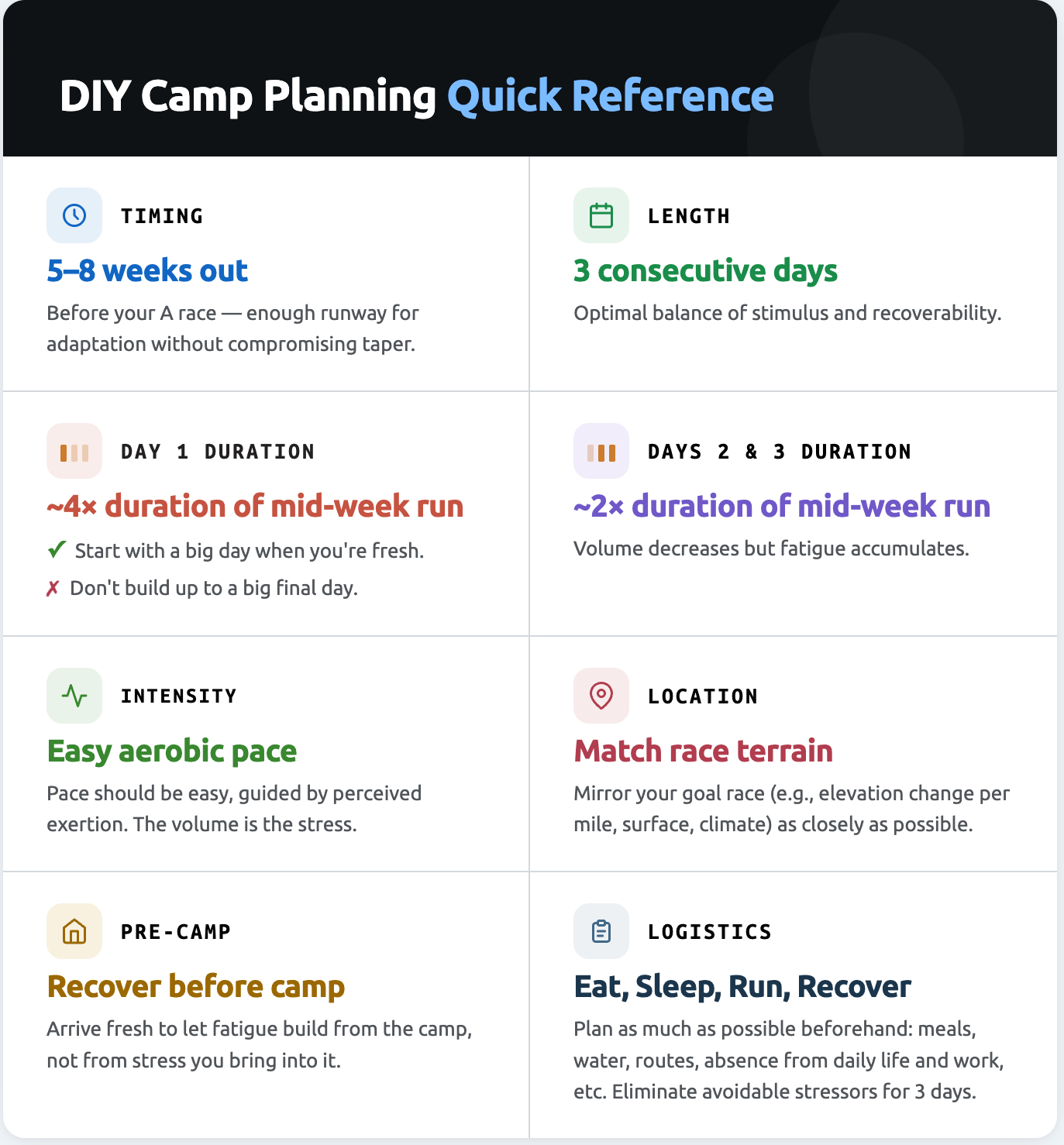
For most 100K to 100-mile athletes, the optimal window for a training camp is five to eight weeks before the A race. Here’s why:
- Too close to race day: You risk carrying too much fatigue to the start line. The musculoskeletal system takes longer to recover than the cardiovascular system, meaning you’ll feel aerobically energized while your legs are still struggling to catch up.
- The sweet spot: Five to eight weeks out is enough time to absorb the workload and carry the adaptations forward to race day.
- Too far out: Specificity fades and you risk peaking too early. You’ll be fit, but you’ll lose the rehearsal benefit that makes a camp valuable.
Pre-Camp Tip: What happens before the camp can make or break its impact on your preparation. Entering a training camp already fatigued reduces its effectiveness and raises injury risk. Successful camps are preceded by a short recovery phase, at least an easier week than normal. Arrive relatively fresh so you can absorb the concentrated training volume and the fatigue that comes with it.
How to Structure a DIY Ultrarunning Camp
Three day DIY ultrarunning camps typically provide the best balance between stimulus and recoverability. Here’s a practical way to scale the structure to your own fitness level.
- Start with your reference run.
Take your typical mid-week endurance run — the steady aerobic session you perform consistently during training. For most experienced ultrarunners, that’s somewhere between 75 and 120 minutes. - Build your daily camp runs off your reference run.
- Day 1: Roughly four times your reference duration. If your reference run is 90 minutes, Day 1 is approximately 6 hours.
- Day 2: Roughly two times your reference. Approximately 3 hours.
- Day 3: Same as Day 2. Approximately 3 hours.
- Schedule the longest day first
The longest day goes first because you’re relatively fresh, so you can manage the effort appropriately and establish a meaningful fatigue baseline. From there, fatigue drives the difficulty and you can keep the intensity low and reap benefits from shorter camp runs. - Plan for low intensity, aerobic pacing
Your camp runs should be relatively low intensity. Focus on easy aerobic pacing, specific to race-day effort, guided primarily by perceived exertion. The goal is steady, sustainable movement, not testing top-end fitness. If you’re working too hard on Day 1, you’ll pay for it on Days 2 and 3, which defeats the purpose of the block entirely.
DIY Camp Logistics: The Part Athletes Consistently Underestimate
A DIY ultrarunning camp is a temporary shift in priorities. For a few days, training and recovery move to the center and work obligations, family logistics, and external stressors need to be intentionally minimized. That requires planning and honest communication. Tell your employer. Talk to your family. Reduce your cognitive load before you start. Mental fatigue compounds physical fatigue and managing normal work stress while running six hours a day undermines both recovery and execution.
► Free Ultrarunning Training Assessment Quiz
Take our free 2-minute quiz to discover how effective your training is and get recommendations for how you can improve.
Camp Location: Match the environment to your goal race as closely as possible, meaning terrain, elevation, surface characteristics, and weather. On-course recon is the best. When exact replication isn’t feasible, prioritize the most defining characteristics of the race.
Coaching Example: In one of my own training DIY ultrarunning camps, I underestimated the logistical complexity. A long, race-specific run required multiple water drops, which added hours of driving on remote forest service roads before and after each session. Some road closures forced reroutes. What should have been a focused training day became mentally and emotionally taxing. The running stress was already high. Layering logistical stress on top of it compromised my recovery and limited how well I executed the following two days. The lesson: stress is cumulative. Your body does not distinguish between physical load and frustration. Simplify your world for the duration of the camp.
Camp Fueling: Plan your meals, go shopping beforehand, make sure the meals are things you really like (because you want to look forward to them). Add more snacks because you’ll likely need them. Camps can be a great time to refine your pre-, during-, and post-run meals and fueling strategies.
Camp Lodging: If you’re staying at home, you can sleep in your own bed. If you plan a destination camp, prioritize comfort and protect your sleep. That means a cool, dark, quiet space to get plenty of rest. Somewhere to take afternoon naps would be good, too.
Camp Partners: Some people prefer to do solo DIY ultrarunning camps. Others bring a training partner or handful of friends to run and hang out with. It’s personal preference but this a time to put yourself first: your pace, your routes, your schedule, your meals, etc. Just make sure the others are on board.
Enjoying This Article? Get More Free Running Training Tips
Get our coaches' best training advice, delivered straight to your inbox weekly.
What a Well-Executed Camp Teaches You
A camp builds confidence grounded in experience, not optimism. Completing a challenging 3-day camp gives you tangible evidence of your own capabilities. It can even help you project a realistic finish time. Fatigue becomes familiar instead of intimidating. Discomfort is reframed as expected rather than alarming. That familiarity carries forward into race day, where uncertainty is often more costly than fatigue itself.
Coach Insight: What I see year after year is that camp also teaches restraint. Success isn’t defined by how aggressively you execute Day 1. It’s defined by sustained execution across all runs and the times between them. That lesson translates directly to long ultramarathons, where discipline and patience often matter more than fitness alone.
The Bottom Line
A DIY ultrarunning camp doesn’t just make you fitter, although it does that, too. It makes you better informed, more confident, and more prepared to execute on race day. Athletes who arrive to the start line genuinely prepared are those who rehearsed race-day reality in training, and a well-designed camp is one of the most honest rehearsals available.
About the Author
Cliff Pittman
CTS Pro Ultrarunning Coach
Cliff Pittman is the Coaching Development Director for CTS, where he expertly leads the Ultrarunning and Cycling Coaching teams. A passionate ultrarunner and active competitor, Cliff specializes in simplifying complex training concepts into actionable strategies, ensuring athletes at all levels—from beginners to elite competitors—can achieve their goals in prestigious events like the Western States 100 and Leadville 100.
Comments 1
I appreciate that you guys put out these articles. They are useful. However, this one, along with other versions of the same, leave out one key thing. No one ever talks about the expected recovery from one of these training camps. Perhaps a new article is warranted.