

Durability in Ultrarunning: How to Measure and Improve Ultrarunning’s Most Important Variable

Updated On
April 15, 2026
CHOOSE YOUR FORMAT
►WATCH THE VIDEO
►LISTEN TO THE PODCAST
►READ THE ARTICLE
Why You Fall Apart After Hour 3
For decades, runners have focused on measuring, testing, and optimizing three performance variables:
- VO₂max: the ceiling of your aerobic engine
- Lactate threshold: the upper edge of sustainable intensity
- Running economy: the oxygen cost of moving forward
Durability in ultrarunning is a fourth variable that has emerged as crucial for performance, especially in longer events. After years of coaching athletes from first-time ultrarunners to world-class competitors, prioritizing durability has proven to be the most impactful of the four.
What Traditional Metrics Overlook
VO₂ max, threshold, and economy are typically measured in a lab, over short durations, and when the athlete is fresh and rested. Those tests are useful but create an incomplete picture of the athlete’s capabilities. Athletes may start ultramarathons fresh and rested, but what matter more is how much of a runner’s fresh-state fitness they can still access after six 12, or even 20+ hours of competition.
Coaching Example: When Identical Fitness Leads to Different Outcomes
I have been in coaching situations where two athletes started the same 100-mile ultramarathon with nearly identical physiological metrics. They had virtually the same VO₂ max in ml/kg/min, essentially the same threshold pace, and very similar running economy values from lab testing.
By Mile 60, the two athletes were in completely different states. One was still running with full control, on pace, efficient, and steady. The other runner was falling apart. His heart rate was climbing, his breathing was labored at a pace where it normally wouldn’t be, and his running form was deteriorating. Although both finished, the time gap between them continued growing all the way to the finish line.
On the start line and on paper, they were evenly matched. On course, one runner was clearly superior. The difference wasn’t visible in the traditional metrics, but it was the result I expected because I knew they were dramatically different in terms of durability.
What Is Durability?
Durability is your ability to preserve your physiological and mechanical performance as fatigue accumulates. It determines whether you maintain your output and keep your pace steady, or slow gradually (or sometimes dramatically) as the distance and duration increase.
The Two Types of Durability in Ultrarunning
Durability has two key components: aerobic and muscular. This is an important and often overlooked aspect of training to increase durability. If you only focus on one and neglect the other, you’re still going to fatigue earlier and more dramatically than you want to on race day.
- Aerobic Durability
This is your ability to maintain cardiovascular efficiency and metabolic function over time. You can evaluate your aerobic durability by observing whether your threshold pace stays steady as hours go by. If it slows sharply after a few hours, that’s a sign you have room for improvement. Does heart rate rise and fall in proportion to effort? If heart rate drifts higher later in races relative to your effort level, you may need to work on aerobic durability.
- Muscular Durability
This is your ability to produce force, maintain form and technique, and move efficiently after hours of running. Accumulated muscle damage is one of the leading reasons ultramarathon runners slow down as races get longer, especially races that feature lots of elevation changes. If muscle soreness is what’s slowing you down the most later in races, you may need to work on muscular durability.
Most athletes are more limited in one component of durability than the other, but overall durability is always a combination of both. Nevertheless, identifying which area fails first can be incredibly valuable for training.
Aerobic Decoupling: The Signal for Inadequate Durability
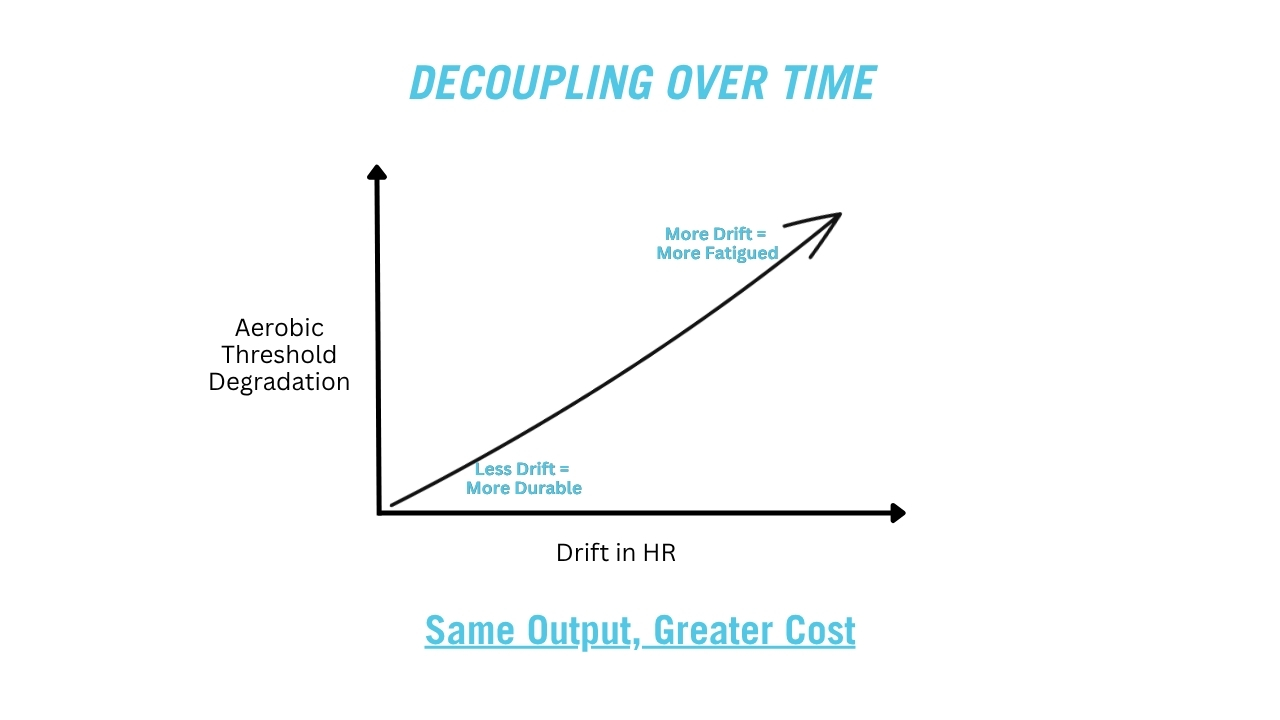
Under normal conditions, pace (or intensity) and heart rate maintain a stable relationship. When your pace increases, heart rate and breathing rate increase. But when pace is steady, heart rate and respiration rate normally remain steady as well. Your physiology and your pace are coupled.
When fatigue builds, physiology and pace can decouple, meaning heart rate rises and you breathe more rapidly even though your pace stays the same or even slows. This upward drift of heart rate and/or respiration indicate an increase in the internal cost of producing the same output.
A 2025 study in the European Journal of Applied Physiology examined how athletes responded after ~2.5 hours of sustained effort (PMID: 41128270). Athletes whose heart rate and breathing drifted up the most showed the greatest degradation in aerobic threshold. The athletes who drifted the least maintained performance more effectively, meaning they were more durable.
► Free Ultrarunning Training Assessment Quiz
Take our free 2-minute quiz to discover how effective your training is and get recommendations for how you can improve.
How to Measure Aerobic Decoupling
To measure durability in a physiology lab, like the one at CTS in Colorado Springs, we can do aerobic threshold testing before and after an extended effort to see how performance holds up or degrades. Although that’s the gold standard, you can gain similar insights from your TrainingPeaks account.
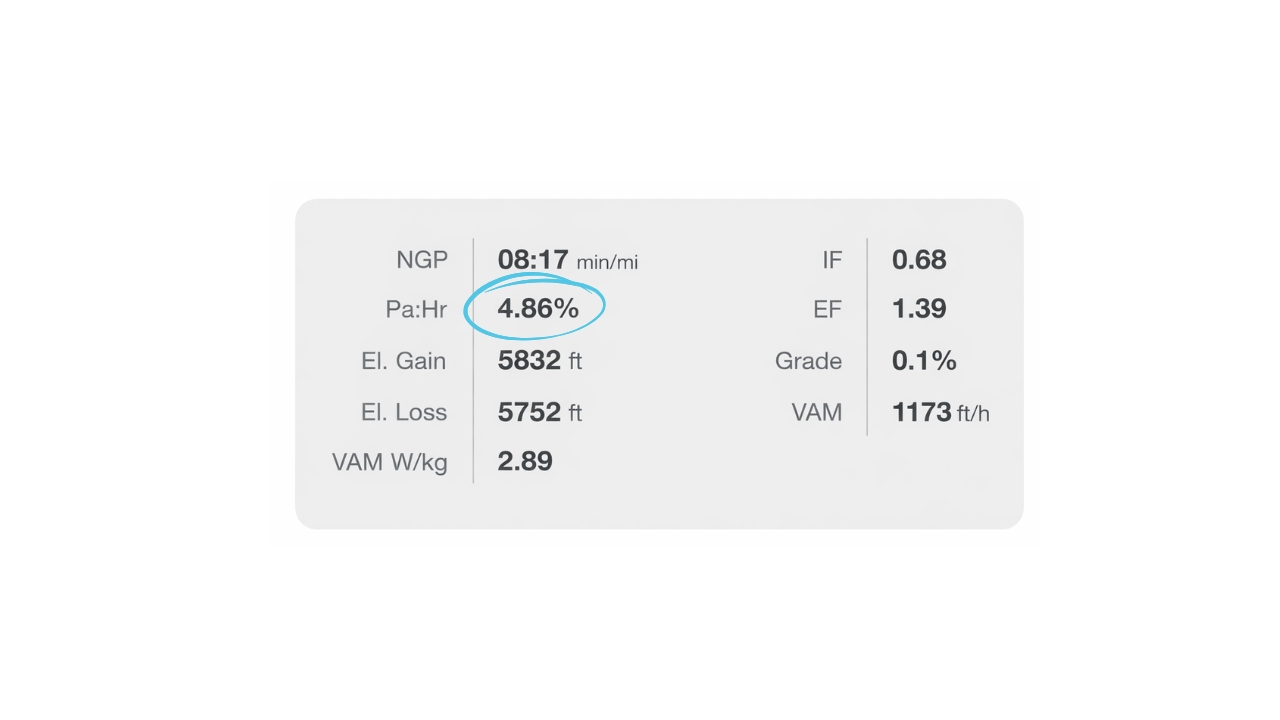
Within the data from any run uploaded to TrainingPeaks, you’ll find a metric called “pace:heart rate” or (Pa:Hr). The value displayed represents the ratio of pace to heart rate in the first half of a run to the second half. Aerobic decoupling is more relevant for longer efforts (think hours vs minutes) but you can also zoom in to a specific portion of your run to see the Pa:Hr for that segment.
How to Interpret Aerobic Decoupling Values in TrainingPeaks
Aerobic decoupling (Pa:Hr) is presented as a percentage. The more your heart rate climbs relative to your pace, the higher the percentage and the greater the decoupling. Generally, less decoupling means you have the aerobic conditioning to sustain that pace.
- <5% decoupling → good aerobic durability
- >5% consistently → you need to more aerobic conditioning to sustain that pace
Assessing Aerobic Decoupling Manually
If you don’t have TrainingPeaks, you can assess durability by comparing your average heart rate and pace from the first half of a long run to the second half. If your pace held or slowed and your heart rate drifted higher, you likely experienced aerobic decoupling.
Important caveat: Not all decoupling is fitness related. Environmental factors matter, and even terrain can impact your data. Context is important. If temperatures rise during your run and/or you experience some dehydration, heart rate may rise relative to pace. If the terrain in the first half of the run is significantly more challenging, that effort could also show up in the data.
To assess durability in real time during long runs or race, notice these real-time signals:
Enjoying This Article? Get More Free Running Training Tips
Get our coaches' best training advice, delivered straight to your inbox weekly.
- Is your breathing changing?
- Is your effort creeping up?
- Is your form breaking down?
How to Build Durability With Training
You build aerobic durability by running consistently and accumulating volume, at the right intensity, over time. There’s no shortcut, but the long-term rewards are worth the effort! One of the biggest mistakes athletes make is going too big too soon. You can’t jump from 90-minute sessions to 5-hour runs. Here’s a better way:
- Increase running volume with frequency first: Start by increasing your total weekly running volume by increasing the number of days per week you run.
- Extend your long run: Once you have increased weekly volume, redistribute the hours to extend your long run without increasing total weekly volume. This may necessitate reducing the number of running days per week, which creates more time for recovery.
- Increase training density: Once the foundation is built, concentrate training stress with back-to-back running days. Be sure to incorporate adequate recovery with this strategy.
Intensity distribution is important when working on improving durability. Easy days must predominate and be truly easy. Hard days (one per week, maybe two) must be intentional and focused, and the intensity must be hard enough to create a meaningful stimulus.
Durability training should also be specific to the demands of your goal event, in terms of terrain, expected event duration, and environmental conditions (e.g., temperature, humidity, altitude, day/night).
Bottom Line: The best athletes train to be better when they’re tired
Most athletes train for what they can do fresh because those are often the hero metrics. The best athletes train for what they can do when they’re tired because that’s where races are won and lost. And even if you’re not at the front of the pack, durability is the metric that keeps you ahead of the cutoff times. It’s what prevents you from slowing down so much you fail to finish. So, if you want to achieve your ultramarathon goals: Start treating durability as a primary training goal—not an afterthought.
References:
Hunter, B., & Muniz-Pumares, D. (2025). Durability of Parameters Associated With Endurance Running in Marathoners. European journal of sport science, 25(11), e70073. https://doi.org/10.1002/ejsc.70073
About the Author
Cliff Pittman
CTS Pro Ultrarunning Coach
Cliff Pittman is the Coaching Development Director for CTS, where he expertly leads the Ultrarunning and Cycling Coaching teams. A passionate ultrarunner and active competitor, Cliff specializes in simplifying complex training concepts into actionable strategies, ensuring athletes at all levels—from beginners to elite competitors—can achieve their goals in prestigious events like the Western States 100 and Leadville 100.