

How to Test Fatigue Resistance and Improve Durability in Cycling

Updated On
May 4, 2026
CHOOSE YOUR FORMAT
►WATCH THE VIDEO
►LISTEN TO THE PODCAST
►READ THE ARTICLE
How to Test Fatigue Resistance and Improve Durability in Cycling
Here’s what happens to a lot of cyclists during long rides – especially Time-Crunched Cyclists who typically only ride 60-90 minutes on weekdays: You feel strong at the start. Your power numbers are sustainable, legs feel fine, and your perceived effort matches your pace. A few hours later, despite a steady effort, you glance at your computer and the power numbers are substantially lower and perceived exertion has increased relative to pace.
That’s not a fitness problem. You have a durability problem.
The good news is that durability is both measurable and highly trainable. In my 20-plus years of coaching experience, I think durability is the most impactful and underrated performance metric in cycling, especially at the amateur and Masters level. Once I show you how to measure and improve it, you can dramatically increase your performance when it matters most: on the final climb, in the final hour, or on the run into the final sprint.
What Is Durability?
Durability is your ability to maintain high performance despite accumulating fatigue.
In simple terms, it’s how well you hold power late in a ride. On solo rides and non-competitive events, durability affects your pace and how you feel in the final third of a long day. In races and hard group rides, durability determines whether you’re racing in the final hour, just surviving in the pack, or off the back. Everyone has power when they’re fresh. What matters is who still has power when everyone has accumulated fatigue.
Durability vs. Fatigue Resistance
You’ll often hear the terms “durability” and “fatigue resistance” used interchangeably, but there’s a useful distinction:
- Durability: Big-picture ability to perform under fatigue
- Fatigue Resistance: Specific, measurable decline in performance
In practice, we test fatigue resistance to quantify durability.
How to Quantify Your Durability
The concept is simple: Compare what you can do when you’re fresh vs. what you can do when you’re fatigued. In more detail, this means: Compare your peak fresh power over a given duration to your peak power for the same duration after significant fatigue, then calculate the percentage decline. Here’s the step-by-step protocol I use:
Step 1: Establish Fresh Peak Power Values
You can use data recorded from rides and races over the past 90 days to establish your current peak fresh power values. If you’d rather, you can also go out and test them directly by warming up, doing some openers, and hitting a 1-minute, 5-minute, or 20-minute max effort in a fresh state with good legs. I also test peak 20-second power for some athletes, too.
Step 2: Ride To Add Fatigue, Then Test
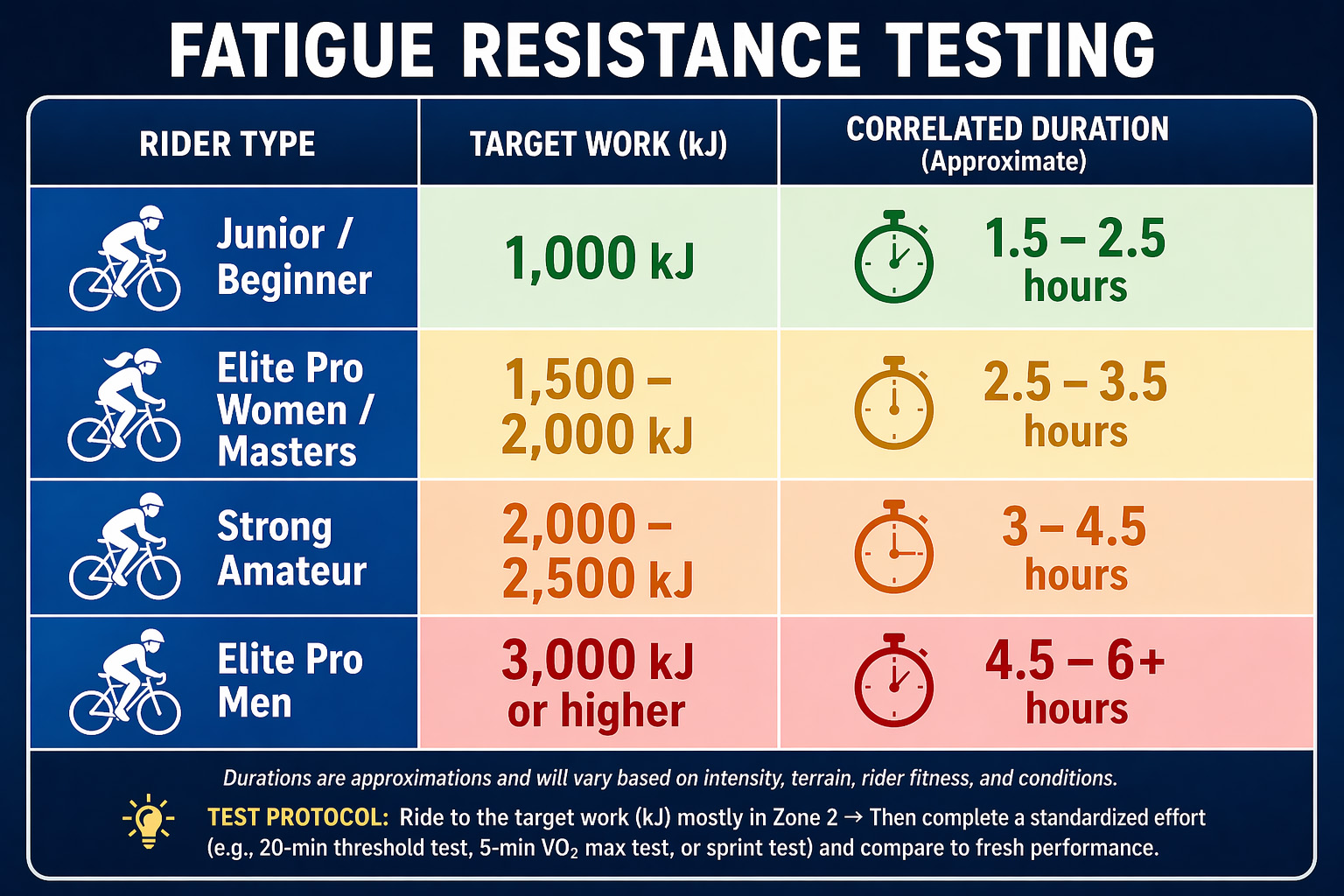
To test fatigue resistance, ride long enough in Zone 2 and 3 to accumulate the kilojoules recommended in the chart below, which could take a couple hours. Then perform a fatigued maximal effort to compare to your rested performance (e.g., 20-minute max power effort).
The accumulated kJ targets for fatigue resistance testing vary by rider type, as illustrated below:
Step 3 : Calculate Decline
Once you have your fresh power and fatigued power, calculate the percentage decline.
Example: Fresh 20-min power: 370W. Fatigued 20-min power: 303W. Decline = -19%
► Free Cycling Training Assessment Quiz
Take our free 2-minute quiz to discover how effective your training is and get recommendations for how you can improve.
Durability Benchmarks
Once you calculate how much your performance declines for a given power duration, here’s the framework I use to evaluate how athletes stack up and whether they need to spend more time developing durability.
- 0–1% → Elite
- 1–5% → Very Good
- 5–10% → Good
- 10–20% → Average
- 20%+ → Needs work
If your durability ranks as Very Good or Good, there’s no urgent need to prioritize it further. If your ranking is “average” or worse, and you’re racing events over two hours with hard efforts late in the ride, this should be a training focus.
Coaching Example: My Durability Compared to a Female UCI Pro Continental Racer
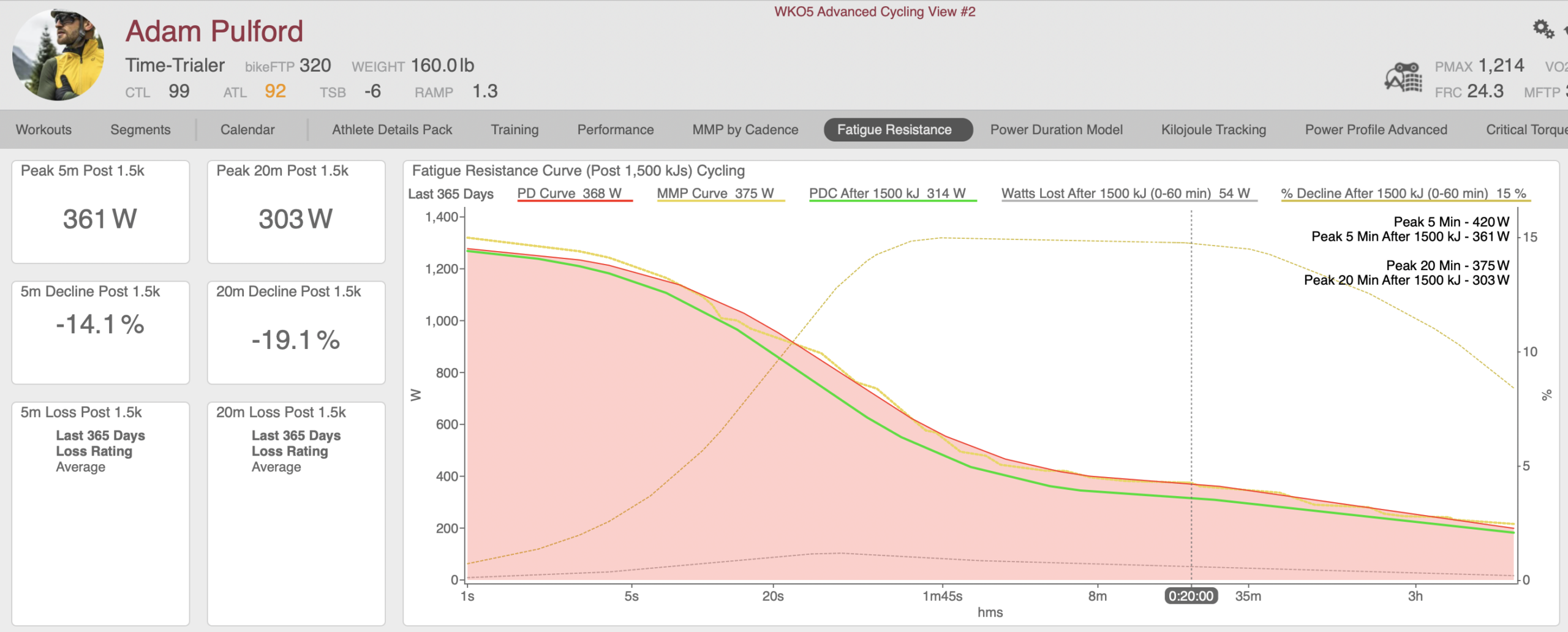
To illustrate the durability benchmarks above, I’ll present myself as a case study. My rested 20-minute peak power this year is 370 watts. My peak 20-minute power after 1,500 kJ of work? Only 303 watts (pictured below). That’s a decline of negative 19.1%, putting me squarely in the “Average” category. That’s not totally surprising, given that I’ve been training with shorter and higher intensity rides recently (enough to win a Masters 35+ criterium recently, though!).
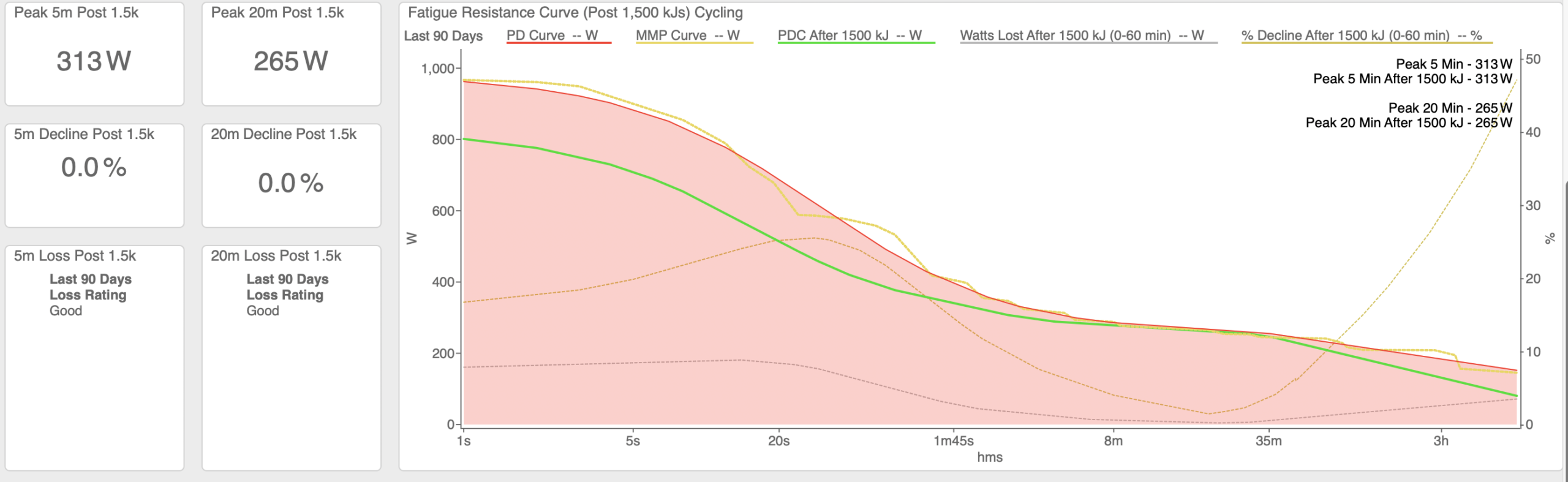
On the other end of the spectrum: one of the elite women riders I work with on a UCI Pro Continental team in Europe recently tested at 0% decline after 1,500 kJ of work (pictured below). Zero. She’s durable as hell — and significantly better than her coach, it turns out.
Durability Paradox: High-Intensity Training Can LOWER Durability
This may come as a surprise, but durability is not directly related to a high VO2 max or FTP. It’s not that a high VO2 max or a high FTP won’t help you become more durable (they can), it’s that the high-intensity training that targets VO2 max and FTP development can reduce durability. When you focus too much on developing your highest power outputs (threshold intervals, VO2max work, high-intensity training), you’ll likely increase your peak fresh power. That’s valuable, but it doesn’t automatically improve your durability. The reason is that high-intensity training tends to develop anaerobic capacity more than aerobic capacity, and durability is fundamentally an aerobic quality.
Key Principles for Training Durability
If you’re a beginner cyclist, almost any consistent training will improve durability. In the first year or even two, just consistently riding 3 or more times per week will gradually increase your Chronic Training Load (CTL), FTP, and VO2 max. Rather than focus specifically on durability at this stage, focus on developing good training habits, getting fit, having fun, and building a foundation.
Athletes who have a base of training need to start targeting durability (along with other event-specific demands). Based on my coaching experience and studies by researchers like Dr. Gabrielle Gallo and Dr. Andy Jones, here are the most effective strategies for improving durability:
- Cumulative Endurance Rides
Time in the saddle is a key component for creating durability. This doesn’t mean every ride needs to be long, but it does mean you need consistent cumulative volume from shorter rides and regular doses of concentrated volume from individual long rides or back-to-back days of medium-duration rides.
- Proper Fueling and Hydration
Carbohydrate availability and good hydration status are necessary to sustain power output late in long rides and races. Running low on fuel or fluids will absolutely lead to bigger declines in power output as the hours pile up. - Hard efforts late in training rides
Specific workouts are included below, but the principle to remember is that you don’t develop durability just by surviving long rides or riding steady from start to finish. To move the needle on durability, you need to challenge yourself with hard efforts on tired legs.
- Strength training builds durability
Strength training doesn’t replace cycling, but it’s a concurrent strategy that makes you a more durable cyclist. Strength training twice a week year-round enhances neuromuscular patterns, muscle fiber recruitment, and the development of fatigue-resistant muscle fibers. You’ll feel the result on the bike when intermittent hard efforts take less out of you and you can handle more repeated efforts.
Cycling Workouts That Build Durability
Principles are one thing, but here are specific cycling workouts I use to build durability in the athletes I coach:
- Late-Ride Intervals
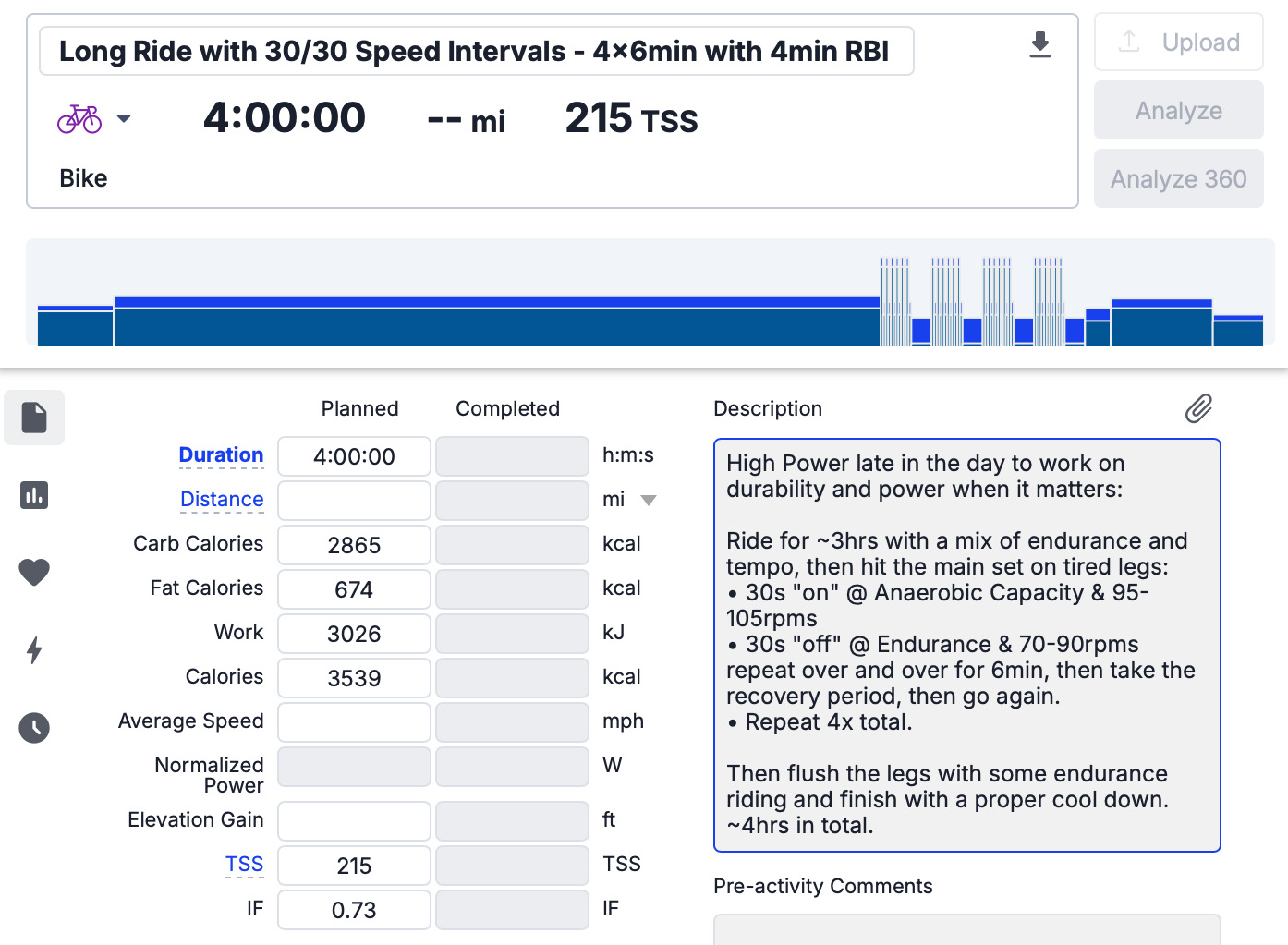
Ride a few hours in Zone 2-3 before your interval workout (2 hours for intermediate riders, 3 hours for more advanced riders). Short high-intensity efforts (see structured workout below, 4 sets of 6-minute 30/30 second SpeedIntervals, separated by 4 minutes of easy spinning) at or after the end of a group ride are excellent durability builders. One or two long hill climbs of 20 to 30 minutes at Zone 4 or slightly above at the end of a long ride are even better.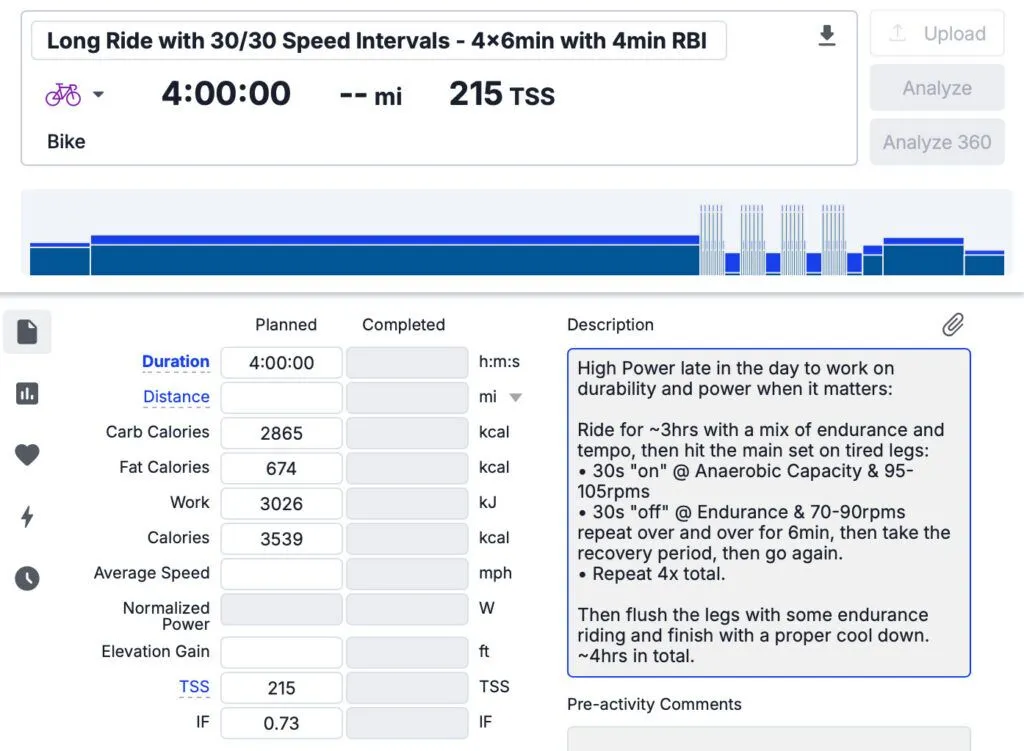
- Sprints on Tired Legs
A few or several hours into a long ride, throw in two or three 20-second sprints separated by 5 minutes of easy spinning. The first time you do this, it will feel horrible and strange. That’s the point. As you practice this, those late-race sprints will feel more powerful and controlled. When that moment comes in a race or group ride, you’ll be ready for it.
- Split Main Sets
This is a more advanced workout because you need some durability built up already to accomplish it. Complete one interval set early in the ride when you’re fresh. Ride endurance pace for a few hours or several hours, then repeat the same interval set on fatigued legs. Try to match your fresh power. These work best with Zone 4 efforts up to about 20 minutes in duration, or short, high-power intervals because of the larger anaerobic contribution. I rarely use aerobic Tempo intervals late in a ride to target durability gains.
- Early Interval Endurance Rides
Do your main interval set early in the ride, then ride steady aerobic endurance for hours afterward. This strategy builds both strong fresh power and lasting durability simultaneously. The early intervals stimulate fresh power. The fatigue from those efforts increases the internal strain during the subsequent hours of riding, effectively turning a long easy ride into a durability stimulus.
- Back-Loaded Climbing Rides
Design routes where the significant climbing comes at the end. For intermediate riders, aim for 1,000 to 1,500 kJ of work before hitting the hard climbs. For more advanced riders, aim for 2,000 to 2,500 kJ. This is a good workout for anyone who has access to difficult climbs, but it’s especially important for athletes preparing for events that feature significant climbs in the final hour.
Durability Solution for Time-Crunched Cyclists
Sometimes the hardest part about training durability is finding the time to do it. To really move the needle on durability, an individual ride needs to be at least 2.5 hours, preferably longer.
For time-crunched athletes, here’s my practical advice. Starting six to eight weeks out from your goal event, whenever you do a long ride, tack on a hard 5 to 20-minute effort near the end. Use the terrain you have available, whether it’s a hill or flat ground, just do the hard effort while you’re fatigued. If you have the durability to reach the finale but have a weak sprint at the end of races, focus on sprints in the final hour rather than 5 to 20-minute efforts.
The Bottom Line
Durability is highly trainable. The first step is to test your fatigue resistance at multiple power durations and see where you have the most room to improve. Then, commit to the sometimes inconvenient, uncomfortable, and easy to skip work that builds durability. It’s not easy, but the adaptations are real, the mental toughness gains are real, and the performance on race day will reflect your work.
Do hard things. Improve your physiology. Win the final climb.
► FREE Mini-Course: Learn How to Maximize Your Limited Training Time
Learn step-by-step how to overcome limited training time and get faster. Walk away with a personalized plan to increase your performance.
"*" indicates required fields
About the Author
Adam Pulford
CTS Head Cycling Coach
Adam Pulford is a dedicated coach at CTS with a passion for elevating athletic performance through tailored, measurable strategies and a deep understanding of the “why” behind each athlete's goals. With nearly two decades of experience, a degree in Exercise Physiology, and a successful track record managing professional cycling teams, Adam also shares his expertise as the host of the Time-Crunched Cyclist podcast, providing actionable insights for endurance athletes.
Comments 2
Pingback: Carefully Curated Triathlon News for May 14, 2026 - TriathlonWire
Curious about your thoughts on two-a-days for durability training. Get in 45-60 minutes of riding including intervals in the morning, then do it again in the afternoon. Before/after work, or something like that. Without being able to fully recover between the sessions, there should still be some accumulated fatigue by the second session that seems like it could be useful for durability training.