

The Three Pillars of High-Quality Training for Cycling
Updated On
May 11, 2026
CHOOSE YOUR FORMAT
►WATCH THE VIDEO
►LISTEN TO THE PODCAST
►READ THE ARTICLE
The Three Pillars of High-Quality Training for Cycling
Most cyclist have no idea whether their training is high quality or not. Instead, they know some basic metrics: hours ridden, miles logged, average speed achieved, and maybe some average or normalized power values. When it comes to knowing whether all those miles, hours, and intervals are moving the needs, most athletes are just guessing. After 20 years of coaching everyone from beginners to elite champions, I’m going to walk you through the framework I use to evaluate high-quality training.
Why Your Training Might Actually Suck
I’m not criticizing your training plan, your coach, or even your commitment. The thing that hurts athletes the most is the “intention-execution gap”, especially now that so much training information is available. You know you’re supposed to separate hard days and easy days. You know you should be wise about time-at-intensity and intensity distributions. You’ve read the articles, watched the videos, talked to your buddies.
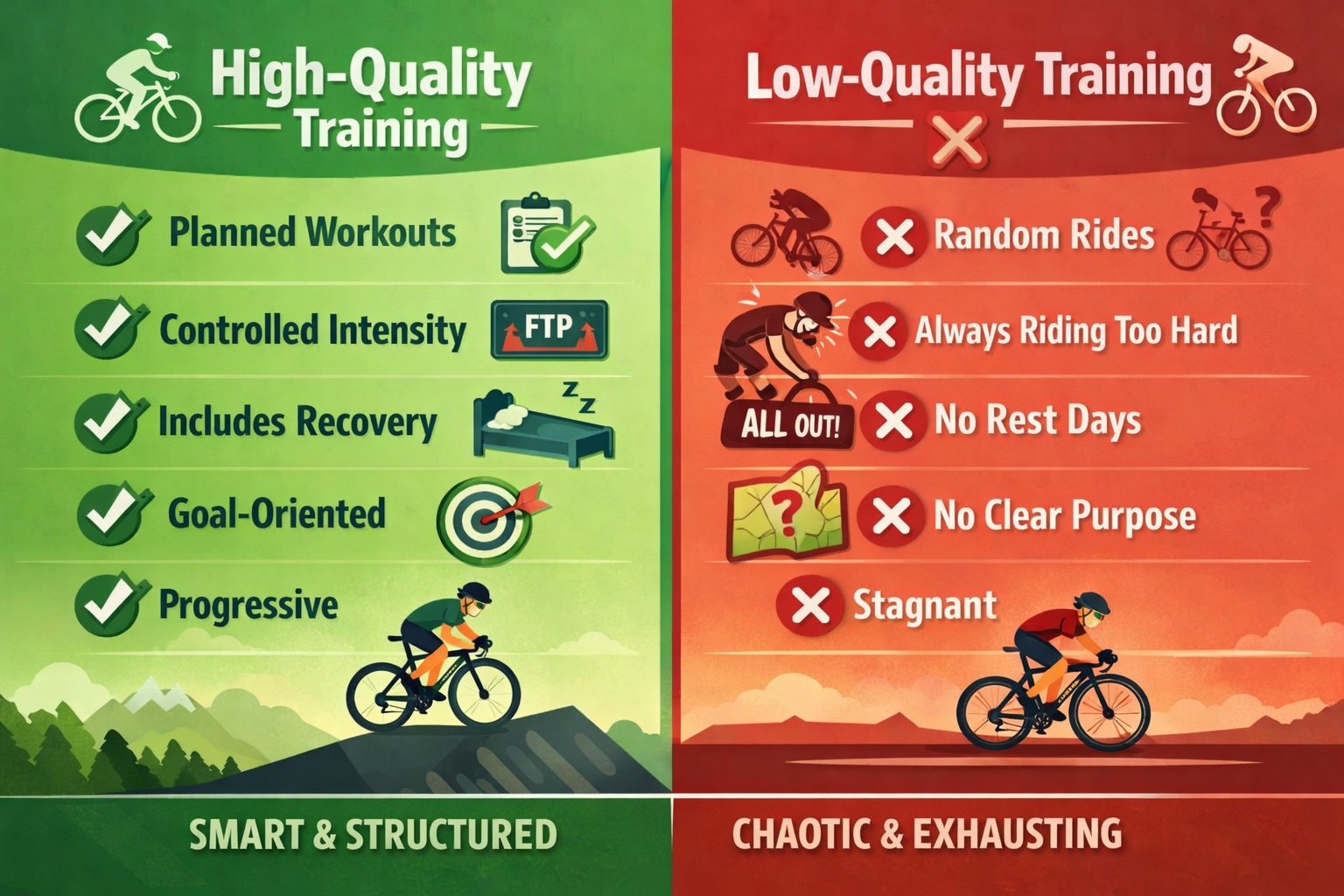
Too many cyclists still equate quality with intensity, specifically high intensity. So easy rides drift into medium effort level, hard rides escalate into epic suffer fests, and true rest and recovery are nonexistent. Quality training is not just about working hard. It’s not about smashing yourself every ride or collecting fatigue like it’s a badge of honor. High-quality training is about doing the right work, at the right time, for the right reason—and executing it properly.
The Three Pillars of High-Quality Training
The missing piece in the mentality of most cyclists is the focus on “adaptation”. The goal of training is not to create training stress and accumulate fatigue. Those are tactics, not the strategy. The goal is maximizing adaptation. And the secret is that you don’t always need to maximize suffering, training stress, or fatigue to maximize adaptation.
The reason I’ve identified these three pillars of high-quality training is that they maximize adaptation and help avoid the common pitfalls of pushing too hard, too often, and too mindlessly.
High-Quality Training Pillar 1: Process
Most people follow a plan, but it’s too superficial and disconnected. I recommend thinking about what you’re doing as a comprehensive process. You need to connect the why behind the workout, the specifics of how to execute it, the overarching purpose of that workout, it’s place in the training block, the fueling that will make it successful, and the recovery activities that will help you absorb that training stress.
My best athletes don’t just check the boxes and follow the directions. They understand what we’re after with each workout, how the workouts fit together, and how their activities on and off the bike work cohesively to shape their adaptations to training.Sounds overwhelming, but it’s pretty simple.
Here’s what a well-defined process looks like in practice:
Today’s ride: Zone 2 endurance. Stay on the low end of the range. Just get the legs moving after your rest day yesterday and set yourself up for tomorrow’s interval day. Fuel moderately (Hourly CHO equivalent to 25-35% of hourly kJ workload) during the ride, eat normally post-ride.
► Free Cycling Training Assessment Quiz
Take our free 2-minute quiz to discover how effective your training is and get recommendations for how you can improve.
Tomorrow’s workout: 7 × 3-minute VO2 max intervals at 106–121% of FTP, 90–100 RPM. Bring your A game, fuel well the before ride to prioritize high carbohydrate availability. This session is designed to build high-end power and raise your VO2 max ceiling. Hydrate and replenish CHO and protein post-ride since you are unlikely to eat much during high-intensity ride.
High-Quality Training Pillar 2: Result
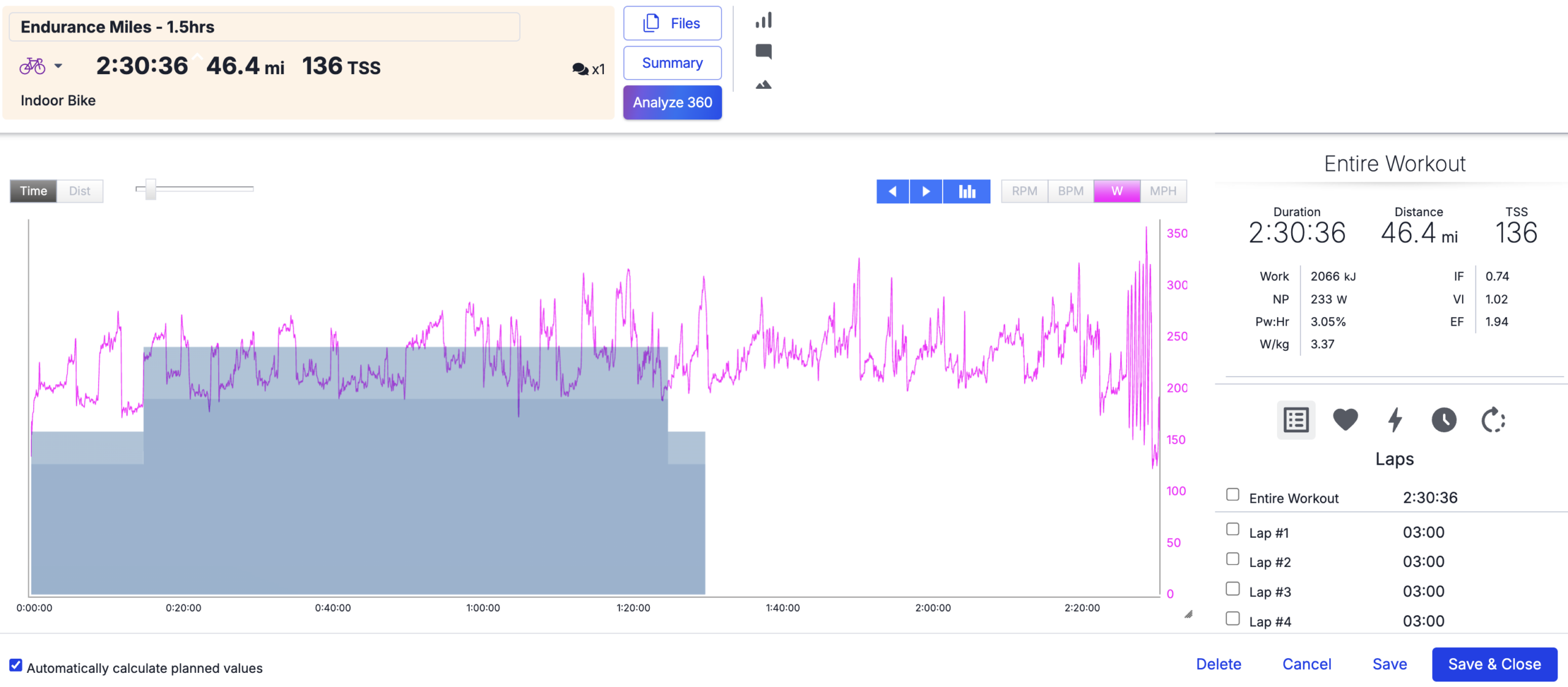
This is where most cyclists mess up. You start with a process and the execution falls apart. Let’s go back to the Zone 2 ride. The plan was to focus on aerobic endurance, stay controlled, keep it easy. But you felt good because it was after a rest day. You pushed into Tempo (Zone 3), then into Threshold (Zone 4) on the rolling hills. Threw in a few sprints at the end because you were rolling with a tailwind, too.
Rolling into the driveway, you feel like a million bucks, but you just screwed yourself for tomorrow. You burned matches (tapped into anaerobic energy contributions) you wanted for tomorrow’s session. That VO2 max session has more impact on your training block than today’s Zone 2 session, and by going too hard you diminished the impact of both rides. This is a perfect illustration of the intention-execution gap.
The image below is a power file from a low-quality Zone 2 training ride like I described. Notice that the power spikes a little above Zone 2 in the first hour, then more significantly above Zone 2 in the second hour.
Two tools that help close the gap between intention and execution are:
- TrainingPeaks compliance scoring: When a workout turns green, you stayed within 20% of the prescribed volume. Orange or red means you went too far over or under. This gives you an instant read on execution quality.
- Prescribed vs. actual power comparison: Overlay the prescribed power range against what you actually produced. The gaps, especially late in an interval or late in a session, tell you exactly where discipline broke down.
High-Quality Training Pillar 3: Fun
This isn’t just performative positivity or magical thinking. Through 20 years of coaching, I’ve learned that athletes who have fun make more progress. That doesn’t mean that every second is enjoyable, or that champions think VO2 max intervals are fun. It means that when the overall process of training isn’t enjoyable, athletes burn out, check out during rides, form bad habits, and eventually quit.
Consistency is the engine of adaptation and fun keeps the engine running. The key is finding the fun without distracting from the purpose of the ride. Here are some of the ways athletes I coach keep it fun:
- Group rides: Social accountability and natural competitive stimulus, especially useful on unstructured days or as a component of long endurance days.
- Explore new routes: Spend time exploring Strava or RidewithGPS for new routes for long days, instead of the same loop you’ve ridden a hundred times.
- Target Strava segments: Not every day, but on some intensity days with intervals that roughly match segment durations. This can add focus and motivation without changing the physiological intent.
- Change the venue for intervals: Instead of the same climb for VO2 max intervals every week, try flat terrain. Same power targets, different stimulus, maybe higher leg speed and riding position on the bike.
- The coffee shop or cafe ride: Meet a friend, keep effort genuinely easy, hit that place you’ve both been talking about. It counts. It contributes.
Why High-Quality Matters Even More for Time-Crunched Cyclists
If you’re working with six to eight hours of training per week (which describes most competitive amateur cyclists) this framework matters even more. You simply cannot afford to waste a ride because of poor execution. Every session needs a clear purpose, clean execution, and enough enjoyment to keep you showing up. Athletes with 15 hours a week can absorb a poorly executed session occassionally and still adapt. Athletes with 7 hours cannot. At that volume, each ride carries more weight, and the cost of intention-execution gaps is higher.
Bottom Line
If you remember nothing else from this article, remember this:
- Process gives your training direction.
- Result confirms the work was effective, whether your execution matched your intention.
- Fun makes training sustainable over months and years.
That combination, not just intensity and not just following directions and checking boxes, is what creates high-quality training. Low-quality training makes you tired. High-quality training you faster.
► FREE Mini-Course: Learn How to Maximize Your Limited Training Time
Learn step-by-step how to overcome limited training time and get faster. Walk away with a personalized plan to increase your performance.
"*" indicates required fields
About the Author
Adam Pulford
CTS Head Cycling Coach
Adam Pulford is a dedicated coach at CTS with a passion for elevating athletic performance through tailored, measurable strategies and a deep understanding of the “why” behind each athlete's goals. With nearly two decades of experience, a degree in Exercise Physiology, and a successful track record managing professional cycling teams, Adam also shares his expertise as the host of the Time-Crunched Cyclist podcast, providing actionable insights for endurance athletes.