
Do Cyclists Really Need Zone 2 Subzones 2a, 2b, 2c?

Updated On
April 20, 2026
CHOOSE YOUR FORMAT
►WATCH THE VIDEO
►LISTEN TO THE PODCAST
►READ THE ARTICLE
Do Cyclists Really Need Zone 2 Subzones 2a, 2b, 2c?
So, your buddy tells you they’re heading out for a: “Zone 2a ride with some Zone 2b efforts, a few 2c micro-surges, and finishing with SupraSoul Crushers…” If your first response is, “What the hell is Zone 2b?” you’ve come to the right place. Zone 2 is (or at least was) one of the simplest and more effective ideas in endurance training: Go easy and aerobic at a conversational pace. The problem some see with Zone 2 is that it’s very broad, meaning it can feel significantly different at the low end of the zone compared to the top end. To some, that feels imprecise, so they want to fill the space with subzones and new labels. Let’s look at the science and the practical applications to see if Zone 2 subzones make sense.
The Origins and Basics of Zone 2
At its core, Zone 2 is simple. It’s the second training zone in the seven-zone power-based system developed by Andy Coggan and Hunter Allen. Prior to their system, coaches and physiologists used their own proprietary zone systems, ranging from three to ten and even 14 zones! Coggan and Allen’s goal was to create a common language for training, more nuanced than “easy, medium, hard” and more easily understood than a 14-zone mess. More than 20 years later, most coaches are now aligned with the Coggan/Allen 7-zone system.
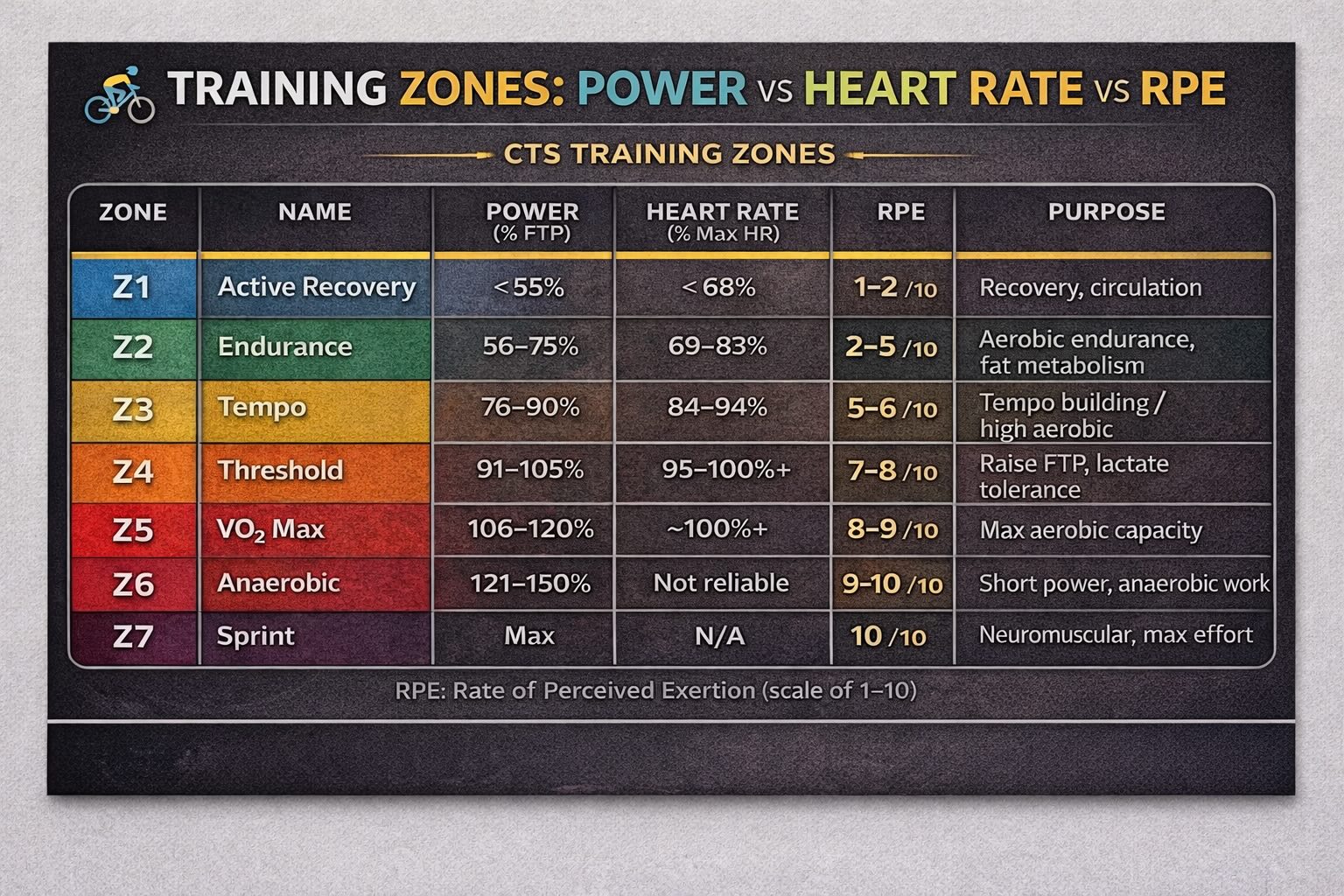
Zone 2 is your endurance zone, spanning roughly 55-75% of Functional Threshold Power (FTP). Practically, it’s a low to moderate intensity zone that corresponds to a Rating of Perceived Exertion (RPE) of 2-5 on a 10-point scale, and a pace at which you could comfortably sustain a conversation with complete sentences.
To understand the physiological basis for Zone 2 in the 7-zone system, you must start with the original lab-based 3-zone system. In this system, illustrated below, Zone 1 is anything up to the first lactate threshold (LT1), the point at which lactate starts to accumulate above baseline. Zone 2 is everything between LT1 and the second lactate threshold (LT2), which is the intensity at which lactate accumulation ramps up rapidly. Zone 3 is everything above LT2.
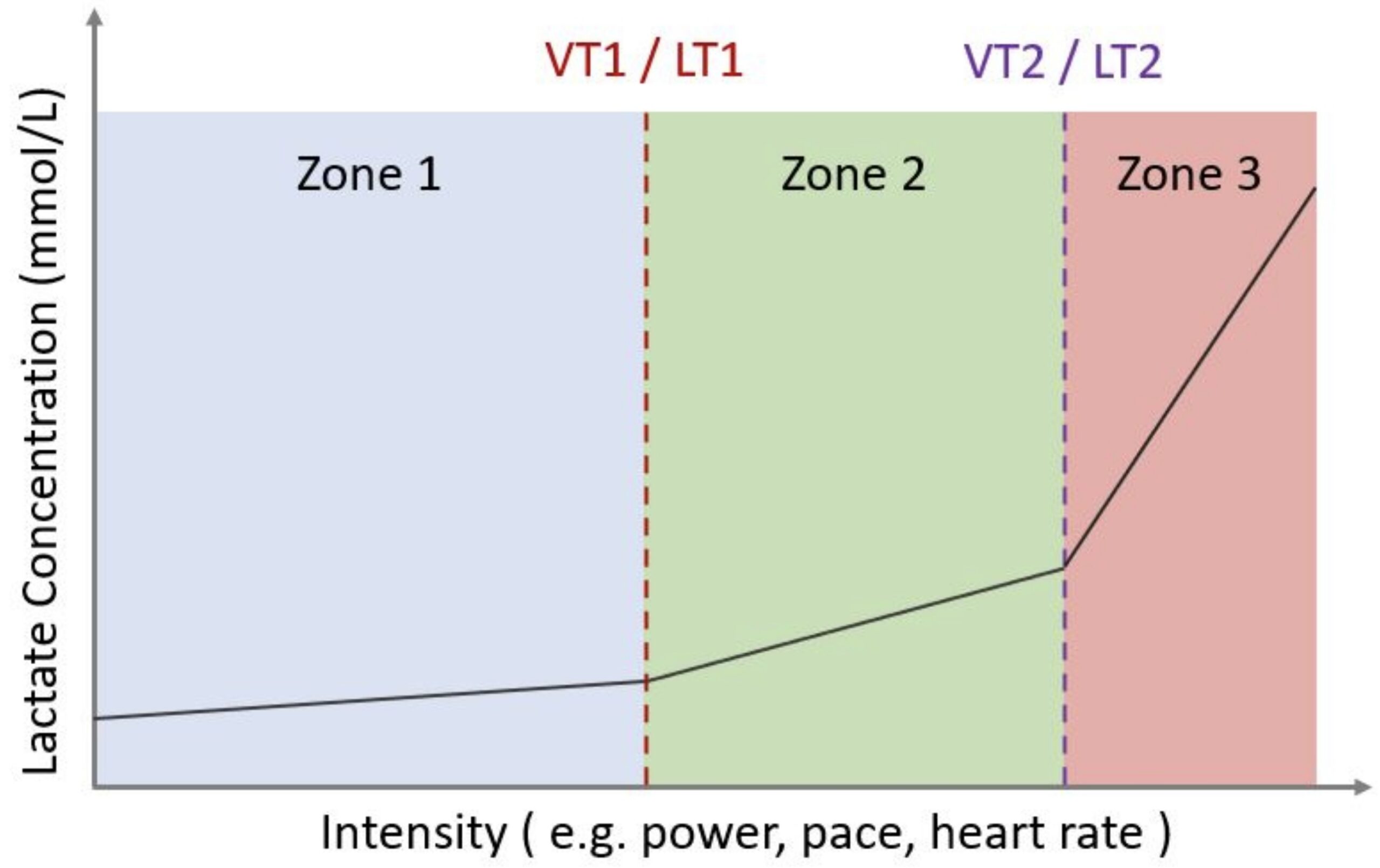
In the 7-zone system, what Coggan and Allen called Zone 2 overlaps with the upper end of Zone 1 in the 3-zone system. Essentially, they split the classic Zone 1 into two parts, recognizing that meaningful changes in lactate response, heart rate behavior, and ventilation occur as athletes approach LT1.
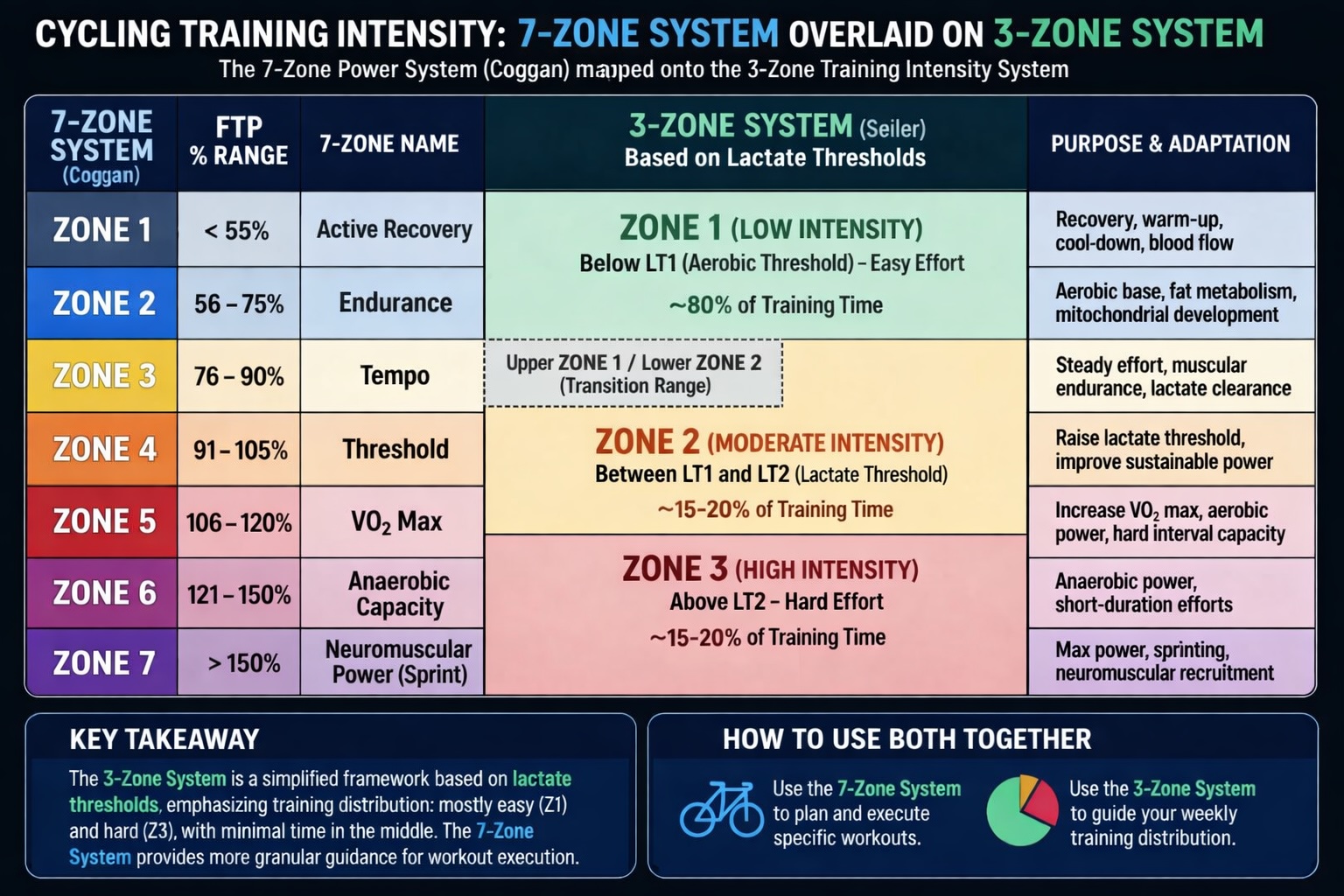
For the history buffs: CTS used a similar distinction early on. We called the lower end of the classic Zone 1 “FoundationMiles” and the upper end “EnduranceMiles.” We dropped that distinction years ago and aligned with the Coggan zones. The chart below summarizes the power, heart rate, and RPE zones CTS uses with cycling athletes.
Do We Need Zone 2 Subzones (Zone 2a and 2b)?
Zone 2 is purposely broad because you’re using the same basic physiology to power intensity anywhere between about 55% and 75% of FTP. The argument against Zone 2 subzones is that, no matter where you are in the zone, you’re doing the work aerobically, mostly with energy from fat and a little muscle glycogen, and you have the capacity to process and clear any lactate produced from the glycolytic breakdown of carbohydrate.
Practically, though, athletes struggle with such a broad power zone. For an athlete with an FTP of 250 Watts, Zone 2 is 138-188 Watts. You definitely notice a difference in heart rate, breathing rate, and RPE at the bottom and top of a zone that spans 50 Watts. Even with much tighter zones (e.g., Zone 4 is 91-105% of FTP), athletes commonly ask, “Should I ride at the bottom of zone vs. the top of the zone?”
► Free Cycling Training Assessment Quiz
Take our free 2-minute quiz to discover how effective your training is and get recommendations for how you can improve.
The idea of Zone 2 subzones is to make the broad (56-75% of FTP) power range more precise or at least less ambiguous for athletes. Some coaches have started prescribing workouts using the following subzones:
- Zone 2 Subzone 2a (low end) → ~55–65% FTP
- Zone 2 Subzone 2b (high end) → ~65–75% FTP
I agree with the concept but not the application. I think there’s a good reason for athletes to understand the value of riding at the bottom or the top of Zone 2, but I think nomenclature beyond “low Zone 2” and “high Zone 2” is unnecessarily complex and that we don’t need another power calculation.
Why High Zone 2 Matters
The upper end of Zone 2 is physiologically meaningful. LT1 is the point at which lactate starts accumulating above resting levels. That means your energy demand is high enough that your body is using anaerobic glycolysis to break down some glycogen, but your mitochondria can process the resulting lactate fast enough to keep blood lactate levels low and steady. Riding in the upper end of Zone 2 can help improve mitochondrial density and function so you can process and clear lactate faster, which gradually increases sustainable power, pace, and durability at LT1.
What About the Fat Max Argument for High Zone 2?
You’ve probably heard this one: “Ride at the upper end of Zone 2 because that’s where you burn the highest percentage of fat (AKA Fat Max).” There are some complications here that frequently hurt athletes’ training:
- Fat Max changes with fitness: Less-trained athletes may hit their Fat Max closer to 60–65% of FTP. Elite racers and experienced masters cyclists might not hit it until 75–78% or higher.
- Fat Max is best determined in a lab: Ventilatory gas exchange is the best way to measure how much fat and carbohydrate you’re burning during exercise. It is difficult to accurately measure this with field testing.
- Inaccurate Fat Max training hurts beginners most: It’s more harmful for an inexperienced athlete to overestimate his or her Fat Max and inadvertently train at Tempo (Zone 3). They think they’re maximizing fat oxidation when they are actually burning more glycogen. It’s less risky for experienced or elite athletes to underestimate their Fat Max because at least they’re still riding in Zone 2.
Coaching Insight: When to Ride Low Zone 2 vs. High Zone 2
I prefer to keep things simple when it comes to figuring out when to ride Low Zone 2 vs. High Zone 2. Here’s my practical guidance:
Ride low Zone 2 when:
- It’s a long day and you want to stay steady all day.
- You’re riding Zone 2 on an endurance day between hard interval days.
- You want to accumulate aerobic volume while limiting day-to-day stress.
Ride high Zone 2 when:
- It’s a shorter endurance ride and you want to get a bit more work done in less time (higher kilojoules per hour and/or higher TSS for the day).
- You’re training objective is to build higher aerobic speed and power
- You’re less concerned with fuel mix and more focused on total work done at an aerobic intensity.
What the middle of Zone 2 should feel like:
If your Normalized Power is roughly in the middle of your Zone 2, your RPE is a 2–5 out of 10, and you feel like you could sustain the pace for hours, you’re probably right in the middle of Zone 2. Either stay there or adjust up or down based on the guidance above.
The Bottom Line: You Don’t Need More Zones. You Need Better Context
The biggest problem I see with adding more training zones or subzones is that athletes start missing the forest for the trees. The science behind training is interesting and important, but you are not a science experiment and real-world performance is not a math equation. To help athletes leverage sports science without getting overwhelmed or overruled by it, I recommend the following framework:
- Use broad systems (3-zone, 7-zone system) for structure.
- Use individual data (FTP, thresholds) for precision.
- Use experience and feedback for execution.
Using this framework, you can always use the upper and lower limits of power zones as guideposts and choose to ride at the lower or upper end of the zone. When it comes to Zone 2, there are some good reasons to ride Low Zone 2 vs High Zone 2, but riding anywhere in the zone builds aerobic endurance, so don’t overcomplicate it. And if someone mentions Zone 2c… that’s just Tempo with extra steps. Zone 2d isn’t a thing. Ignore those.
► FREE Mini-Course: Learn How to Maximize Your Limited Training Time
Learn step-by-step how to overcome limited training time and get faster. Walk away with a personalized plan to increase your performance.
"*" indicates required fields
About the Author
Adam Pulford
CTS Head Cycling Coach
Adam Pulford is a dedicated coach at CTS with a passion for elevating athletic performance through tailored, measurable strategies and a deep understanding of the “why” behind each athlete's goals. With nearly two decades of experience, a degree in Exercise Physiology, and a successful track record managing professional cycling teams, Adam also shares his expertise as the host of the Time-Crunched Cyclist podcast, providing actionable insights for endurance athletes.
Comments 2
Whilst I take the points you raise about being specific about the system you are trying to improve, for me the breadth of Zone 2 means that I can ride whilst having a conversation with another rider, or myself (!), and not have to have a constant focus on the HR or power meter. It also means that I can tackle a greater variety of terrain and still remain within Zone 2. Perhaps if I was on the indoor trainer I could target specifics within Zone 2 but outdoors the width of it is part of its appeal.
Author
Yes, that flexibility was exactly the point of a wide range for Zone 2, and for the most part that’s still applicable. The idea of low Zone 2 vs. High Zone 2 is added nuance for specific circumstances. We often do the same thing with Zones 3 and 4, where we can target longer duration efforts at the lower end of the zones and shorter more powerful efforts at the higher end of the zones. But especially when it comes to Zone 2, if you’re anywhere in the zone you’re doing good work that stresses your aerobic engine, optimizes fat utilization, increases mitochondrial density, and improves your sustainable, conversational, all-day aerobic pace. – Jim Rutberg, CTS Coach