
Cycling Nutrition: What to Eat and Drink During Bike Rides of Any Length
Updated On
August 27, 2026
CHOOSE YOUR FORMAT
►WATCH THE VIDEO
►LISTEN TO THE PODCAST
►READ THE ARTICLE
Cycling Nutrition: What to Eat and Drink During Bike Rides of Any Length
When you ask a group of cyclists what they eat and drink on rides, you’ll get almost as many answers as there are riders in the group. Everyone fuels a little differently, which is perfectly normal. Cycling nutrition and hydration are not one size fits all, and fueling strategies can even change from one ride to another. However, there are some key principles cyclists should use as starting points.
Once we discuss the principles, I’ll give you recommendations for short (60-75 minutes), medium (1-3 hours), long (3-6 hours), and extra-long (6+ hour) rides. We’ll also talk about scaling your fueling based on intensity, and training your gut to handle higher fueling demands.
Cycling Nutrition Principles to Remember
Hydration drives cycling nutrition strategy
Your nutrition strategy can only work if you are well hydrated. It doesn’t matter what you eat or how much; if you are dehydrated that energy will either make it to working muscles more slowly or stay in your gut long enough to lead to nausea. Dehydration slows gastric emptying and slows gut motility. At first, the detriment is small, but it gets worse the more dehydrated you become.
Carbohydrate fuels high intensity cycling
There is a time and place for training with low carbohydrate stores. However, when it’s time to go hard in interval workouts or competitions, those high-intensity efforts are fueled by carbohydrate. If you don’t have carbohydrate available, your power output, ability to repeat hard efforts, and likelihood of success all go down. Cycling is an intermittent-intensity sport, meaning there are periods when of low- to-moderate intensity that are primarily fueled by fat, but there critical moments of group rides or competitions are higher intensity efforts that require carbohydrate. Similarly, the interval workouts that build the fitness that makes those high-power efforts possible are fueled by carbohydrate.
Cycling nutrition during rides is therefore affected by not only the length of the ride, but potentially by intensity demands as well.
Eating the right amount of carbohydrate is better than eating as much as you can!
The standard sports nutrition recommendation of 30-60 grams of carbohydrate per hour of aerobic exercise may seem antiquated when you see modern competitive cyclists consuming 90-120 grams of carbohydrate per hour. However, 30-60 grams per hour works for a lot of amateur cyclists training in Zone 2 on a normal endurance ride. The right amount of carbohydrate to consume during a ride should be based on your hourly work rate, which is based on your intensity. During easy rides your work rate is lower and maximizing carbohydrate consumption is both unnecessary (i.e., won’t make you faster or more powerful) and increases your chances for gastric distress. You only need to aim for high carbohydrate consumption (e.g., 90 or more grams per hour) when your rides are long enough and/or strenuous enough to deplete carbohydrate stores. This will be covered in greater detail below in “How to Scale Carbohydrate Intake”.
Gastric Distress is a Greater Risk Than Underfueling
On the bike it’s better to be a little hungry than to be over filled. Eating more than you need or can process quickly means you have food hanging around in your gut too long. That scenario often leads to nausea. To make matters worse, the only remedy involves slowing down, cooling down, sipping water, and waiting.
On the other hand, erring on the side of being slightly hungry means you can quickly and easily get back to feeling great by eating some carbohydrate. Assuming you’re well hydrated, fixing a slight caloric deficit only requires 10 minutes and consumption of about 20-25 grams of carbohydrate.
Ideally, you’re fueling is always on point, but we all know mistakes happen. When in doubt, err on the side of consuming fewer calories while maintaining good hydration status. You want to preserve gut motility and prevent nausea.
Separate Energy from Hydration
Carbohydrate-rich sports drinks can be very useful, but like everything else there is a time and a place. When considering what to drink, I think it’s worth considering how much you’ll need to drink. If it’s hot out, your hydration needs will increase dramatically, but your ability to absorb carbohydrate will not. When your hydration is in your bottles and your food energy is in your pocket, you can adjust intake independently based on temperature and intensity.
How to Scale Carbohydrate Intake
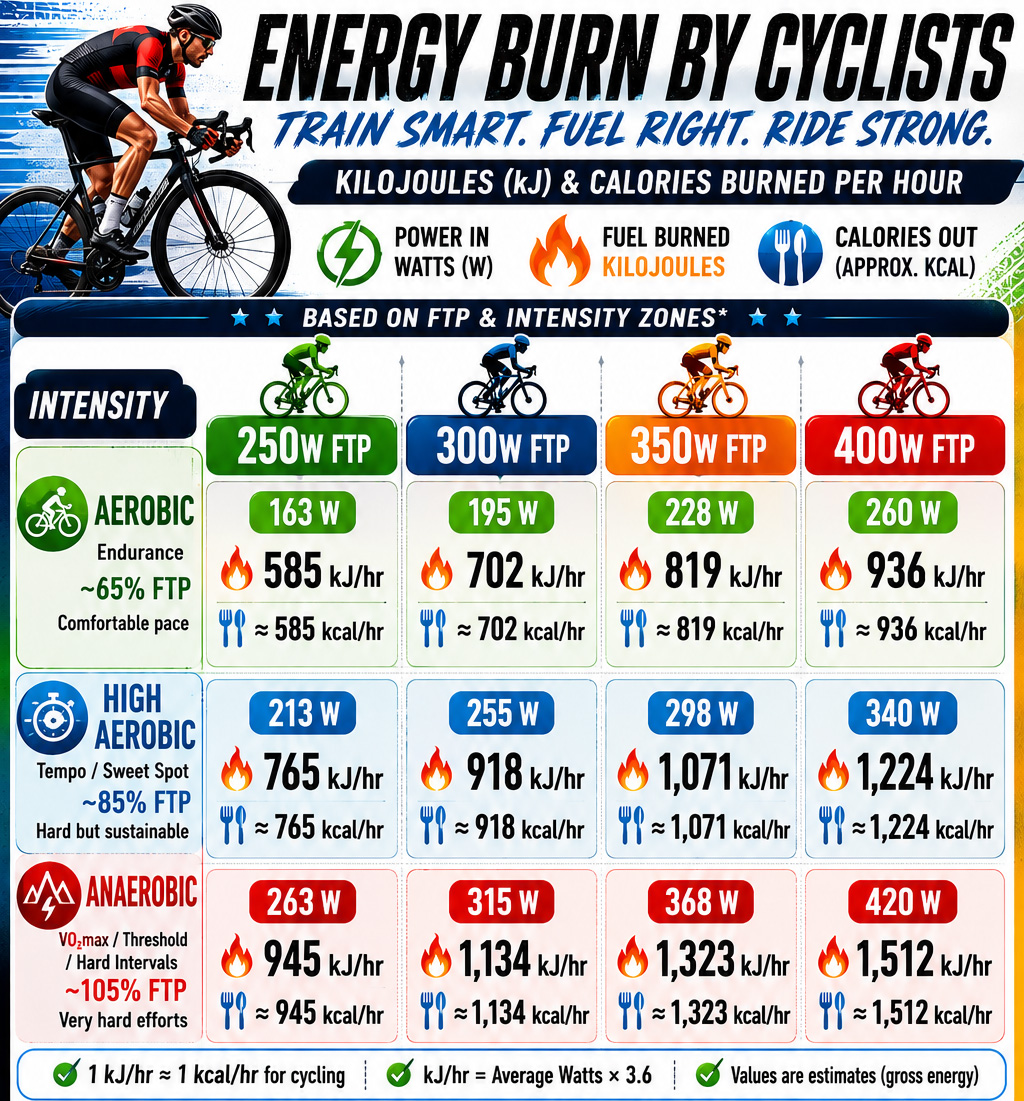
The reason carbohydrate recommendations are always provided in ranges (e.g., 30-60 grams per hour) is because the amount of energy you need per hour depends on how much work you’re doing. Kilojoules-per-hour is the gold standard for determining hourly work rate. If you’re riding with a power meter, this is a value you can see right on your cycling computer. If you don’t have a power meter, we can use a simple scale of Easy, Medium, Hard to illustrate the point that you need to increase fuel consumption to power a higher hourly work rate.
The infographic below shows three intensities: Aerobic (easy), High Aerobic (medium), and Anaerobic (hard), along with how your hourly work rate in kilojoules increases based on your fitness. The overall point is that when you ride easy, you’re primarily burning fat as fuel, along with some glycogen. Then, as you go to medium intensity and high intensity, you burn more glycogen to meet greater energy demands. The stronger you are, the more energy you can burn per hour, both from fat and carbohydrate, but muscle glycogen stores don’t scale up as much as your fitness can. To preserve glycogen stores or delay their depletion at any level of fitness, you must start to fuel with carbs to keep carbohydrate availability high.
The Old Way: Scaling Carbohydrate Intake by Grams
For a long time, carbohydrate recommendations for cyclists were split into “aerobic rides” and “performance rides”. For easier or shorter endurance rides, the standard recommendation was (and still is) to consume 30-60 grams of carbohydrate per hour during rides longer than 90 minutes. For rides shorter than 90 minutes, no carbohydrate fueling isn’t necessary, but you do need to consume fluids to stay hydrated. For longer and more strenuous rides, like interval days, hard group rides, and race days, the recommended carbohydrate intake increases to 60-90 grams per hour. These recommendations are summarized in the infographic below, along with corresponding recommendations for fluids and electrolytes.
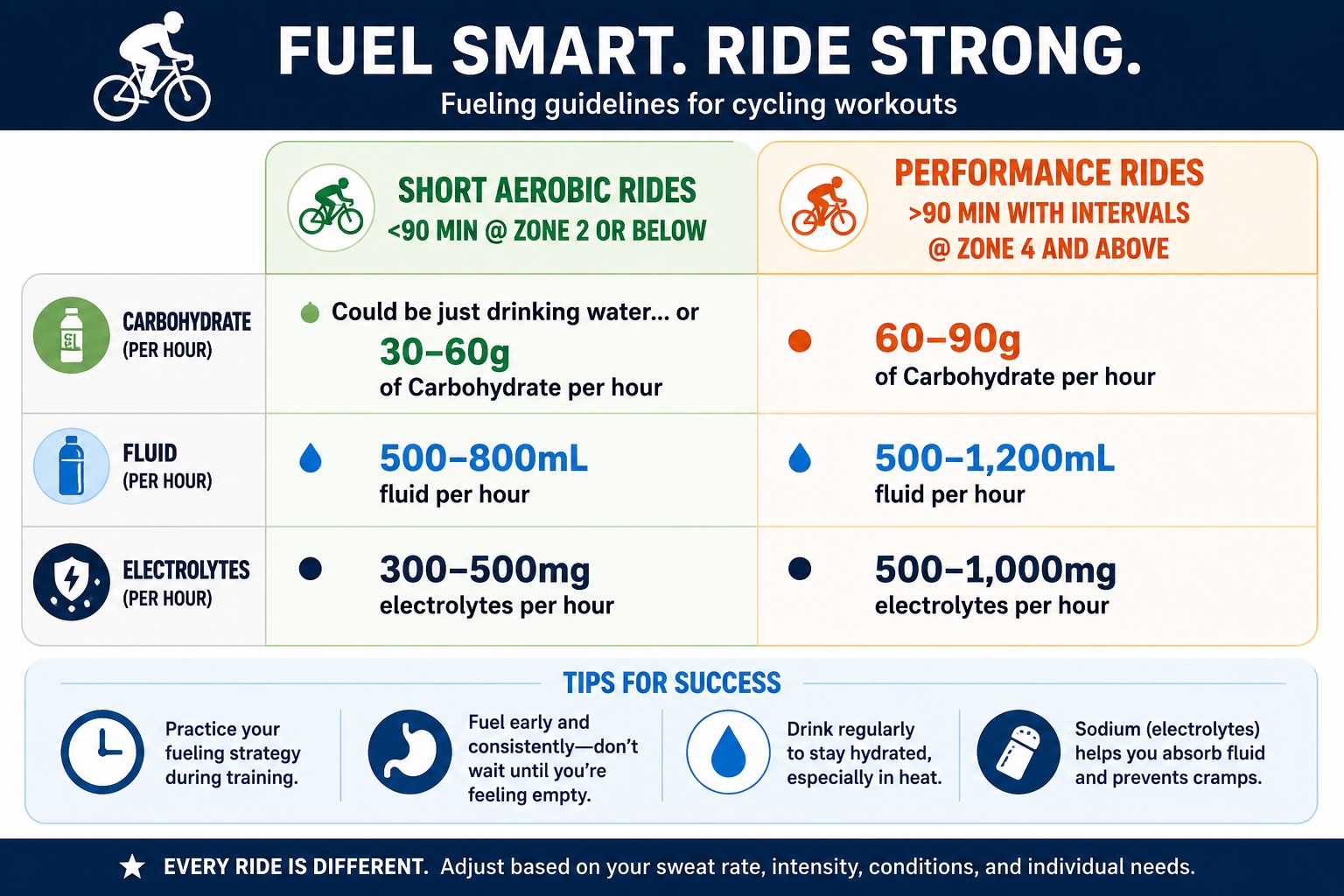
Now, compare the information below with the chart above that shows how your hourly kilojoule output increases with fitness (i.e., FTP). The 30-60 gram and 60-90 gram ranges work great for people with moderate fitness, but start to break down for athletes who can produce a high workload. If you’re wondering why the pros – who have FTP values in the 350-400 watt range – are now going so fast by consuming 100+ grams of carbohydrate per hour, it’s partly because they were chronically underfueled when they followed the standard recommendations.
The New Way: Scaling Carbohydrate Intake by Percentage of Hourly Work Rate
The more modern and nuanced way to fuel for cycling is to base hourly carbohydrate intake on a percentage of your hourly work rate. Scaling energy intake as a percentage of energy output takes care of the underfueling problem strong athletes had when following standard gram-oriented recommendations. It also solves the GI distress problem that beginners, less fit, and smaller athletes faced when they overfueled based on gram-oriented recommendations.
To scale your hourly carbohydrate intakes based on the percentage of energy output, first you must define what type of ride you’re one: Aerobic or Performance. Aerobic rides are shorter rides under 90 minutes or longer rides that stay at or below Zone 2. For these rides, aim to replenish 25-35% of your hourly kilojoule output with carbohydrate calories. For performance rides (Zone 4+ interval workouts, hard group rides, races), aim to replenish 35-50% of your hourly kilojoule output with carbohydrate calories.
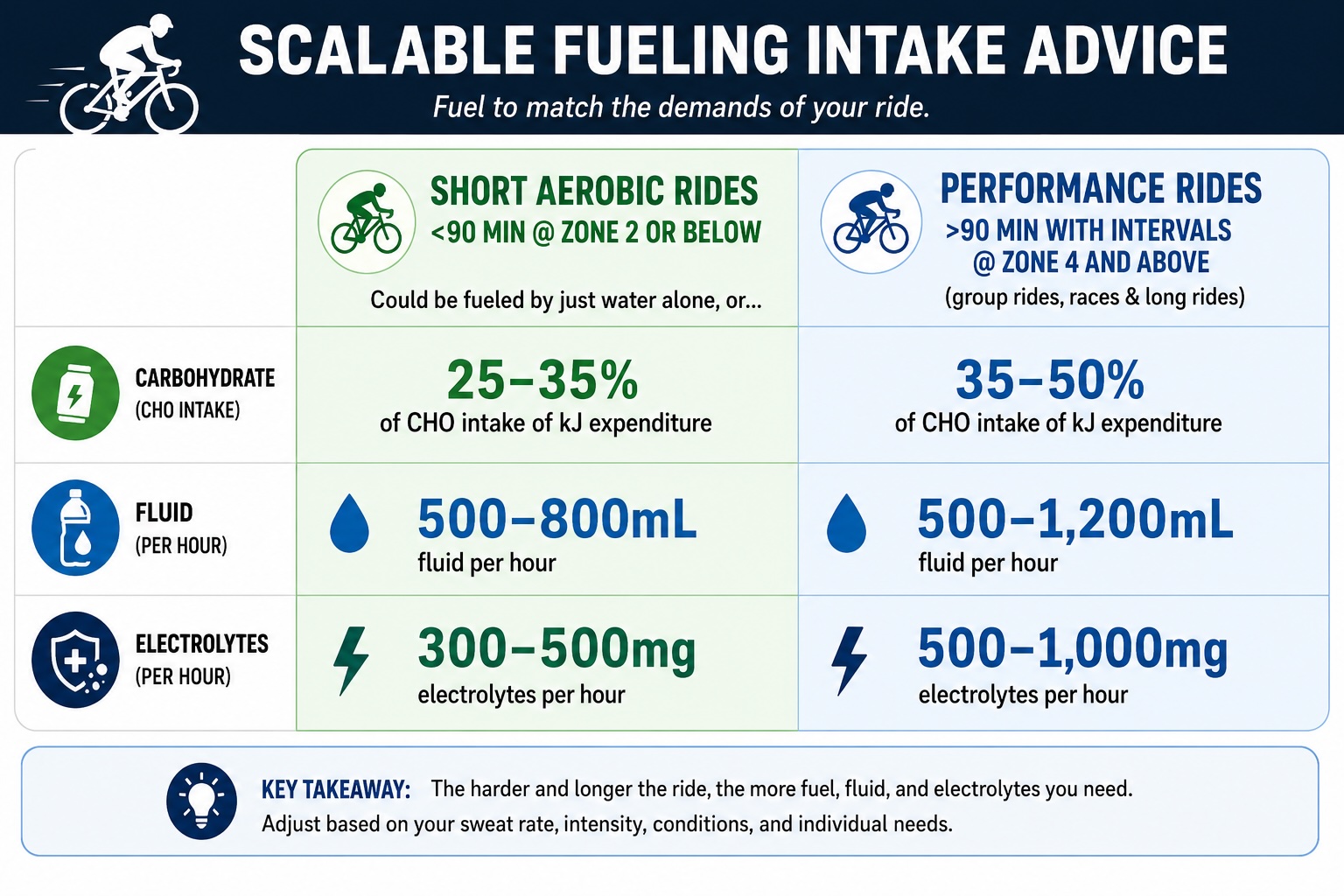
You’ll notice, the fluid and electrolyte recommendations are the same as the graphic above. The standard recommendations are constant, but recommended fluid intake will change with sweat rate. This is why it’s good to separate energy intake from hydration, so you can independently adjust energy intake based on work rate and fluid/electrolyte replenishment based on sweat rate.
With all of the above taken into consideration, here’s what to eat and drink for rides of any length:
► Free Cycling Training Assessment Quiz
Take our free 2-minute quiz to discover how effective your training is and get recommendations for how you can improve.
Cycling Nutrition for Rides of Any Length
What to Eat and Drink During Short Rides (up to 60-75 minutes)
Best hydration choice: plain water
Calorie target: None. If it’s been 24 hours or more since your last strenuous workout, your muscle glycogen stores should be fully replenished. With full glycogen stores you have more than enough carbohydrate on board to fuel a short ride. And since some short rides can be very intense (like indoor interval workouts or criteriums), you’re not going to be able to digest food very well anyway. Fluid replenishment is the highest priority, because you can sweat out up to 1.5 liters of fluid in a hot, high-intensity hour.
What to eat after a short ride: You don’t need a huge meal, but consuming a small meal rich in carbohydrate and containing a moderate amount of protein within 30-60 minutes after your ride will help jumpstart glycogen replenishment
What to Eat and Drink During Medium Rides (1-3 hours)
Best hydration choice: water and/or electrolyte-rich sports drink
Calorie target: 25-35% of hourly energy expenditure if known, 40-60 grams of carbohydrate per hour if energy expenditure is unknown.
Best foods for medium rides: bars/foods with a mix of carbohydrate, fat, and protein for moderate-intensity rides. Shift more to simple sugars from chewables or gels as intensity increases. For cycling nutrition within this hour range, consuming carbohydrate has been conclusively shown to improve performance in intermittent-intensity sports like cycling. Sustainable power, peak power, and time to exhaustion increase, and repeatability of hard efforts improves.
What to eat after a medium ride: You’ll definitely want a moderate-sized meal rich in carbohydrate, protein, and fat within 60 minutes after the ride. Save recovery drinks for rides that accumulate more than 1500 kilojoules of work, or for times when you will be training hard again within the same day or less than about 18 hours.
What to Eat and Drink During Long Rides (3-6 hours)
Best hydration choices: preferred combo of water, electrolyte drink, carbohydrate drink. Separate energy from hydration when anticipating hot weather or high intensity.
Calorie target: For easy endurance rides of this length, consume 25-35% of hourly energy expenditure if known, 40-60 grams of carbohydrate per hour if energy expenditure is unknown. For performance rides of this length, consume 35-50% of hourly energy expenditure. This will often mean 75-90 grams per hour, which requires some gut training to minimize the chances of gastric distress.
Best foods for long rides: Start with solid foods, including sandwiches, homemade rice bars, and sports nutrition bars. Save the chewables and gels for the last third of the ride. If the intensity is high throughout the ride, you may need to consume simpler-to-eat foods like chewables and gels for most of the ride, and you should consider using high-calorie, carbohydrate-rich sports drink if possible.
What to eat after a long ride: Sit down to a substantial meal within 60 minutes of finishing the ride. Start with a carbohydrate-rich recovery drink if you’re not going to be able to get a meal right away, or if you’re doing a multi-day event. You don’t need to gorge yourself, especially if you were eating properly on the bike. It is better to have a regular sized meal and continue snacking and hydrating throughout the afternoon/evening. Your first meal after a long ride should be rich in all three macronutrients (carbohydrate, fat, and protein) because they are all necessary for post-workout recovery. Focus more on carbohydrate and protein than fat. This is a good time for concentrated carbohydrate sources like rice, pasta, and potatoes, along with colorful and crunchy vegetables that deliver valuable micronutrients and fiber. Protein sources like fish, tofu, chicken, red meat, and yogurt are great for post-workout meals, but try to avoid fried proteins and heavy, fat-laden sauces. Consider a pre-bedtime snack to fuel muscle protein synthesis overnight.
What to Eat and Drink During Extra-long Rides (6+ Hours)
Best hydration choices: preferred combo of water, electrolyte drink, carbohydrate drink. Separate energy from hydration when anticipating hot weather or high intensity.
Calorie target: For easy endurance rides of this length, consume 25-35% of hourly energy expenditure if known, 40-60 grams of carbohydrate per hour if energy expenditure is unknown. For performance rides of this length, consume 35-50% of hourly energy expenditure. This will often mean 75-90 grams per hour, which requires some gut training to minimize the chances of gastric distress.
However, we recommend being conservative with caloric intake because it’s easy to overload the gut as rides get very long. The current trend is toward very high carbohydrate consumption (90-120 g/hr) during strenuous and long rides. Significant gut training is necessary before most athletes can consume more than 90 g/hr without GI distress. Such high carbohydrate intakes may not be beneficial, either, if your sustainable intensity and pace for extra-long rides is not high enough to burn fuel as fast as your putting it in the tank.
Best foods for extra-long bike rides and races: Consuming a steady flow of energy is the most important goal, so you want a variety of foods that are appealing and can adapt to changing tastes. The intensity of very long rides is generally moderate, so your gut is more likely to handle a variety of solid foods, gels, chews, and sports drink as you ride. And studies show that absorption of carbohydrates into the bloodstream happens equally fast across all types of carbohydrate supplements (solid food, chewable, gel, sports drink). Your ability to absorb carbohydrate fast enough is rarely a problem at the typical intensity for extra-long rides, so focus on what you want to eat and are willing to eat. The best nutrition strategy in the world is useless when you won’t eat what’s in your pocket.
After the ride: The big thing is to stay present and engaged long enough to actually get a good meal. Oftentimes, riders just totally shut off their brains at the finish of an extra-long ride. Don’t consider your ride over with until you have showered, dressed, and eaten. Push through and stay focused until those tasks are complete, and you’ll feel a lot better the next morning. If you have multiple extra-long days planned (like a bike tour or stage race), start with a recovery drink that’s rich in carbohydrate and protein as soon as you finish, and then move on you a balanced meal similar to what’s described above after a long ride. Strongly consider a pre-bedtime snack to fuel muscle protein synthesis overnight and to help support muscle glycogen replenishment.
Want help putting this into practice? A personal cycling coach can help you integrate fueling, training, and recovery into a strategy built around your goals and schedule.
Additional Resources:
TrainingPeaks: Importance of Carbohydrates and Glycogen for Athletes
Mysportscience.com: How Much Sodium Do I Need
TrainingPeaks: Fueling Insights from Inigo San Millan
► FREE Mini-Course: Learn How to Maximize Your Limited Training Time
Learn step-by-step how to overcome limited training time and get faster. Walk away with a personalized plan to increase your performance.

About the Author
Adam Pulford
CTS Head Cycling Coach
Adam Pulford is a dedicated coach at CTS with a passion for elevating athletic performance through tailored, measurable strategies and a deep understanding of the “why” behind each athlete's goals. With nearly two decades of experience, a degree in Exercise Physiology, and a successful track record managing professional cycling teams, Adam also shares his expertise as the host of the Time-Crunched Cyclist podcast, providing actionable insights for endurance athletes.
Comments 59
Pingback: Best Mountain Biking Gear for Hot-Weather Riding | Ozarks Mountain Biking
Pingback: Qué comer antes, durante y después de rodar
Pingback: Carefully Curated Triathlon News for July 16, 2026 - TriathlonWire
Pingback: Cycling Mikey
Pingback: Packing Essentials for Your Italian Cycling Tour in Europe
Pingback: How Long Does It Take to Road Bike 100 Miles? - BRAG - Bicycle Ride Across Georgia
0
Pingback: Carefully Curated Triathlon News for April 17, 2025 - TriathlonWire
Your recommendations are pretty spot on, although in our cooler Maine climate, most of the year I comfortably push the no hydration or fuel out to 2 hours. The former admittedly won’t work too well if it’s an 80F+ July day. Not many of my rides exceed that window, as I prefer some company for longer ones, and there is virtually no one locally to ride with, and when I find someone near my age (75), I generally like to push the pace with greater intensity than they are used to. It’s only in summer, where my pedaling involves longer hours – on my purely pedal driven prop drive catamaran, exploring offshore islands, and chasing and photographing sailing/rowing/pedaling events. Those efforts can be close to 40 miles, and up to 8 hours duration. Fueling and hydration is dramatically different for that, and I consume a lot of fluid and carbs, starting early on. If anyone is curious as to the type of events I photograph on Maine waters, here is one such amazing opportunity I experienced this past year from Belfast… https://tinyurl.com/33j2bhvw
Pingback: What Makes a Great Cycling Experience? Find Out Here! - Ravish Magazine
Pingback: Discover the Joy of Cycling: Your Guide to Getting Started - Fitness Program
Could you please share the source of your recent article regarding carbohydrate intake during exercise, specifically the part about the amount of carbohydrates during cycling? Thank you in advance.
Pingback: Are Poptarts the optimal ride food? – Well Rounded Bikes
Pingback: Cycling Training Plan for Beginners (10 Weeks and Beyond) | Gear Cycler: Find the Latest Gear Reviews
Pingback: How I Fueled My Latest Century Ride – Words From the Riverbed
Pingback: Senior Mountain Biking Nutrition: Top Diet Tips & Food Guide - PeakPedals: Mountain Biking for Seniors
Pingback: Mountain and Road Bikes - eBikeAI
Pingback: Pro Cyclist Diet to Lose Weight - eBikeAI
Pingback: What To Carry on a Bike Ride or Cycling Adventure - CTS
Pingback: Is Riding a Bike for an Hour a Day Good? Exploring the Health Benefits - Bike Shopping Pro
Pingback: What Cyclers Should Prioritize in Their Diets | Dr. Allen Cherer's Blog
Pingback: Fueling Your Cycling Performance: What to Eat and Drink for Optimal Results – Rev Up Your Cycles
Pingback: Nutrition for Long Road Rides: Fueling Your Journey to Success - Life-Fitness-Bike
Pingback: Essential Elements of a Cycling Training Plan - TF Coaching
Pingback: Cycling Nutrition: Fueling Your Ride for Optimal Performance – Ask The Job
Pingback: How to Bike Uphill Without Getting Tired (10 Tips to Kill It) | Fit Active Living
A real mixed bag of opinions here. My advice is do what you think suits you best for for whatever you are doing in the form of exercise you participate in. It is not a one size fits all. Different strokes for different folks as they say. I have followed the same routine for 20 years doing my cycling and it has worked well for me. For those of you thinking I am autistic no I am not. If it works for you then if it ain’t broke don’t fix it. I am now 66 and cycle 17 miles every day and feel the benefits of my cycling.
Your just a young boy then.
I’m just a day into my 78 th year and absorbing so much information about what I should and should not do.
19/06/22 did my first 70. 3 Luxembourg, just for fun, ( started training in the February i’m always up for a challenge).
Now with Swansea Sunderland and Europeans in Belgium behind me I’m getting over last nights birthday celebrations looking towards World Championships in New Zealand in 2024. ( silly me).
I’ ve just read your info on nutrician and the last few lines I totally agree with “ what works for you …..” hence I shall continue with that well known diet that many folllow “ The See Food diet”
It does contain 5 fruits lots of carbs etc etc l just modify it in the spring to reduce weight by 2-3 kg for the summer.
My main training problem is
Family first
Dog next
Training last as I’m enjoying the challenge of not racing others but beating my last outing ( competition time).
My biggest competition is me, ans long as I’m improving I shall be happy.
Hopefully in the New Year I too will get out on my bike more regular
Sorry but this article clearly shows a lack of understanding. Very dilute sugar and salt osmolarity are essential requirements of hydration. You have not cited any scientific sources, or even mentioned coffee or alcohol.
I would never ever start using a gel prior to a race start. You’re just asking for the blood to go to your stomach and small intestine…. away from hard working muscles??? Sounds like a recipe for gastrointestinal disaster.
Here’s a start:
https://www.youtube.com/watch?v=JAhvCuJNu3I
You’ll have to do better than this to keep me on board and reading /listening.
Thanks
The article may contain errors, but posting a link to a well-known super quack is not exactly the correct way to show that. And you talk about scientific sources?
More info on the drink part of this plan would be important for salty sweaters like me. I don’t think suggesting water for the 1-3 hour rides is right. Carrying water is fine if you want to have it for cleaning glasses or to decide on the fly what you want to mix to drink, but plan to consume electrolytes unless you never get a salt crust or chalky feeling to your skin after you ride.
Pingback: What to Eat before Road Cycling? (9 Options!) | Biker You
Pingback: What Should I Do After Cycling? - Vehicles Aid
Pingback: Nutrition In Cycling: A Complete Guide to the Cycling Nutrition
Pingback: What to Look For in the Best Sports Drinks - CTS
Pingback: Alimentazione per il ciclismo: Cosa mangiare e bere durante le uscite in bicicletta di qualsiasi durata - Estate Correndo
Pingback: Fuel your ride, so you can ride well-fueled! | Gunnison High School Mountain Bike Team
Pingback: Endurance Ride Checklist: What Smart Cyclists Take on Everyday Rides and Epic Adventures - CTS
Pingback: How to Get Faster at Cycling - CTS
Pingback: Energy Expenditure: Calories, Kilojoules, and Power in Cycling - CTS
Pre-bedtime snack is better than my 2 AM snack following a ride over 4 hours. Well written advice that I wished I knew the first time I attempted the Tour of CA Alps aka Deathride…
On hotter rides if you are hydrating sufficiently with even a low carb sports drink like Skratch for example, you are likely getting your recommended 20-30% of expenditure calories. So I don’t see how you can separate calories from hydration. If you ignore the calories that accompany hydration, you will take in far too much. If using a higher carb drink (like most older formulations which are 2x the calories of Skratch) you may over-“eat”.
Pingback: Cycling Training Plan For Beginners
Thanks for the article. Fueling is one of my main problems.
I’ve been doing 8+ hour rides and almost always end up under fueling. Either I don’t want what I’ve brought or my stomach won’t process what I’ve eaten. Gels are friendly on the gut but don’t last long. I’m trying to do the ride with minimal stops and fuel on the go as much as possible.
It may sound counter intuitive but my best performance on the bike has been on rides where I have a sit down lunch halfway through. It does cut a chunk of daylight out of my ride though.
Is there a magic food out there my gut will tolerate and keep me fueled all day? What on bike nutrition have you all had good luck with on long rides?
Hi Shaun,
I’ve had luck with homemade energy balls with rice, usually peanut butter, and whatever else is around. On long rides like yours, you may have to eat a couple of them.
Science in Sport has a 80g Beta Fuel, but I’m not sure how you’d get 8 bottles of that on a ride.
Rice Krispie type bars are also pretty easy on my stomach and get some fuel in me.
Pingback: ▷8 Best Road Bikes for Beginners in 2021🥇 + Pro Tips
Pingback: O que comer após uma atividade de ciclismo? | Xis-Tudo
Pingback: 20+ Bicycle Safety Tips for 21st Century – Be Safe on Roads!
Pingback: Cycling Nutrition: Practical Guide for Eating and Drinking on the Bike - CTS
I am 58 years of age, 90kg and lack energy when cycling.
1. What is the ideal carbs vs protein vs fat % meals to eat the day(s) before a 50km race?
2. Is there any benefit in taking a pre-workout prior to a race and if yes, what would you suggest?
3. Of the 100’s of performance boosters available, what would you recommend for me?
Thanks
Pingback: The Guide To Effective Cycling Interval Training - CTS
Pingback: 3 Things You Need for A Cross Country Cycling Trip – EdsBearings – Skateboarding & Sports Blog
Thanks. I think this is a useful article but could do with a few additions
– Practice nutrition as you would any other skill. If your event is critically dependent on nutrition then it is good to build habits during training. So sometimes you may want to change the guidelines above, e.g. to simulate the nutrition you are planning during a real event. Practice should include things like the cues you will use to eat/drink e.g. alarm on garmin.
– Never try something new when it matters. Obvious but all too often folks panic before an event and try something different. It will rarely if ever give any benefit and but very often will lead to disaster.
– Your gut can be trained. As you say carb absorption varies between individuals but can also be varied at the individual level by training, which in this case simply means slowly increasing the amount of carbs you eat per hour ride on ride. This is not necessary if your ride is short but when you get into the 4hour plus range this becomes important especially if the event is one that will require going deep in the later hours. This will also help you find out which sort of nutrition works best for you.
– Eat from minute 1. The food you eat in the first hour will be fueling your later hours. It’s all to easy to get caught up in the emotion of the start and find a lot of time has slipped by without eating anything. You can’t get this time back and you can’t overeat to catch up.
Couple of others
– If your ride is on varied terrain plan when you will be eating. For example some events will have climbs that last over and hour and descents that last 30 minutes. If you are comfortable eating during either then fine. But if you find it hard to eat while working hard or are not a comfortable descender don’t just assume you can eat every 20 minutes. Have a plan. Also this can work great for event pacing, by breaking it into small chunks and treating each feed as a little reward and a time for a quick relax refocus.
– Don’t rely on feed stations. They can run out or have food you can’t manage. I find it best to take all the carbs I need with me. It doesn’t add much to weight and means I only have to queue for water which, worst case, can be got elsewhere.
– Make it easy to get to food in all conditions. I have ridden in events where I could not get to my food because of my rain jacket. Also I’ve had times when I have dropped food or not been able to eat it because my hands are too cold to get it open. Top tube bags may look ugly but are very convenient and with bars I find it best to open them in advance so they just need to be slipped out. In case of emergency it can also be worth tucking a gel or two into your shorts on top of the quads. Regardless of conditions you should be able to get to them there,
Good article,good suggestion!Thank you for share
Great article!
I would add that on long rides which take a rider through high temperatures in early to mid afternoon it can be helpful to reduce calorie consumption and/or switch to carbs that are easier to metabolize / clear the gut quickly to avoid GI distress as blood flow to the stomach can slow as it competes with flow to the skin for cooling.
Adding some information / thoughts on how to think about the different types of carbs in different situations would be great!
Great article. Any information on the average kJ of work per hour for female cyclists?
Thanks
Great article thanks. With respect to hydration, do you have a guide for how much should be drunk to ensure good hydration?
very useful article to help dial in the most practical and useful combo of hydration and nutrition that will likely lead to efficient riding – thank you!