

Training Density: More Power Without More Training Hours

Updated On
April 13, 2026
CHOOSE YOUR FORMAT
►WATCH THE VIDEO
►LISTEN TO THE PODCAST
►READ THE ARTICLE
Training Density: More Power Without More Training Hours
What if you could improve your cycling performance without increasing your power output or adding more training volume? Sounds impossible, but it’s exactly what successful cyclists do, and I’ll show you can do it by increasing training density.
What Does Training Density Mean?
Training density is the amount of work you can do in a distinct period of time. Many times, we think of it on a weekly or monthly timeframe: how hours or miles you rode per month, or how many Training Stress Score (TSS) points you recorded per week or per month. But you can also apply the training density concept to individual training sessions.
During an interval workout, group ride, or race, training density is the amount of work done compared to the recovery time. It’s the work:rest ratio. If you can do the same amount of work in less time, you’ve increased the density, and the stress, of the session. As I’ll explain in more detail, the best way to accomplish this in training is by reducing the duration of recovery periods between hard efforts.
Why Training Density Matters More Than You Think
In most races, group rides, and hard training days, performance is determined by repeatability rather than by one big effort. To be successful on the bike you must be able to go hard, recover just a little bit, and then go hard again, over and over. Repeatability—not peak power—is often the true performance limiter. Manipulating training density is the most effective way to address this performance limiter.
How Training Density Makes You Fast, Durable, and Tough
Anyone can go hard once. Everyone has one strong effort in their legs. Good riders can handle a handful of big efforts. Champions have the durability and repeatability to match everyone else’s best efforts and still have a few of their own. That’s what you want and that’s what training density delivers.
Cycling is an intermittent intensity sport, meaning long periods of easy to moderate intensity interrupted by undefined and unpredictable periods of extreme intensity. Think about how road, gravel, and mountain bike races actually unfold. Consider group rides and even solo rides on hilly terrain or windy days. These aren’t steady-state efforts. The intensity is always changing, unpredictable, and relentless. Standard interval workouts with full and predictable recovery periods are great for developing fitness (which is 100% necessary), but to prepare for the real world we need to replicate real-world demands. Training density does this by concentrating hard efforts and limiting recovery between them.
Functional Reserve Capacity: The Science Behind Training Density
To borrow a phrase from retired pro cyclist Jens Voight, this is “Shut Up Legs” training. It’s the training that improves your ability to produce power and go fast when your legs are screaming.
Functional Reserve Capacity (FRC) is essentially your “anaerobic battery”. By definition, FRC is the amount of continuous work you can do above FTP before you fatigue. Practically, that means:
- When you go hard → the battery drains
- When you ease up → it recharges
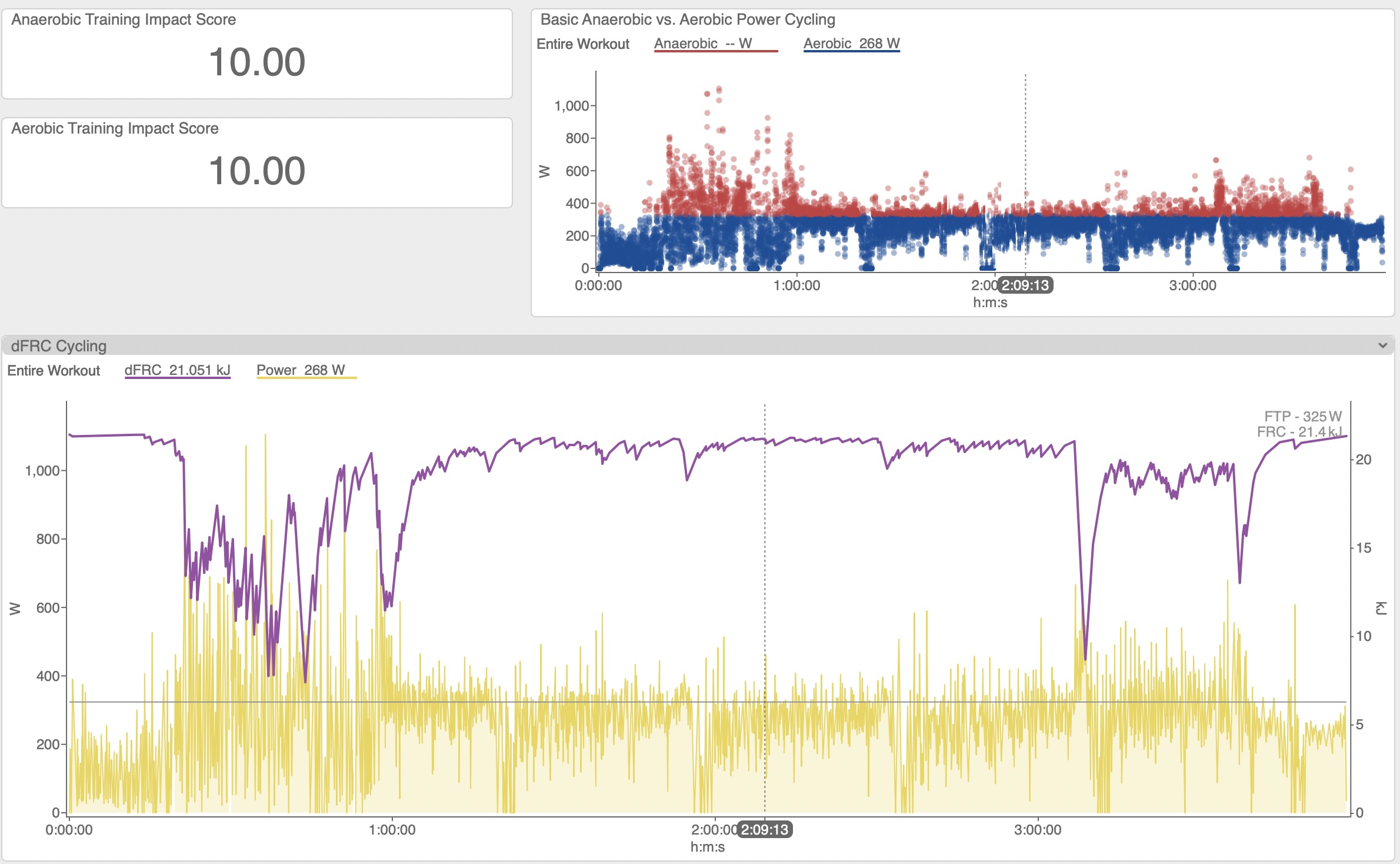
The image below is a race file from one of my elite athletes in Spain. The bottom chart displays his power output in yellow and the purple line is the rider’s dynamic FRC. When the purple line dips, he’s draining the battery, and then once he eases up it takes time for the anaerobic system to recharge. Early in the race there was a high-density period of anaerobic work, followed by steady riding, and then more intensity at the end of the race.
Training to improve FRC helps you in the following ways:
- Bigger anaerobic battery: There’s a finite number of kilojoules you can produce when you’re above FTP. Improving FRC through density training increases this number.
- Faster recharging: When you combine a strong aerobic foundation with FRC training, your aerobic engine can recharge your anaerobic battery faster.
- Higher peak power: When you start with a bigger battery, you can put more anaerobic energy into your legs and deliver that power on demand.
- More durability: The bigger your anaerobic battery, the fewer times you’ll be pushed to your limits responding to ride or race demands. You’ll partially drain your battery when the riders around you fully deplete theirs. That means you’ll have more left in the tank when it’s time for a decisive effort.
The best riders can drain and recharge that battery repeatedly under fatigue.
How to Increase the Density of Your Cycling Training
The core concept behind increasing training density is to do more work (kilojoules) in less time. We base it on kilojoules because work is work, it’s independent of body weight, FTP, or VO₂ max. And the workout variable we manipulate is recovery time.
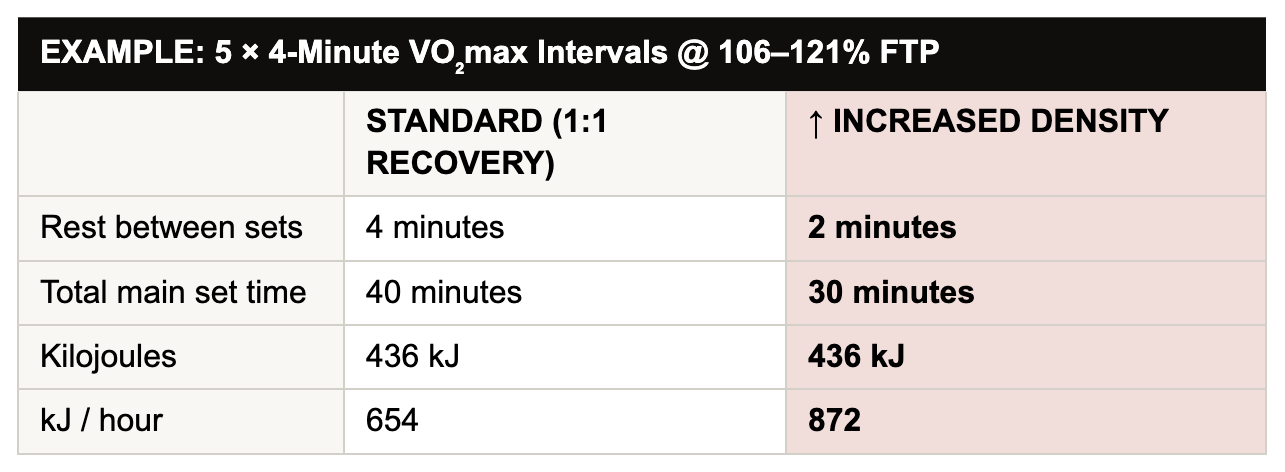
The chart below shows how shortening the recovery time in a 5 x 4-minute VO₂ max interval workout increases training density from 654 kJ/hr to 872 kJ/hr.
► Free Cycling Training Assessment Quiz
Take our free 2-minute quiz to discover how effective your training is and get recommendations for how you can improve.
The same concept can be applied to other interval types and durations, although for building FRC, the workouts need to be at or above FTP (i.e., Zone 4, 5+). The point is not to make the power targets for intervals higher, but to limit the recovery between efforts at the same target powers.
Coaching Example: Same Intervals, Different Recovery Periods
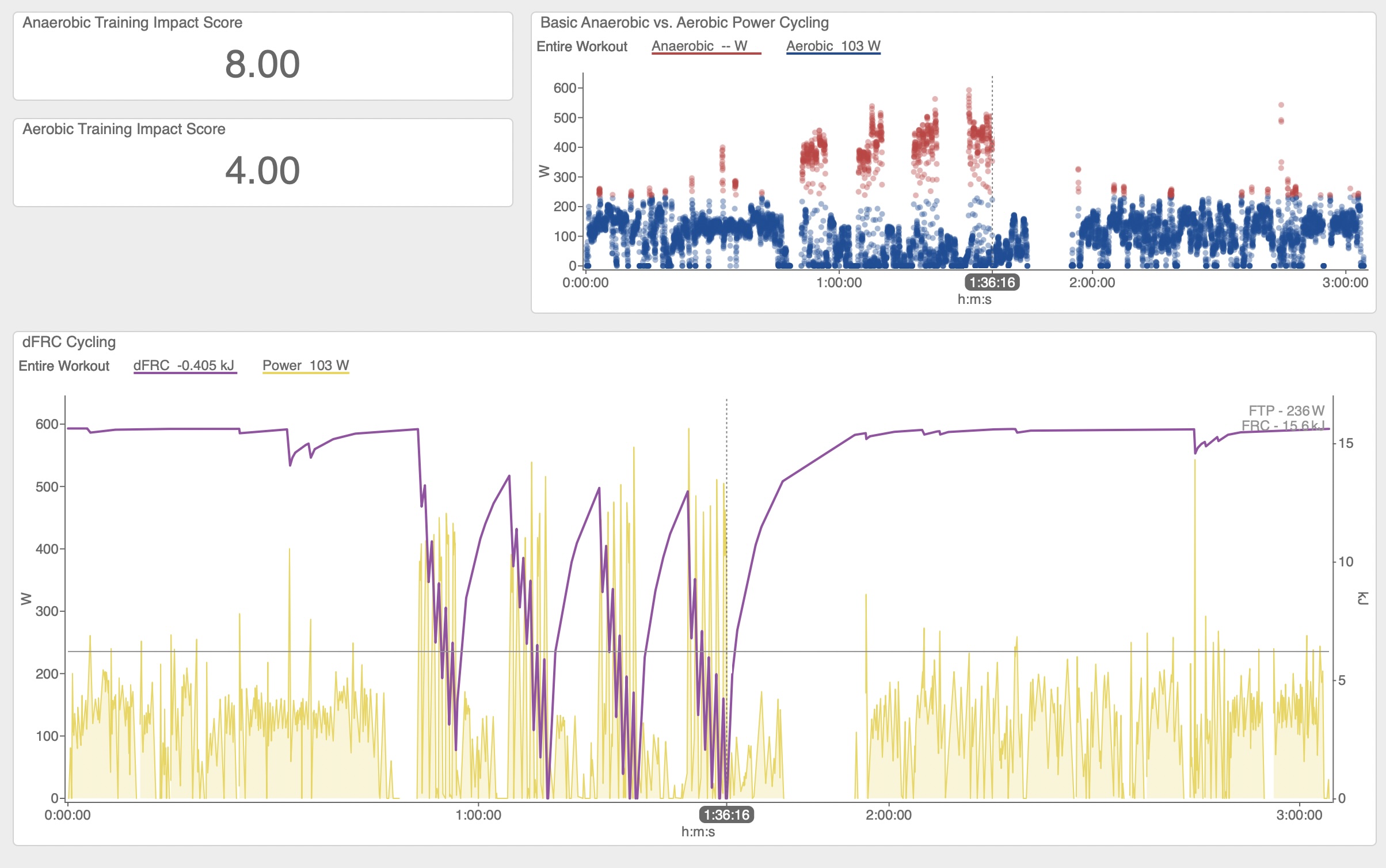
What does “draining the battery” look like? The two images below represent the dFRC charts from two workouts featuring intervals of the same duration. The only difference between them is the duration of the recovery periods between efforts. The first image is an example of training density. The recovery periods are short. You’ll notice that the first interval partially drains the anaerobic battery, as indicated by the purple line dipping sharply. With incomplete recovery between intervals, the subsequent efforts completely drain the anaerobic battery and it does not completely recharge between efforts.
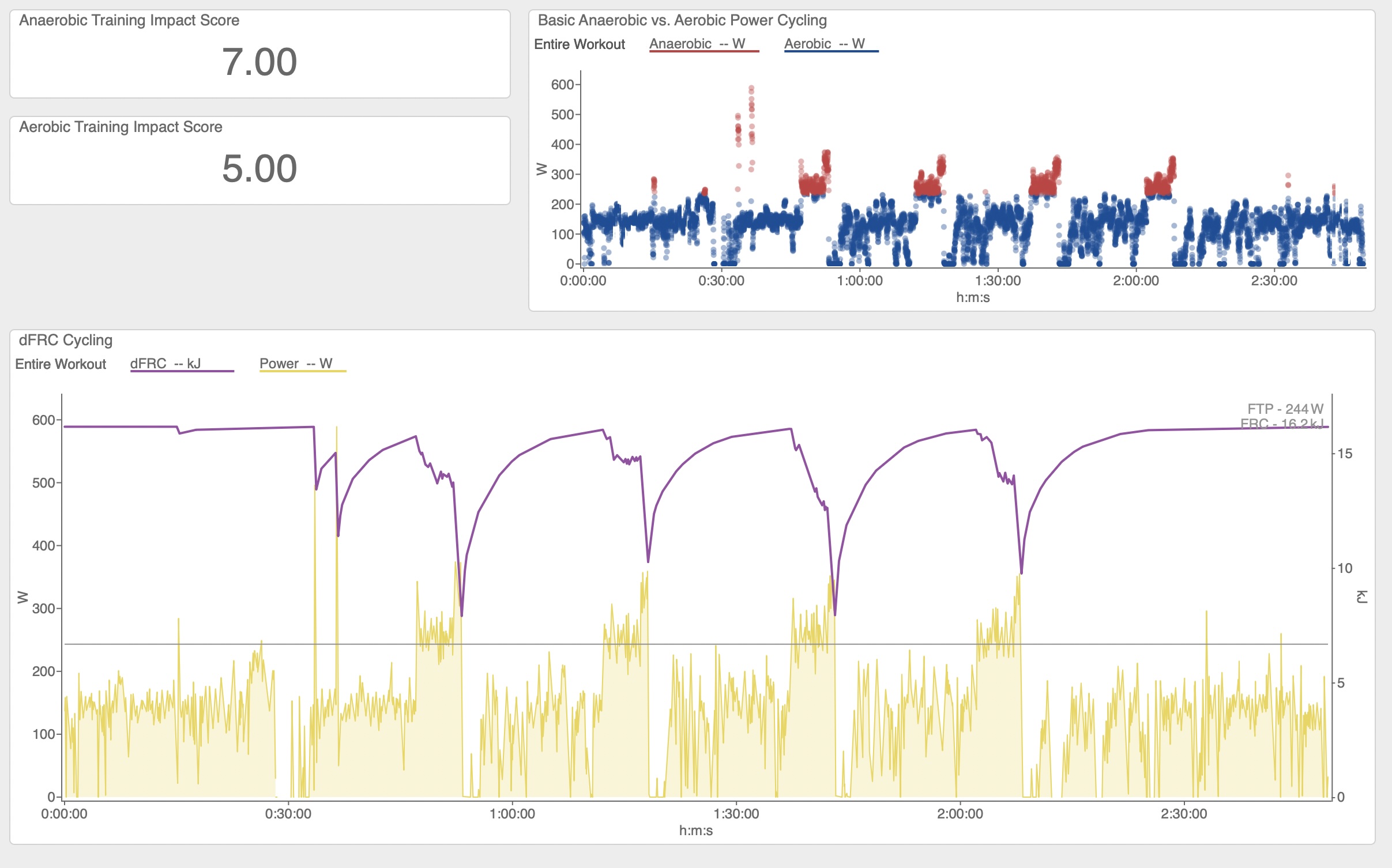
The workout in the second image (below) features longer, complete recovery periods. You can see that between hard efforts, the dFRC line returns to baseline, meaning the athlete is almost entirely aerobic. From this state, it is difficult for each individual effort to fully drain the anaerobic battery. This workout can be effective and useful, but it is not targeted at developing Functional Reserve Capacity.
There’s a Catch: Training Density Is Really Hard
As you might expect, limiting recovery between high-intensity efforts makes any interval workout feel harder. Fatigue accumulates quickly and power output may drop in later intervals, even for interval workouts you can handle with longer recovery periods.
Won’t failing to maintain the target power outputs do more harm than good? It’s a matter of perspective. Let’s say you can successfully execute the 5×4-minute VO2max intervals above with 4 minutes rest, but your power drops off in the final two intervals when you shorten the recovery periods to 2 minutes. Limiting the recovery is changing a variable to stimulate a new adaptation. Over time, you’ll adapt to be able to hold the target power output across all four intervals, which means you’ll have improved repeatability under fatigue.
The Toughness Factor of Training Density
Short recovery periods don’t just train physiology. They train your ability to stay engaged, push through discomfort, and perform when you don’t feel rested and ready. You have the ability to dig deeper than you believe, and this type of training helps you find that out.
How To Apply Training Density To Your Training
Increasing the density of your training by compressing recovery periods adds stress, so this type of training needs to be used carefully.
- Timing: I incorporate this training in the final weeks of an athlete’s build phases, before the peaking/specialization phase. This is often 6-8 weeks before a goal event.
- Frequency: One high-density session per week is plenty for most athletes, sometimes paired with a second interval session with normal recovery periods. Advanced athletes may do two high-density sessions/week.
- Intensity: This approach works across intensities, but it’s most effective at Zone 4 and above, where anaerobic contribution is more significant.
An advanced application of the training density idea is to complete a structured interval session (Zone 4+ with normal 1:1 recovery periods) and then jump into your local group ride. Now you’re already fatigued, forced into unpredictable efforts, and training real-world repeatability. Use this scenario sparingly, but strategically.
Coach Insights: What Works and What Doesn’t
To test this idea in your own training, the simplest thing to do is take the interval workouts currently in your program and reduce the recovery periods by one minute. Do that consistently over a few weeks and you’ll start to notice:
- Better repeatability
- Improved durability
- More confidence in hard efforts
What doesn’t work? Trying to reduce recovery times and increase power output at the same time. Don’t go harder, just take less recovery time between intervals. It’ll feel harder, trust me.
The Bottom Line
Anyone can go hard when they are fresh. And you already know you can dig deep when there’s plentiful and predictable recovery coming after the effort. But can you go hard when you’re already tired? Can you repeat those hard efforts even as the fatigue builds? That’s where races are decided. That’s where you get dropped or stay with the pack. It’s how you make the breakaway stick. You don’t get that from training with full recovery.
► FREE Mini-Course: Learn How to Maximize Your Limited Training Time
Learn step-by-step how to overcome limited training time and get faster. Walk away with a personalized plan to increase your performance.
"*" indicates required fields
About the Author
Adam Pulford
CTS Head Cycling Coach
Adam Pulford is a dedicated coach at CTS with a passion for elevating athletic performance through tailored, measurable strategies and a deep understanding of the “why” behind each athlete's goals. With nearly two decades of experience, a degree in Exercise Physiology, and a successful track record managing professional cycling teams, Adam also shares his expertise as the host of the Time-Crunched Cyclist podcast, providing actionable insights for endurance athletes.
Comments 1
This is exactly what XERT had been doing since day one. They call it MPA.
An excellent training tool