

Does FTP Matter For Criterium Racing?
Updated On
August 18, 2026
CHOOSE YOUR FORMAT
►WATCH THE VIDEO
►LISTEN TO THE PODCAST
►READ THE ARTICLE
Sprints and repeated accelerations out of corners are the first things that come to mind when most cyclists think about criterium racing. As a result, the prevailing mentality is that anaerobic training is what makes the all the difference for crit-focused racers. As with all bike races, all intensities matter. But for the criterium-focused riders, Functional Threshold Power (FTP) matters more than you think (or want to admit). Managing the balance of training intensities depends on the type of rider you are – all-arounder, sprinter, or breakaway specialist – but it all starts with building a big aerobic engine and solid FTP.
The Case for FTP’s Importance for Criterium Racing
I live and coach in the Washington DC area, where the criterium scene is robust, there are lots of mid-week and weekend criteriums throughout the season, and there’s a large population of cyclists who focus almost entirely on crits. I can already hear some of you thinking, “This guy doesn’t know what he’s talking about — crits are all anaerobic, and you need a fast sprint to win.” Duly noted but consider this: A strong sprint doesn’t matter if you can’t reach the finish, and it only matters if you have enough energy left to ride into a winning position within the final few laps.
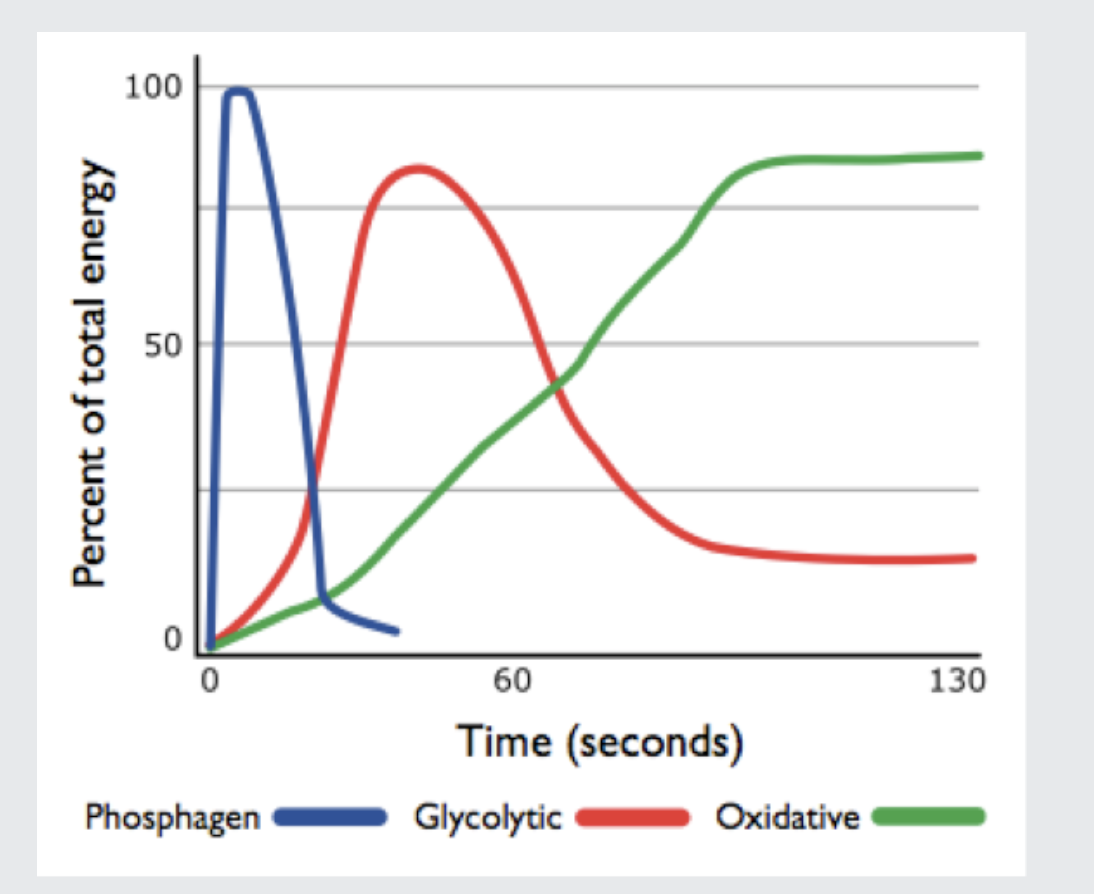
Criteriums are primarily aerobic and favor athletes who have a well-developed anaerobic capacity layered on top of a deep aerobic foundation. A simple but classic chart shows that continuous exercise efforts of 75 seconds or longer are driven primarily by the aerobic energy system. Even in shorter, punchier efforts that feel more anaerobic, the aerobic system is still the engine behind it all.
To be successful racing criteriums in the U.S. or kermesses in Belgium, you need to train FTP, your sprint, repeatability, and hard on/off efforts to race your best. And as always, it comes down to having a good plan built on progressive overload and training specificity.
Cardiovascular Demand: Time Trials vs. Criteriums
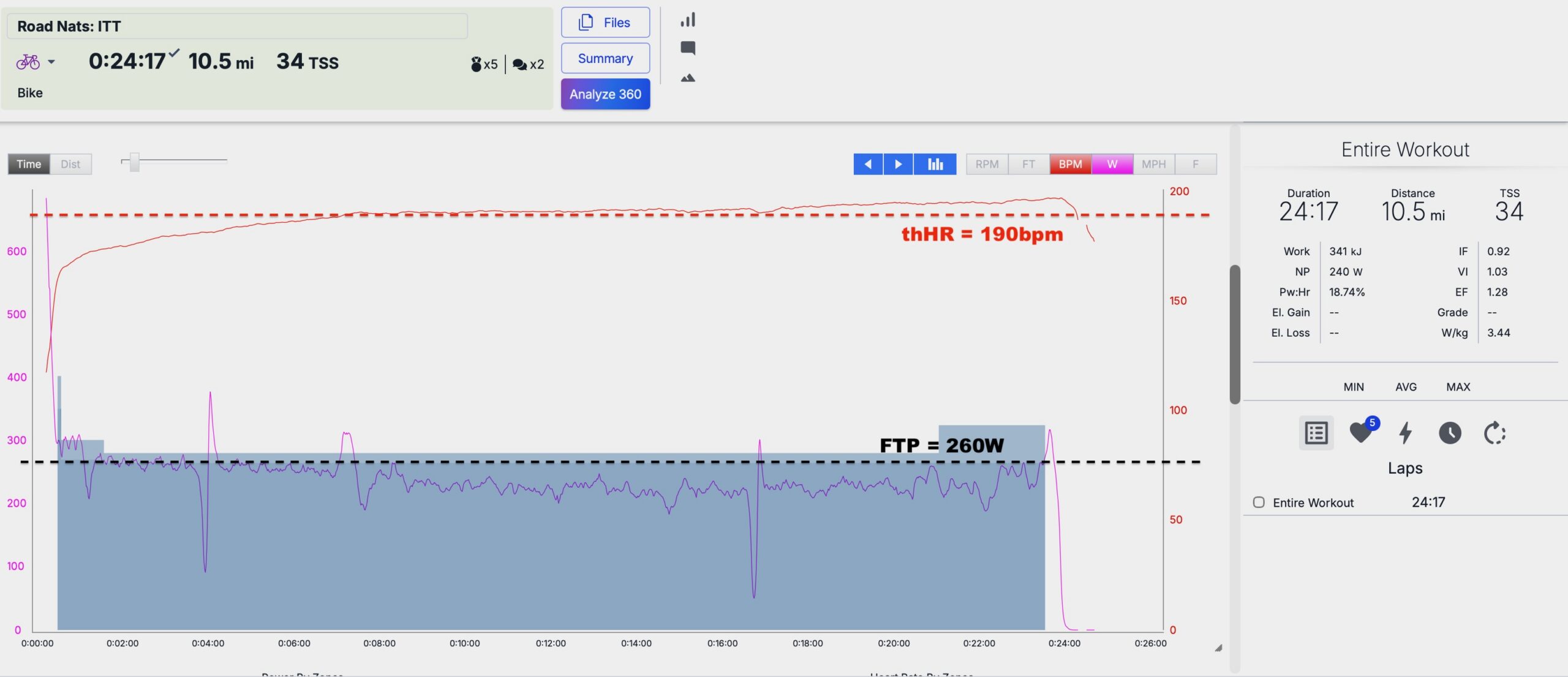
To illustrate the fact that criteriums are mostly aerobic, I pulled files from one of my elite U23 riders. Let’s compare her Elite Road National Championships Time Trial against a criterium at Tulsa Tough.
In the time trial, her heart rate response was smooth and predictable. It built steadily, reaching right around threshold about five minutes in. From there, her heart rate stayed relatively steady, increasing to finish above threshold. This is a classic time trial heart rate profile: lots of time spent in Zone 4 (threshold), with a lot of FTP-level power and heart rate throughout.
Note: The athlete’s power output for this time trial looks like it was lower than her FTP because we normally track data with power pedals and the power for this TT was recorded on a different power meter.
In the criterium, the picture looked completely different, at least at first glance. Power was highly variable. The power line is spiky, squiggly, constantly surging and easing off, exactly what you’d expect from a criterium. Heart rate told a different story. It wasn’t as steady as in the time trial file, but it also didn’t bounce around with the power. Instead, it climbed and stayed high, hanging in Zone 4 for most of the race, much like the steady, hard effort you see in a time trial. Even though the power output looked chaotic, the internal, cardiovascular demand was steady, high, and sustained.
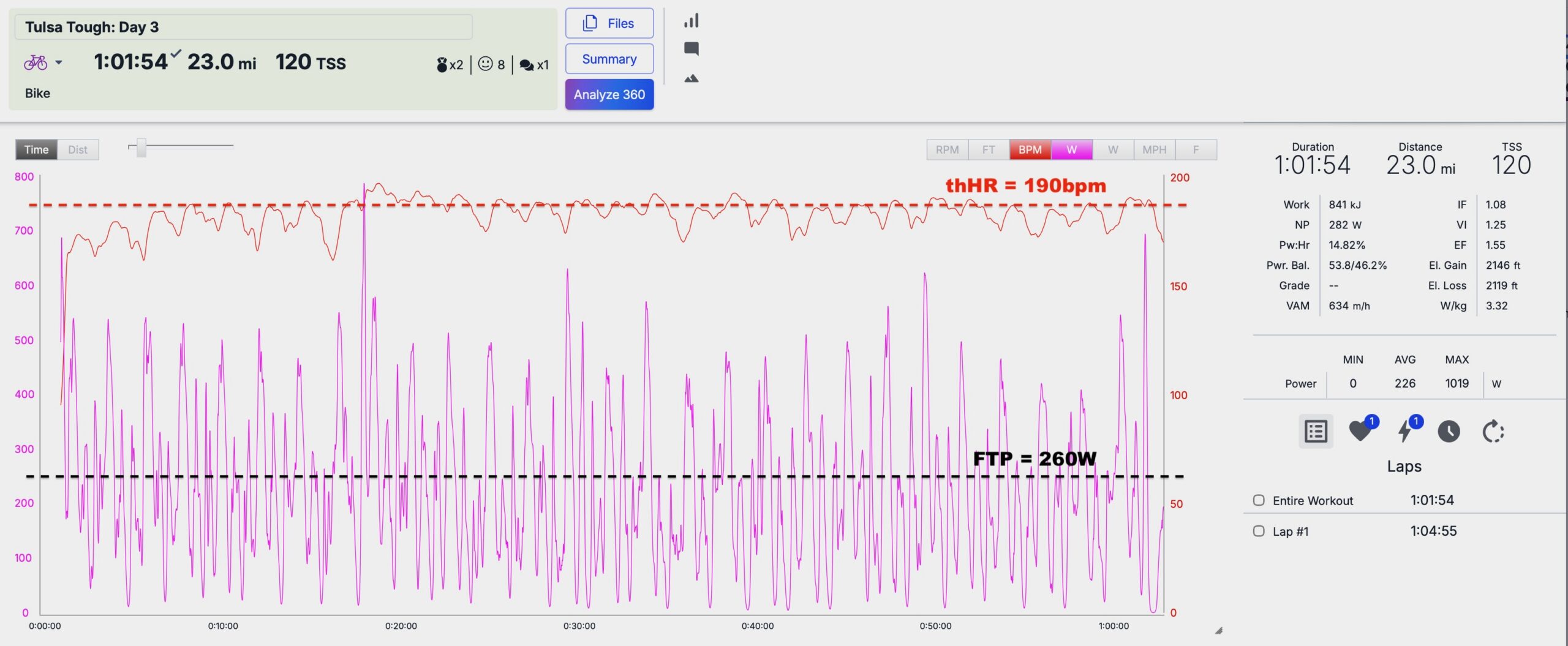
The crank tells one story, but the body tells another. How you produce power is different between the two events, as we’ll see next. But to provide the energy for either scenario, the aerobic system, represented by heart rate and breathing rate, grinds away at a high, sustained level for the entire race.
Anaerobic Contributions to Criterium and Time Trial Races
Looking only at heart rate data, criteriums and time trials (and even cyclocross races) look pretty similar. Anyone who races these disciplines can tell you they are very different from a power production standpoint. One useful way to visualize this is through what TrainingPeaks calls the anaerobic battery, or Dynamic FRC (Functional Reserve Capacity), which is effectively your available anaerobic capacity at any given moment.
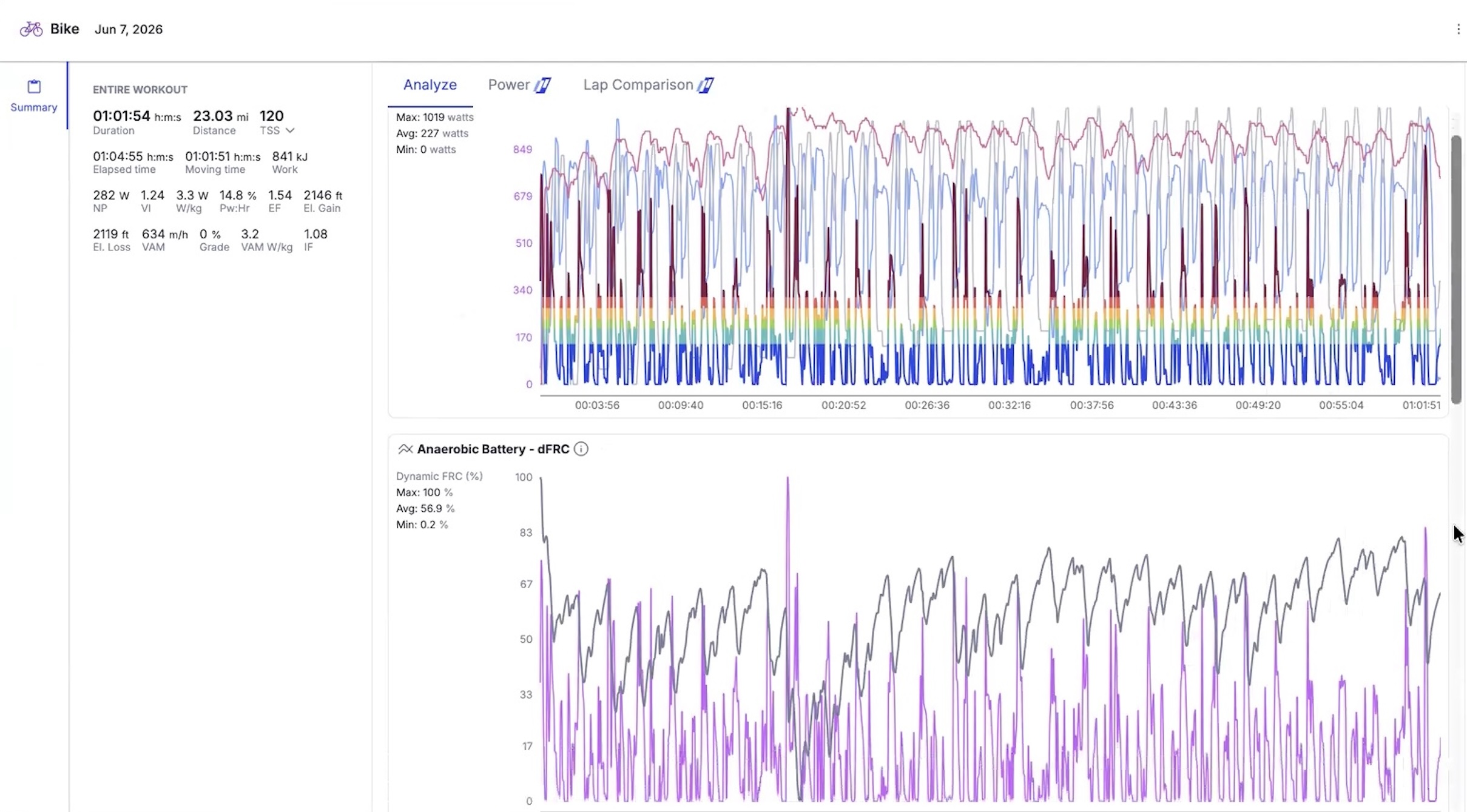
You start a race at 100%. As soon as the racing gets hard, that battery starts draining. In the criterium file illustrated below, the rider’s anaerobic battery dropped fast within the first 15 minutes of hard racing, right around the same time her heart rate spiked into that sustained high zone. As the race settled, she was able to regenerate some of that battery, but she stayed suppressed for most of the race, ultimately draining down to around 42% during her final sprint effort.
In the short time trial file illustrated below, a similar but less pronounced pattern emerged: a hard anaerobic draw off the start line, followed by recovery and a steady, sustained effort to the finish, with the anaerobic battery dipping again near the end.
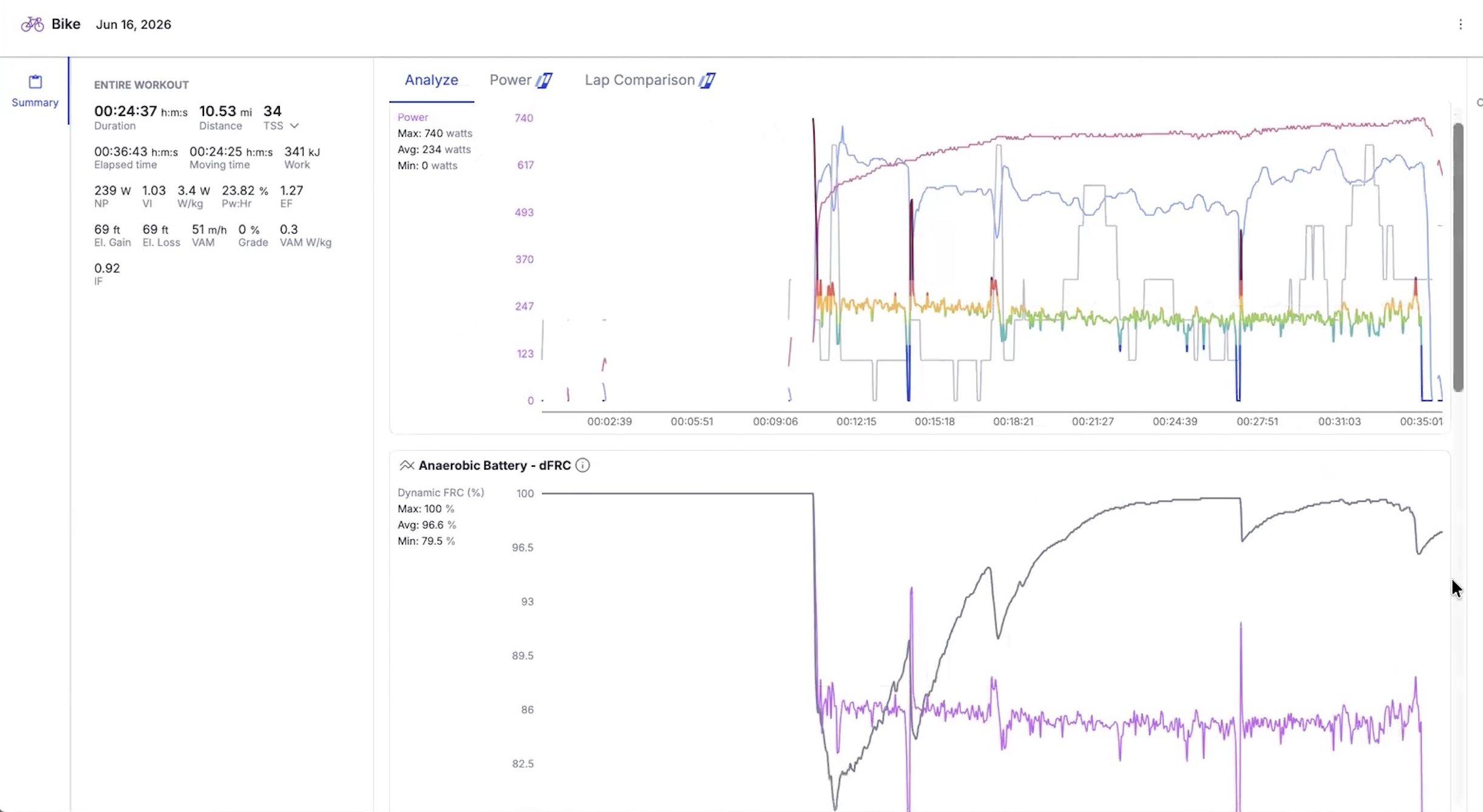
The takeaway: both races draw meaningfully on anaerobic capacity, but the aerobic system is the backbone that allows the rider to keep producing power and recovering between efforts, race after race, lap after lap.
The Benefit Of Improving FTP For Criteriums
After looking at the aerobic and FRC responses to criterium efforts, let’s examine how improving FTP pays off in a real-world criterium even though it’s characterized by repeated hard surges.
► Free Cycling Training Assessment Quiz
Take our free 2-minute quiz to discover how effective your training is and get recommendations for how you can improve.
For simplicity’s sake, let’s say every surge in a crit hits 600 watts, and you’re otherwise pedaling around 250–300 watts. If your FTP is 300 watts, each surge to 600 watts represents 300 watts of anaerobic contribution above threshold.
Now, with training you raise your FTP to 330 watts. Those same 600-watt surges now only represent 270 watts above threshold.
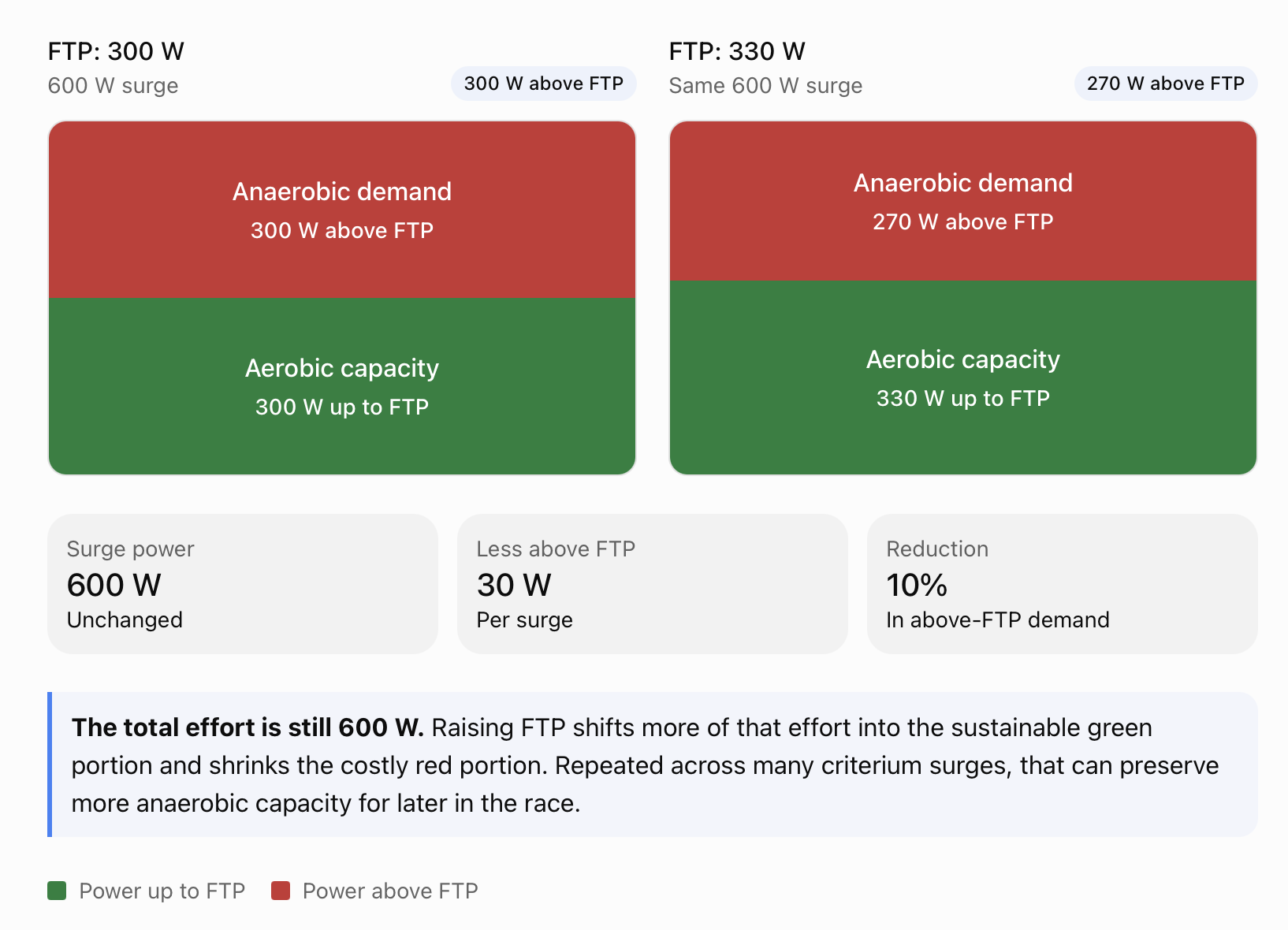
That 30-watt difference in FTP matters a lot, because fatigue accumulates disproportionately once you’re over threshold. The higher your FTP going into criterium season, the less fatigue you accumulate from each surge, and the better you’ll hold up late in the race.
To be clear: The importance of aerobic conditioning and a high FTP doesn’t mean you can skip anaerobic training. The dFRC chart clearly shows a heavy anaerobic contribution during criteriums, and if you neglect that hard, punchy work you’ll get spit out the back as soon as the attacks start, no matter how high your FTP is. The point isn’t to abandon anaerobic work. It’s that a lot of crit racers overemphasize anaerobic training relative to aerobic training.
Rider Types: Sprinters vs. Breakaway Riders
Functional Threshold Power matters more for some riders than others. There are two main types of riders in criteriums:
- Sprinter-type crit racers are the riders who live for criteriums. They excel in punchy, technical races that feature lots of accelerations. And they love to see the race end with a bunch sprint or small-group sprint. They tend to be less strong at long, sustained efforts, the kind that require a bigger FTP and long time-to-exhaustion (TTE).
- Breakaway riders love long, sustained efforts. In terms of athlete phenotype, they’re generally more aerobic and have less anaerobic capacity than the classic sprinter-type racer. Breakaway enthusiasts thrive on riding away from the pack to drop the sprinters and improve their odds in a reduced field.
Some riders are genuinely strong at both. Although that’s a rare combination, riders who can combine the aerobic strength and long time-to-exhaustion of a breakaway rider with the final-lap punch of a sprinter tend to do very, very well in criteriums!
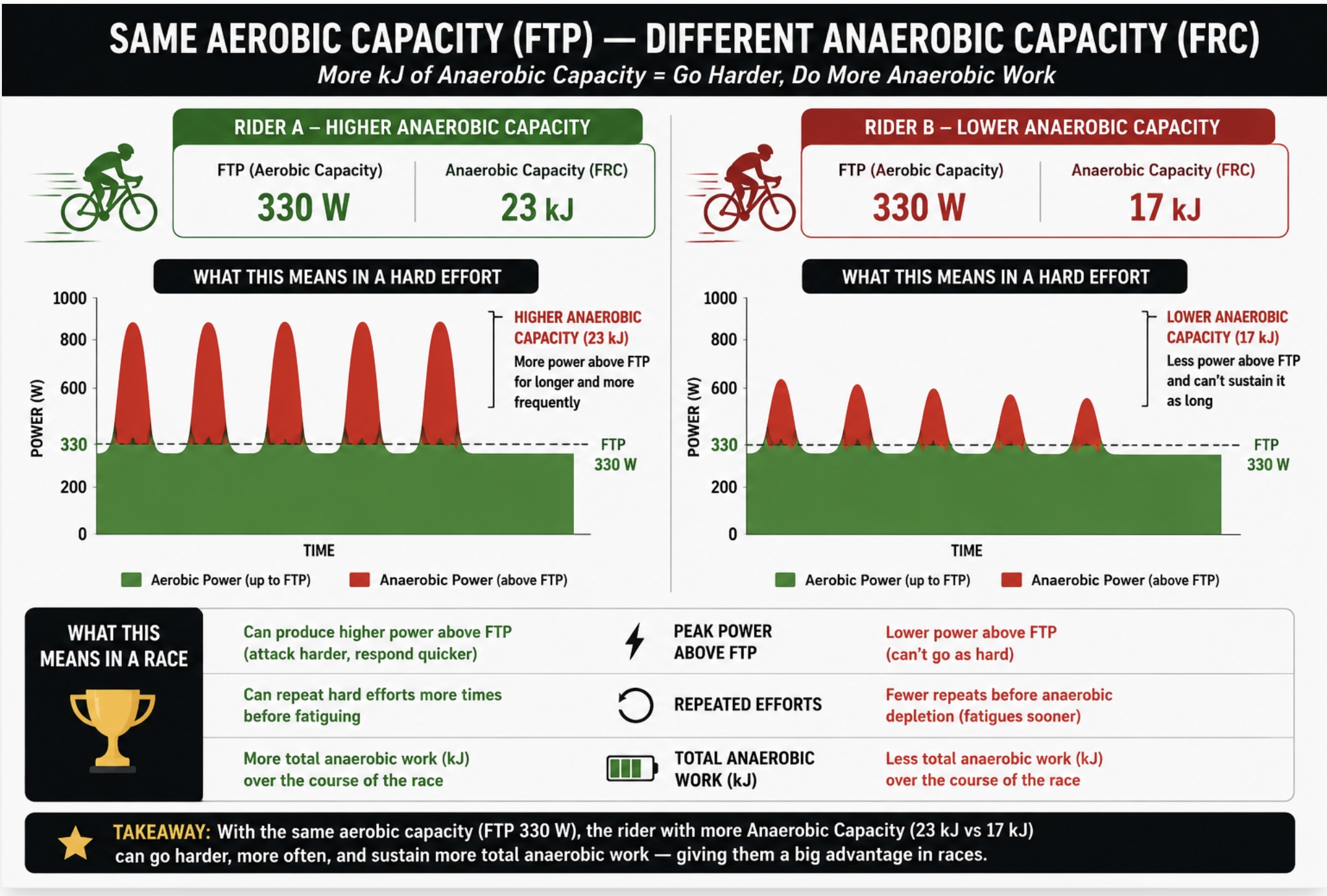
The image below illustrates how sprinters (Rider A) and breakaway riders (Rider B) fare during criteriums. Assuming both riders have the same FTP of 330 watts, the sprinter with greater anaerobic capacity can do more work above FTP and can handle more repeated high-power efforts. Breakaway riders are at a disadvantage when there are repeated high-power efforts, but can turn the tables on the sprinters by keeping the pace steady and very high.
If You’re a Sprinter-Type Criterium Racer
The best strategy for a sprinter-type crit racer is to build a strong aerobic base early in the season, leading into a longer block of FTP work. You want your FTP to reach its highest point about 10-12 weeks out from your high-priority racing block.
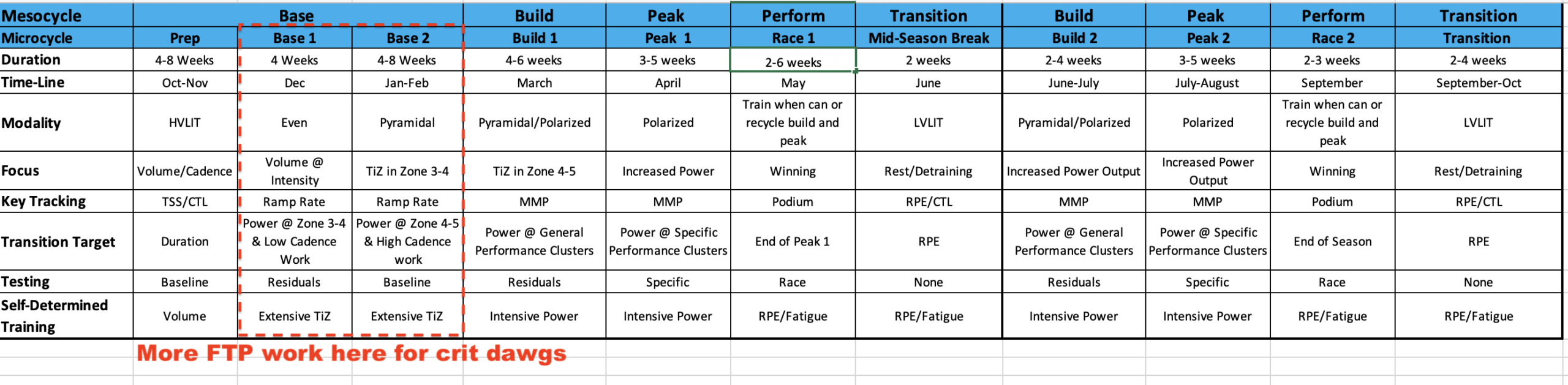
Build your FTP first, then shift focus to VO2 max work, on/off intervals, and sprint training about 8–10 weeks out from your first race block, heading into your peak phase. If you do that, you’ll likely have the FTP to power a great crit season.
If your preparation was lacking, you may find yourself fatiguing in the closing laps or fading after responding to big attacks. These are telltale signs that your FTP is too low and that the repeated surges are taking too much out of you. If that’s the case, your best race strategy will probably be sitting in and waiting for the sprint (more on that later).
If You’re a Breakaway Rider
If you’re FTP is high, you have a robust time-to-exhaustion at FTP, and you thrive on long, sustained efforts but keep getting swarmed in the final sprint, you’ll likely benefit from more anaerobic training throughout the season.
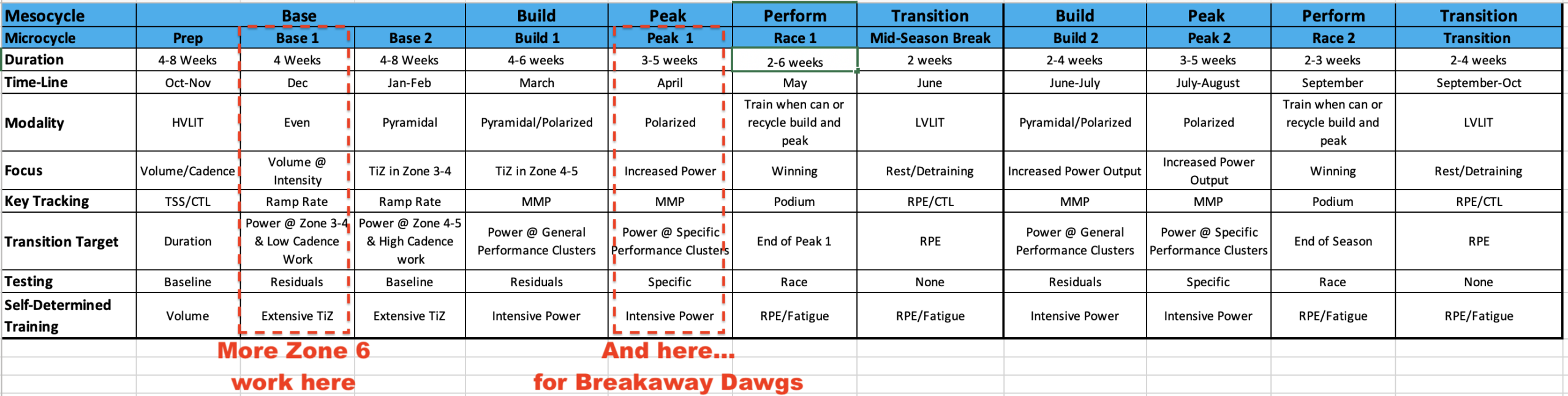
Start incorporating anaerobic work in the late base and early build phases, alongside your typical Tempo, Sweetspot, and threshold work. Build a block of intensity during your base phase, another in the build phase, and then swing back toward higher-intensity threshold work before shifting into criterium-specific anaerobic training (e.g., VO2 max, on/offs, and sprint work) in the final 6–8 weeks before your big crit block.
Work on Your Race Craft!
Finally, it doesn’t matter how big your FTP is or how hard you can sprint if you can’t actually drive your bike in a pack. To race successfully, you need to refine your cycling skills, race more often, and spend more time riding in fast groups.
More intervals, long rides, sprint training, or torque training won’t help you with race craft. And I’m sorry to say that e-racing on an indoor trainer has very limited utility for improving outdoor race craft. Racing outside teaches you to race outside. Group rides help with race tactics. Skills clinics with professional coaches build confidence in corners or in sprints and help reduce anxiety.
There are plenty of super-fit riders who don’t know how to race. If that’s you, I encourage you to invest in practice instead of piling on more interval workouts. Do more group rides, skills clinics, and fun race games. Find your people: local bike shops, Facebook groups, local clubs and teams, or even a group chat where people organize rides. Get out there. It will improve your confidence, your skills, and your enjoyment of the sport far more than another interval session will.
I coach a lot of juniors and U23 riders. If you’re young or new to the sport, there may be a season or two where you set aside the perfect training plan in favor of just racing more. It’s a matter of getting smarter, gaining experience, and building race craft. You can layer in FTP and sprint work after that foundation is in place.
The Bottom Line
Don’t make the mistake of thinking that success in criteriums is all about anaerobic capacity and a strong sprint. Criteriums are mostly aerobic with a significant contribution from the anaerobic system. A highly developed aerobic engine and a robust FTP mean you can do more work aerobically before calling upon your very limited “anaerobic battery”.
- Breakaway riders: You may need to train FTP less and anaerobic capacity more.
- Sprinter-type riders: You probably need to train FTP more than you think and train it further out from your race block so you sustain it through the race season.
- All criterium racers: If you’re fit but struggle with results because of your skills or race craft, ease off the solo interval work and get to group rides and skills clinics.
All three pieces — aerobic development, anaerobic sharpness, and race craft — work together to set you up for what really matters: racing your bike and having fun.
► FREE Mini-Course: Learn How to Maximize Your Limited Training Time
Learn step-by-step how to overcome limited training time and get faster. Walk away with a personalized plan to increase your performance.
"*" indicates required fields
About the Author
Adam Pulford
CTS Head Cycling Coach
Adam Pulford is a dedicated coach at CTS with a passion for elevating athletic performance through tailored, measurable strategies and a deep understanding of the “why” behind each athlete's goals. With nearly two decades of experience, a degree in Exercise Physiology, and a successful track record managing professional cycling teams, Adam also shares his expertise as the host of the Time-Crunched Cyclist podcast, providing actionable insights for endurance athletes.