
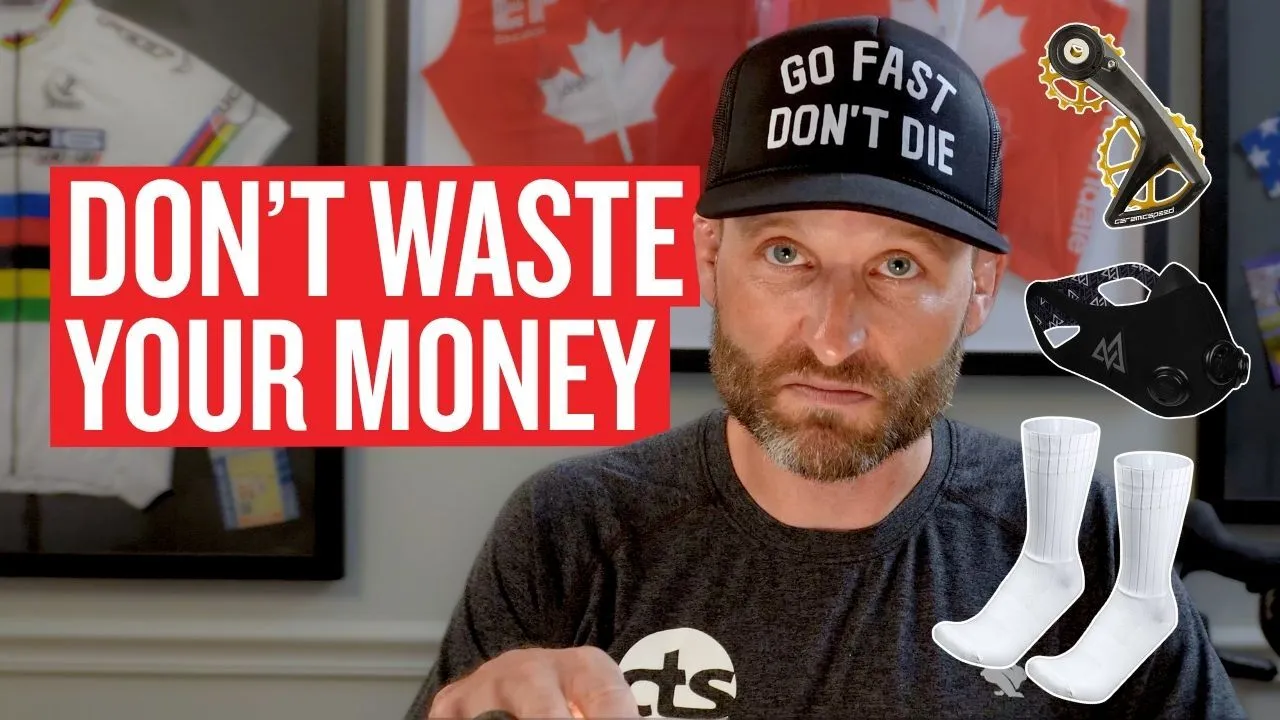
7 Cycling Products That Aren’t Worth Buying

Updated On
October 12, 2026
CHOOSE YOUR FORMAT
►WATCH THE VIDEO
►LISTEN TO THE PODCAST
►READ THE ARTICLE
7 Cycling Products That Aren’t Worth Buying
Cycling can be an expensive sport, but you can make it outlandishly expensive by wasting money on cycling products that neither make you faster nor improve your experience on the bike. We’re not here to judge you for buying things you want. It’s your money, after all. But if you think money buys speed, we have some myths to bust. Based on 20-plus years of experience coaching amateur and elite cyclists, plus current research, I’ve ranked the 7 worst things you can spend your money on when it comes to performance per dollar.
Wasteful Cycling Product: The Latest Supplement Stack
Most supplements are a waste of time and money. Don’t take my word for it. The Australian Institute of Sport (AIS) and the International Olympic Committee (IOC) have examined the efficacy of nutritional supplements extensively. The AIS Sports Supplement Framework has three guiding principles:
- Is it safe?
- Is it permitted in sport?
- Is there evidence that it “works”?
Based on those principles, AIS groups supplements into four groups: A, B, C, and D:
- Group A: Strong Evidence to support that an ingredient for a supplement may work for an athlete. There are only a handful of supplements that fit into Group A: caffeine, beta-alanine, dietary nitrate/beetroot juice, sodium bicarbonate, creatine, and glycerol.
- Group B: Emerging evidence and scientific support but further research required. Some popular but unproven supplements fit into Group B: Ketone supplements, probiotics and prebiotics, carnitine, fish oil, Vitamin C, and Pickle Juice.
- Group C: Little to No Evidence of a performance benefit, or the ingredient has not been researched enough yet. Almost everything that’s not illegal fits into Group C, mostly because of a lack of research. Well-researched supplements in this group include branched-chain amino acids (BCAA), glucosamine, magnesium, Co-Enzyme Q10, and ß-hydroxy ß-methylbutyrate (HMB).
- Group D: High Risk or Banned Substance. Anything claiming to be a testosterone booster or ATP booster is usually in Group D because of the probability of contamination with illegal substances. The AIS list of Group D supplements includes stimulants, prohormones and hormone boosters, and some peptides.
Coach Insight: You shouldn’t spend more time mapping out your supplement strategy than your training strategy. A better recommendation is to consult a Sport Dietician, even if you think your diet is pretty good. A professional can make sure you’re eating enough total calories to support your training, and cycling your macronutrients to match your specific energy demands throughout the year.
Wasteful Cycling Product: Multiple Wearable Sensors
I covered the issue of wearable sensors and mostly fictitious “training readiness scores” in a previous article and video. Here’s the short version. Some wearables can be helpful for monitoring and improving your sleep habits and daily routines, and for helping increase awareness of how your body is feeling and functioning.
The “readiness scores” provided by these sensors are not as useful as the raw data, provided you can track the trends in the data over time. The readiness scores use proprietary calculations without much transparency about what they’re prioritizing. Raw data trends over time can be compared to other quantitative and qualitative training data, how you feel, and how your training is going. Tracking all three: recovery data, training data, and how you feel is the best option. The worst option is using multiple devices that present varying and conflicting information about the quality of your training, recovery, and sleep.
Coach Insight: Multiple readiness scores cause a ton of noise and confusion. The better option, if you’re going to use a wearable sensor, is to choose one system/device and track data daily alongside training data and subjective feelings. Give yourself at least two months of consistent data tracking before making substantive decisions based on the wearable sensor data.
Wasteful Cycling Product: Ketone Supplements for everyday training & recovery
Many millions of dollars have been spent on marketing for ketone supplements, and a ton of research studies have been completed. Here’s the thing about the research… not only has it yielded mixed results in terms of improving endurance performance, but researchers keep expanding the scope of studies trying to find a meaningful benefit that will justify the product’s use.
The basic claim is that rapidly increased B-hydroxybutyrate [BHB] levels in the blood from exogenous ketones “could” provide an alternative, oxygen-efficient fuel source to the brain and muscles during exercise. However, when you control for equal energy intake with carbs, or carbs + ketones, or just ketones alone, and test time trial performance, ketones do not provide any extra benefit for endurance athletes. You can read some a good article from Asker Jeukendrup and there are additional references at the bottom of this article.
For recovery, ketones show mixed results, too. At best, there could be a benefit in signaling for mTORC1, which is a primary regulator for recovery and metabolism. High doses of ketone esters may increase your body’s production of erythropoietin (EPO), as well. These potential benefits sound promising, but are not yet supported by strong evidence.
“But, it doesn’t hurt, right?” Perhaps, but ketone supplementation with high quality products and in the doses required can hurt your wallet. Delta-G Ketone Ester, at 20-25g in each bottle, will cost about $30-45 per serving. KetoneAid Ester in 25g doses costs about $25-30 per serving.
Coach Insight: If you don’t have a ketone supplement sponsorship, the cost relative to the potential gain isn’t worth it. I coach age group athletes who buy the stuff and elite athletes who have sponsorships. I haven’t observed any benefit to their performances or recovery. I’d rather athletes focus on consuming adequate carbohydrates relative to training energy expenditure, focusing on recovery nutrition, and getting more sleep.
Wasteful Cycling Product: Cryotherapy Sessions for Recovery
Cryotherapy and ice-cold water plunges do not accelerate full body recovery or improve next-day performance in training or competition (Costello et al. 2015). Post-workout recovery takes time. There are a few ways to shorten that process, but most are free and available in your home.
Cold water immersion after training, particularly after high-intensity or high-heat sessions and competitions, can be very relaxing and an effective way to decrease core temperature and inflammation. Cold water immersion (50-60 degrees Fahrenheit for 5-15 minutes) immediately after training is good for reducing core temperature, which helps restore homeostasis after workouts and races.
Alternatively, there’s strong evidence that ice plunges following strength training can impair muscle repair and adaptations. Additionally, for endurance athletes, elevated inflammation markers don’t mean you’ll have poor performance the next day.
Coach Insight: Going out of your way for cryotherapy sessions or purchasing an elaborate cold plunge set up is a waste of money. The results aren’t there in terms of speeding up recovery. Cooling down after a hot and/or intense workout is a good idea, but you can accomplish that with your own shower, bathtub, or nearby creek.
► Free Cycling Training Assessment Quiz
Take our free 2-minute quiz to discover how effective your training is and get recommendations for how you can improve.
Wasteful Cycling Product: Ceramic Bearings and Oversized Pulley Systems
Before you come after me with pitchforks, there’s an important caveat here. Ceramic bearings and oversized derailleur pulley systems are a waste of money if you are also neglecting basic bike maintenance. In ideal circumstances, these equipment upgrades can reduce energy loss from drivetrain friction. My issue is the cost-per-watt. Saving about two watts for $700 worth of parts is a difficult ask when most amateur cyclists can gain 20-30 watts at FTP through 6-8 weeks of proper training. And while you’re doing that training, cleaning your standard drivetrain and using a high-quality lubricant or wax will yield similar energy savings. Even Ceramic Speed, who makes these products, is transparent about the relative influence that cleaning components can have compared to oversized pulleys and ceramic bearings. Read “10 Ways to Minimize Drivetrain Friction” on their site. I’m a fan of Ceramic Speed and similar companies, I just see a lot of people on the group ride who give away a lot of watts by neglecting basic maintenance.
Coach Insight: If you’re looking to optimize mechanical efficiency, talk to your mechanic. A good mechanic (not just a good salesperson) will look at the likely places where you’re losing watts: wheels, hubs, bottom bracket, chain and cassette. You need to replace worn items anyway, and replacing standard components and keeping your drivetrain clean will be the most cost-efficient way to make your bike faster.
Wasteful Cycling Product: “Altitude” Training Masks
The reason “altitude” is in quotes is because there’s a difference between reducing the partial pressure of oxygen in the air you’re breathing and simply reducing airflow. Many of the masks marketed as altitude training masks just reduce airflow. They’re more like suffocation training than altitude training.
In a six-week cycling study, a reduced airflow mask did not produce changes in hemoglobin or hematocrit. Researchers concluded the mask acted more like a respiratory training device than an altitude simulator. Some outcomes improved, so “completely useless” would overstate the evidence. But the altitude pitch fails.
Coach Insight: If you want to improve the oxygen-carrying capacity of your blood, there are more effective ways to do it. Obviously, an altitude camp is an option, but that’s expensive and time consuming. There’s reasonable evidence that consistent heat exposures (sauna and/or hot water immersion) can provide some of the same hematological adaptations as altitude training. And if you really want to spend money on an altitude intervention that may or may not work, you can try an altitude tent that allows you to sleep in a hypoxic environment (reduced partial pressure of oxygen). An altitude tent can be effective, unless your sleep quality and hours drop because of the tent environment.
Wasteful Cycling Product: Aero Socks
I know several athletes I coach will be mad at me for saying this, but not all “aero” socks are fast, and no aero sock will help you more than learning to draft, corner at speed, and time your attacks and efforts for maximum effectiveness.
Here’s what the data below shows: Some socks provide a wattage savings. Others don’t. And still others COST your watts. Worse yet, it’s hard to tell by just looking at the socks themselves.
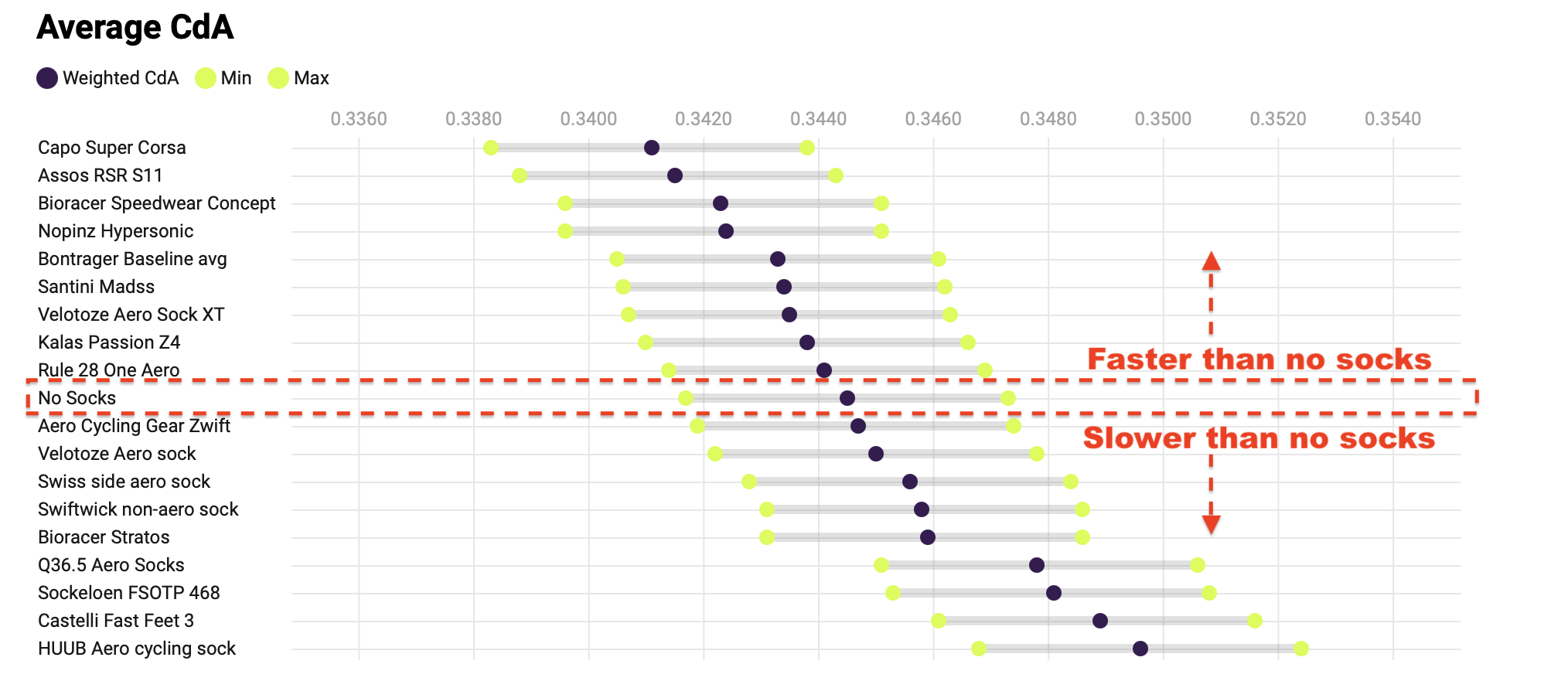
Source: Cyclingnews.com – We took 16 pairs of aero socks to the wind tunnel to find which was fastest, and we’re still shocked by the results
Coach Insight: Aero socks are the perfect storm of wasteful spending. They aren’t that expensive, they look fast and reasonably cool, and it’s difficult to tell whether they’re helping or not. Socks are easy to buy. Improving bike handling skills and pack riding tactics is harder. Knowing which aero socks are actually fast is important, but knowing how to actually ride is more important. What’s a better purchase? Three sessions with a skills coach who can help you work on drafting, rotating in a group, taking corners smoothly. Or, get a professional bike fit to reduce your frontal area!
Bottom Line
Buying new stuff is fun, and if you have the funds then buy whatever you want! But understand that the greatest investments you can make are time (more training time and more sleep time), consistency (fewer missed workouts and fewer long periods away from training), quality (better plan, focused workouts, better food, better sleep), and guidance (hey, I have to recommend coaching at some point)
Resources:
Costello, J. T., Baker, P. R., Minett, G. M., Bieuzen, F., Stewart, I. B., & Bleakley, C. (2015). Whole-body cryotherapy (extreme cold air exposure) for preventing and treating muscle soreness after exercise in adults. The Cochrane database of systematic reviews, 2015(9), CD010789.
Siri, Morvarid et al. “The science of ketogenic supplements for athletes: boosting endurance, efficiency, and energy metabolism.” Nutrition & metabolism vol. 23,1 11. 14 Dec. 2025, doi:10.1186/s12986-025-01067-z
Valenzuela, Pedro L et al. “Perspective: Ketone Supplementation in Sports-Does It Work?.” Advances in nutrition (Bethesda, Md.) vol. 12,2 (2021): 305-315. doi:10.1093/advances/nmaa130
► FREE Mini-Course: Learn How to Maximize Your Limited Training Time
Learn step-by-step how to overcome limited training time and get faster. Walk away with a personalized plan to increase your performance.
"*" indicates required fields
About the Author
Adam Pulford
CTS Head Cycling Coach
Adam Pulford is a dedicated coach at CTS with a passion for elevating athletic performance through tailored, measurable strategies and a deep understanding of the “why” behind each athlete's goals. With nearly two decades of experience, a degree in Exercise Physiology, and a successful track record managing professional cycling teams, Adam also shares his expertise as the host of the Time-Crunched Cyclist podcast, providing actionable insights for endurance athletes.