

Coaching Counterpoint: Personalization Is About More Than Workouts

Updated On
March 7, 2025
By Jim Rutberg,
CTS Pro Coach, co-author of “Ride Inside“ and
“The Time-Crunched Cyclist”
Sports science and coaching professionals read and report on many of the same research papers, sometimes with different interpretations. A scientist and writer I respect a great deal, Alex Hutchinson (author of “Endure” and the Sweat Science column for Outside Online), recently reported on a study that investigated personalization of workouts and “trainability”, or the inter-individual differences in how people respond to training stimuli. The headline, “The Case Against Personalized Workout Plans”, is provocative but may warrant a different take.
About the study
The review study in question, “Standard Deviation of Individual Response for VO2max Following Exercise Interventions: A Systematic Review and Meta‑analysis” included 24 experimental studies involving adult participants doing supervised, structured exercise. Specifically, the included studies measured VO2 max, were looking at changes in VO2 max (absolute or relative) from pre- to post-training intervention, and included non-exercise control groups.
For background, researchers have investigated the idea of inter-individual differences in training response (i.e., “responders” vs. “non-responders”) for a long time. We’ve all known athletes who appear to make rapid progress while others take longer. Or athletes who appear to respond to specific types of training (e.g., short, high intensity intervals) more readily or to a greater extent than others. The research question is why? Are the differences due to genetic factors, athlete phenotypes, or the personalization of workouts? Of those three, personalization would be the easiest to affect through training.
Study Findings
Alex Hutchinson does a great job of explaining the findings of the review study: “The main analysis compares the standard deviations—a measure of how much individual variation in response there is—for the changes in VO2max in the exercise group and the control group. If there’s true individual variation in response to exercise, then the standard deviation should be bigger in the exercise group than the control group. If the standard deviations are the same, it suggests that the response is uniform across individuals.”
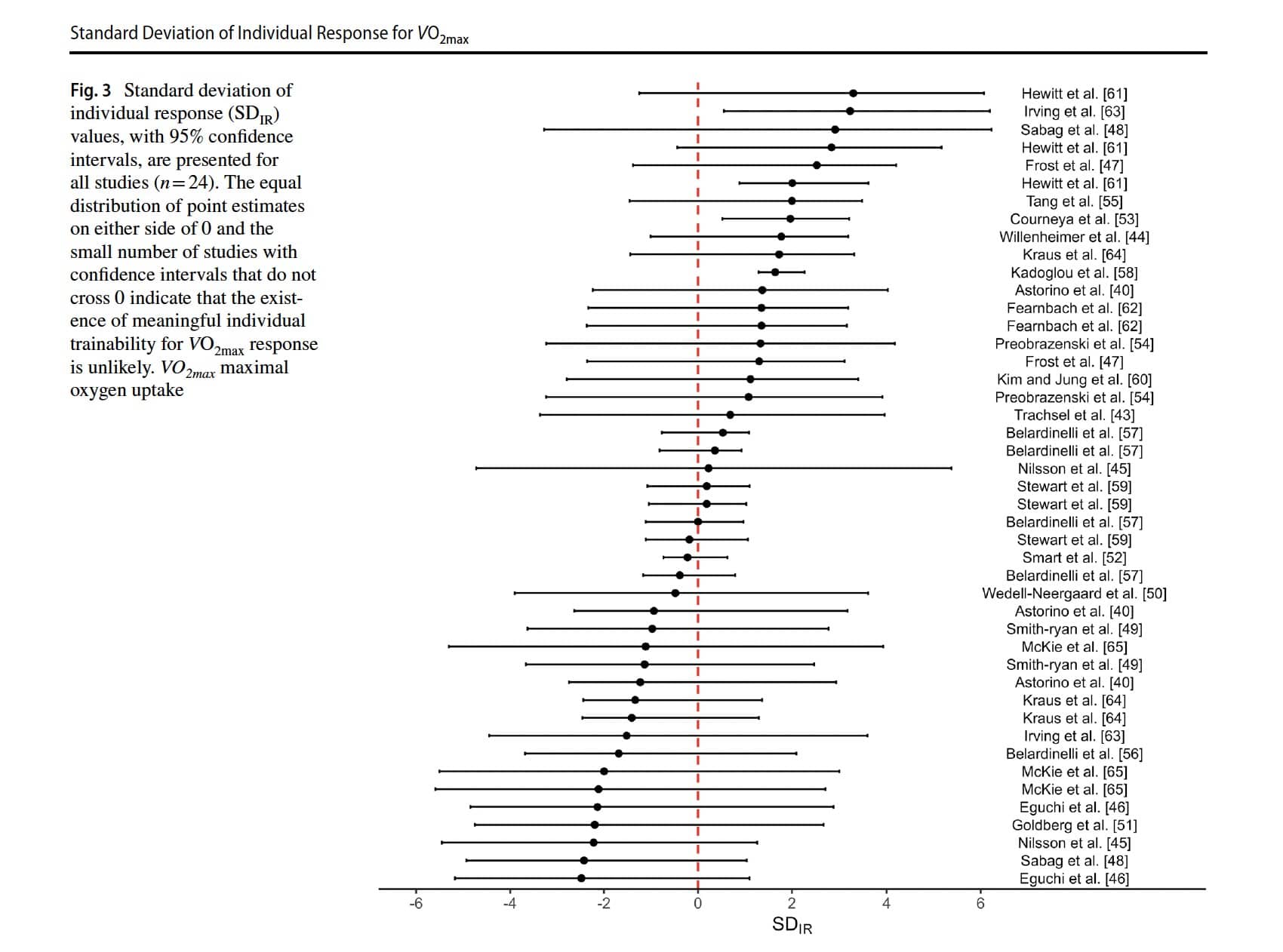
The figure below is from the review study. Black dots to the right of the red line indicate that standard deviation was bigger in the exercise group, which supports the idea of individual variation or “trainability” of VO2max. Black dots to the left of the red line indicate the opposite. The results are almost evenly split to the left and right of the red line, and researchers concluded “the existence of meaningful individual trainability for VO2max response is unlikely”.
Is this the end of personalized training plans?
No. This research essentially says that training plans based on proven sports science principles and designed to improve VO2 max are likely to work equally well for most athletes. But improving VO2 max is only one component of performance. And even if you could extrapolate these findings to say that well-devised plans to improve any individual component of performance (e.g., Functional Threshold Power, anaerobic capacity, maximum sprint power, etc.) all work equally well, the improvements are still limited to physiological metrics. They are also limited to standardized training plans that require strict compliance, which is almost always unrealistic for real-world athletes.
► Free Cycling Training Assessment Quiz
Take our free 2-minute quiz to discover how effective your training is and get recommendations for how you can improve.
What is the value of personalization?
The value of a personalized training plan is not necessarily to leverage inter-individual variability in how you respond to training. We know your performance metrics will improve when you consistently follow a training plan built on proven sports science principles. The tricky part is integrating those principles and that plan with your actual lifestyle. Real athletes don’t live in physiology labs and training almost always takes a back seat to work and family priorities (as it should be, in most cases). The value of personalized training plan, then, is to best align actual behavior to ideal training conditions. Real training is never perfect, nor is sleep, nutrition, or stress management. Personalization aims to mitigate the consequences of these imperfections and maximize the effectiveness of the behaviors you do execute.
How this study relates to coaching
I should make absolutely clear that I agree with Alex’s analysis or explanation of the study. My issue is in how I think athletes might interpret the study’s findings. It would be a mistake to interpret this study to mean that “any old training will do” because individualizing workout plans doesn’t increase the likelihood of greater improvements (at least in VO2max). But that interpretation is probably the biggest risk associated with this study, because it leads athletes to dismiss the value of individualizing any or all other aspects of training and preparation.
At CTS, our philosophy has always been that workout plans are necessary and must be well devised, but they are not the greatest source of value we provide to athletes. That’s why we’ve invested in developing great coaches and not a library of pre-made training plans. A good training plan – with or without a lot of individualization – will only improve performance so far. Coaching engages the entire person, which means we must consider all aspects of your life. We cannot coach you as an athlete without considering your lifestyle, career, and relationships outside of sport. And it goes beyond integrating your training plan into your personal and professional schedules. We’re talking about balancing priorities, understanding your personality, learning how you respond to feedback, how you express yourself, what adds to your confidence and what diminishes it, and much more.
So, is “The Case Against Personalized Workout Plans” bad news for coaches or coached athletes? No, if anything it highlights where the true value of coaching sits, and it’s not in “secret sauce” training plans.
Reference:
Renwick, John R M et al. “Standard Deviation of Individual Response for VO2max Following Exercise Interventions: A Systematic Review and Meta-analysis.” Sports medicine (Auckland, N.Z.), 10.1007/s40279-024-02089-y. 19 Aug. 2024, doi:10.1007/s40279-024-02089-y
► FREE Mini-Course: Learn How to Maximize Your Limited Training Time
Learn step-by-step how to overcome limited training time and get faster. Walk away with a personalized plan to increase your performance.
"*" indicates required fields
About the Author
Jim Rutberg
CTS Pro Endurance Coach
Jim Rutberg is a seasoned coach and endurance athlete with over two decades of experience, having co-authored ten influential books on training and nutrition, including “The Time-Crunched Cyclist”, "Training Essentials for Ultrarunning", and "Ride Inside." His unique blend of academic knowledge, elite racing experience, and hands-on coaching at CTS positions him as a leading expert in endurance sports, dedicated to helping athletes reach their highest potential while balancing family life and personal passion for cycling.
Comments 1
When your CTS coach asks you on your weekly phone call, “how are you”? and sometimes twice, if they don’t think you are being honest, with your 1st reply. Coaches ask about your lifestyle activities, to plan/determine next week’s training, and beyond. This value of “personalized” coaching takes STARTS, then. Coaches know if you have more energy to perform more intervals next week. In addition they may ask “give me one more week”, if you/ the athlete are on the edge. With enthusiasm, you’ll likely hear “ you’ll like the results”. The secret sauce is your coach.