
How to Build The Best Recovery Weeks for Cyclists
Updated On
August 10, 2026
CHOOSE YOUR FORMAT
►WATCH THE VIDEO
►LISTEN TO THE PODCAST
►READ THE ARTICLE
Best Ways To Build Recovery Weeks for Cyclists
Recovery weeks sound like the easiest part of training to get right. Take a week off. Rest until you feel fresh and ready to train again. After 20 years of coaching cyclists, I can tell you athletes mess up recovery more than anything else. Even athletes who whole heartedly believe recovery is necessary to make progress mess it up. Why? Because they’re not scheduling it the right way.
Restructuring your recovery blocks can be a huge gamechanger for your training, without adding more training hours or intervals. I’ll show you how I structure recovery blocks for my athletes and provide practical tips that you can apply to your training to get the intended response: increased fitness, freshness, & performance, and tons of fun for several years to come.
First Step: Replace “Recovery Week” with “Recovery Block”
The term “recovery week” is antiquated. It implies athletes always need a full week of recovery when that’s not true. It suggests that a period of recovery needs to align with a seven-day Monday – Sunday calendar week. Furthermore, it lulls people into the pattern of scheduling a certain ratio of “training weeks” to “recovery weeks”. The common “3 weeks on, 1 week off” pattern that dominates static training plans is an example. Ironically, that pattern originated in Eastern Bloc countries to accommodate the use of performance enhancing drugs, and it worked reasonably well even without the drugs, so it stuck. Even ChatGPT and Claude tend to structure training by the 3:1 paradigm because that pattern dominates the materials those models were trained on.
Replacing “recovery week” with “recovery block” may seem like a silly semantic change, but it makes a big difference in athlete conversations.
For athletes who have been training a while or beginners who want to start a smarter way, its ok to be more nuanced and personalize training to your physiology and the work you’re doing (assessed by TSS, ATL, CTL, etc.). It’s better to schedule recovery based on workload and fatigue rather than arbitrary ratios.
Key Concept: Base Recovery Blocks On Cumulative Stress
When you are in a hard, race-specific phase of training you might need a recovery block after two weeks because of the combination of intensity and volume. Or, during the Base and Build phases when most rides are in Zone 2 and we’re trying to push aerobic capacity up, you may be able to absorb five to six weeks of training with key rest days before needing a substantial recovery block. In this scenario, the intensity is lower and volume is higher, but overall stress is manageable and meaningful for the desired adaptation.
I recommend monitoring the following metrics (includes CTL and TSB from TrainingPeaks or the analogous metrics in the software you use). When you’re in a build phase, you can use the parameters below to evaluate whether you’re doing enough work and whether it’s time for some rest. I’m not looking at one metric, but rather a constellation of inputs, including subjective feelings of mood and just, “How are you feeling?”
Is it time for a recovery block?
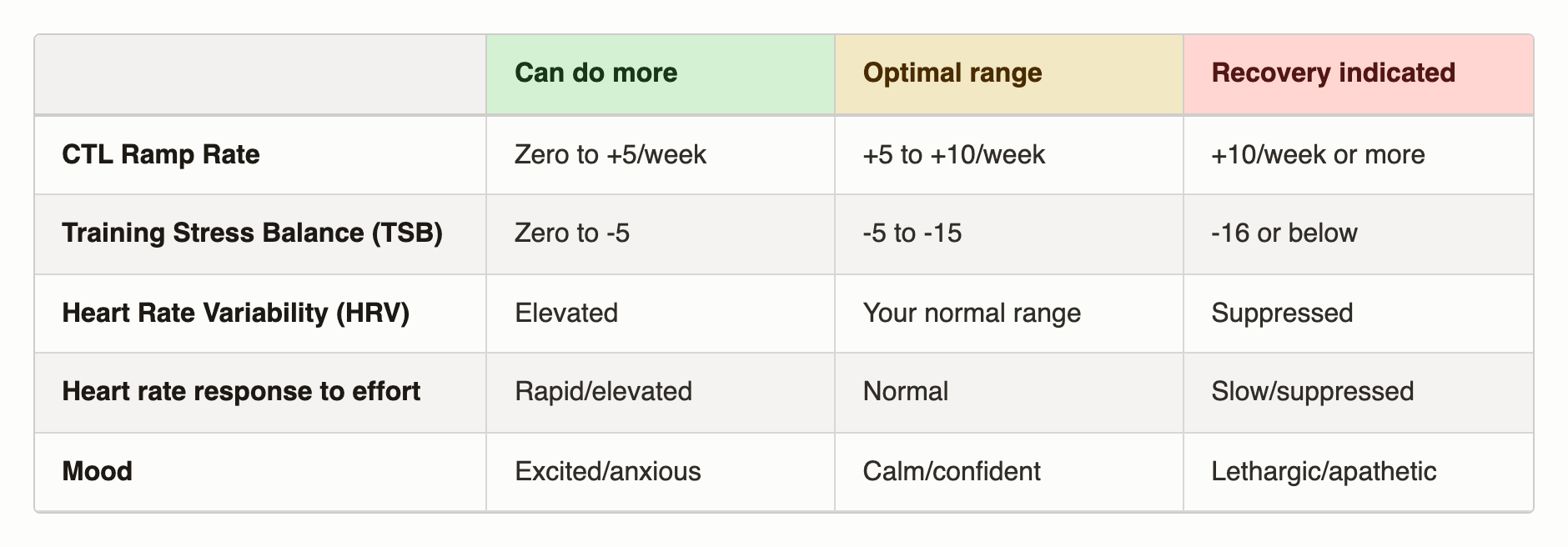
A lot of athletes rest BEFORE they’ve accumulated enough stress to stimulate the adaptation they’re after. That’s more common when rest is scheduled by a training template rather than your actual data or feedback. Which leads me to my next point: you may be recovering for too long.
Recovery Block Duration: You May Not Need A Full Week
Depending on how much you are training, total hours, TSS, race days, and how well you have been sleeping, you may be fully ready to return to training in fewer than 7 days. There can also be consequences for resting too long. Training and recovery are a balancing act. Training stimulus decays over time, and the frequency of your workouts controls how training stress layers and builds over time. This is why a training pattern of two big weekend rides and no rides on weekdays isn’t the most effective strategy. There’s too much time between training stimuli.
If your training data is in TrainingPeaks you have a good model for current fatigue. Acute Training Load (ATL) is a weighted 7-day average of training stress (compared to CTL, which is a weighted 6-week average of training stress). ATL is good for illustrating how short-term fatigue builds and rolls off.
The weighted average is what makes ATL useful. It means today’s workout has the biggest influence on fatigue and yesterday’s workout has slightly less influence. A workout from 5 days ago impacts ATL, but much less. And the work you did two weeks ago has virtually no influence (on ATL). Practically, what this means is that you can watch fatigue drop precipitously during a recovery block. For most athletes training 10 hours per week or fewer, a five-day recovery block is typically sufficient. If you’re riding 20 hours per week, ATL will be higher and you’ll need a longer recovery block to achieve meaningful restoration.
How do you know if you’ve recovered enough? There isn’t a magic number, but I like to see a 10-25% drop in ATL by the end of a recovery block. This can be influenced, however, by the duration and intensity of the training block preceding the recovery period. Along with watching ATL drop, you want to see TSB rise until it’s slightly negative (e.g., 0 to -5), again depending on training history and training goals.
Recovery Block Examples
Standardizing recovery blocks to five or seven days makes things simple, and if you need a rule of thumb to follow, then they are good starting points. If you want to be more nuanced in your approach to recovery blocks, here are four examples of how I schedule recovery blocks in specific scenarios.
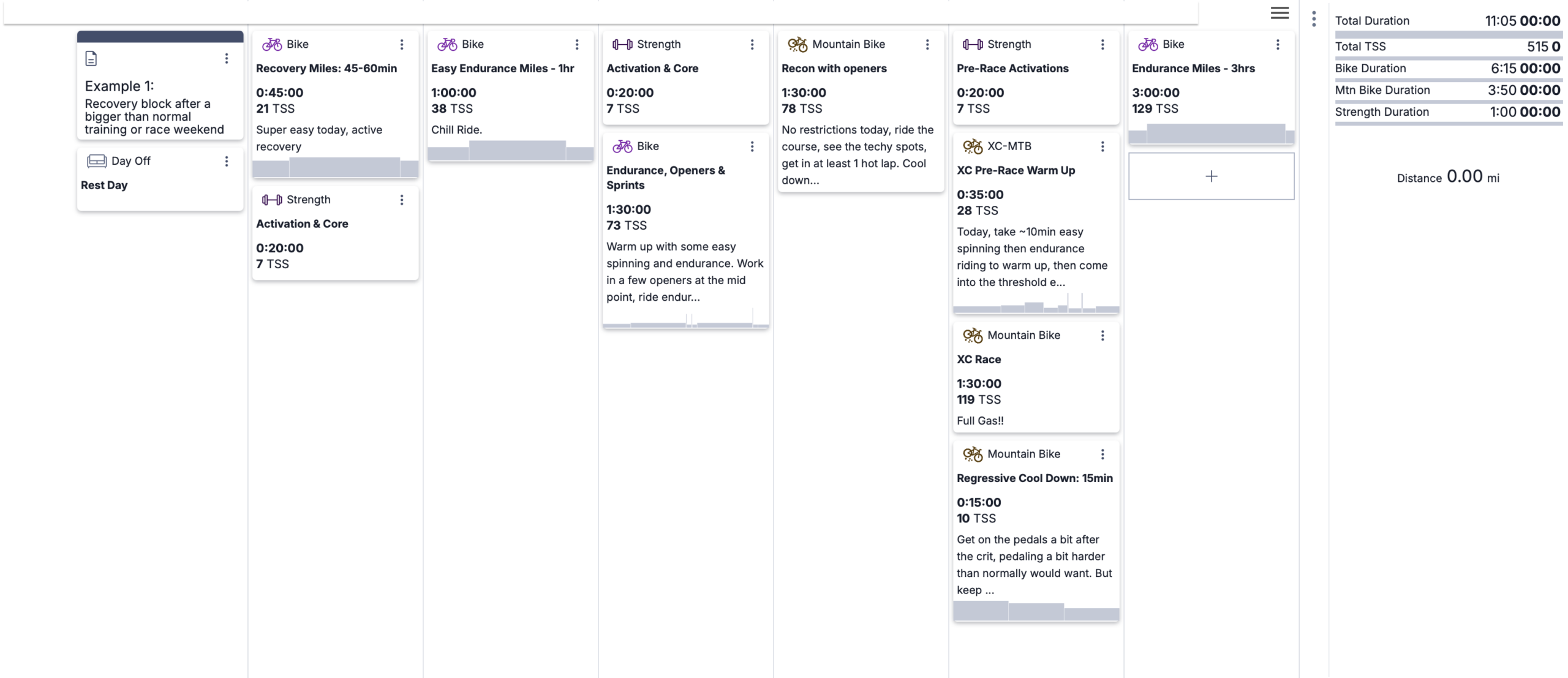
Scenario #1: You had a bigger than normal weekend of training or racing.
- Rest Day Monday
- Easy & short Tuesday, Wednesday,
- Opener day Thursday
- Back to hard training or racing Friday and into the weekend
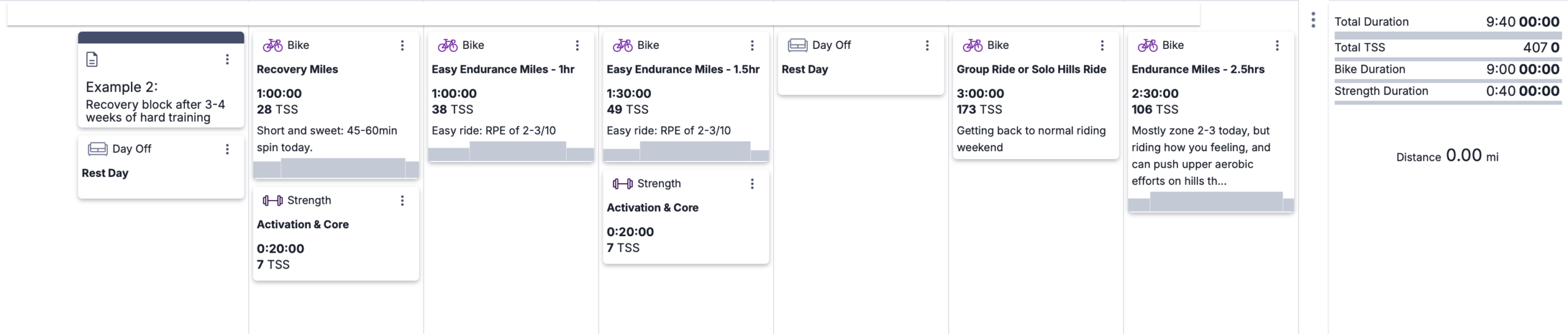
Scenario #2: Recovery block after 3-4 weeks of substantial training
► Free Cycling Training Assessment Quiz
Take our free 2-minute quiz to discover how effective your training is and get recommendations for how you can improve.
- Rest Days Mon & Friday
- Easy Tuesday, Wednesday, Thursday
- Back to normal on the weekend
Scenario #3: Recovery block ON A WEEKEND
- Friday = Off
- Short & Easy Saturday
- Sunday = Off

This scenario may seem strange, but it’s common with several of the career professionals and Time-Crunched Cyclists I work with. Although they are accustomed to piling on training hours on weekends, if once in a while we take an easy Friday, light Saturday, sleep in and rest day on Sunday, then once Monday comes around they are fresh, antsy, and ready to rip! Sometimes, not pushing yourself to the limit on a weekend with training added on top of family commitments and household tasks can do wonders for recovery.
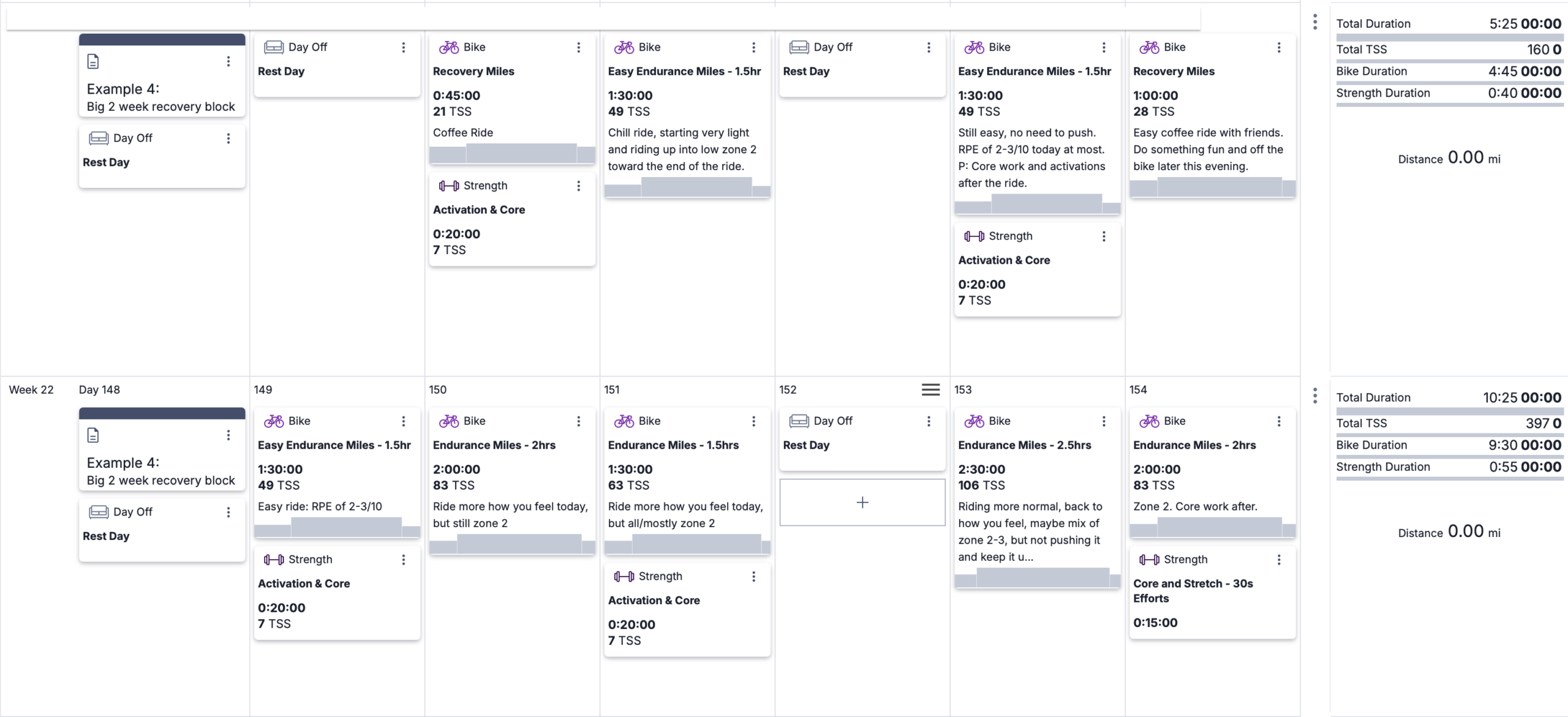
Scenario #4: The 2-Week Recovery Block
When it’s time to take a more significant recovery block, here’s how I structure it. In the first week, take three rest days or more. On the other days, ride 45-60 minutes, easy in Zone 1-2, and no more than 90 minutes if you just can’t listen. The second week, easy endurance rides, 1- to 2.5-hour rides in mostly Zone 2, with 1-2 rest days. Basically, you’re getting back into it but not training full-gas yet. Depending on the training load you built up before this recovery block, ATL should be come down rapidly in week one and then diminish more gradually during the second week.
What should rides look like during a recovery block?
For my Type-B athletes, I just tell them to keep rides easy and unstructured. In practice, this manifests as recovery rides at RPE of 1-2 and endurance rides at RPE 2-3. I don’t add cadence intervals or spin-ups or even skills work. Just keep it simple.
For my Type-A athletes who need data and prescriptions to feel comfortable and confident (and there’s nothing wrong with that!), I prescribe Zone 1-2 (40-60% of FTP) on recovery rides, and about 50% of FTP (maybe up to 70% on hills or headwinds for easy endurance rides.
Terrain can be a challenge for recovery blocks, depending on where you live. Some of my athletes who live in extremely hilly areas use their gravel or mountain bikes for recovery blocks because they have lighter gearing, or you might need to do some recovery rides on an indoor trainer.
Recovery Block Timing: Frequent, Shorter Breaks Are Superior to One Big Break
One thing I’ve changed from the way I coached athletes 15-20 years ago is how I schedule recovery blocks throughout the year. My age-group, emerging elite, and pro athletes have experienced more success from frequent, shorter breaks after big races or big blocks of training, rather than waiting to take a 1-2 month break at the end of the competition season.
Taking one to three weeks to deload after substantial training and racing blocks means athletes are fresher for the next block and hold up better year-round. These shorter breaks are good for mind and body, allowing for more enthusiasm and energy throughout the year, and helping to prevent burnout, injuries, and problems. For me, the results show it works. Most of my athletes perform better this way.
Example: A three-week mid-season break might look like this: First week is super light, the next week is easy endurance, and the volume starts to increase again in the third week, up to normal endurance rides and maybe a group ride. Overall, though, no intervals and very little structure. The concept of “deloading” is to reduce physical stress by lowering intensity and to reduce mental stress by stepping away from structure, all while maintaining good recovery and nutrition habits.
The key to this strategy, however, is that you must commit to building a big foundation of fitness early in the year. You can’t be chasing fitness in the spring and summer, because then athletes don’t have the confidence to lean into the downtime.
Final Advice: What NOT To Do During Recovery Blocks
You would think that resting is easy, but a lot of athletes mess it up. Even the pros, sometimes especially the pros! Here’s a quick list of stupid things you SHOULD NOT DO during recovery blocks:
- Stay up late because tomorrow isn’t a hard training day.
- Take on more work and home projects because you suddenly have more time. Remember, all stress is stress. Training stress gives way to adaptation if you rest. Home Depot stress just makes you tired.
- “Sprints on recovery rides?” What are you doing?! Granted, that one sprint isn’t going to ruin your entire training plan, but it’s also not likely to be a good sprint because… you’re tired. It’s pointless and is more an indication that you lack the confidence to just… rest.
- Lift heavy. A recovery block on the bike should also be a recovery block in the gym. Remember: we’re trying to GET RID of stress. If anything, do easy mobility and range of motion movements during those sessions.
Resources:
Ivy J. L. (2004). Regulation of muscle glycogen repletion, muscle protein synthesis and repair following exercise. Journal of sports science & medicine, 3(3), 131–138.
Recovery Podcast with Christie Aschwandan
► FREE Mini-Course: Learn How to Maximize Your Limited Training Time
Learn step-by-step how to overcome limited training time and get faster. Walk away with a personalized plan to increase your performance.
"*" indicates required fields
About the Author
Adam Pulford
CTS Head Cycling Coach
Adam Pulford is a dedicated coach at CTS with a passion for elevating athletic performance through tailored, measurable strategies and a deep understanding of the “why” behind each athlete's goals. With nearly two decades of experience, a degree in Exercise Physiology, and a successful track record managing professional cycling teams, Adam also shares his expertise as the host of the Time-Crunched Cyclist podcast, providing actionable insights for endurance athletes.
Comments 1
Great article. Thanks