
Ranking Workout Recovery Methods From Best To Worst
Updated On
June 24, 2026
CHOOSE YOUR FORMAT
►WATCH THE VIDEO
►LISTEN TO THE PODCAST
►READ THE ARTICLE
Ranking Workout Recovery Methods From Best To Worst
The recovery industry is worth billions of dollars. It is also built largely on athlete anxiety, the fear you’re not recovering well enough, not doing enough between training sessions, and not getting the edge everyone else seems to have.
There’s an enormous gap between what the evidence supports and what athletes spend time and money on. To close the gap, here’s a ranked, evidence-based guide to what actually works, what kind of works, and what is a complete waste of your time and money.
Before You Get Mad…
This is the kind of topic that ruffles feathers. If something you love and rely on ends up in the lower tiers, that doesn’t mean you have to stop doing it. It means it doesn’t have as much or any evidence backing up its effectiveness. If you want to keep doing it because you like it, that’s fair. Our recommendation is that you stop counting on it as a meaningful part of your recovery. Our goal isn’t to be contrarian, it’s to help you make better decisions about where to spend your time, energy, and money.
How We Ranked Recovery Methods
The content below covers a lot of items, from behaviors to foods to gadgets. We’ve ranked them into tiers based on the strength of the evidence supporting their efficacy. You can see the tiers in the image and list below:
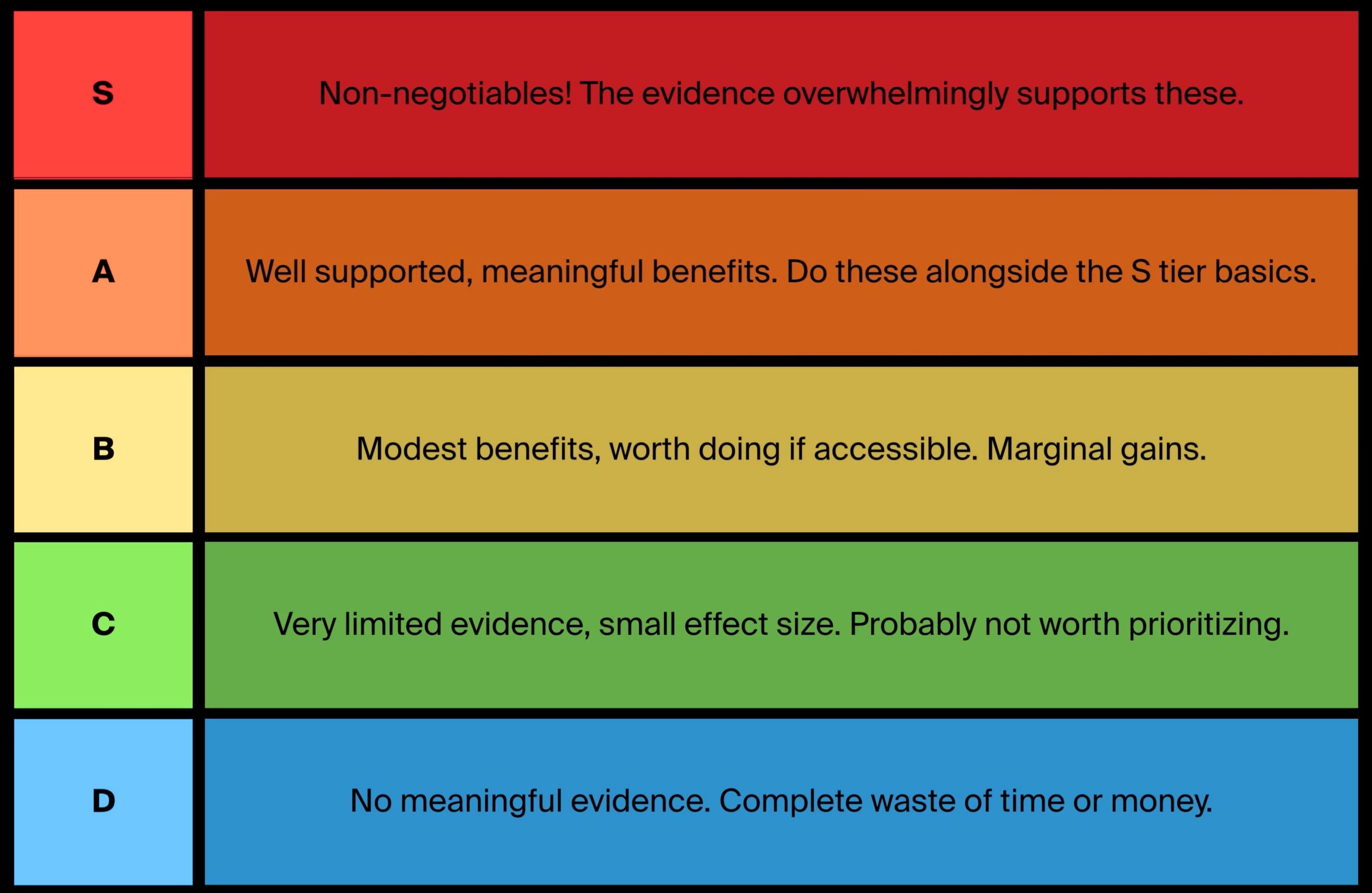
- S-Tier: Non-negotiables. Do not skip. Overwhelming evidence to support effectiveness.
- A-Tier: Well-supported with meaningful benefits. These should be high priority.
- B-Tier: Modest benefits, worth doing if accessible. Falls into “marginal gains” category.
- C-Tier: Very limited evidence, small effect size, probably not worth prioritizing.
- D-Tier: No meaningful evidence. Waste of your time or money.

S-Tier: The Non-Negotiables
Sleep
Sleep is the most powerful recovery intervention and it is completely free. During sleep, your body releases growth hormone, repairs damaged tissue, restores neuromuscular function, replenishes glycogen, and regulates immune function. No recovery intervention compensates for poor sleep. Full stop.
For athletes, the target is eight to nine hours. Evidence-backed practices to get there:
- Consistent sleep and wake times
- A dark, cool room
- No screens in the hour before bed
- No alcohol close to bedtime. Alcohol destroys sleep architecture. You may fall asleep faster, but you are not recovering the way you think you are.
Nutrition
You cannot recover from or adapt to training you haven’t fueled for. Consuming adequate calories to support your training is fundamental. Eating enough on hard and/or long training days is the primary nutritional challenge for ultrarunners sustaining higher training volumes.
Protein drives muscle protein synthesis and repair. Per the ISSN position stand on ultrarunning nutrition, the daily target is 1.6 to 2.2 grams of protein per kilogram of body weight. Best practice is to spread protein intake across the entire day. With your post-workout meal, remember that carbohydrates restore glycogen, so don’t overemphasize protein and under-consume carbohydrate after workouts.
Even with an elevated protein recommendation, most athletes can meet their protein needs because of their overall elevated calorie intake. You’re eating more, and therefore can eat more protein. If you’re struggling to reach your protein intake goals with real food, then consider protein supplements.
Hydration and Rehydration
Rehydrating post-exercise with sodium is very well supported. The fluid target is approximately 150% of fluids lost from sweat during the 4 hours after exercise. Learning your sweat rate at a range of temperatures helps you hydrate with enough fluids during exercise to keep weight loss under about 2% of bodyweight during most workouts. Then weigh yourself without clothes before and after training sessions to calculate what you need to replace. Your post-run drinks and meals should contain sodium so fluid is actually retained and used, not just flushed through.
Training Load Management
This is the most underappreciated recovery tool in endurance sports. Your training load is not capped by what you can withstand, but rather by what you can recover from. Too much volume and too much intensity doesn’t leave enough time and space for adequate recovery. Periodization and training load management are huge topics of their own, but general guidance is keep hard days hard, easy days genuinely easy. Running easy days too hard is the most common way athletes undermine their own recovery without ever realizing it. Periodized training with deliberate recovery phases is the gold standard for long-term progress.
A-Tier: Well-Supported, Meaningful Benefits

Active Recovery
Active recovery simply means low-intensity movement after a hard effort. It’s an easy walk, an easy bike ride, a light swim. The mechanism is sound: facilitated circulation without additional muscle damage. This maintains blood flow to tissues as they recover, supports the repair process, and reduces perceived soreness.
Active recovery is not the same as rest. It is a distinct and complementary tool. Sleep is still the gold standard for recovery, but easy activities can help you feel less sore and stiff and maintain a daily movement pattern.
Stress Management
Psychological stress draws from the same recovery pool as physical stress. Your stress response to the demands of life, work pressure, relationship stress, or sleep anxiety all elevate cortisol and directly impair recovery. Athletes who manage mental stress recover faster from equivalent physical loads.
Sounds great, but how does this work in today’s high-stress environment? You can’t sidestep all stress but focus on stress reduction when training stress is highest. Identify and reduce non-training stressors during high-load training periods. If you have a training camp scheduled, ask the family to help with childcare, take time off work, and truly disconnect. The impact during peak training volume and taper is real and significant.

B-Tier: Modest Benefits, Legitimate Marginal Gains
Creatine
This is the most evidence-supported nutritional supplement for recovery in sports nutrition. It’s one of only a handful that have strong evidence for effectiveness. Creatine is well established for reducing muscle damage markers and accelerating recovery between high-intensity efforts. It’s particularly relevant for athletes doing strength training alongside running.
Creating dosing recommendations for runners are just 3–5 grams per day, no loading phase required. Pure creatine monohydrate is cheap and accessible.
Massage
There is genuine evidence for massage reducing DOMS (delayed onset muscle soreness) and improving perceived recovery. The mechanism is plausible: increased blood flow, reduced muscle tension, parasympathetic activation. The effect size is modest, although cost and accessibility are the primary barriers for most athletes.
Compression
Both compression garments and pneumatic compression devices have some evidence for reducing DOMS and improving perceived recovery. There’s more research supporting the use of compression post-exercise than wearing compression garments during exercise.
The effect size is modest but consistent across studies. Compression garments are low-cost and accessible. Pneumatic compression devices show similar or slightly better benefits, but at significantly higher cost. The evidence doesn’t separate them dramatically enough to justify the price difference for most athletes.
One honest bonus: if a pneumatic device forces you to sit down for 30 minutes with a book and relax, that’s a real benefit in the form of rest and stress management.
Tart Cherry Juice
This one often surprises people. A study published in the Scandinavian Journal of Medicine and Science in Sport showed that marathon runners who consumed tart cherry juice had reduced muscle damage markers and inflammation compared to a placebo group. (Howatson et al. 2010)
Practical application: 30 ml of concentrate twice daily in the days surrounding a hard effort or race. The effect size is modest, but the evidence is real.
► Free Ultrarunning Training Assessment Quiz
Take our free 2-minute quiz to discover how effective your training is and get recommendations for how you can improve.
Post-Exercise Sauna (Heat Exposure)
We must make an important distinction for this one: using heat for recovery and using heat for adaptation are not the same thing.
Heat acclimation (e.g., 20-30 minute post-exercise heat exposures on 10 consecutive days to drive plasma volume expansion and thermoregulatory adaptation) is a deliberate training stress that draws from your recovery pool. Post-exercise sauna as a recovery tool is a different application, featuring occasional, shorter exposures (10-15 minutes). The proposed mechanisms are increased blood flow, parasympathetic activation, and muscle relaxation.
If you enjoy the sauna because it feels good and helps you unwind, go for it. Think of it as a tool that supports recovery through relaxation and blood flow.

C-Tier: Limited Evidence, Probably Not Worth Prioritizing
Cold Water Immersion / Ice Baths
This one is genuinely nuanced, and the conversation online rarely gets it right.
Cold water immersion does reduce acute inflammation and perceived soreness. That part is real. The problem is that an inflammatory response is exactly what you want after training. Inflammation is part of the adaptation signal. Blunting it blunts the adaptation.
Research by Roberts and colleagues published in the Journal of Physiology showed that cold water immersion blunted strength adaptations in resistance-trained athletes. (Roberts et al. 2015) For endurance athletes, the picture is less clear. Endurance adaptations rely on different signaling pathways, so the interference may be less pronounced.
Our honest position: cold water immersion is probably not harmful for endurance athletes when used moderately, but it isn’t meaningful for moving the recovery needle, either. Where it has a legitimate case is in stage racing, when you need acute recovery between consecutive race days. In this use case, long-term adaptation is less important than helping you feel better for the next day.
Sleep Support Supplements
Since sleep is S-Tier, anything that genuinely supports sleep is worth a brief mention.
- Magnesium has some evidence for improving sleep quality in deficient individuals. Obtain magnesium through food first (leafy greens, nuts, seeds), and supplement if dietary intake is insufficient. Magnesium citrate or glycinate are better absorbed than magnesium oxide. As always, consult with a dietician for guidance here.
- Melatonin has evidence for sleep onset, but not sleep quality. It can be useful for travel and circadian disruption, but shouldn’t become a nightly dependency.
Beyond those two, the evidence for sleep supplements drops off quickly.

D-Tier: No Meaningful Evidence (For recovery, at least)
Most of what’s in D-Tier has a plausible theory behind it but no meaningful evidence to support it. The recovery industry leverages unproven plausibility for profit. Take a mechanism that sounds scientific and may have a kernel of truth, build a product around it, and market it before the research catches up. Again, if you love something in the group below, that’s fine. All we’re saying is that the interventions in Tiers S through C above are better uses of your time and money.
Cryotherapy Chambers
This intervention has even less evidence than cold water immersion, which itself has modest evidence at best. It’s higher cost, less accessible, and less studied. Cold exposure in a cryotherapy chamber is shorter and less controlled than a simple cold bath. If cold water immersion lands in C-Tier, cryotherapy has even less justification. The cost-to-benefit ratio is indefensible.
Cupping
We must make an exception for cupping. Every other intervention in this tier has at least a plausible mechanism. Cupping doesn’t even have that.
The marks cupping leaves are bruising from suction. Cupping is popular because some elite athletes have used it and it looks dramatic on camera, but correlation is not causation. There is no credible physiological pathway by which suction on the skin accelerates muscle recovery. Zero mechanistic plausibility. Zero peer-reviewed evidence.
Dry Needling
There is evidence for dry needling in pain management and trigger point release, but zero evidence for accelerating recovery. It may have a legitimate place in injury management, which is why you might see the procedure in your physical therapist’s office, but it does not belong in a recovery conversation.
Enjoying This Article? Get More Free Running Training Tips
Get our coaches' best training advice, delivered straight to your inbox weekly.
Static Stretching
Static stretching does not reduce DOMS. Although this may come as surprise, that is well established in the literature. A Cochrane review by Herbert and colleagues found that stretching before or after exercise does not meaningfully reduce muscle soreness or injury risk. Static stretching has genuine benefits for improving acute range of motion. But that is a different benefit from recovery. If you enjoy stretching, stretch. Just don’t count it as recovery work.
Exogenous Ketones
Ketone esters have generated genuine research interest, and the proposed mechanism is real. Exogenous ketones may accelerate glycogen resynthesis and potentially reduce muscle protein breakdown. Early research by Holdsworth and colleagues showed some promising findings, but subsequent research has been far less consistent.
The glycogen resynthesis findings haven’t replicated cleanly. Performance benefits have been similarly inconsistent: some studies show benefit, others show nothing, and a few actually show impairment.
The evidence base is too immature and too inconsistent to recommend ketones as a recovery intervention, especially given the expense. This is D-Tier right now. If the evidence changes, the tier placement changes. That’s how science works.
Broccoli Shots (Nomio)
Nomio is a broccoli-derived supplement marketed primarily around reducing lactate during exercise. Secondary claims around recovery include reduced oxidative stress and accelerated post-exercise repair. The active ingredient is isothiocyanates (ITCs) which activate the NRF2 pathway and have a genuinely interesting mechanistic theory behind them.
The research behind Nomio comes primarily from studies co-authored by the company’s own founders and one of the key supporting studies is not yet peer reviewed. Nevertheless, elite athletes are using it and endorsing it. That’s not evidence. That’s marketing.
The theory is real. The evidence is not there yet. That’s why Nomio is D-Tier right now. If the evidence changes, the recommendation may change.
Most Other Supplements
The supplement industry is largely unregulated and overwhelmingly unsupported by evidence for recovery specifically. A few specific examples that are pertinent to the running community:
- BCAAs show no meaningful benefit beyond adequate total protein intake.
- Glutamine shows no evidence for recovery benefit in healthy athletes consuming adequate protein.
- Sulforaphane-based supplements (like those marketed around NRF2 pathway activation) have interesting mechanistic theory, but the evidence for meaningful recovery benefit in athletes is essentially absent. The marketing is sophisticated. The price point is high. The evidence does not justify either.
The Simple Summary
The recovery industry wants you to be anxious so spend money on solutions. The evidence points to a simpler solution: Sleep. Eat. Hydrate. Manage your training load. That’s where the overwhelming majority of recovery comes from. Active recovery and stress management are the best of what’s left. Creatine, massage, compression, and tart cherry juice are worth doing if you have access to them, but none of them compensate for poor sleep or inadequate fueling.
References:
Howatson, G., McHugh, M. P., Hill, J. A., Brouner, J., Jewell, A. P., van Someren, K. A., Shave, R. E., & Howatson, S. A. (2010). Influence of tart cherry juice on indices of recovery following marathon running. Scandinavian journal of medicine & science in sports, 20(6), 843–852. https://doi.org/10.1111/j.1600-0838.2009.01005.x
Roberts, L. A., Raastad, T., Markworth, J. F., Figueiredo, V. C., Egner, I. M., Shield, A., Cameron-Smith, D., Coombes, J. S., & Peake, J. M. (2015). Post-exercise cold water immersion attenuates acute anabolic signalling and long-term adaptations in muscle to strength training. The Journal of physiology, 593(18), 4285–4301. https://doi.org/10.1113/JP270570
Tiller, N. B., Roberts, J. D., Beasley, L., Chapman, S., Pinto, J. M., Smith, L., Wiffin, M., Russell, M., Sparks, S. A., Duckworth, L., O’Hara, J., Sutton, L., Antonio, J., Willoughby, D. S., Tarpey, M. D., Smith-Ryan, A. E., Ormsbee, M. J., Astorino, T. A., Kreider, R. B., McGinnis, G. R., … Bannock, L. (2019). International Society of Sports Nutrition Position Stand: nutritional considerations for single-stage ultra-marathon training and racing. Journal of the International Society of Sports Nutrition, 16(1), 50. https://doi.org/10.1186/s12970-019-0312-9
About the Author
Cliff Pittman
CTS Pro Ultrarunning Coach
Cliff Pittman is the Coaching Development Director for CTS, where he expertly leads the Ultrarunning and Cycling Coaching teams. A passionate ultrarunner and active competitor, Cliff specializes in simplifying complex training concepts into actionable strategies, ensuring athletes at all levels—from beginners to elite competitors—can achieve their goals in prestigious events like the Western States 100 and Leadville 100.
Comments 1
Very informative and helpful! What about red light therapy?