
The 40+ Masters Cyclist Training Playbook
Updated On
June 23, 2026
CHOOSE YOUR FORMAT
►WATCH THE VIDEO
►LISTEN TO THE PODCAST
►READ THE ARTICLE
The 40+ Masters Cyclist Training Playbook
Do masters athletes actually need more time for recovery, or are they just busier with work and family demands and therefore struggling to manage their training load? This has been an ongoing debate for a long time, and it’s about time we settled it.
Over the past 26 years, CTS has coached tens of thousands of master level athletes, including national championships across road, track, and MTB disciplines. CTS Athletes have earned thousands of Leadville belt buckles finisher awards at Unbound Gravel, SBT GRVL, BWR events, and races across the globe. And we’ve written many articles on training for Masters and Grand Masters athletes: article, article, article, article, and more. Many of the athletes we coach don’t compete at all. They rely on coaching to stay fit for their next adventures, manage their fitness and performance, and stay healthy as they age.
The Consequences of Aging As An Athlete
There are some very real physiological consequences of growing older. Although aging athletes are still responsive to training and can improve performance at any age, you’re fighting against diminishing returns. Your maximum aerobic capacity – or VO2 max – gradually decreases, you have more trouble building and maintaining muscle mass, and bone density is likely to decrease. You might have trouble sleeping through the night without waking up to use the bathroom. You may also have accumulated injuries that limit range of motion or joints that take longer to warm up. Together, these challenges can compromise training and recovery, even if you have more time to train than you did when you were younger.
On the flip side, masters athletes have great opportunities. You’re likely more stable in your career, have older kids or you’re an empty nester, and have the resources to afford the equipment and professional services to help you succeed. That’s why riders over 40 and even over 50 are often faster and stronger than they were in their 30s.
Performance training for masters cyclists is all about being smart. Focusing on good habits reduces the risk of injury, burnout, or stagnation.
Masters Cyclist Strategies For Maximizing Performance
Here are strategies that consistently help masters cyclists maximize performance while minimizing burnout, injury, and stagnation.
1. Become a Recovery Ninja
You may think you’re not recovering quickly because you’re getting older, but you may also be bad at recovery. At your age, you’ve likely achieved mastery in at least a few things. Mastering recovery should be your next goal. The best masters athletes develop highly effective recovery habits and treat recovery with the same seriousness they give to intervals and long rides.
If you’re following a decent training plan, your coach or the person who built the plan should have structured the training days and recovery days appropriately. A typical setup might be 2 “hard” days in a 7-day week, separated by at least a day, with the other days distributed between easy endurance rides and rest days. Beyond the structure of the week, there are two key areas of recovery to pay attention to:
Building an Effective Post-Workout Recovery Routine
Don’t make these mistakes after a hard workout, race, or group ride:
- Hang out in your kit. You’re just wasting time. Get out of your sweaty cycling kit. Grab a recovery shake or prepped post-workout snack, and take a shower. After you get cleaned up, fuel with a larger meal.
- Focus only on protein for recovery. Do not overemphasize any one macronutrient. Refuel with carbohydrates, protein, and fluids. You need to replenish carbohydrate and consume some protein (20-40 grams, preferably) with your post-workout meal.
- Get right back to work or the next task. Ideally, spend 20-30 minutes intentionally relaxing after hard training. Give your body and mind time to reset.
The scenario I see that messes people up is getting home, sitting in their chamois for 30 minutes looking at Strava and Training Peak before eating or drinking anything, then finally showering and being rushed to get to their next meeting or call. Or… they get home and immediately shower, dress, and get to work or the next task without eating or taking a moment to return to “normal life”. That kind of a rush happens sometimes, but try not to make it every time.
Prioritize Sleep
The most effective recovery tool remains the least exciting one: sleep.
Aim for 7-8 hours of quality sleep each night by:
- Going to bed earlier than you think you need to
- Limiting screens before bed
- Keeping your bedroom cool and dark
- Establishing a consistent bedtime routine
Good training, good nutrition, and great sleep form the foundation of long-term success as a masters athlete.
2. Train Consistently, Year-Round for Many Years
Time is your number one training asset. Too much time away from exercise diminishes the compounding effect that training can have over time. It also makes it harder to keep the gains you make each time you have a good season or a good year. The old adage “use it or lose it” is 100% true for Masters athletes. The longer you can keep you VO2 max, muscle mass, bone density, and range of motion from declining, the better off you’ll be 10 and 20 years from now. The opposite is true, too. What you lose now is harder to regain as the years advance.
What Consistency Does and Doesn’t Mean
Some people see “train consistently” and confuse that with “never take breaks”. You absolutely need breaks from racing, intervals, and structured training. But most amateur athletes training fewer than 700 hours per year don’t need months away from cycling. A couple of weeks of active recovery or non-cycling activities usually does the trick.
Training consistently also does not mean “train every day”. Some people like to brag about long cycling or running streaks, like riding every day for 3,000 days or something. Exercise streaks are often more about creating control and routine in someone’s life, and there’s nothing wrong with that. Daily movement is good, but daily training often leads to stalled progress and a person who is going through the motions and not improving any aspect of fitness or performance. The rare exceptions are people who are very good about varying their activity type and duration to create space for recovery within an unending schedule of activity.
Consistency Benefit: Staying Ready Keeps Your Options Open
There’s a major difference between “getting fit” and “staying fit”. Getting fit requires significantly more work and a longer runway to see meaningful progress. Staying fit is easier than you think. Once you’ve built a strong aerobic foundation, you can maintain much of that fitness with relatively modest training volume and strategically placed intensity sessions. The science of detraining shows that you can maintain up to 80% of your current fitness for 4-6 weeks despite a 50% drop in training volume. Your fitness is resilient and if you stay fit you can absorb short, unanticipated breaks more easily.
For me, staying fit is all about keeping my options open. If my cycling buddies call me for an epic weekend, I can say yes. I might not be in peak condition all the time, but I can say yes to impromptu opportunities or ramp up my training to be in peak condition with relatively little notice (1-2 months). I see this openness to opportunity as a huge advantage for Masters cyclists.
► Free Cycling Training Assessment Quiz
Take our free 2-minute quiz to discover how effective your training is and get recommendations for how you can improve.
3. Change Your Data Habits
Too many people get hung up on CTL, fitness scores, stress scores, and other metrics that are helpful in guiding your journey but can’t be looked at in isolation. Data is important, but I often reference data differently when I work with Masters cyclists compared to younger competitors and junior racers.
- Deemphasize Chronic Training Load: CTL in Training Peaks is a weighted average of your daily Training Stress Scores (TSS) over the past 6 weeks. It’s heavily driven by volume, and once you’ve maxed your volume for a few months, it’s not going to grow much more. It’s normal for CTL to plateau masters and Time-Crunched Cyclists training less than 10-12 per week who are consistent. This doesn’t mean fitness is not increasing or improving. It just means we must look to data and aspects of training for signs of improvement.
- Pay Attention To Kilojoules: Start training to increase kilojoule output, as in kilojoules-per-hour and total kilojoules. As you get stronger, you’ll see these kJ values increase along with FTP. However, because volume doesn’t change, CTL may not either.
- Track your peak power durations: If you’re not racing, then both average power and normalized power are your performance outputs. Key durations are peak 20min, 40min, and 60min average powers as well as normalized powers. If you’re racing criteriums, road races and mountain bike races, the duration for these events are usually 45-90 minutes for masters. Depending on the course, peak average and normalized powers are helpful to track progress. Keep in mind, even though a criterium is super hard, the TSS may be low (70-90 total) because of the short duration and on-off power distribution. As a result, it’s a big effort but may not nudge your CTL at all.
- Look Beyond The Numbers: Other things that Training Peaks, Interval.icu and Vekta may not show you: The longer you train and race, the more you improve your pacing, ability to read the competition and time your efforts, and “spidey sense”. Deliberate practice develops mastery not just your age and race reps. Master’s athletes who have been training and racing for years have a distinct advantage on their side: wisdom. But this only happens if you keep practicing and stay consistent, learn from your experiences, stay open to new things, and try new ways to win.
4. Stop Concentrating Volume on Saturday-Sunday Long Rides
Training volume is important in a Masters program but MORE is not always better. One of the biggest mistakes I see with Masters cyclists is doubling down on weekend long rides when you don’t have the bandwidth or time for them. These rides carry a huge recovery cost that leaves athletes too tired to address other weekend priorities with family, friends, and homes. And the fatigue bleeds into the following week, reducing the available time for productive work on weekdays. The weekly hours on the bike look good, but the distribution is wrong.
Instead, plan your volume blocks when you’re going to benefit most from the endurance block and you have the time to ride and recover. For athlete preparing for longer gravel races who must develop the durability to pedal for 6, 8 or 10-hour races, I start planning key endurance blocks about 4-5 months before the race. We choose weekends when they have more time off from work, kids are out of town, or maybe they are taking a vacation and can bring the bike. I look for creative blocks of time to get in a dense chunk of back-to-back-to-back rides, sometimes accumulating 10-15 hours on a long weekend.
You’ll need to take a few rest days after something like this if you’re not used to it, then a few easy rides, but if you find 3-4 chunks of time like you’re when several months out from a race, it really adds a nice layer to the base, then you can get back to normal intervals and moderate volume between.
5. Rethink Your Training “Week”
I’ve had the opportunity to interview renowned coach and best-selling author Joe Friel several times over the years. When we talked, he referenced an important shift he recommends in how Masters and Grand Masters (60+ yrs) cyclists view a “training week”.
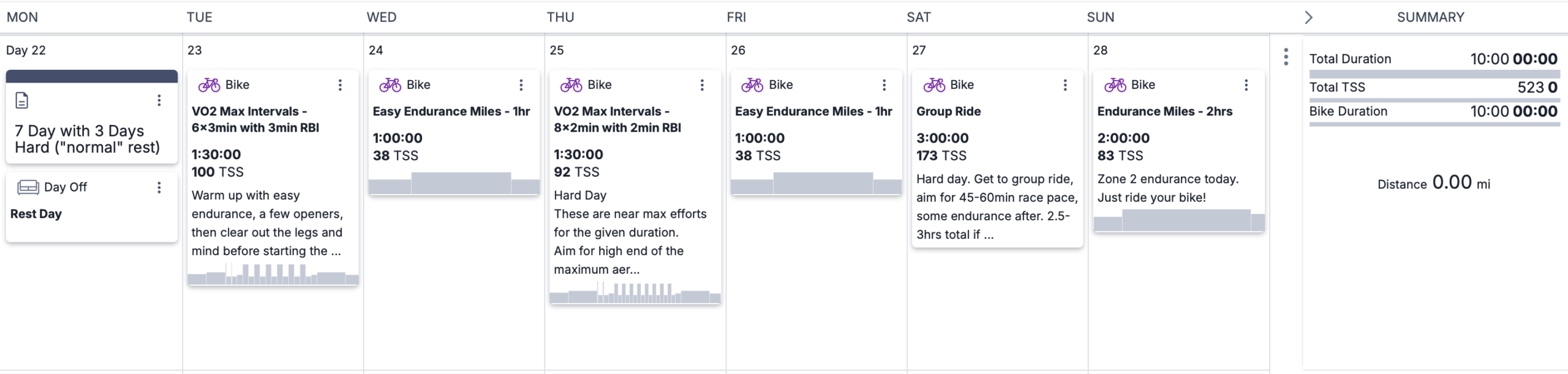
Cyclists most commonly align a “training week” a 7-day calendar week. This often means a rest day on Monday, hard workouts on Tuesday and Thursday, and maybe Saturday, with a long ride on Sunday, an endurance ride on Wednesday, and maybe an easy ride or rest day on Friday. The image below is a fairly classic example of this.
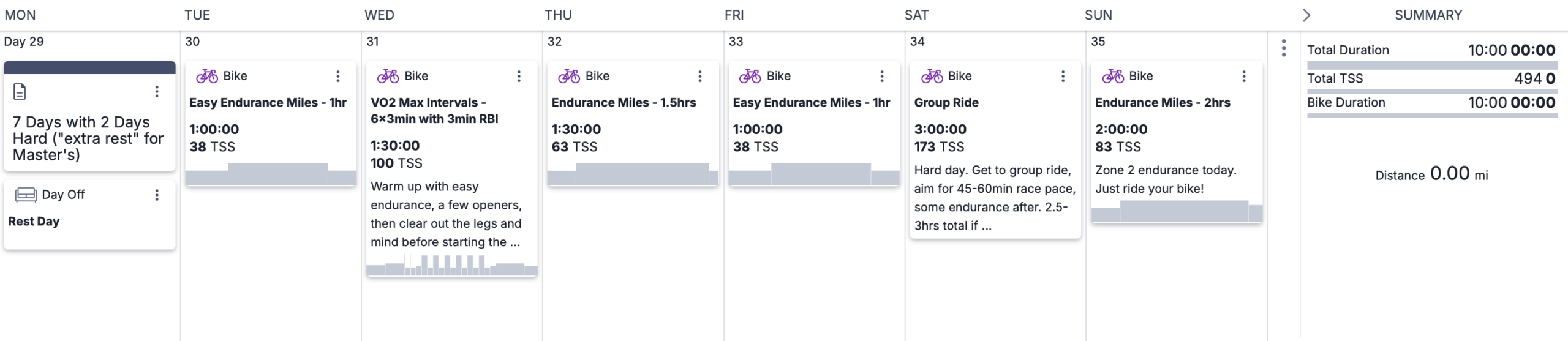
If you’re having trouble hitting your targets as prescribed or just stay super tired, simply try removing one of the hard days and slot in another easy or endurance day. The image below represents the same 10-hour training week, but with one less interval day, allowing for more time to recover, which works well for many of my Master’s athletes who still have a job and need or want to stick to a 7 day per week rhythm or cycle.
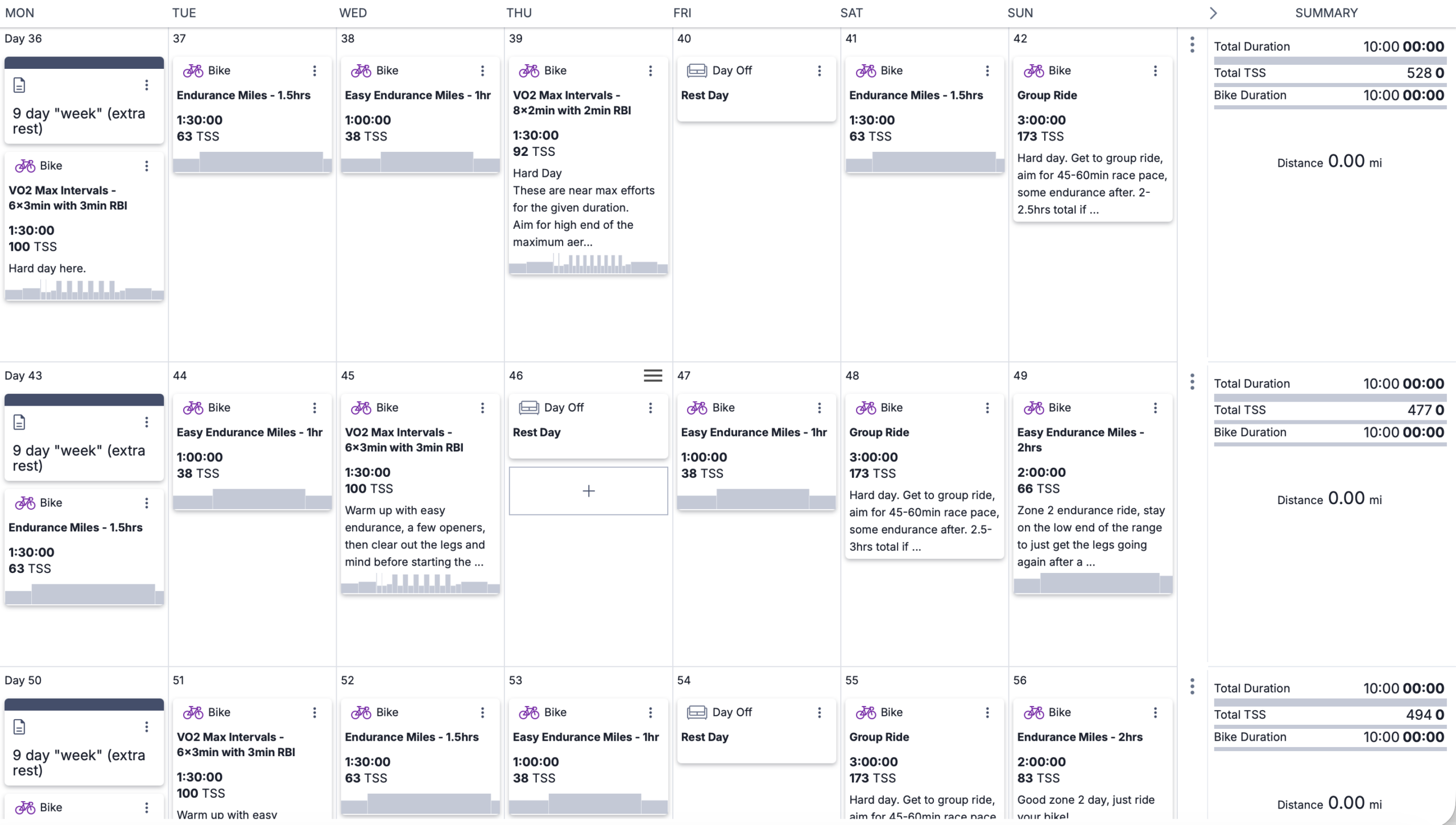
Next, if you’re a retired Master’s athlete or have some pretty solid flexibility in your schedule, you could take a page from the Joe Friel book and apply a 9 day “week” plan where you have 2 easy days between all of your hard days and have a 9-day rolling cycle. The example I have here shows the rest days not happening on any consistent one day of the week, but specifically slotting in for good rest after hard days or blocks, allowing someone to still hit a group ride on the weekend and get their intervals done, too.
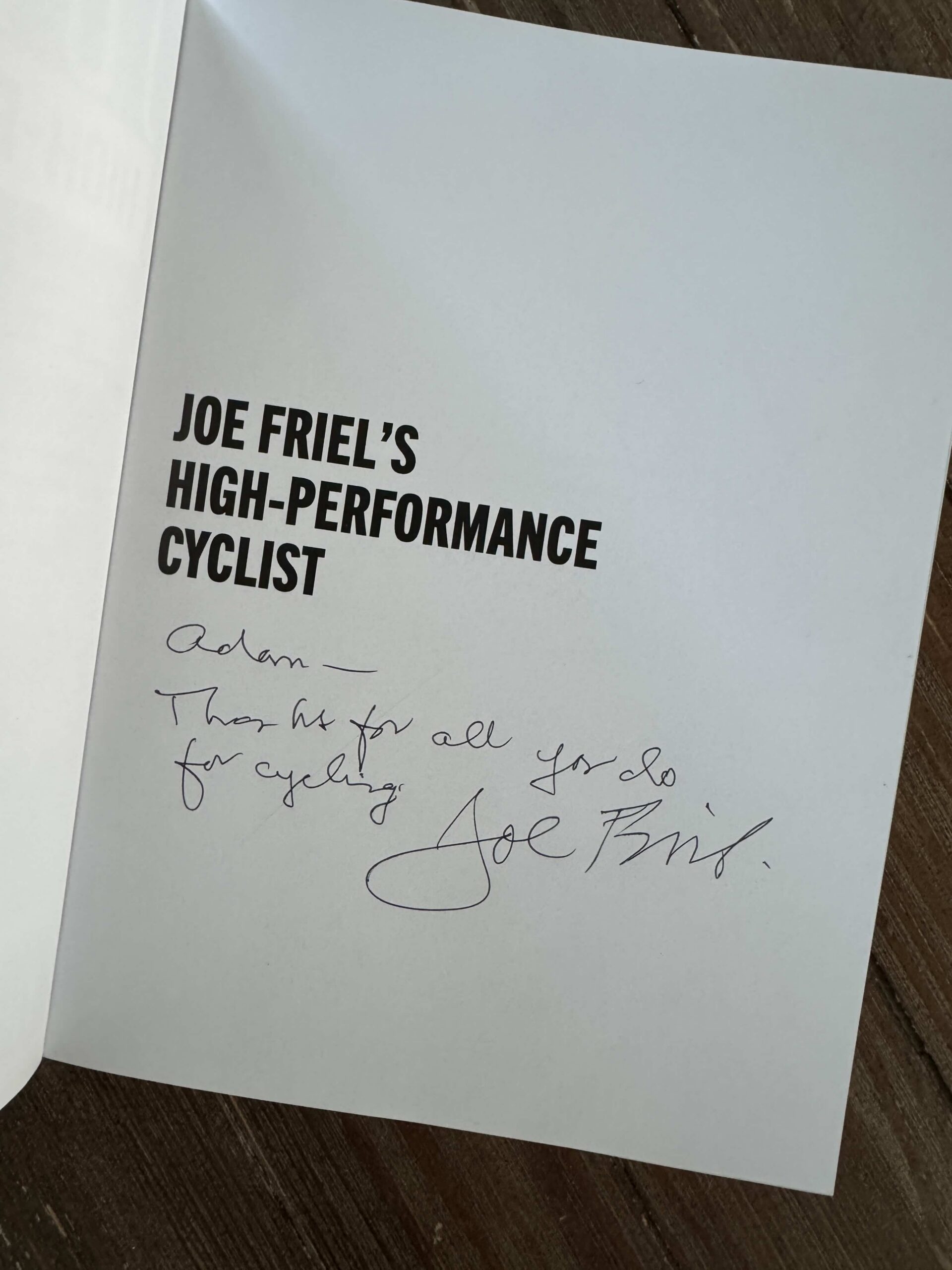
If you want more detail about this slight shift in weekly patterning, check out Coach Joe’s latest books, “Joe Friel’s High Performance Cyclist” and “Fast After 50, 2nd Edition”, both of which dropped this year. I was super honored to get his new book with a personal note from a legendary coach like him, and someone who I got inspiration from as a young coach and still do today. Joe paved the way for coaches like myself to have a career in this sport as we do and for athletes like you who want to train smarter, better, and do it in your later year with high success.
6. Make Time For Strength Training At All Costs
Athletes can build muscle at any age, but it becomes more difficult to both maintain existing muscle mass and build new muscle tissue as you get older. Lifting weights year-round becomes increasingly necessary as Masters cyclists grow older.
Don’t like the gym or the process of counting reps and sets isn’t your thing? Try Pilates. Some of my busiest Time-Crunched Cyclists start a Pilates practice in their late 40s and tell me, “It’s the best thing I’ve ever done for my body.” Pilates can help develop strength through a range of motion and balance out the over trained muscles and postures from the bike, realigning your body to a less tight, hunched over posture. Yoga does something similar and incorporates movement with breath, sometimes heat, and does a great job of using isometrics with full range of motion movements to realign. Pilates and yoga won’t increase strength as much as weights in the gym, but can help build and maintain from your starting point and may be better if your goals are mobility vs just stronger muscles.
Bottom Line
Research makes it clear that at some point in aging, VO2 Max and other performance markers start to decline due to hormonal changes and other factors of aging. This may start as early as ~35 for men and women. Those with good genetics and strong training habits will decline less. You can’t do much about your genetics, but you can do A LOT about your habits.
So, do masters athletes require more recovery? Or are they so busy they need to change a few habits to stay on top of it? Yes to both. In your 30s it’s probably more that you’re too busy and less about chronological age. In your 50s, the proportion may flip, but it’s always a combination of both as your body and lifestyle demands evolve.
My advice is accept aging and all it has to offer, but change training habits to specifically slow the impact of aging and you will become more successful into your Grand Masters time and beyond.
► FREE Mini-Course: Learn How to Maximize Your Limited Training Time
Learn step-by-step how to overcome limited training time and get faster. Walk away with a personalized plan to increase your performance.
"*" indicates required fields
About the Author
Adam Pulford
CTS Head Cycling Coach
Adam Pulford is a dedicated coach at CTS with a passion for elevating athletic performance through tailored, measurable strategies and a deep understanding of the “why” behind each athlete's goals. With nearly two decades of experience, a degree in Exercise Physiology, and a successful track record managing professional cycling teams, Adam also shares his expertise as the host of the Time-Crunched Cyclist podcast, providing actionable insights for endurance athletes.
Comments 1
I would appreciate more on how to balance strength training with cycling. You show some suggested training calendars, but they don’t actually have any time for strength training built into them. Then the last suggestion is about strength training, but how do you suggest a master/senior build that into their cycling calendar?