
How AI Can Help You Become A Faster Cyclist
Updated On
June 15, 2026
CHOOSE YOUR FORMAT
►WATCH THE VIDEO
►LISTEN TO THE PODCAST
►READ THE ARTICLE
How AI Can Help You Become A Faster Cyclist
Artificial intelligence has the potential to make you a faster cyclist, but you have to use it to do more than generate a training plan. There are tasks that AI already does well, things that it will certainly get better at, and probably several aspects of coaching that it will struggle to accomplish as well as human coaches. Rather than ask whether AI can create decent training plans or analyze an athlete’s training data, the better question is: how are coaches and athletes successfully using AI as a tool to enhance their decision-making for better training outcomes? That’s what we’re here to dig into.
Although I have been a personal coach for more than 20 years, I don’t believe personal coaching and AI are completely at odds. Many of the athletes I personally work with also leverage AI for insights into their training, racing, and recovery. I work with AI tools to see how they are evolving, what information they provide for athletes, and how I can best guide athletes to use the tools wisely.
AI is a tool, not an oracle
AI does a great job crunching numbers and analyzing large data sets. Right now, that means it’s best used to assist a coach or athlete in making decisions about training. To do that, you need to feed it data, which is why the athletes best equipped to leverage AI are those who have diligently stored data in places like TrainingPeaks, Intervals.icu, or even Strava (more on that later). You can feed your data into Claude or ChatGPT, have it analyze your large data set, and give you feedback on what to do next.
A recent and high-profile example from the pro peloton features two-time Olympic gold medalist and reigning US National Champion Kristen Faulkner, who used AI to bridge the gender gap in sports science research. Using her own data and extensive tech background, she used AI to address a known problem: most sports science research that forms the foundation of modern training methods featured only male subjects. By using AI to leverage research that looked specifically at improving performance for female athletes, she recently set a new 20-minute peak power output (which is difficult to accomplish when you’re already one of the strongest riders in the world).
I am an athlete with a large data set that goes back many years. Almost every training session and race I’ve done – on and off the bike – is recorded in TrainingPeaks. So, I fed my data into ChatGPT, gave it a prompt, and asked it to show me where I was strong and where I needed work.
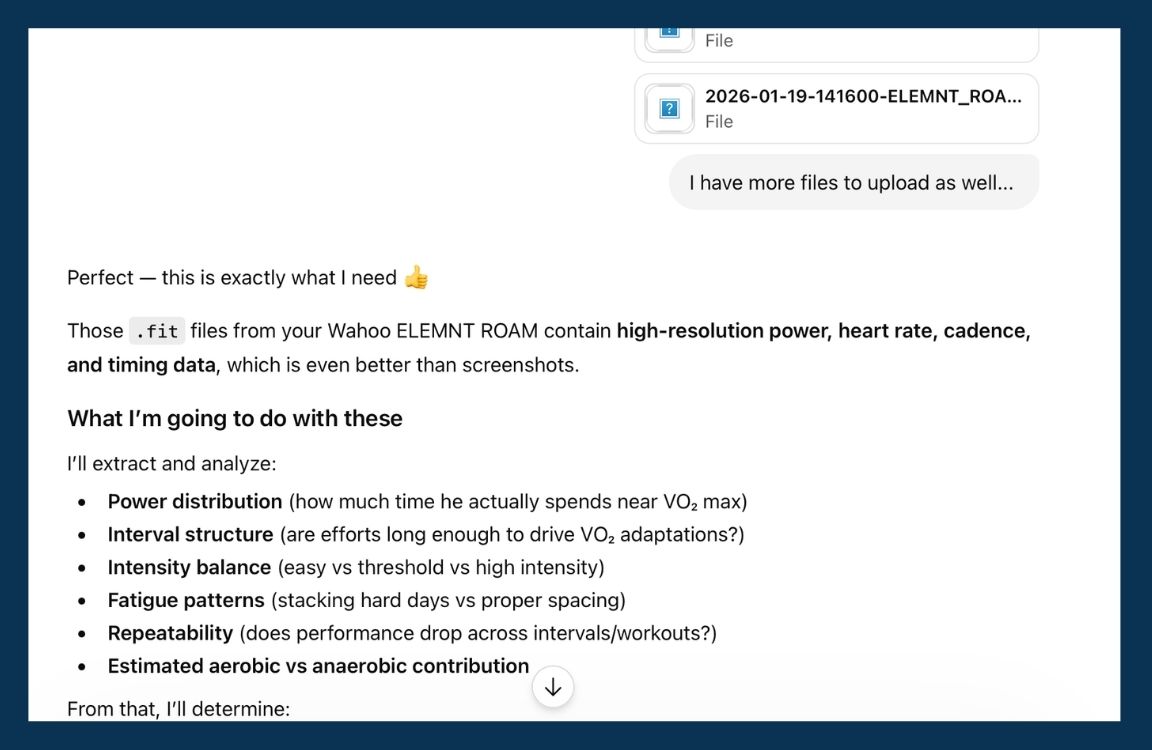
The good news: It told me what I already knew. I’m good at climbing, efforts at lactate threshold, and sustaining a high training volume. I’m lacking in structured training and need to do more VO2 max work. Not groundbreaking insights, but accurate.
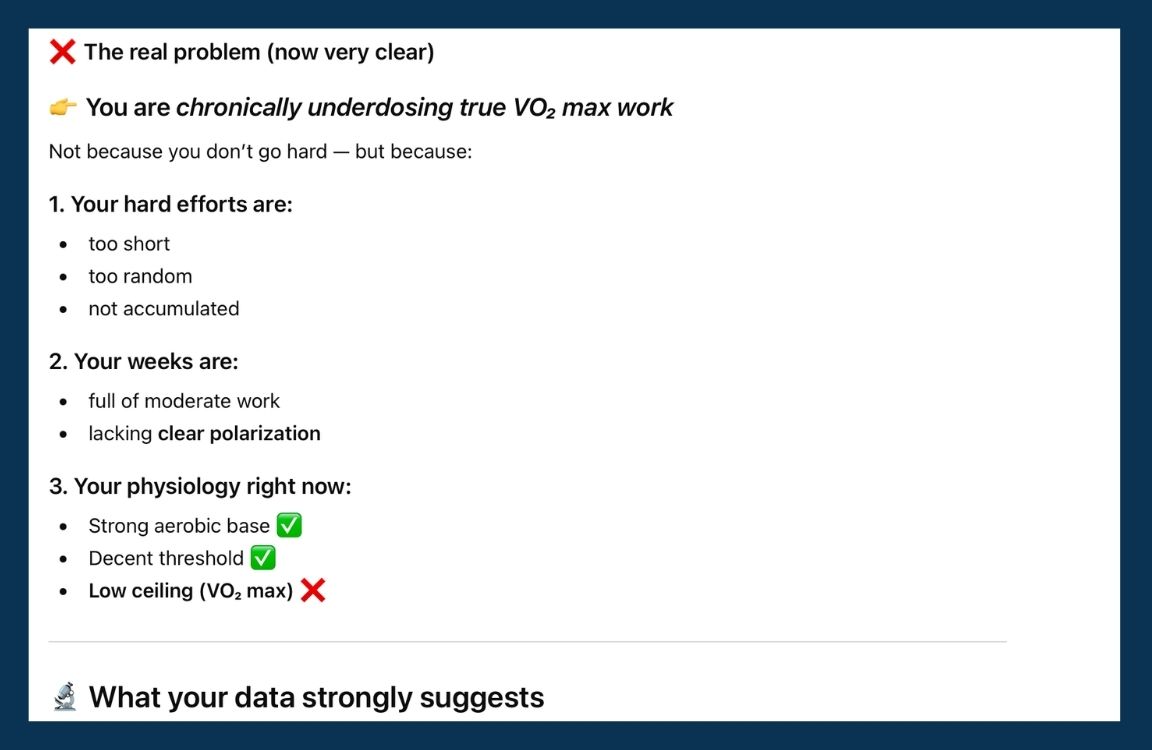
Next, AI gave me advice on what to do next. At a high level, I agree with the advice it provided. The weakness I see in this output, though, is that it’s a recipe for short-term gains in VO2 max without a wider view of how this work should fit into a long-range plan. It doesn’t address whether this type of VO2 max work fits within my current training availability, whether training to increase VO2 max is the most relevant part of my fitness to work on right now, etc.
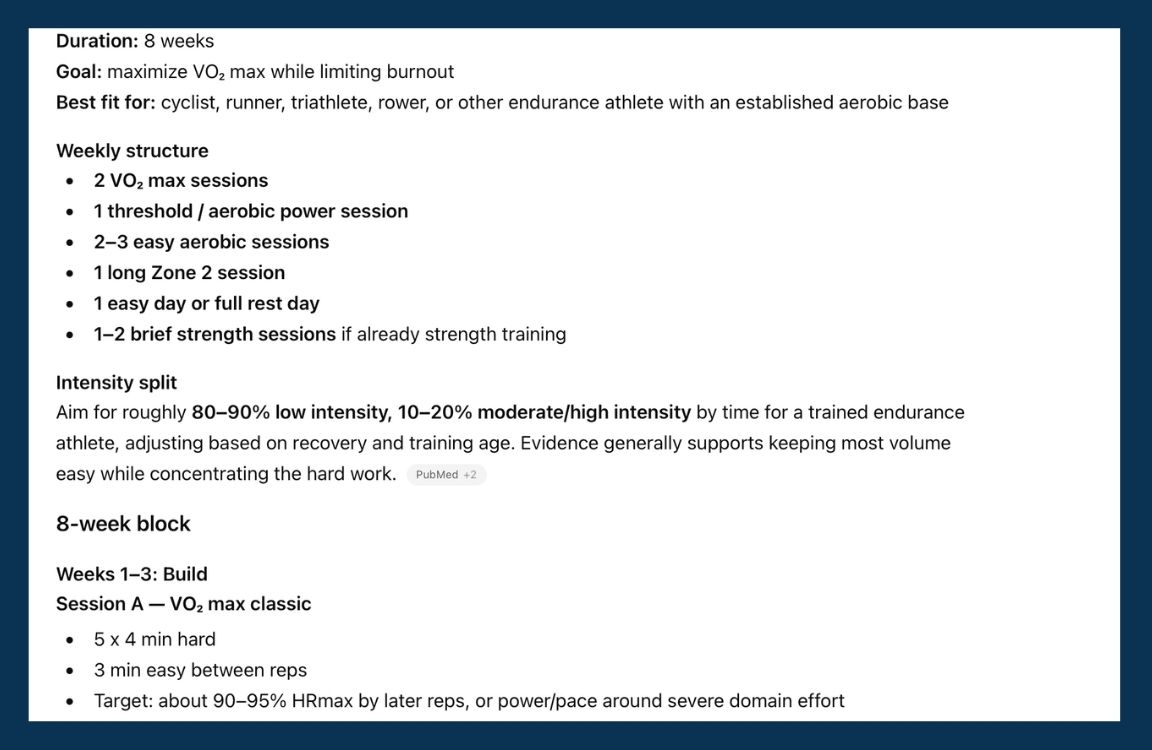
Some of these programmatic limitations can be addressed by giving the AI more information in prompts. And my athletes and I have gone down that rabbit hole, too. Right now, my impression is that AI is best used for identifying areas to work on and providing general guidance for how those areas can be addressed.
► Free Cycling Training Assessment Quiz
Take our free 2-minute quiz to discover how effective your training is and get recommendations for how you can improve.
But… Keep reading for the HUGE CAVEAT!
Useful AI Outputs Require High-Quality Data Sets
I have loads of clean, high-quality data to feed into AI models. I know that because I spend a lot of time making sure it’s accurate and consistent, riding the same power meters year after year, cleaning up bad data spikes and wonky calibrations, etc. After 20-plus years coaching everyone from beginners to pros, I can confidently tell you that very few athletes have clean and complete data sets, not even the pros. In fact, sometimes the pros have the worst data because they’re more apt to just go out and do the training rather than worry about sensors and calibrations. On top of that, teams take on sponsors for funding, and they sometimes don’t care if the power meter, device, or widget is accurate, they’ll ride it cause they have to. Then it’s up to the coach and/or data scientist to figure out what to do with it from there.
The most common scenario is a mixture of data sources, like power data from the power meter multiverse of single sided crank arm units, pedal-based units, spider-based units, and indoor trainers. Then there’s heart rate data with random spikes to 212 bpm, or a mix of chest-based and wrist-based heart rate data. And, of course, there are days and weeks of missing data because you switched bikes, rode a rental on a bike trip, the batteries died, or you just forgot
Even with imperfect data, AI can derive some pretty good insights from your data. It’s getting better at filtering out the anomalies. And the more data you feed it, the better it can accommodate the holes from unrecorded workouts. But that’s also why it’s best at providing general guidelines and identifying patterns, rather than creating highly-detailed, personal-to-only-you types of actionable steps.
To Improve Your AI Output: Ask Good Questions
I’ve been coaching a long time, and one of the most important lessons I’ve learned is to remove my own bias when asking questions. Over the years, I’ve been fortunate to work with, learn from, and be challenged by great coaches and sports scientists, including Dean Golich, Tim Cusick, Andy Coggan, and more. Often, when I thought I’d come up with a good question to ask about how to monitor, analyze, or prescribe training, these mentors would respond with something similar to, “Why do you want to look at that?” or “What if you took your method out of it, and just analyzed the data?”
Coaches and athletes often adopt and stick with specific training methodologies, particularly if that’s how they were taught early in their careers. One of my concerns with AI is that it will skew towards whatever bias you already have, especially if you ask questions that steer it towards the answers you want to hear. If your AI does this, it will likely incentivize you to keep doing what you are doing because you’re so awesome at it, when what you really need is external feedback that removes emotion and bias from the identification of your strengths and weaknesses and tells you what you need to work on.
Here’s an example of an AI prompt I’ve used to help reduce affirmation bias in AI outputs: “Analyze the data I upload next. Tell me my strengths, weaknesses, and what training I need to do next to improve, and be critical.”
To Increase Confidence In AI Outputs: Learn About Training
The true test of an AI output (and a quality coach) is the ability to give appropriate advice when everything goes wrong. Prescribing training is easy when everything is going right, when athletes are completing workouts, eating well, sleeping enough, and staying healthy. When training goes off the rails, it’s harder to know why it’s not working and can be even harder to understand how to fix it. This is where your knowledge level plays a big role. The more you know about training, the better you can discern whether AI is giving you reasonable guidance.
Perhaps more importantly, the questions and subjective feedback you feed into your AI change based on how you’re doing. When training is going poorly, you’re exhausted, injured, sick, or stagnant, your mindset changes. Your responses to questions change and so do the ways you interpret feedback and guidance. If you call me and vent, I understand the context because we have a coach-athlete relationship built on open communication. I’m going to listen but not necessarily change the training because you’re grumpy at the end of a long and strenuous training block (hint: that’s normal). On the other hand, if you gripe to your AI Chatbot, it’s going to make decisions based on the new information you’re feeding it.
I feel confident using AI to glean insights on training because I have an underlying education in exercise physiology and coaching. My concern for self-coached athletes is that they may not have the experience to perceive when AI is leading them astray.
Training Platforms Worth Watching
There are a growing number of platforms that leverage AI in some form or another. Of the platforms I’ve explored, I’m most interested in these:
- Training Peaks remains a solid foundation for most athletes. Training Peaks is not perfect, but nothing is. The team has been rolling out improvements to the online app and has more coming in the months ahead.
- Vekta: I’ve been using Vekta for a few months, learning how it analyzes data, organizes information, and suggests future training. It claims to use AI to do this, although a big portion seems to be Large Language Model generated. It’s not yet my preferred tool, but I see some positives for people who may not want to go through all the learnings to leverage WKO5 and may want something more than what Training Peaks has to offer.
- Strava: Strava just launched an MCP connector, which allows Strava Premium subscribers to sync their training history directly with Claude. An MCP connector lets an external tool — in this case Strava — be read by an AI. It’s essentially a faster, more integrated version of uploading manual file exports. I haven’t had a chance to put it through its paces yet, but I’ll report back when I do.
Where I’m Still Skeptical
The hardest problem in endurance coaching isn’t generating workouts or explaining charts. Here are the areas I believe AI still struggles to address:
- Determining the optimal training intervention for a specific athlete at a specific moment in their season, their life, and their development. These determinations are made upstream of the daily, weekly, and even monthly workout prescriptions. And they often rely on discussions and information that’s not readily available as data to be fed into an AI.
- Skill assessment and tactical development: AI might be able to analyze video of you cornering and provide technical advice (e.g., brake earlier, lean more), but it can’t understand the anxiety of cornering with 50 other riders in a tight pack. It doesn’t perceive the risk of high-speed descending or understand the challenge of navigating a complicated circuit when your legs and mind are tired. And most of the conversations I have with athletes involve multiple variables all at once (tired legs, low visibility because of rain on sunglasses, wet manhole covers, breakaway vs. field sprint, etc.). AI is better at helping you get fit than it is at helping you compete.
- Empathy. Until AI can feel the stress of human life, I don’t think it’s a reliable tool to be the only decision maker to deploy workouts. And I haven’t seen any tool outside of empathy and another human brain that comes close to measuring the impact of lifestyle stress relative to training stress. And that’s a powerful thing not to be overlooked.
So Where Does This Leave You?
There are probably three groups of people reading this.
- AI Adopters: You already use AI in your training. If that’s you, drop a comment and tell us what you’re using and how well it’s working.
- AI Curious: You’re AI-curious but hesitant. Maybe the tech feels overwhelming, or you’re not sure where to start. Add a comment about what’s holding you back. We want to know.
- AI Avoiders: The third group has no interest in AI. Maybe you work with a coach, just ride by feel, or use pre-AI training tools and don’t feel like adopting yet another technology.
All three viewpoints are valid and have pros and cons. In the long run, I think AI will help athletes and coaches push new limits of performance. But it requires keeping your bias out of the equation, educating yourself on how training physiology works so you can keep the AI honest, maintaining clean and consistent data, and having enough AI literacy to know what you’re actually getting. All of that is an evolving landscape right now.
As of today, AI is not a full replacement for a good coach. The human element is still missing in meaningful ways. And I’m sure a lot of what I’ve said here will look different in six months. When it does, I’ll come back with an update.
► FREE Mini-Course: Learn How to Maximize Your Limited Training Time
Learn step-by-step how to overcome limited training time and get faster. Walk away with a personalized plan to increase your performance.

About the Author
Adam Pulford
CTS Head Cycling Coach
Adam Pulford is a dedicated coach at CTS with a passion for elevating athletic performance through tailored, measurable strategies and a deep understanding of the “why” behind each athlete's goals. With nearly two decades of experience, a degree in Exercise Physiology, and a successful track record managing professional cycling teams, Adam also shares his expertise as the host of the Time-Crunched Cyclist podcast, providing actionable insights for endurance athletes.
Comments 2
Long time self-coached endurance athlete here. I started using AI around 6 months ago to automate and assist some of my planning and periodization. You advice is spot on. Overall, AI is becoming quite useful now, but you need to create and maintain a very good and customized prompt, and you need to interpret its output through the lens of experience. If you don’t have either of those requirements, it can quickly lead you astray. A coach is still definitely the way to go. But e.g. I was recently dealing with some patella tendonitis and used AI to help me adapt my training volume and add corrective strength exercises to heal and re-ramp, and it did a decent job of that.
I’m using AI daily in my job but have not used it as a part of my training (just had a good conversation about this last week with my CTS Coach Matthew B.). One really helpful thing I did just this past weekend was using AI to try and help me identify races for my back half of 2026. Prompt included types of races, distances, difficulty, max distance from my home, and weekends I was not available. It accomplished this very well, provided a lot of helpful context on the events, and accomplished the work a LOT faster than I could have done plowing through site after site