

Strength Training for Ultrarunners: Here’s The Framework That Actually Works

Updated On
August 5, 2026
CHOOSE YOUR FORMAT
►WATCH THE VIDEO
►LISTEN TO THE PODCAST
►READ THE ARTICLE
Strength Training for Ultrarunners: Here’s The Framework That Actually Works
Strength training for ultrarunners is important, but many athletes and coaches try to get the wrong results from the weight room. As an NASM-certified trainer and an experienced ultramarathon coach, the problem I frequently see is runners attempting to mimic the demands of ultrarunning in the weight room. Running already does that. The weight room is the place to achieve specific adaptations that improve running performance but that you can’t obtain through running alone.
There are a lot of reasons to combine running and strength training. Some of them don’t improve running performance, and that’s fine. Building and maintaining muscle mass is important for longevity, leading an active lifestyle, and being able to play with your grandchildren when you’re 80. That’s a different strategy than what we’re talking about here. In this article, I’m talking directly to runners who want one thing from the weight room: better running. This is for runners who want to go faster and be more durable, more resistant to injury, and more resilient on race day.
First Lesson: Perspective
You don’t need to lift weights if you don’t want to, don’t have time to, lack the skills to lift safely, or have injuries that prevent you from doing so. Strength training is a complementary tool in a runner’s overall program. You can be a fit, healthy, and durable runner without lifting. It’s just that lifting weight could probably make you even better in all those categories. So, if you’re not doing it now or don’t want to start now, I’d still encourage you to consider it in the future.
The other side of the coin is valid, too. You might want to lift weights for reasons that have nothing to do with running, including aesthetics, muscle mass for health, or the gym community. That’s fine, too. Just recognize you may need to accept some trade-offs in running performance.
A Runner’s Purpose In The Gym: Build What Running Can’t
Running already builds a tremendous amount of what your legs need, including the capacity to utilize more oxygen, increased mitochondrial density, optimization of muscle fibers to aerobic exercise, local muscular endurance, and movement efficiency at race pace. Running makes you better at running.
You want to incorporate strength training to stimulate adaptations that running does not. Running does a relatively poor job of developing maximum strength, muscular power, and fast force production. When you lift weights, you generate more force and recruit more muscle fiber units than you do while running. This leads to adaptations that are useful for running, but that you can’t achieve through running.
It’s just as important to identify what you DON’T want to pursue in the gym. Strength training should not be used to induce or increase fatigue, or to generate fatigue so you can then run on tired legs.
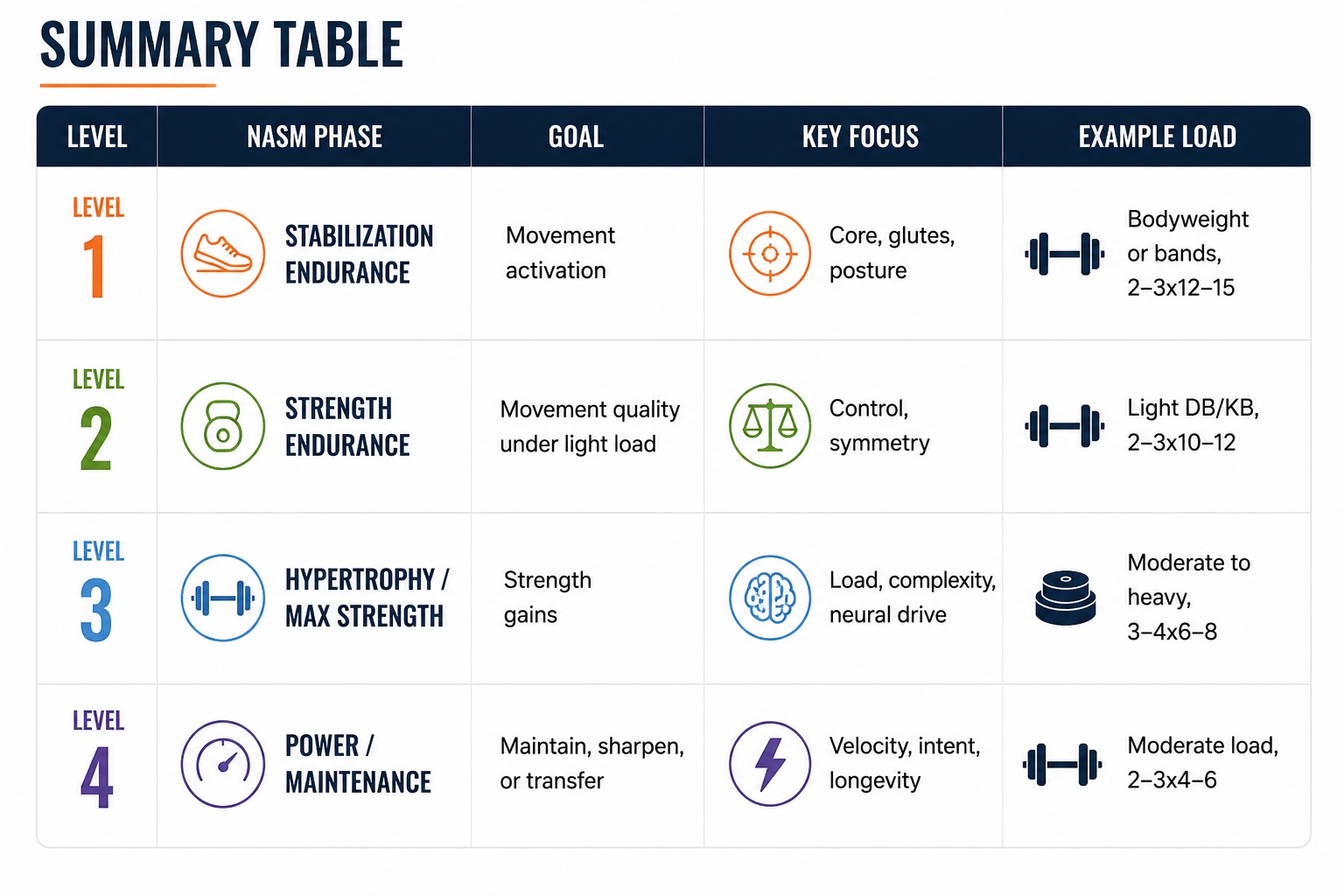
The Progression Model: NASM’s OPT Framework
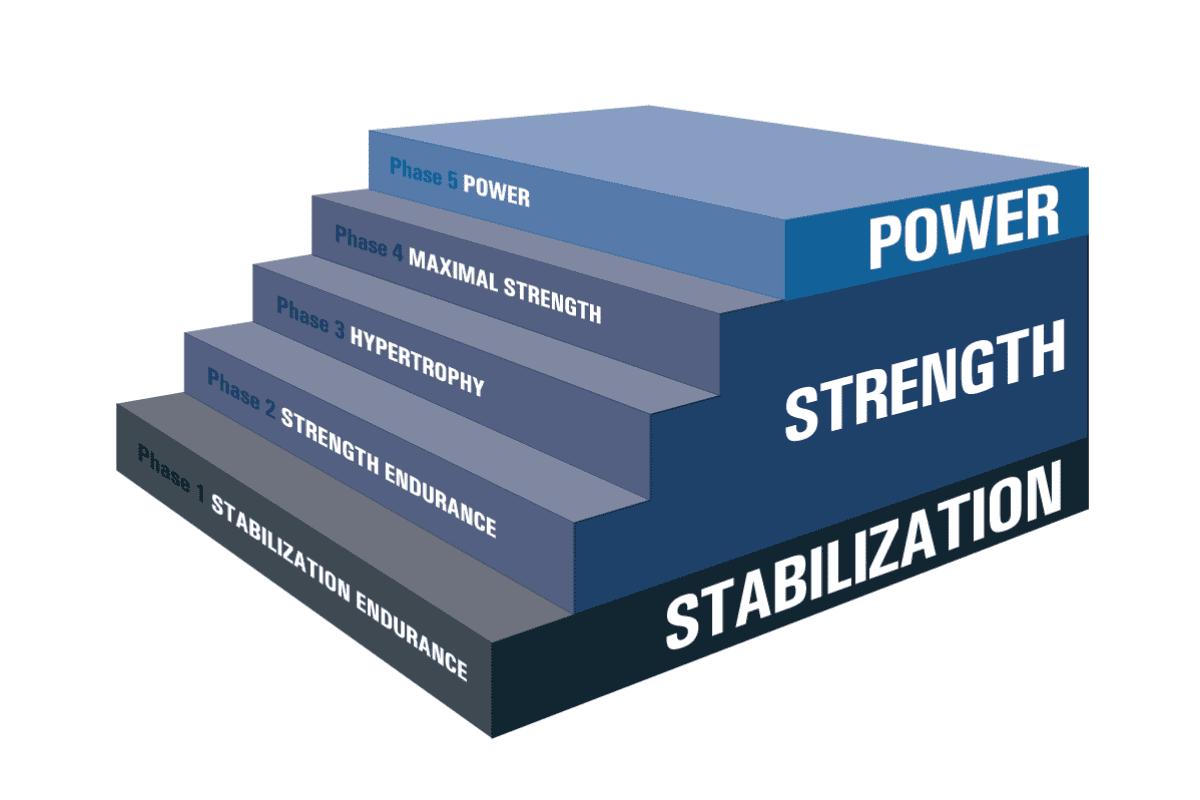
One reason it may seem like strength training and endurance training are at odds is that coaches and trainers often approach the intersection from their primary discipline. Strength training professionals emphasize strength training because that’s their primary focus. Ultramarathon coaches emphasize running because that’s their comfort zone. I’m not immune to bias, but I do approach the intersection of strength and ultramarathon training as a coach with professional certifications and real-world experience in both. That’s why I use the NASM’s Optimum Performance Training (OPT) Model. It’s a framework that works and it’s built on solid, well-established evidence about how strength develops in a trained body.
Phase 1: Stabilization
This is where you learn to move correctly under load before you add resistance to a movement that isn’t correct yet. When you skip this step you start strengthening poor movement patterns, which makes it more difficult to correct and establish correct movement patterns later. For example, let’s say you start with a faulty hip hinge or a collapsing single-leg stance. Then you add resistance and gain strength and coordination in that faulty movement. Initially, your body can compensate, but as you add more resistance you’re reinforcing the mechanical fault that will eventually lead to an overuse injury.
Stabilization is where your nervous system learns the correct pattern. Everything after this phase is built on top of it.
Phase 2: Strength Endurance
Once you have the movements dialed, you move into strength endurance, which is characterized by higher-rep work with light to moderate loads. This is where a lot of programs go off the rails. Some trainers and coaches see “higher rep, lower resistance” and think the objective is to maintain a high heart rate and stress the cardiovascular system. They add a “cardio” component by shortening rest periods, adding a target heart rate, and encouraging constant movement. That may make some sense for general exercisers, but you’re already getting plenty of cardiovascular work from your run training.
For an endurance athlete, the proper goal of the strength endurance phase is to prepare your body to safely handle heavier loads in Phase 3. High-rep, moderate-load training conditions muscles, tendons, and the nervous system to tolerate more resistance over more repetitions so you can safely progress to phase three.
A systematic review and meta-analysis by Bohm and colleagues found that meaningful tendon stiffness adaptations require a minimum of about eight weeks of consistent mechanical loading, with continued adaptation over longer periods. Muscle can show meaningful strength gains within a few weeks. Tendons remodel more slowly than muscle. Strength endurance, done correctly, prepares tendons, motor unit recruitment patterns, and general work capacity for the heavier loads coming next. It’s a short bridge, not a destination.
Phase 3: Muscular Development / Maximal Strength and Power
This is where the big payoff happens. You’ve mastered the movements and conditioned your connective tissues to handle the load. Now it’s time to use your muscles to generate more force than you ever do while running to develop strength that running alone can’t develop. There’s strong, consistent evidence that these strength adaptations improve running economy. A systematic review and meta-analysis published in Sports Medicine found that heavy and plyometric strength training improved running economy in distance runners, while low-load, high-rep training showed little to no benefit for running economy.
Worried about building too much muscle and “getting bulky”? Although this is a common concern, significant hypertrophy (muscle growth) is unlikely for endurance athletes. Realistically, most ultrarunners couldn’t build significant muscle mass through a hypertrophy phase even if they wanted to. Adding muscle requires a lot of calories and protein, which is why bodybuilders eat so much. Your running volume, energy balance, and dietary composition are not conducive to hypertrophy. You can gain strength by increasing the force your existing muscle tissue can generate, but you’re not likely to dramatically increase muscle mass.
Truth be told, running economy is not as big a priority for trail and ultrarunners compared to track and road runners. Research comparing elite road and trail runners found trail runners were measurably stronger, but also that their strength resulted in a greater cost of running on flat ground (i.e., lower running economy). In races, though, the reduced running economy didn’t hold them back. Instead, the trail-running specific adaptations protected them from muscular fatigue that stops unprepared trail runners in their tracks.
Specificity Example: Descents in trail races do the most damage to your legs. Downhill run training develops the ability to absorb repeated eccentric loading without your legs falling apart. That’s training specificity. Strength training provides an upstream advantage: greater eccentric strength and connective tissue capacity before you even get to the downhill run training.
Phase 4: Maintenance
A big mistake runners make is to cease strength training as they approach peak run volume. You absolutely should shift the focus of strength training as you into a race build, but that means shifting into a maintenance phase rather than stopping altogether.
► Free Ultrarunning Training Assessment Quiz
Take our free 2-minute quiz to discover how effective your training is and get recommendations for how you can improve.
The adaptations you’ve spent months building are needed most for late-race durability during your goal event. If you stop lifting entirely, you’ll lose the adaptations just when you need them most. Fortunately, it takes a lot less work to maintain your gains than it took to create them in the first place.
How much strength training is enough during the maintenance phase? A review by Mujika and colleagues on the minimum effective dose of training found that strength adaptations can be maintained for extended periods, in some cases fifteen weeks or more, despite a significant reduction in the volume of strength training. The key is to maintain frequency and continue with intensity (keep the force high). The minimum effective dose comes out to about one or two sessions per week.
When to Lift: Scheduling Matters as Much as Frequency
I use the following framework: hard days hard, easy days easy. That means strength training pairs with your quality run days, not your recovery days.
On days when you are going to run and lift in the same day, run first and schedule your strength session at least three hours after the end of your run.
Two things happen in that window. Endurance training spikes a molecular signal called AMPK, and it takes roughly three hours to return to baseline. Loading heavy while AMPK is still elevated blunts some of the strength and power adaptations you’re after in the gym. Perhaps more important, the time gap gives your body a head start on glycogen replenishment, so you’re not asking your legs to produce force on an empty tank.
Three hours is the minimum, not a guarantee of full recovery. Glycogen replenishment takes considerably longer. But it’s enough separation to stop working against yourself on both fronts.
If your schedule doesn’t allow for any separation between endurance and strength training, either within the same day or on separate days in a way that doesn’t compromise recovery, you might need to reconsider progressing all the way to a Muscular Development/Maximal Strength phase. In the long run, it may be better to stay in the Stabilization phase (low load and low volume) instead of trying to force strength training into a schedule that can’t really accommodate it. You’ll gain some benefits and it won’t hinder your running progress.
Recommended Exercises
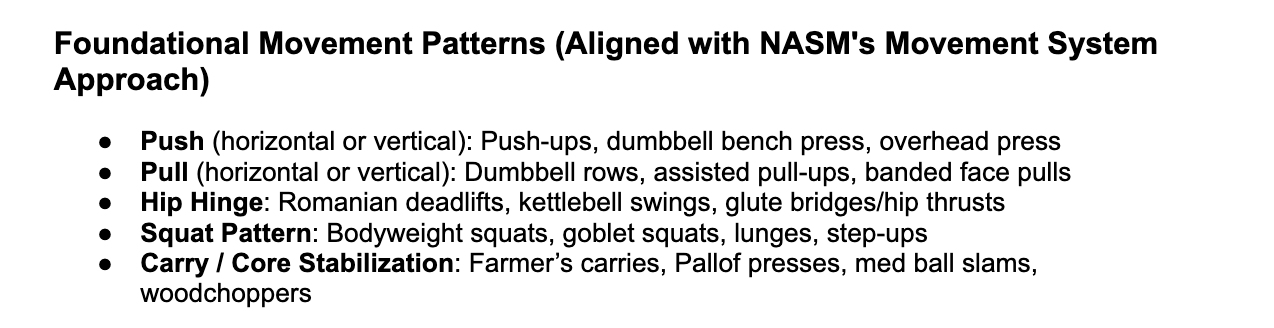
Keep it simple. Everything breaks down into the six movement patterns described in the image below:
Enjoying This Article? Get More Free Running Training Tips
Get our coaches' best training advice, delivered straight to your inbox weekly.
Master those patterns first. Add load and complexity only once you’re moving well and confident in your form.
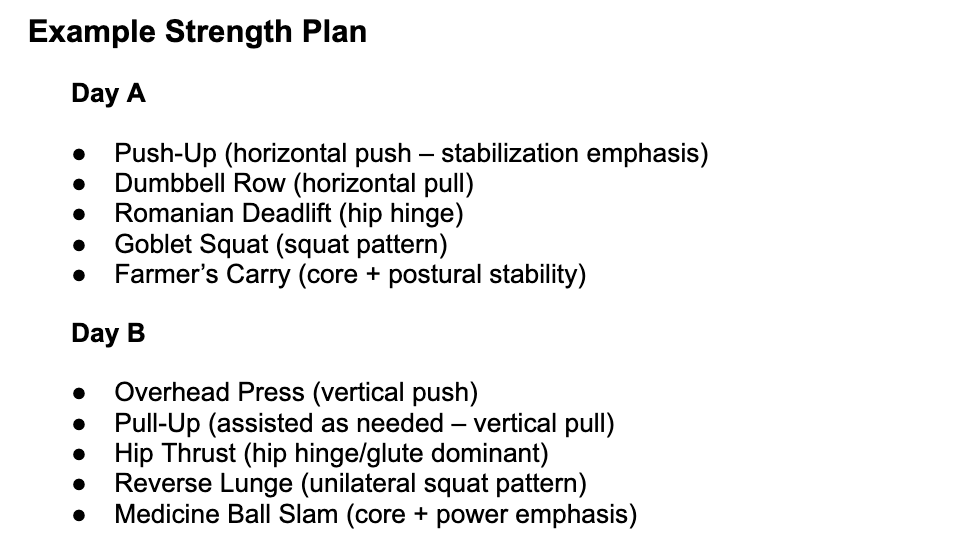
How does this all come together? The image below illustrates an example for two strength days within a single week:
Simple is Fine
You can make strength training very complicated, but you don’t need to. Everything above — the OPT phases, the tissue adaptation timelines, the dose-response research, the timing between sessions — it all matters for managing load, lowering injury risk, and optimizing effectiveness.
But at the end of the day, you can accomplish all that by following three simple principles:
- Master the movement before you chase the load.
- Progress to heavier weight only when you’re confident in your form.
- Two strength sessions a week, paired with your quality run days, ideally at least three hours after your run session.
And if that still sounds like too much, it’s absolutely fine to stay in Phase 1, the Stabilization Phase, for as long as you want. Those sessions carry minimal risk but provide real protective value on their own. That’s a far better outcome than rushing into heavier loads or careless volume.
References:
Bohm, S., Mersmann, F., & Arampatzis, A. (2015). Human tendon adaptation in response to mechanical loading: a systematic review and meta-analysis of exercise intervention studies on healthy adults. Sports medicine – open, 1(1), 7.
Spiering, B. A., Mujika, I., Sharp, M. A., & Foulis, S. A. (2021). Maintaining Physical Performance: The Minimal Dose of Exercise Needed to Preserve Endurance and Strength Over Time. Journal of strength and conditioning research, 35(5), 1449–1458.
About the Author
Cliff Pittman
CTS Pro Ultrarunning Coach
Cliff Pittman is the Coaching Development Director for CTS, where he expertly leads the Ultrarunning and Cycling Coaching teams. A passionate ultrarunner and active competitor, Cliff specializes in simplifying complex training concepts into actionable strategies, ensuring athletes at all levels—from beginners to elite competitors—can achieve their goals in prestigious events like the Western States 100 and Leadville 100.