
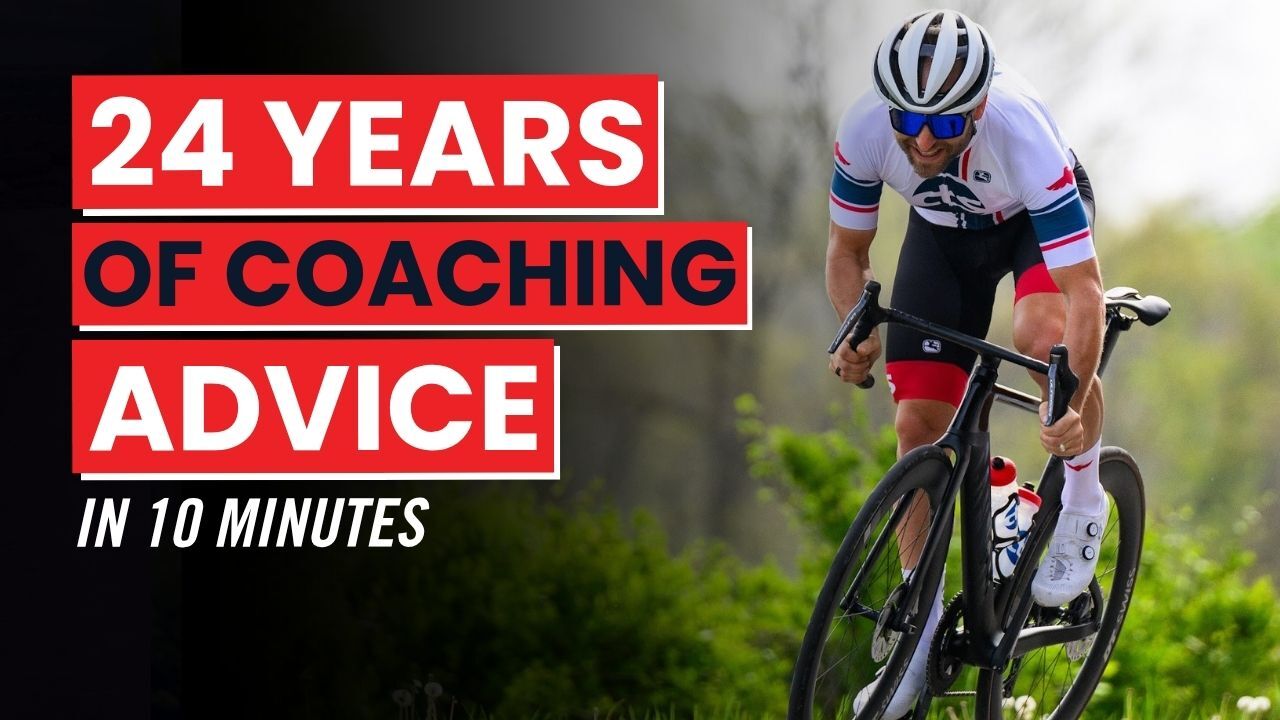
24 Years of Cycling Coaching in One List
Updated On
September 7, 2026
CHOOSE YOUR FORMAT
►WATCH THE VIDEO
►LISTEN TO THE PODCAST
►READ THE ARTICLE
24 Years of Cycling Coaching in One List
What if I could distill 24 years of cycling coaching experience into a single blog post? That’s essentially the challenge I gave myself, and the list below is the result. Each of the points listed could be an entire article, and in many cases, my colleagues and I have covered these topics in greater detail in other articles, podcasts, and videos.
How is a post like this useful to you as an athlete? Well, I’d encourage you to approach it from these perspectives:
- Confirmations of what you already do: Ideally, you’re going to see a lot of familiar information and insights in this list. If that’s the case, my hope is that you gain or retain confidence in your approach to training and performance.
- New angles on familiar methods: Experience has led me to view traditional tools and methods of training through new lenses. Many times, considering something you’re familiar with from a new angle unlocks a new way to make progress.
- New additions to your knowledge base: I’m still learning new things after 24 years of coaching all types of athletes, and hopefully you’re learning new things, too.
My Best Advice for Any Cyclist
Please note, the following points are not presented in order of priority or importance or anything other than how they came to mind.
What it takes to get fit is not the same as what it takes to stay fit.
Athletes get this wrong all the time, to their detriment. Gaining fitness requires lots of work. It takes hours of consistent training accumulated over weeks and months. Once gained, however, fitness is relatively easy to maintain. Keeping what you’ve gained requires smaller inputs at regular intervals to essentially remind your body that those adaptations are still being used.
This is an essential concept for periodization. You can’t train everything all at once. But you can direct most of your focus to a particular aspect of fitness while doing just enough to maintain other areas. For instance, you may be primarily focusing on aerobic base in the winter, but strategically incorporating a few threshold efforts or sprints to keep those areas from deteriorating too far.
Fitness is not performance.
Fitness builds capacity to do work. Performance is what you do with your fitness. As the accessibility of training data and analysis tools increases, athletes have a ton of new ways to define success and achieve improvement. And there’s nothing wrong with training to improve software metrics. But if you want to improve performance, you must also develop skills, tactical savvy, the ability to gauge intensity without real-time numbers, and the internal motivation to push beyond your numbers when necessary.
You can’t overdo Base, but you can probably overdo Build.
Base is your aerobic foundation, and it’s not just useful for the current season. Base training accumulates over years and there’s no substitute for the five, ten, or 20 years of cumulative aerobic base you create. On the other hand, incorporating too much intensity in the Build phases of individual seasons can leave you tired, burned out, and unmotivated to ride. This not only hurts your seasonal performance but can take a notch out of your year-over-year progress as well.
The longer I’ve been a coach, the more value I’ve placed in the year-over-year accumulation of base aerobic conditioning. As a young coach, I focused on shorter-term gains, probably because I didn’t have the experience to truly see the value of long-term gains. Now I know that an athlete’s seasonal peaks will be higher, and their seasonal performances will be greater, when I prioritize long-term fitness gains over a multi-year progression.
Overtraining doesn’t exist, but Under-recovery absolutely does.
This is mostly a matter of semantics, but how we communicate matters. Athletes can certainly get into trouble when training stress and recovery are out of balance. However, it’s more often a problem of under-recovery than an issue of training too many hours or with too much intensity. And that’s the dangerous part, because you can suffer from under-recovery even when your weekly training hours are not extreme.
For most athletes balancing career and family priorities with training, under-recovery stems from low-quality or too little sleep, refusing to take easy days (e.g., trying to make up for lower training availability by always going hard), and failing to account for lifestyle stress in their overall stress:recovery balance. So, if you’re feeling blasé about training, look at your recovery habits first.
Strength training is an essential training intervention to improve endurance cycling performance.
We’re past the point of half-measures and maybes. Strength training makes you faster on the bike and healthier off the bike. That doesn’t mean you can only train in the gym, of course, but it does mean that all cyclists should make room and devote consistent time to year-round strength training. For cyclists over 40, and definitely over 50, strength training gains even greater importance, not just for staying fast but also for preserving muscle mass and promoting healthy movement patterns.
You are not defined by your last race.
Many athletes think it’s all over after a bad race. It’s not. It’s just one day in your life, another lesson learned, another experience to make you better. You’re more than just one race. And that goes for good ones AND bad ones, and for the races you trained all year for as well as the ones you just jumped into on a whim.
No matter how good you were today, there’s always somebody better.
Along with my last point, when you win, that’s wonderful, just know there’s plenty of other fast people that could have won as well. That’s the beauty of cycling (and most competitive sports). You win when you get all the variables right at a particular moment, which means the strongest athlete can be beaten through tactics, teamwork, luck, and daring. It also means that winning – even frequently – doesn’t mean you’re unbeatable.
Winning is special and should be celebrated. Losing is common and should be educational.
Either way, spend 24 hours celebrating or analyzing what happened, then move on. Genuinely experience the emotions from both, never be dismissive of them, but don’t let the emotions from your recent performance overtake you.
Train your mind as much as you train your body.
Athletes sometimes look at mental training as only performance-oriented (e.g., visualization, mental toughness, resilience), but I believe it goes beyond that. You are constantly interpreting the world and training your mind with your thoughts. You can’t necessarily control which thoughts you have, but you can control how you respond to them, what emotions you attach to them, and how you direct or redirect them. These are powerful skills for everyone, and especially so for athletes.
► Free Cycling Training Assessment Quiz
Take our free 2-minute quiz to discover how effective your training is and get recommendations for how you can improve.
Descending and technical skills are mandatory for outdoor cycling.
Whether you’re racing the Tour de France or doing a group ride, your handling skills are crucial for your safety and speed, and important for everyone around you. It’s great that you can go uphill fast, but if you can’t go downhill quickly, safely, and confidently, descents will never be fun, and they will always be a disadvantage for you in competition. The same is true for high-speed corners on flat ground.
Somewhere along the way, cyclists got the idea that handling and descending skills just develop naturally over time. Skiers, golfers, and even pickleball players take lessons to improve their technical skills. Cyclists should do the same. Get with a good coach or mentor and devote consistent time to skills practice. It’s not about becoming a daredevil or taking huge risks. It’s about gaining confidence and competence so technical moves are not intimidating.
The goals of training and racing are complete opposites.
To be reductionist, racing is doing as little as it takes to win. Training is doing as much as you can while still being able to adapt.
People tend to understand the training part, but then think the hardest worker wins on race day. Often, it’s the racer who conserves energy the best and only exerts themselves in the key moments that make the biggest difference. There’s no prize for highest kilojoule expenditure at the end of a race.
Training quality is determined by the relevance of the plan and how well the athlete executes the plan.
In other words, high-quality training is both planning and doing. The plan must be relevant to the athlete and the goal, and the athlete must actually do what’s in the plan. The biggest misses I see in athlete performances – even in cycling’s biggest events – stem from mismatches in planning and execution. And the worst scenario is an athlete who executes perfectly on a plan that under-delivers.
Following a good plan most of the time beats trying to perfectly follow the perfect plan.
Perfectionists do not fare well in endurance coaching or endurance sports because there are simply too many uncontrollable variables. There is no perfect training plan and there are no perfectly performed workouts. Adaptability beats perfectionism in endurance sports, hands down. So don’t get too spun up about precise interval times and intensities, time-at-intensity measured down to the second, or the exact carbohydrate breakdown of your pre-race meal or mid-race fueling options. It’s better to aim for what you want and understand how close you need to get to still be successful.
“Most people overestimate what they can do in a day and underestimate what they can do in a year.”
Adapted from a Bill Gates quote and ubiquitously utilized by self-help authors ever since, the fundamental idea absolutely applies to athletes. Training is a delayed-gratification exercise. You will only see the results of what you do today in a few weeks, and it will take months for the cumulative effect of a training block to manifest in a meaningful shift in your fitness and performance. That doesn’t mean today isn’t important. Each day matters, but only in the way that individual strokes with a sharpening stone eventually hone a razor-sharp blade.
Everyone adapts to training at any age.
Age can affect the rate of adaptation to exercise stress, but all physiological systems – muscles, bones, connective tissues, neurological pathways, the cardiovascular system – can improve at any age. The highest VO2 max you could achieve may drop as you get older, but you have plenty of room between where you are now and that biologic ceiling.
Athletes and coaches must respect the impact of age on training capacities and recovery needs. We can’t train a 75-year-old the same way we train a 25-year-old. But so far, we have not found an upper age limit on the ability to improve fitness and performance.
True athlete development takes time.
I’ve been in this game long enough to realize that athlete development is a long process, and sometimes it’s much longer than athletes or sponsors would like. Furthermore, rushing athlete development is almost always detrimental to the athlete. And lastly, one athlete’s meteoric rise through the ranks and result sheets should be viewed as the anomaly, not proof that you’re developing too slowly.
Endurance training is moving meditation.
People ask all the time, “What do you think about during all those hours on the bike?” Everything, and sometimes nothing. Cycling, running, swimming, even walking are repetitive movements. At a steady, sustainable pace, the activity fades into the background and your mind takes center stage. This can be useful for working out serious questions, losing yourself in daydreams, or finding a quiet place.
Exercise as meditation is an important consideration when planning your training, or sometimes for evaluating the rides you find yourself doing. Exercise does not have to be directed at improving fitness or performance. Take “exercise streaks”, for instance. There’s virtually no good training rationale for a cyclist to ride every day for six months. But if that’s what you need to do because you need a routine you can control when everything else seems out of control, fine. Let’s work with that and make sure you’re managing the workload, nutrition, and sleep as well as you can while also taking steps to change the situation that makes a training streak necessary.
You can talk yourself into, and out of, almost anything.
Whether you think you can or think you can’t, you’re probably right. Self-talk is more powerful than most people would like to admit. So, work on making your self-talk positive and helpful, or at least neutral, and always realistic. Humans’ natural tendency is to notice the negative and game out the worst-case scenario. We’re wired to perceive danger and work out how to survive. Sport incentivizes us to notice opportunity and work out how to excel and win. That’s the self-talk you want to cultivate.
Your ”Why” fuels your “How”.
Coaching has taught me there are many routes to the same destination. You can manipulate training interventions, workout details, and periodization methods six ways to Sunday and still get to the start line fit and ready to race. Some of those choices come down to your values, motivations, and the reasons you are training. When your training reflects your “why”, you’re more likely to stick with it when the going gets rough (and it will). Your victories are also more likely to mean something more than a trophy on a shelf.
People don’t care how much you know until they know how much you care.
Cliché, for sure. But that doesn’t mean it’s inaccurate. I’m a pretty smart guy and I’ve accumulated a ton of knowledge and experience in 24 years of coaching. But these days, raw knowledge is becoming a commodity. Empathy, interpretation, and connection are not. An athlete’s journey is non-linear. It’s a rollercoaster. Empathy and human connection still matter and they’re some of the best tools when navigating the ups and downs of training and life.
What Would You Add?
I’m pretty sure I’m just scratching the surface with my list. What have you learned during your journey as an athlete and/or coach that I haven’t included? Or, which of the items on my list resonate most with your personal experiences in endurance sports? Share your thoughts in the comment section so we can all learn from our collective knowledge.
► FREE Mini-Course: Learn How to Maximize Your Limited Training Time
Learn step-by-step how to overcome limited training time and get faster. Walk away with a personalized plan to increase your performance.
"*" indicates required fields
About the Author
Adam Pulford
CTS Head Cycling Coach
Adam Pulford is a dedicated coach at CTS with a passion for elevating athletic performance through tailored, measurable strategies and a deep understanding of the “why” behind each athlete's goals. With nearly two decades of experience, a degree in Exercise Physiology, and a successful track record managing professional cycling teams, Adam also shares his expertise as the host of the Time-Crunched Cyclist podcast, providing actionable insights for endurance athletes.
Comments 1
I have always rode a bike — old 3-speed English Racer to my Juliana Santa Cruz Mountain Bike to a Pepto-Bismol pink Trek and now my Specialized Ruby with Di2 Integra — at each age and each stage of my riding I loved every minute on whatever bike I was on. I’m in my 70’s now, but I feel like I’m riding better now than ever before. It’s a balance between actually riding, strength training, stretching, rest and nutrition. It all plays a role in making biking fun. And don’t compare yourself to anyone else — ride to your ability and comfort zone. Thanks for writing about your 24 years of coaching and what you’ve learned.