
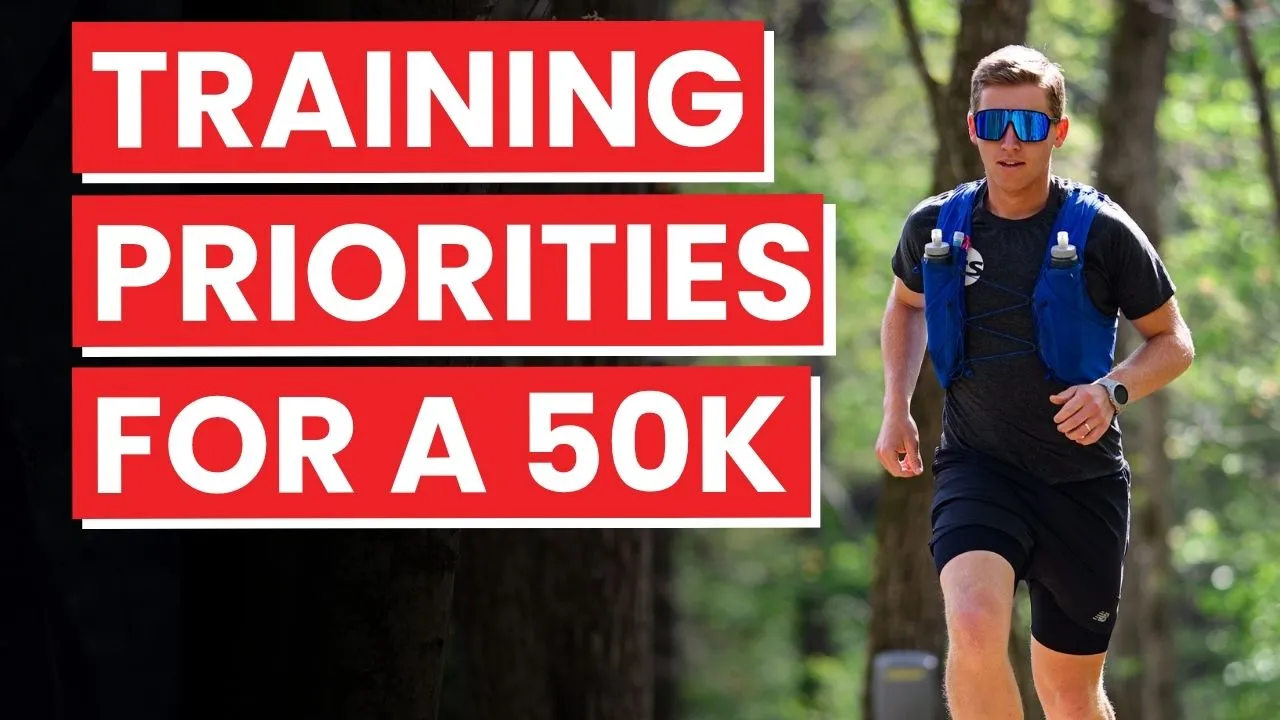
How to Prioritize Your 50K Training

Updated On
September 9, 2026
CHOOSE YOUR FORMAT
►WATCH THE VIDEO
►LISTEN TO THE PODCAST
►READ THE ARTICLE
How to Prioritize Your 50K Training
One of my biggest pet peeves about the endurance coaching profession is how we sometimes make things more complicated than necessary. Training for your first 50K is a great example. A 50-kilometer trail race is often a runner’s introduction to ultra-distance racing. Naturally, we want you to be prepared so you have a positive experience and stick with ultras. That means walking a fine line between encouraging athletes to train with enough volume and intensity and structure to make real progress, while not overburdening athletes with so much minutiae that ultradistance run training seems overwhelmingly complicated, tedious, and not fun. In my experience, it comes down to prioritizing what matters the most and introducing helpful-but-not-imperative options farther down the priority list.
To help you out, I’m sharing the hierarchy I use with the athletes I coach. There are three tiers, ranked by importance, starting with the essentials that make the most difference and ending with the stuff that often gets the most attention but matters the least.
Now, if you arrived on this page looking for the basics of 50K training, go to this article to learn everything you need to know.
Tier One: The Essentials of 50K Training
Get these six aspects right, and you’ll most likely finish your first 50K in good shape, even if you get things from Tier Two wrong and completely skip everything in Tier Three.
First: Training Availability
The most important part of training is being healthy enough to train consistently. Sounds obvious, but inconsistency is what derails most first-time ultrarunners. And it usually stems from a mismatch in your actual training availability and how much training you think you’ll be able to sustain. It’s better to plan conservatively so you can accumulate training volume in the beginning. That initial base helps your muscles and tendons adapt to the load before you add move weekly training hours and additional training interventions like intervals.
Starting conservatively is not going to slow down your progress. It will likely accelerate progress because your running volume will be more sustainable. You will be more likely to stick with a conservative plan because it’s less disruptive to your schedule, the runs are easier to recover from, and you’re less likely to struggle with preventable injuries from ramping up training volume or intensity too quickly.
Second: Training Volume
When you make the most of your training availability you can accumulate meaningful training volume. There’s no substitute for time spent running. Your legs and your aerobic system adapt to the running you actually do, not what you meant to do or what a plan on paper says you should have done.
How much is enough? Most first-time 50K athletes have some running experience already, often from marathon and half-marathon training or triathlons. You’ll want to leverage existing fitness by building toward the range of five to eight hours a week by the peak of the build phase. What matters more than the total weekly hours is the trend and the structure behind it. Your overall training volume should climb gradually over months rather than weeks. It’s better to think about training volume in organized blocks that could span a few weeks and are separated by recovery periods. Your long runs should get progressively longer, too, since your long runs become shorter rehearsals for race day pacing, nutrition, and hydration strategies. Don’t get hung up on hero metrics like a single big week of training or an epic individual run. It’s the consistent and gradual accumulation of training volume that drives the most important adaptations.
Third: Train to specific event demands
This is something athletes often get wrong. Your training should prepare you for the specific demands of your goal event. Generalized fitness and lots of running volume form the foundation, and then you must narrow the focus to address race-day demands as the race date approaches.
What does that mean? It means looking at the key features and characteristics of the event, an then designing your training to address those features. It could mean aerobic work below your first ventilatory threshold to build the kind of steady-state endurance a 50K requires. You might need to work on preventing and coping with muscle damage if the course is mountainous and features a lot of descending. It could mean technical running skills and footwork if your race has rocky or root-covered footing.
A flat, tame gravel 50K and a steep, technical mountain 50K are almost different sports, even though they’re the same distance on paper. One might take 4 hours, the other might take 8. Study your specific course, and train for that course, not for a generic 50K using a plan pulled off the internet.
Fourth: Training Load Management.
This is your stress and rest equation. How much stress (inclusive of training, lifestyle, career, and relationships) can you absorb and adapt to, based on how much rest and recovery you can consistently commit to? This is a very personal and highly variable balancing act, and no two athletes are the exact same. Your plan must be based on what you can handle, not what your training partner or spouse or some running influencer can do.
There are some notable differences in the athletes I work with who have various combinations of kids or no kids, working full time or not working, and sleeping at least eight hours per night vs. six hours and fewer. The athletes with more stress outside of training (kids, jobs, less sleep) often excel with lower training volume, more easy days relative to hard days, and closer attention to subjective feedback to adjust their plan on the fly. Athletes with more bandwidth to absorb training (no kids, retired or semi-retired, long sleepers) can sustain higher weekly training hours and more frequent hard sessions.
Which group is more likely to finish or go faster? In my experience, there’s little to no difference in finisher rates, especially for first-time 50K runners, so long as you individualize training stress to match your capacity for recovery. If you’re a busy professional or a parent running on six hours of sleep instead of eight, that doesn’t mean you’re doing it wrong. It means your training volume and intensity need to respect that reality, rather than chasing a plan built for someone with a different recovery capacity than yours.
Fifth: Adequate daily nutrition.
This means fueling your training and your recovery day to day, not just on race day. Training for your first 50K is likely a meaningful increase overall energy expenditure and your energy intake (usually on a 3-day rolling average) needs to reflect that. Don’t worry about weight management while training for a 50K. Fuel the workouts and recovery and let body composition change naturally. It’s more important watch for the signs of under-fueling: Nagging fatigue that doesn’t improve with a rest day, getting sick more often than usual, slower recovery between sessions, irritability, or losing your period if that applies to you. Any of those are signals to eat more, not to push through. Under-fueling during a heavy training block is one of the fastest ways to stall your progress, get injured, or show up to race day depleted before you’ve even started.
Sixth: Nutrition and hydration strategies for training and racing
This is one of the most common limiters in ultrarunning and the leading cause of DNFs, but nutrition and hydration are entirely trainable. Practice taking in carbohydrate and fluids consistently during your training runs. Test your nutrition choices during longer runs, when you’re fatigued, so race day isn’t the first time you’re testing what your gut can handle. Athletes who show up to their first 50K with a rehearsed fueling plan experience fewer nutrition-related problems.
► Free Ultrarunning Training Assessment Quiz
Take our free 2-minute quiz to discover how effective your training is and get recommendations for how you can improve.
Tier Two: Refinements to 50K Training
Tier Two is where you take the essentials above and refine the ways you apply them to your own training. This stuff is worth doing well, and these things can be the difference between good preparation and great preparation, but imperfections here probably won’t derail your entire race.
Periodization
The essentials were training availability and volume. Periodization organizes your training into phases that target specific aspects of fitness as you build toward your race. A plan without periodization is just a lot of running. A periodized plan generally starts with generalized training that can include low-intensity volume and high-intensity intervals to build capacity. Then you move to a build phase where volume increases and intensity gives way to longer, race-specific efforts on terrain that matches your course.
Plan your training in advance to progress toward higher volume and lower intensity work, preparing you for the specific demands of a 50K. But also understand the need for flexibility, and adapt based on life and how you respond to training.
Training intensity distribution
This is simply how you divide your training between easy efforts and harder efforts. The general principle is to favor more easy volume and incorporate less hard intensity than feels intuitive. Hard efforts should be layered in deliberately, with a clear purpose, and separated by plenty of recovery time. You don’t want to just add intensity because you feel good on a given day or because more intensity feels like more progress. To prepare for your first 50K, most of the work should be lower-intensity, sustainable efforts, with some harder efforts once or twice a week.
Heat and altitude acclimatization
Heat and altitude acclimatization are wise interventions if your race demands either. Both are trainable, depending on how much time and effort you want to devote to them. Keep in mind, heat training (repeated daily heat exposures over 7-14 days, followed by maintenance exposures every 2-3 days) has a cost in terms of time, focus, end energy. If your schedule accommodates it, great. Same with any sort of altitude intervention (including using heat training as an altitude training substitute). But if you can’t accommodate these interventions, you can still prepare adequately for a race in a hot environment or a high elevation. You’ll need to adjust your pacing and fueling strategies, and generally race more conservatively, but your fitness is still the number one most important factor in getting to the finish line.
Macronutrient distribution in your daily diet
The essential component was consuming enough calories to support training and recovery. This is about how you target carbohydrate, protein, and fat consumption relative to your training. That means leaning more on carbohydrate around your harder or longer sessions, when high carbohydrate availability is more important. It means spreading protein intake across the entire day because that supports recovery and adaptation better than a single large dose. Get this right and you’ll likely recover faster between sessions, feel more consistent day to day, and feel better on race day. Getting it wrong probably won’t prevent you from finishing your first 50K, since total intake matters more than precise distribution at this level.
Tapering
A basic taper means backing off training volume in the final one to two weeks before your race, while keeping a bit of intensity, so you show up fresh rather than fatigued. Some first-timers taper too little because they’re anxious about losing fitness. Or they taper too much and feel stale and sluggish by race day. The standard is two weeks, starting with a rapid drop (about 50%) in training volume that then levels out gradually, retaining training frequency (so shorter runs, not fewer), and incorporating some intensity to keep all energy systems primed. How much does a taper matter? At most, you’ll gain 1-3% in performance. It’s a good idea to go into your event rested rather than tired, but don’t stress out too much over creating the perfect taper.
Strength training
Strength training doesn’t directly make you faster, but it builds tissue resilience and force production that running can’t. These adaptations support the durability work you’re already doing on the trail. Two strength training sessions a week is plenty for a first 50K, or any distance, frankly. Just don’t let it compete with your primary objectives or sacrifice your running, either by volume or key sessions.
Race-day pacing and effort management
This is a hard thing to get right on your first 50K, and pacing often goes wrong in the first hour. Adrenaline and start line enthusiasm make a fast pace feel easy, and it’s tempting to bank time early while you feel good. Don’t fall for it. The better approach is to run the first third of your race by perceived effort, not pace, and to make that effort deliberately conservative.
Enjoying This Article? Get More Free Running Training Tips
Get our coaches' best training advice, delivered straight to your inbox weekly.
Run the first third easier than you think you should. If there’s climbing early, hike it, even if you feel like you could run it. Hiking at a strong, efficient pace is often just as fast as a slow jog uphill, and the energy cost is lower. A good rule of thumb: if you’re not slightly bored or slightly annoyed at how easy the first 8 to 10 miles feel, you’re going out too hard. The discipline you show in the first hour will be rewarded (or penalized) in the final hour.
Footwear and gear suited to the race course
Don’t fall for trendy shoes. Instead, consider the course when choosing your gear. Rocky, technical terrain wants a shoe with a protective rock plate and aggressive lugs for traction. Just because your favorite pro runner wears the latest super shoe doesn’t mean it’s the right choice for you. And always train in the shoes you’re planning to race in.
If there’s significant vertical gain, trekking poles are worth learning to use in training, not picking up for the first time on race morning. Hydration vest capacity should match your aid station spacing. And the single most important gear rule for a first 50K: nothing new on race day. Shoes, socks, hydration setup, nutrition products… test all of it in training and specifically during long runs.
Tier Three: Marginal Gains Or Not Worth It
There is an endless list of gadgets, supplements, and technologies that promise to revolutionize your performance but mostly just cost you money, time, and focus. Some interventions have modest evidence behind them: Compression boots and apparel might help perceived recovery slightly.
But the majority of what the recovery industry sells is monetizing the fear you’re not doing enough, not recovering well enough, or missing out on some edge everyone else is getting. Cool water immersion can have some benefits if your core temperature is elevated, but cold plunges (and particularly expensive cold plunge tubs) probably do more to blunt training stimulus than promote recovery. Massages can be fine if they feel good and you like them and can afford them, but cupping doesn’t do anything besides leave marks on your skin.
If you enjoy these things, there’s probably little harm or risk associated with them, but they do add some level of stress and activity to your routine that would be better spent just resting. And none of them will compensate for getting the essentials wrong or provide more value than incorporating some of the refinements discussed above.
About the Author
Cliff Pittman
CTS Pro Ultrarunning Coach
Cliff Pittman is the Coaching Development Director for CTS, where he expertly leads the Ultrarunning and Cycling Coaching teams. A passionate ultrarunner and active competitor, Cliff specializes in simplifying complex training concepts into actionable strategies, ensuring athletes at all levels—from beginners to elite competitors—can achieve their goals in prestigious events like the Western States 100 and Leadville 100.