
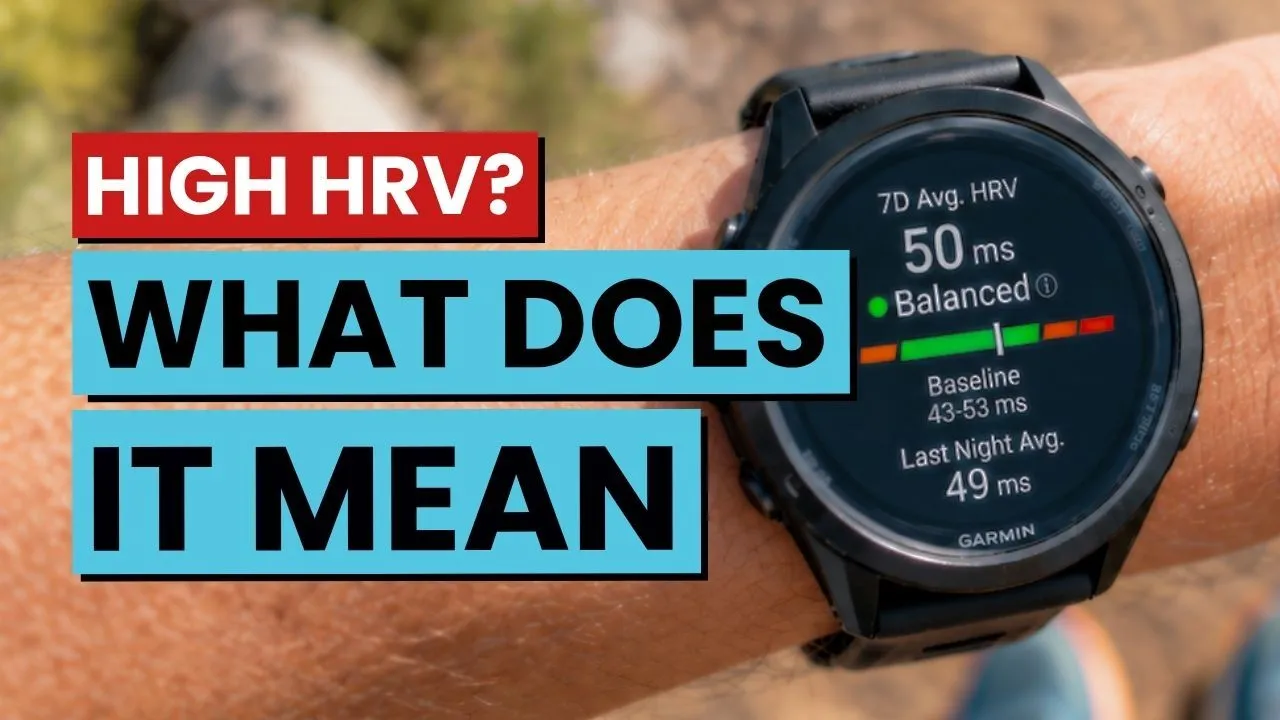
Best Ways Ultrarunners Should Use Heart Rate Variability

Updated On
September 16, 2026
CHOOSE YOUR FORMAT
►WATCH THE VIDEO
►LISTEN TO THE PODCAST
►READ THE ARTICLE
Best Ways Ultrarunners Should Use Heart Rate Variability
Although I consistently advocate for making training less complicated, heart rate variability is one place where thinking too simplistically can get you in real trouble. The simplistic view on HRV is that a high HRV is always good and a low value is always bad. Directionally, there is some truth in the “high-good, low-bad” framework, but in practice the framework falls apart under real training stress and with variations in how, when, and what equipment is used to record measurements. Should you monitor HRV as an ultrarunner? Yes. But if you’re going to do it, here’s how to do it right.
Basic Science of Heart Rate Variability (HRV)
Your heart doesn’t beat like a metronome. The gaps between heartbeats are not uniform, and that variability is controlled by your autonomic nervous systems (ANS). HRV reflects the balance between your parasympathetic nervous system (rest, recovery, digestion) and your sympathetic nervous system (stress, fight-or-flight, mobilization).
More variability (i.e., higher HRV value) between beats generally reflects a nervous system that is readily responsive to both sympathetic and parasympathetic stimuli. Less variability (i.e., lower HRV value) reflects a system locked into a more sympathetic, stress-dominant pattern.
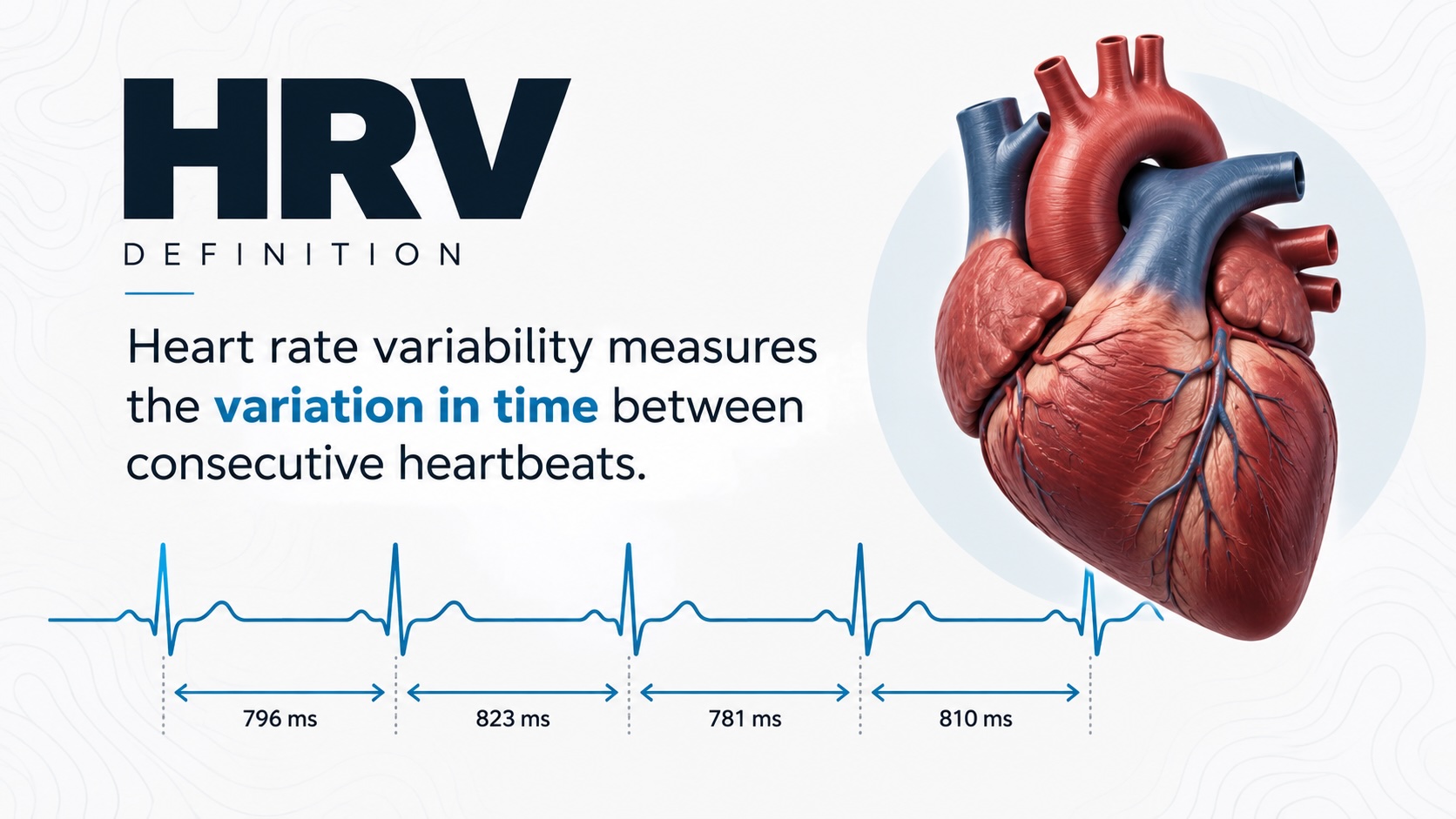
Think of it like a suspension system. A responsive suspension system can absorb a range of road conditions and adjust smoothly. A stiff suspension system is braced for one condition and struggles to adapt when things change.
The Nuanced View of HRV You Need
The popular framing is simple: High HRV means you’re recovered and ready to train hard. Low HRV means you’re fatigued and should back off. There are kernals of truth there, but here are the important nuances you need to know:
- Normative values vary enormously between individuals. Genetics, age, training history, and baseline fitness all shift where “normal” number. Comparing your raw number to someone else’s, or to some arbitrary target on an app or online, will lead you astray.
- HRV trends downward as you accumulate training fatigue. That’s not necessarily a signal of a problem. Rather, it’s often an essential effect of training. You’re applying stress, the body is responding, and a downward trend during a hard block is often exactly what you’d expect if the training is working. The mistake athletes make is treating every downward tick as a red flag. If you back off every time, you’ll never accumulate enough stress to adapt. You’ll spend the season chasing a number instead of building fitness.
- Higher isn’t always better. Reasonably steady HRV values over a period of days and weeks is generally a better signal than a sudden spike or elevation of HRV. A number that spikes unusually high can be a precursor to illness, as the body mounts an early immune response before symptoms show. I’ve seen this in my own data and in athletes I coach.
- Devices and apps don’t measure the same thing the same way. Different platforms calculate and present HRV differently, apply different smoothing factors, and generate different proprietary readiness scores based on the same underlying signal. Your number on one platform doesn’t always compare to your won past values if you switch devices or measurement protocols.
The big takeaway here is that your real target is neither an objectively high or low HRV value. What you want is a stable value over time, within your own normal range.
HRV Best Practices: Morning Static vs. Overnight Measurements
There are two accepted approaches to measuring HRV and each has a real value and a real limitation.
Morning static readings typically utilize an app like HRV4Training that uses your phone’s camera or a chest strap to measure HRV for a few minutes each morning, either before or after sitting up. This method benefits from consistent conditions and reasonably precise measurement, meaning it’s excellent for capturing day-to-day variability. The limitation is inconvenience. It requires a few minutes of stillness every single morning, ideally at a consistent time. For athletes juggling training, work, and family, that consistency is often the first thing to slip, and once the protocol breaks down, the data gets harder to trust.
Overnight readings using wearable devices like Garmin, Oura, or Whoop give you convenience and consistency. You don’t have to remember to do anything, and the device captures data across hours of sleep rather than a single wakeup snapshot. This is genuinely useful for spotting trends over time, which I think is where the real coaching value lives anyway. The limitation is that overnight readings are somewhat less controlled than your purposeful morning readings, and accuracy varies by device.
HRV Device Differences and Recommendations
The devices also aren’t identical in how they hand you the data. Garmin applies a rolling average to smooth the trend line — I’m honestly not a fan, since I’d rather see actual daily values plotted against my normal range and draw my own conclusions. Whoop turns it into a gamified daily score. Garmin also feeds HRV into other derived metrics like training readiness. TrainingPeaks (pulling from your device of choice) and HRV4Training mostly hand you raw data and let you interpret it. HRV4Training does a good job explaining what a given reading might mean, making it a solid starting point if you’re new to this. It also integrates with other devices if you’d rather pull overnight readings from something like Oura.
My honest take: if you can maintain a consistent morning static protocol without it becoming a source of stress or a scheduling headache, that data will generally be more precise. But if that consistency isn’t realistic for your life, an overnight reading you’ll actually maintain day after day beats a precise method you abandon after three weeks. Consistent, slightly-less-precise data beats precise data with gaps in it, because the entire value of this metric comes from the trend line, not any single number.
My HRV Framework for Adjusting Training
I do not look at any single HRV value and make a training call based on it. If you’re using this morning’s HRV as a “go/no go” signal, you’re using it wrong. Here’s a better way:
► Free Ultrarunning Training Assessment Quiz
Take our free 2-minute quiz to discover how effective your training is and get recommendations for how you can improve.
- HRV Trends Relative to Past Performance: To make use of HRV data, I look back through an athlete’s HRV history alongside their training log and asking one question: When did the athlete respond well to a block (upward or stable HRV trend), and when did they respond poorly (sustained downward HRV trend)? That retrospective view is where the real coaching value lives. It tells me how you responds to volume, to intensity, to a specific stimulus, and I use that to shape future training.
- HRV In Context: I use HRV to confirm what I’m already seeing elsewhere. If an athlete’s output is declining, their subjective feedback is trending negative, and their HRV trend is moving down out of normal range at the same time, that constellation is a much stronger signal that it’s time to shift into a deload than any one of those things alone. The trend confirms the story; it’s rarely the thing that tells the story on its own.
Coaching Example: Say an athlete is moving through a build phase with rising volume and a couple of quality sessions each week. If their HRV trend holds steady or even ticks up slightly while load increases, that tells me their body is absorbing the work well and I might have room to push a little further. However, if the trend drifts down for a week or two, sessions start feeling harder than they should for the same effort, and subjective feedback starts including words like “flat” or “heavy”, then I’m not waiting for a crisis to act. That combination is enough to pull back volume or intensity before it turns into a bigger setback. Neither call comes from HRV alone. It’s always the combination that moves me to act.
The Mistake to Avoid: Changing Training Too Soon
A downward HRV trend during a hard training block isn’t automatically a problem. The entire point of a training block is to accumulate fatigue, then recover so you can absorb the training stress and come out with positive adaptations. If your HRV dips because you’re doing the work, and your output and subjective feel are holding steady, that’s not a red flag… yet.
Be patient. What you’re watching for is the point at which the trend departs from your established normal range and stays there. A day or two of fluctuation is just life (sleep, caffeine, stress, alcohol, etc.). Multiple consecutive days outside your normal range, especially paired with declining performance and subjective feedback, is a yellow flag. Extend that further, and it becomes a red flag worth acting on.
Staying inside your normal range — even if that range shifts slightly lower during a demanding block — is the actual goal.
HRV In Context With Resting Heart Rate
HRV and resting heart rate measure related but distinct things. HRV reflects the balance and flexibility of your autonomic nervous system. Resting heart rate is your baseline heart rate at rest, and it tends to increase with accumulated fatigue, dehydration, heat stress, illness, and general systemic load.
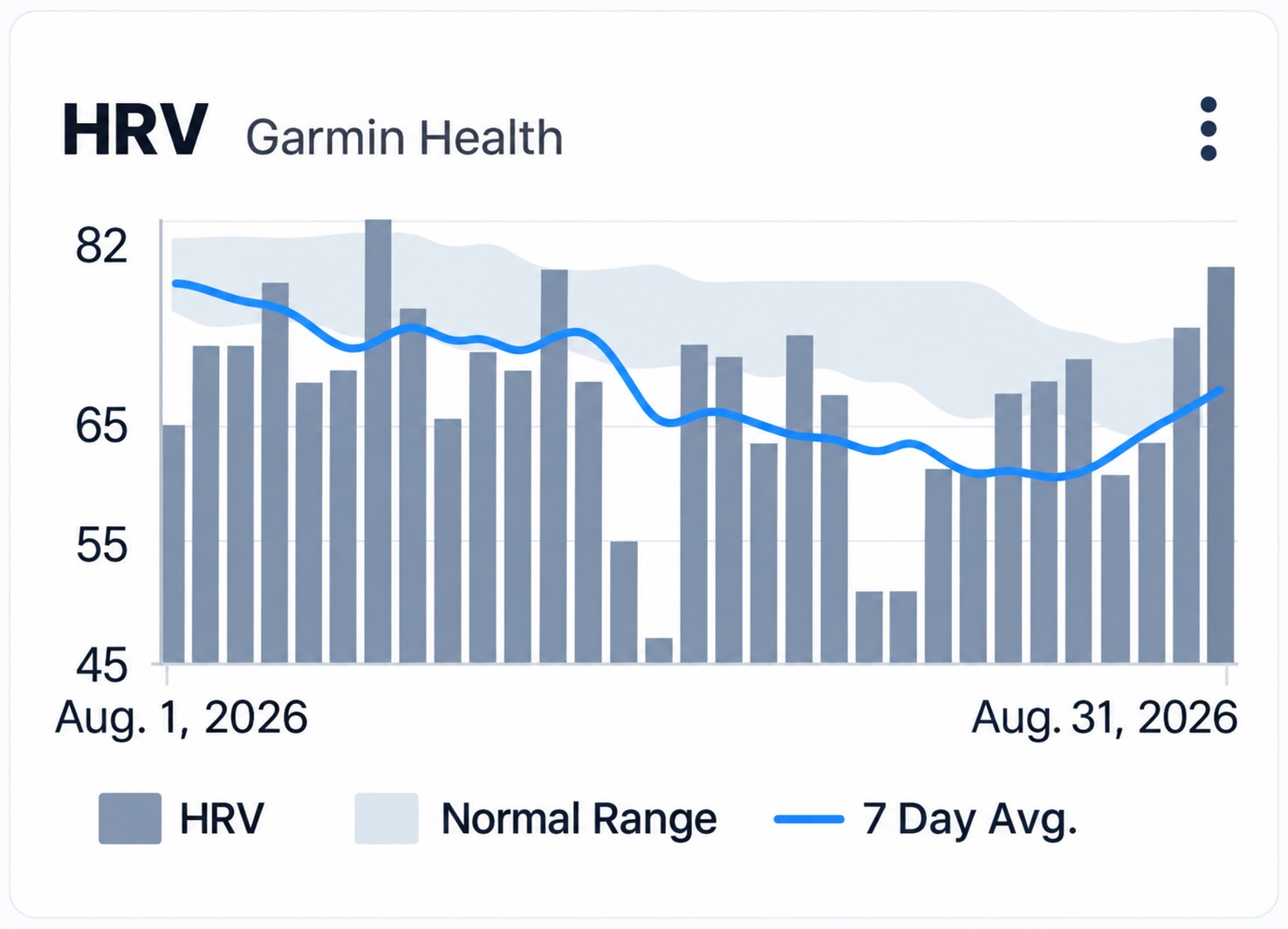
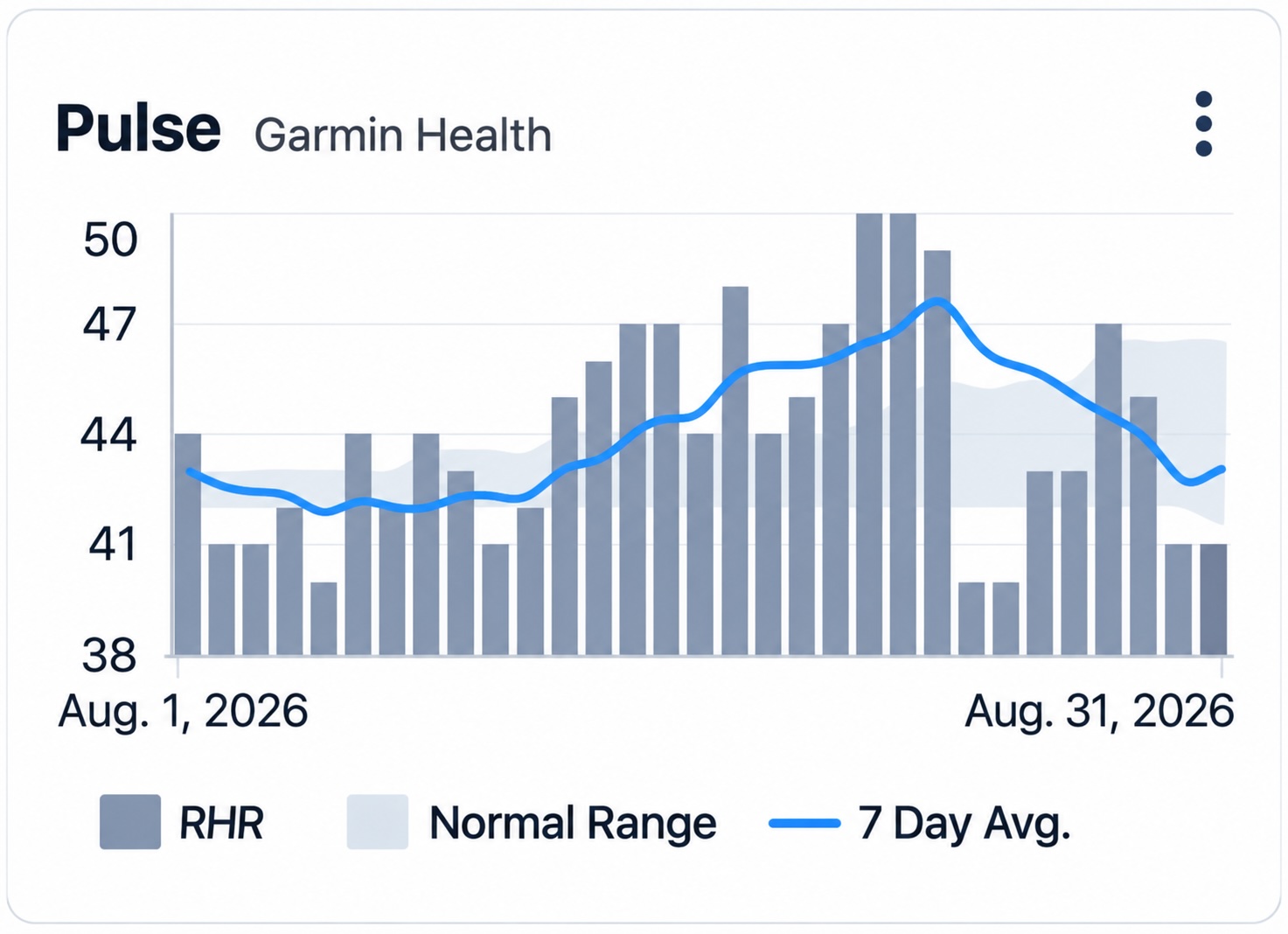
When I see HRV trending down and resting heart rate trending up at the same time, over a period of days, that’s a much stronger and more consistent signal than either metric alone. It suggests broad systemic stress, not just a noisy reading from one device on one night.
My Real-World Example From Three Weeks at Altitude
From August 13th through the 23rd, I was in Colorado, with significant periods at 6,000-7,000 feet (Colorado Springs) and 9,000-10,000 feet (Leadville) above sea level. I live in Fayetteville, Arkansas at 1,200 ft above sea level. My HRV showed a clear downward trend while I was in Colorado, followed by a gradual recovery back toward my normal range once I returned home to my usual elevation. My resting heart rate told the same story, but from the other direction. It climbed during that stretch in Colorado and settled back down since I’ve been home.
Enjoying This Article? Get More Free Running Training Tips
Get our coaches' best training advice, delivered straight to your inbox weekly.
If I’d let that downward HRV trend dictate my day-to-day training decisions while I was at altitude, I would have done almost no training. That would have been the wrong read. My system was accounting for real environmental stressors: altitude, disrupted sleep from race support duties, and generally lower sleep quality from being away from home at elevation. That’s not a training problem. That’s my body doing exactly what it should do under those conditions.
With an understanding of the context, I trained while in Colorado and put in solid volume during that stretch. However, I also pulled all structured intensity out of my training because the data was showing I was already under some stress. And I planned a deload once I got back so I could actually absorb everything, both the training and the travel stress, before building back up.
And it worked. My HRV trended back up, and my resting heart rate has settled back down, telling me I’ve rebounded to homeostasis and I’m ready for quality work again. That’s the entire value of this tool in one example: not a stop sign that says cease training when the number drops, but context that helps you make a better decision.
The Bottom Line
Practically, here’s what I recommend to athletes who want to get meaningful, actionable insights from HRV:
- Pick one measurement method. You can do morning static or overnight, but base the decisions on which one you’ll do consistently, for long enough (e.g., weeks) to establish a real baseline.
- Don’t use a single-day value as a “go/no go” signal. Look at the trend across a week or more, relative to your normative range, and in the context of your training performance and subjective feedback.
- Expect the trend to move down during legitimate hard blocks. That’s not failure. Watch for sustained departure from your normal range, especially when it lines up with declining output or flat, negative subjective feedback.
- Pair HRV with resting heart rate whenever you can.
As an additional resource, I recommend Marco Altini’s blog. The founder of HRV4Training and an advisor to Oura, Marco writes one of the best public resources on this subject anywhere. I’ve learned a lot from him, and if you want to go deeper on the science, his blog is a genuinely excellent place to start.
About the Author
Cliff Pittman
CTS Pro Ultrarunning Coach
Cliff Pittman is the Coaching Development Director for CTS, where he expertly leads the Ultrarunning and Cycling Coaching teams. A passionate ultrarunner and active competitor, Cliff specializes in simplifying complex training concepts into actionable strategies, ensuring athletes at all levels—from beginners to elite competitors—can achieve their goals in prestigious events like the Western States 100 and Leadville 100.