
The Stress and Recovery Principle Behind Every Successful Endurance Athlete

Updated On
October 14, 2026
CHOOSE YOUR FORMAT
►WATCH THE VIDEO
►LISTEN TO THE PODCAST
►READ THE ARTICLE
The Stress and Recovery Principle Behind Every Successful Endurance Athlete
If there is one fundamental principle to physical training, one idea that every other idea relies on, it’s the principle of Stress and Recovery. Sometimes referred to as Overload and Adaptation, it’s the simple idea that exercise induces a training stress that stimulates the body to adapt, and that the body needs recovery time absorb the training stress and achieve the intended adaptation. Getting it wrong can unravel your entire training process, so let’s talk about how to get it right!
The Basics of Training Stress and Recovery
The idea that Stress + Rest = Adaptation isn’t new, nor did it originate with physical training. Back in 1936, endocrinologist Hans Selye described what he called “General Adaptation Syndrome”. He wasn’t studying athletes, but rather how the body generally responds to stress from injury, illness, cold exposure, and physical exertion. He found that people consistently exhibited the same three-stage pattern: Alarm (initial reaction), Resistance (rebuilding and adaptation), Exhaustion (when the stress doesn’t let up, the system breaks down instead of adapting). That third phase is where overtraining lives, and where a lot of hardworking, well-intentioned athletes end up, usually because they confused training harder with training smarter.
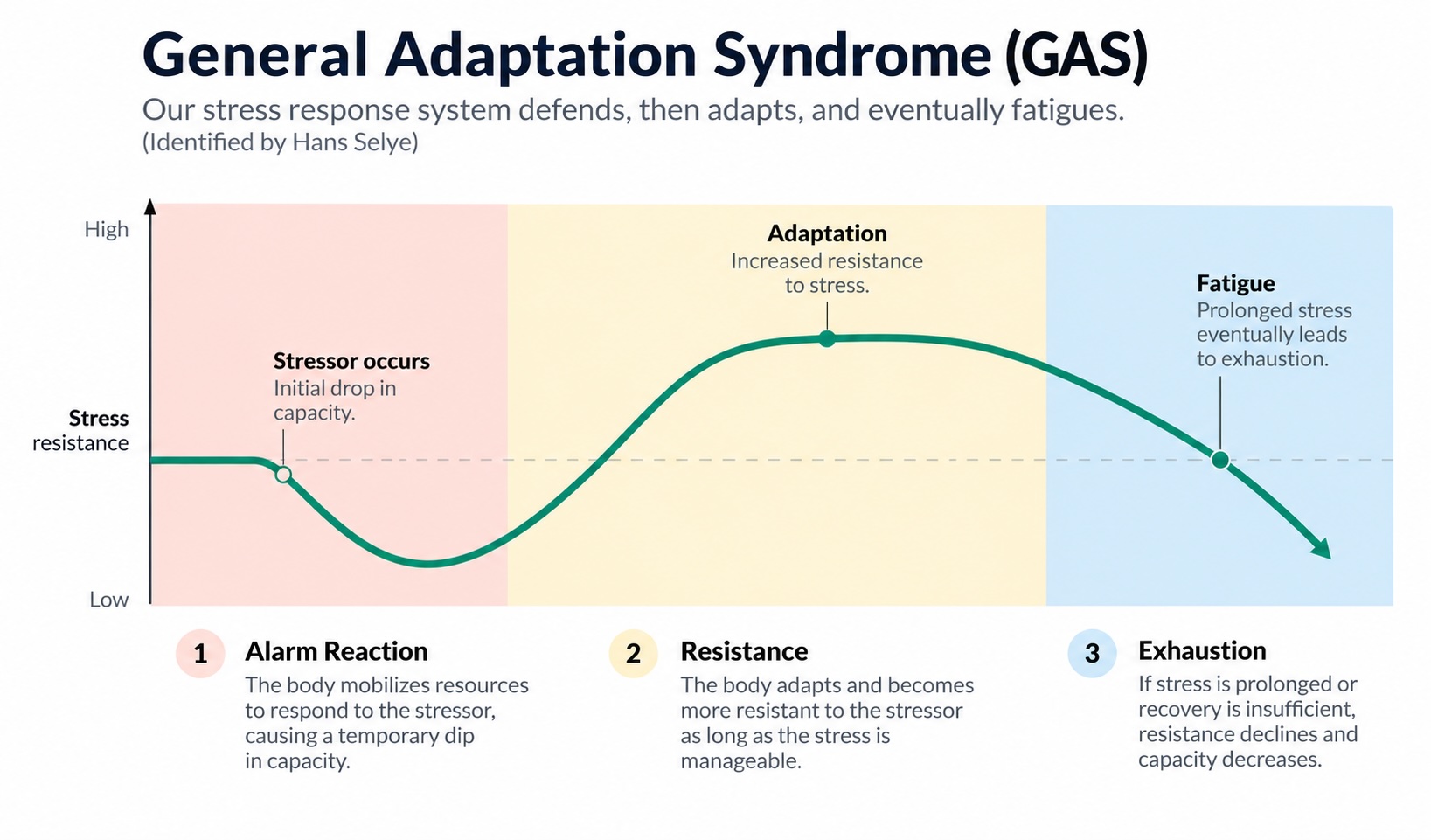
Every periodization model, including block training, polarized training, etc., leverages the same underlying principle.
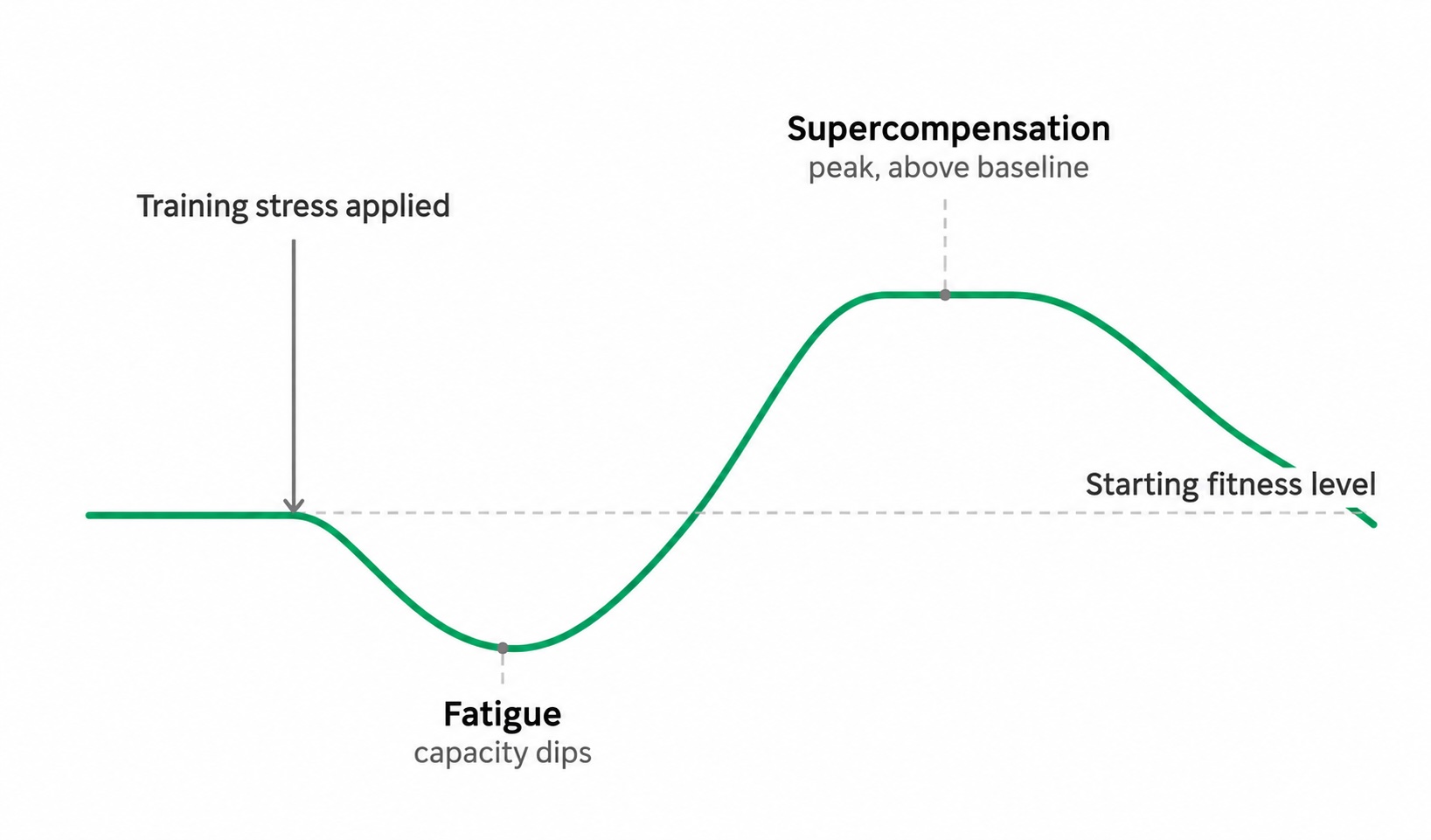
In Selye’s paradigm, most of the exercise training process occurs in the Resistance phase. Represented graphically below, you apply a training stress and your capacity to perform drops within the hours and days immediately after. The initial response is fatigue, not improved fitness. When you allow time for rest, and you supply adequate food and fluids, you replenish glycogen stores, synthesize muscle protein, repair tissues, restore hormonal balance, and more. Your capacity for performing work rebounds slightly higher than it was before your last training stimulus. That overshoot is called supercompensation, and it’s the entire reason training produces fitness gains instead of just producing fatigue.
The Asymmetry Between Fitness and Fatigue
In 1975, sport scientist Dr. Eric Banister and his colleagues proposed what’s now called the fitness-fatigue model. The core insight was that every training session produces two effects simultaneously: a smaller fitness gain that builds slowly and fades slowly, and a larger fatigue cost that builds fast and clears fast. Your readiness to perform on any given day is the gap between those two curves. Fitness minus fatigue. If that sounds familiar, it might be because that’s essentially what modern training software calculates. TrainingPeaks, for instance, uses Acute Training Load (fatigue) and Chronic Training Load (fitness) to calculate Training Stress Balance, which they refer to as “form”. Form can also be thought of as readiness to perform, whether that’s a training session or a competition.
Here’s why the asymmetry matters. Fatigue clears faster than fitness fades, so a reduction in training workload can clear fatigue close to a race while the fitness underneath it stays largely intact. That’s the entire logic of a taper.
The Consequences of Messing Up Stress and Recovery Balance
Stress and recovery is so integral to every other aspect of training that there are massive consequences to messing up the balance between them. When you overdo the stress and don’t provide enough time for recovery, you drift toward what researchers call “overreaching”. Push through that long enough without correcting course, and you’re looking at what’s now formally recognized as overtraining syndrome.
Researchers Meeusen and colleagues laid this out in a joint statement from the two major sport science organizations in Europe and the United States back in 2013 (Meeusen et al, 2013). They concluded that: Training must include overload to work at all, but overload only produces fitness when it’s paired with enough recovery to let the body actually process it. Strip the recovery out of that equation for long enough, and the consequence can be months of suppressed performance, disrupted hormones, and in many cases, an athlete who steps away from the sport altogether.
When athletes get too much recovery relative to training stress, you just don’t improve. It’s safe, because there isn’t typically enough stress to increase injury risk, but you’re not increasing your capacity for work, getting faster, more durable, or stronger. This is where a lot of “general exercisers” stall. They go to the gym to do the same exercises or walk/jog the same route and pace they’ve done for months or years, and nothing changes.
Applying The Stress and Recovery Principle to Ultrarunning
The demands of ultrarunning look different from most other endurance sports. The stress of trail running comes from tens of thousands of footstrikes, over rough terrain, sustained for 5 – 20+ hours. Durability, the ability to keep producing force and moving efficiently after accumulating a lot of fatigue, is more of a limiter in ultrarunning than your aerobic engine. However, you develop durability the same way as every other adaptation: through stress and recovery. You improve through repeated exposure to mechanical stress, followed by recovery that lets the tissue, the nervous system, and the fueling systems actually rebuild stronger than before.
One of the biggest differences between ultrarunning and other endurance sports is the timescale of adaptation. It just takes longer to develop the durability required for success. Instead of balancing stress and recovery for a few weeks to manage a 5K, you’re managing it across months and years to build the tissue resilience required for a 100-mile running race.
The Timeframes for Stress and Recovery
To understand the role of stress and recovery across large and small timeframes, let’s start with the longest periods (year-to-year) and move to the shortest (interval-to-interval).
Year to Year
Across a multi-year career, stress and recovery manifest as “training age”. It takes more than a single season to develop into a durable and resilient ultrarunner. The cumulative training stress from an entire season creates the foundation for the next season, but also necessitates a deliberate and extended recovery period between training seasons. A multi-year approach to training sometimes includes shifting a runner’s priorities to base aerobic development – with little to no racing – for a season.
Training Block to Training Block
Within a season or calendar year, endurance training is broken down into blocks, each with a specific physiological focus. These could include a VO2max block, a threshold block, an endurance block, etc. Training blocks are meant to concentrate training stimulus on a narrow area of your physiology to drive adaptation. As a result, training blocks often induce significant fatigue over a period of several weeks.
Recovery periods between training blocks are very important, but they are often too short or too incomplete because athletes get impatient and coaches get nervous. Whether it takes seven days or two weeks of rest and Zone 1 activity to deload enough to be ready for meaningful training again, it’s your training readiness that dictates the timeframe, not the calendar.
Skip or shortchange that recovery period and your next training block won’t be as effective, which hinders your progress. You’ll stack a new kind of stress on top of unresolved fatigue from the previous block, which increases the chances for overreaching rather than positive adaptation.
► Free Ultrarunning Training Assessment Quiz
Take our free 2-minute quiz to discover how effective your training is and get recommendations for how you can improve.
Day to Day Within A Week
This is probably the most difficult aspect of stress and recovery to get correct. Your weekly training stress will be largely governed by duration, intensity, and pattern of your individual sessions.
When you’re focused on high-quality, high-intensity efforts, it’s best to separate hard workouts by at least a full day of rest. This allows acute fatigue to dissipate enough to allow for a high-quality workout in the next hard session.
When you’re focused on aerobic base or durability, you may choose to concentrate volume with runs on back-to-back days. This increased training density means running with accumulated fatigue, which is exactly the capacity you’re trying to build. And because it’s a bigger dose of stress compressed into fewer days, you’ll need more recovery after 2- or 3-day running blocks.
The same logic governs which sessions get placed next to each other. Strength training pairs with a hard running day, rather than being on a separate day between running sessions. This preserves an “easy day” to be purely about recovery rather than an opportunity for a different type of stress. Most of the time, when completing strength and endurance training on the same day, do the endurance work in the morning and strength in the afternoon, separated by at least four hours to preserve the quality level for each.
Interval to Interval Within A Workout
The work:recovery timing of an interval workout plays a huge role in the physiological stress being targeted as well as the effectiveness of the session itself. Very short recoveries can be effective for sustaining a high workload (near VO2 max, for instance) for longer than you could from a single effort. Longer recovery periods between high-intensity efforts allows for greater velocity or force production. For longer intervals, like 10- to 20-minute efforts, the work:recovery ratio is often 2:1, meaning 10 minutes of easy recovery between 20-minute efforts.
When you cut the recovery between intervals too short, the quality of the subsequent intervals diminishes. You won’t be able to reach the same intensity or duration targets. That changes the time-at-intensity values you accumulate during the workout, which changes the stimulus and affects the intended adaptation.
When you extend the recovery periods between intervals to be too long, you miss out on the benefit of cumulative exposure to the desired intensity.
Coaching Example
A few years back I coached a masters athlete training 8 to 10 hours a week. He was highly motivated, doing everything I asked, and then adding extra on top of it. He was doing extra strides, extra strength work, extra everything, because in his mind more stress simply meant more progress. His training log looked fine. His subjective responses indicated everything was not fine.
We cut his volume by close to a third for three weeks, and pulled almost all the focused workouts, to let his body catch up to stress he’d applied weeks earlier. He came out of that recovery block and set a lifetime best within six weeks. Nothing about his fitness changed during that recovery window. What changed was that he finally provided his body the time to convert stress into adaptation, instead of just piling on more stress.
So where does coaching add value? On the surface, the stress and recovery principle sounds simple enough that a templated app or AI could manage it. In truth, programming the stress is relatively easy. Any reasonable plan can put a hard day next to an easy one. One of my most valuable roles is discerning how an athlete is absorbing stress in real time so we can adjust recovery and reschedule upcoming training stresses before problems arise. Some of that comes from watching the constellation of training data, but it also includes listening to the athlete’s subjective feedback, tone of voice, and word choice.
Enjoying This Article? Get More Free Running Training Tips
Get our coaches' best training advice, delivered straight to your inbox weekly.
Coaching is relationship-driven. Programming the workouts is the easy part. Adapting to the mess in front of you, the athlete who didn’t sleep, the one nursing a tweaked calf, the one who’s about to overreach because their last race went better than expected, that’s the real skill, and it’s the part no template handles for you.
The Bottom Line
Stress, followed by recovery, produces adaptation. That’s the entire mechanism behind every training plan that has ever worked, and it runs identically whether you’re looking at a multi-year career, an annual plan, a training block, a week, a single workout, or the 30 seconds between two hard intervals.
Apply the stress without respecting the recovery, and you don’t end up a better athlete. You end up injured, exhausted, or burned-out. Respect the recovery without applying enough stress, and you’ll feel fine but never improve.
Resources:
Calvert, T.W., Banister, E.W., Savage, M.V., & Bach, T.M. (1976). A Systems Model of the Effects of Training on Physical Performance. IEEE Transactions on Systems, Man, and Cybernetics, SMC-6, 94-102.
Imbach, Frank et al. “The Use of Fitness-Fatigue Models for Sport Performance Modelling: Conceptual Issues and Contributions from Machine-Learning.” Sports medicine – open vol. 8,1 29. 3 Mar. 2022, doi:10.1186/s40798-022-00426-x
Meeusen, R., Duclos, M., Foster, C., Fry, A., Gleeson, M., Nieman, D., Raglin, J., Rietjens, G., Steinacker, J., Urhausen, A., European College of Sport Science, & American College of Sports Medicine (2013). Prevention, diagnosis, and treatment of the overtraining syndrome: joint consensus statement of the European College of Sport Science and the American College of Sports Medicine. Medicine and science in sports and exercise, 45(1), 186–205. https://doi.org/10.1249/MSS.0b013e318279a10a
Rochette, Luc et al. “Stress: Eight Decades after Its Definition by Hans Selye: “Stress Is the Spice of Life”.” Brain sciences vol. 13,2 310. 12 Feb. 2023, doi:10.3390/brainsci13020310
About the Author
Cliff Pittman
CTS Pro Ultrarunning Coach
Cliff Pittman is the Coaching Development Director for CTS, where he expertly leads the Ultrarunning and Cycling Coaching teams. A passionate ultrarunner and active competitor, Cliff specializes in simplifying complex training concepts into actionable strategies, ensuring athletes at all levels—from beginners to elite competitors—can achieve their goals in prestigious events like the Western States 100 and Leadville 100.