

Easy Runs: The Science Behind Ultramarathon’s Greatest Training Tool

Updated On
May 13, 2026
CHOOSE YOUR FORMAT
►WATCH THE VIDEO
►LISTEN TO THE PODCAST
►READ THE ARTICLE
Easy Runs: The Science Behind Ultramarathon’s Greatest Training Tool
If you’ve been running for any amount of time, you’ve heard the advice: make your easy days easy and your hard days hard. People generally believe the premise, but rarely apply it to their own training. Running too hard on easy days is one of the most common mistakes ultrarunners make, and one of the biggest barriers to long-term endurance development. Perhaps we’ve been thinking about it the wrong way. Instead of viewing easy runs as the filler between more important interval and high-intensity days, view the easy days as your fundamental, most important training and the interval days as the added extras. When done correctly, endurance runs at low intensity become the highest leverage tools you have improving performance.
The Aerobic Engine Drives Everything – Even High Intensity
Any sporting endeavor longer than about 90 seconds is primarily fueled by aerobic metabolism. Granted, there’s a lot of anaerobic contribution to short, high-intensity efforts, but your aerobic engine is very good at ramping up to meet energy demand quickly.
About 80% of the energy expended for a mile run at maximal effort comes from the aerobic system. By the time you get to a 5K, it’s closer to 95%. A marathon or ultramarathon is almost entirely aerobic. Again, there are anaerobic contributions, and accelerations or surges on hills call on your anaerobic system, but the vast majority of your energy for endurance events, even high-speed endurance events, comes from the aerobic engine.
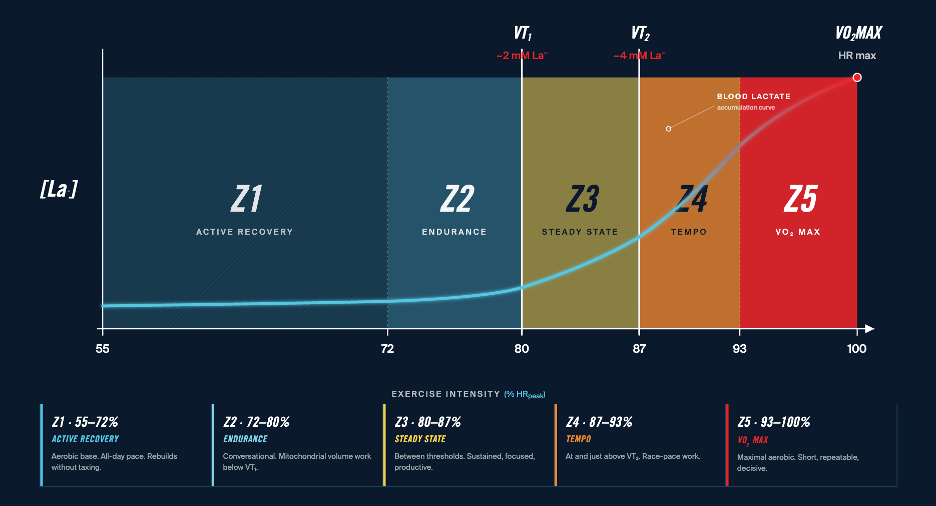
As I’ve described in previous articles, from a physiology standpoint we consider “easy running” to be below LT1(first lactate threshold). LT1 is the point where blood lactate begins to rise above resting baseline, but your body can process it rapidly and you can sustain this pace or intensity for hours. For review, the chart below describes the training zones CTS uses (5-zone system) and notes the locations of LT1 and LT2. Zones 1 and 2 are easy running below LT1.
What Easy Runs Actually Do For You
Below LT1, your breathing remains controlled and you can talk comfortably. Fat oxidation is efficient and most energy for muscle contractions is derived from fat. The recovery cost from runs at or below LT1 are relatively low, meaning you can accumulate more time at this his intensity compared to higher-intensity efforts. This is the physiological scenario that builds the engine that supports everything else.
Here’s what’s happening “under the hood”, so to speak, to facilitate the adaptations from easy running:
- Increased mitochondrial growth. Easy running stimulates an increase in the number, size, and capacity of these energy-producing organelles inside your muscle cells.
- Increased capillary density. More capillaries in skeletal muscles means faster oxygen delivery and improved circulation of waste products.
- Improved fat oxidation. Your body gets better at using fat as fuel, meaning you can run faster and longer with fat as your primary fuel. This spares your limited glycogen so you have some stored carbohydrate energy for later (along with the carbohydrate you consume during exercise).
- Optimized aerobic enzyme activity. There are lots of small biochemical reactions that contribute to the aerobic engine’s efficiency. Consistent, frequent easy runs helps establish the biochemical machinery that underlies all of your endurance capacity.
Research and practice back this up. Inigo San Millán, who has worked extensively with Tour de France cyclists and elite endurance athletes, has shown that athletes who spend the most time at genuinely easy effort develop the highest mitochondrial density and fat oxidation capacity. Steven Seiler’s research on intensity distribution across elite athletes in multiple sports confirms the same pattern. Easy training dominates in terms of time-at-intensity, whether you measure in weeks, months, or years.
The Damage Caused By Making Easy Runs Too Hard
Every intensity level from easy to maximum has its place in an athlete’s overall plan. And some athletes must adjust their training intensity distribution to accommodate other factors, like work and family priorities. As a coach, the damage I see athletes cause for themselves comes from letting their training drift into a middle area between easy and hard.
It’s not necessarily that Zone 3 is bad or to be avoided at all costs. The problem comes from training in Zone 3 when your training plan called for Zones 1-2 or Zone 4+. If all training gravitates to the middle, you’ll end up spending too much time in Zone 3. Here’s the problem: the aerobic adaptations you accomplish from Zone 3 are similar to those from Zone 2, but the recovery cost is significantly higher. You’re paying more to get roughly the same return. However, you’re increasing the time required for recovery between meaningful training sessions, which either reduces the number of meaningful sessions you can complete in a given week or month, or reduces the quality of subsequent training sessions.
Why Athletes Make Easy Runs Too Hard
The concept of creating clear distinctions between easy days and hard days (easy days easy, hard days hard) has been broadcast far and wide for a long time. So, why do athletes still go too hard? From my years of coaching experience, four reasons consistently show up:
- Poor internal calibration. What I’m recommending as “easy” feels too easy for many athletes, particularly new runners. Life taught you to work hard and to equate sweaty, out-of-breath, muscle-screaming workouts with progress. Easy feels like lazy and ineffective. It takes time to calibrate your internal intensity gauge. For now, tools like heart rate monitors and pace alarms can help.
- The “junk miles” myth. Easy running has been dismissed as junk miles for decades in track and road running culture. The belief: if it isn’t hard, it isn’t working. We need to reverse this: the only junk miles are those run at inappropriate intensities.
- Social and external pressure. Strava segments, faster training partners, and the local run club can all create peer pressure to run faster than you should. Social connections can be important for creating a support network and helping with motivation and accountability but be careful to stick to the training intensities that are right for your goals.
- Your ego. Going fast feels more validating than going slow. You’ve worked hard and you’re good at this, so it can be hard to let less experienced runners pass you and leave you behind. But ask yourself: Do you want to train fast, or do you want to race fast?
What Should Easy Runs Look Like?
At CTS, we distinguish between two categories of easy running, and both sit below LT1:
► Free Ultrarunning Training Assessment Quiz
Take our free 2-minute quiz to discover how effective your training is and get recommendations for how you can improve.
- Recovery runs (Zone 1, RPE 1–4). The value here is to facilitate circulation. You’re moving blood and nutrients and cellular waste products, and preparing the body for what comes next. This is not a primary adaptive stimulus. It’s recovery.
- Endurance runs (Zone 2, RPE 5–6). Still below LT1, but this is where the meaningful adaptations discussed above happen.
During your Endurance runs, easy feels like:
- A conversational pace, meaning you can speak in full sentences without much effort.
- RPE 5–6 on a scale of 1–10. You’re working, but you could go significantly harder. When in doubt, don’t be afraid to dip into RPE 3-4 rather than push toward 6-7.
- A pace you could hold all day. If it feels embarrassingly slow, you’re probably right where you need to be.
In your data after an Endurance run, easy looks like:
- Heart rate consistently below your LT1 heart rate.
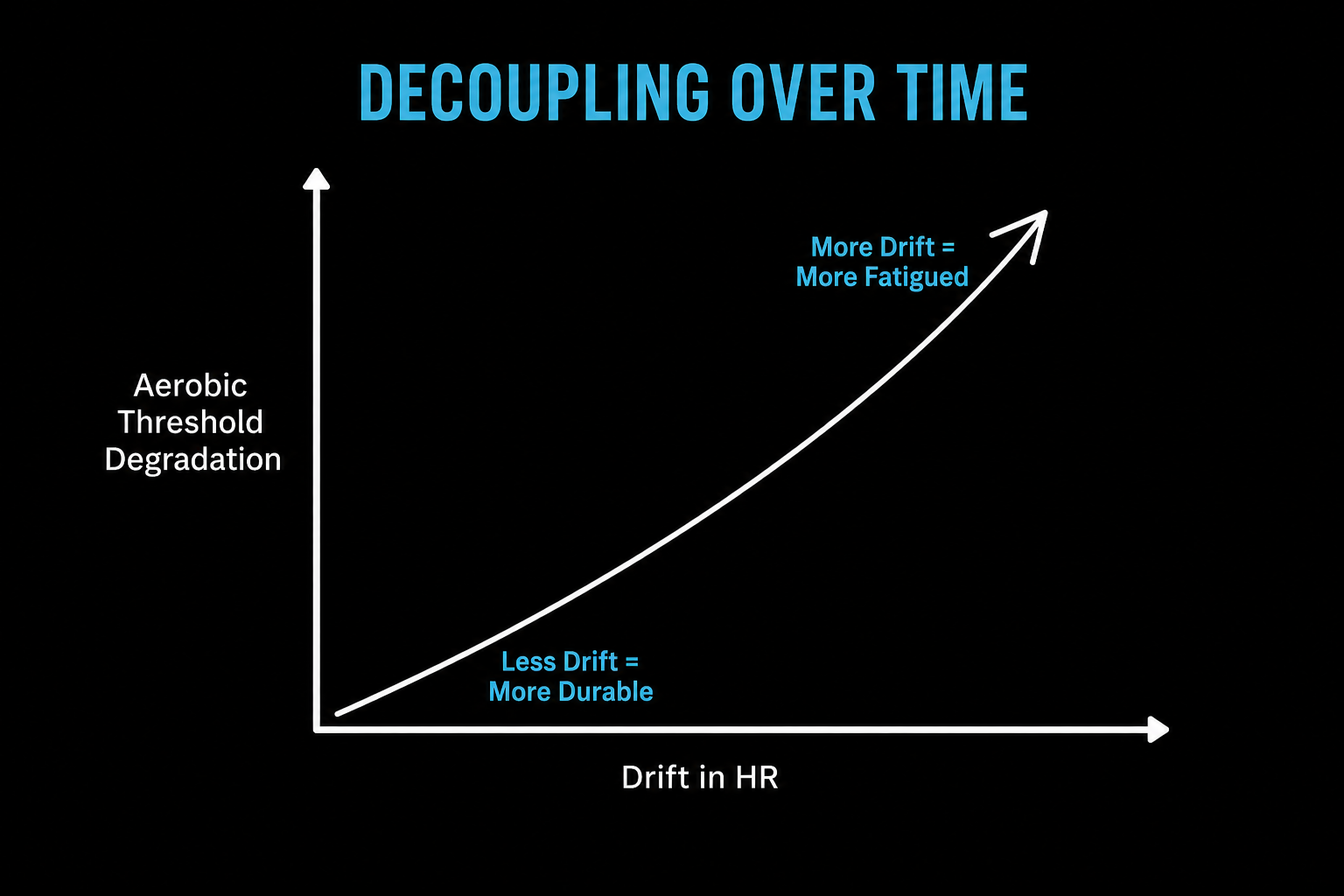
- Pace-to-heartrate decoupling less than 5%. Decoupling (Pace:Hr) compares the first half of your run to the second half. If heartrate climbs and pace declines as the run gets longer, you’re decoupling percentage will be higher, which means the effort got harder for a diminished return.
Coaching Example: More Easy Running Time Yields More Total Training Volume
Consider two ultrarunners pursuing the same goal race with the same training time availability. Athlete A spends 70% of training time below LT1 and, on average, manages to train 10 hours per week. That’s 7 hours per week of time-at-intensity in the zone where the primary aerobic adaptations happen. Athlete B spends 80% of training time below LT1 and, on average, manages to train 12 hours per week, leading to 9.6 hours per week below LT1.
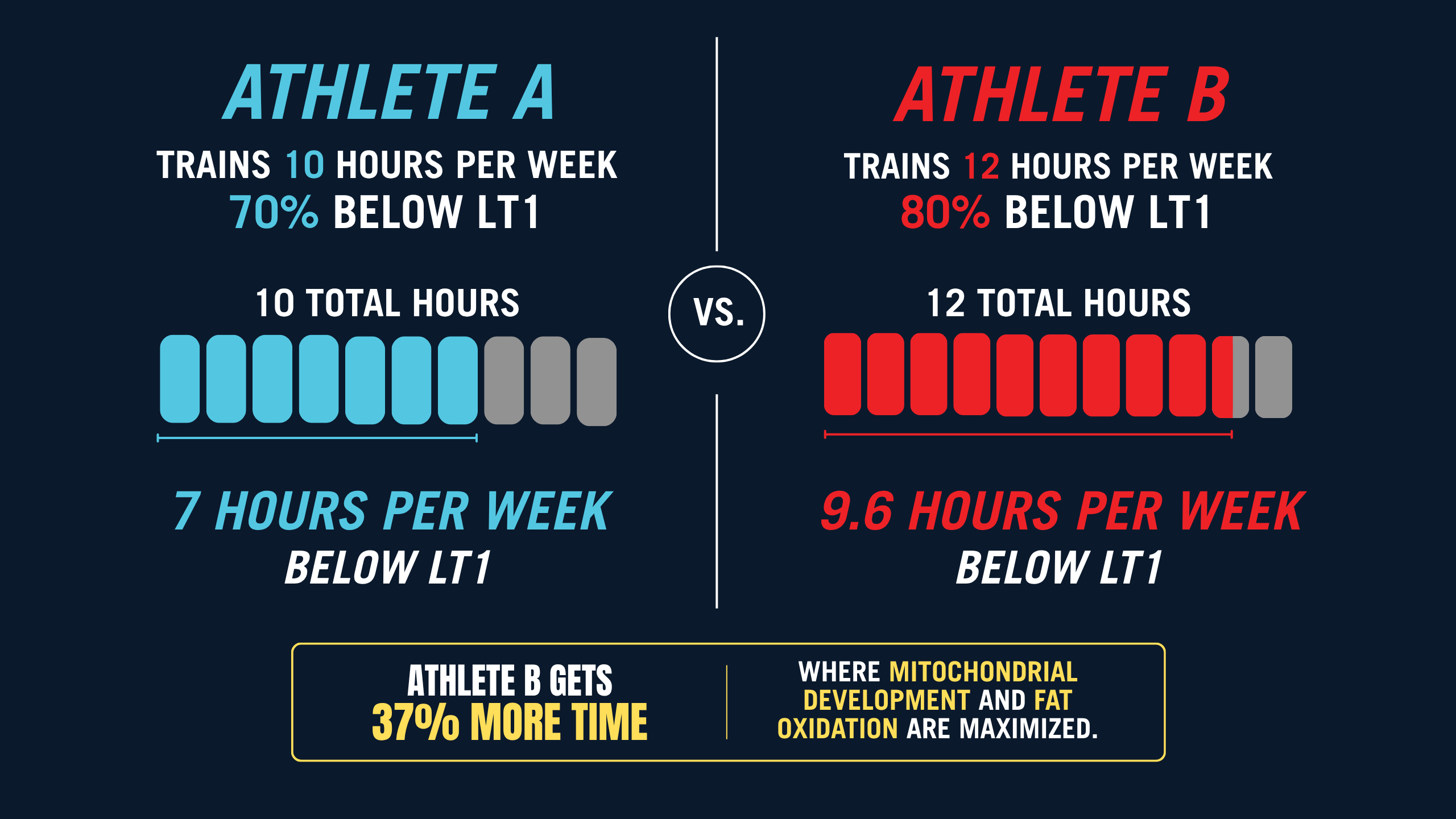
Athlete B gets 37% more time where mitochondrial development and fat oxidation are maximized. And here’s the key: Athlete B runs more (12 hours per week compared to 10) because their easy days are actually easy. Lower recovery costs per session means a higher ceiling on weekly volume.
The Ultramarathon Lesson That Applies to Every Training Week
Since we’re all ultramarathon runners, here, how about an ultramarathon illustration of easy running done right? In a long race, athletes who go out at RPE 7 in the first 20 miles slow down dramatically, and many fail to finish. Athletes who go out at RPE 5–6 (or easier) don’t slow down as much, and they pass people in the final 30 miles who went out too hard. Starting easier is a well-documented ultramarathon pacing strategy (PMID: 39526871, PMCID: PMC7578994) .
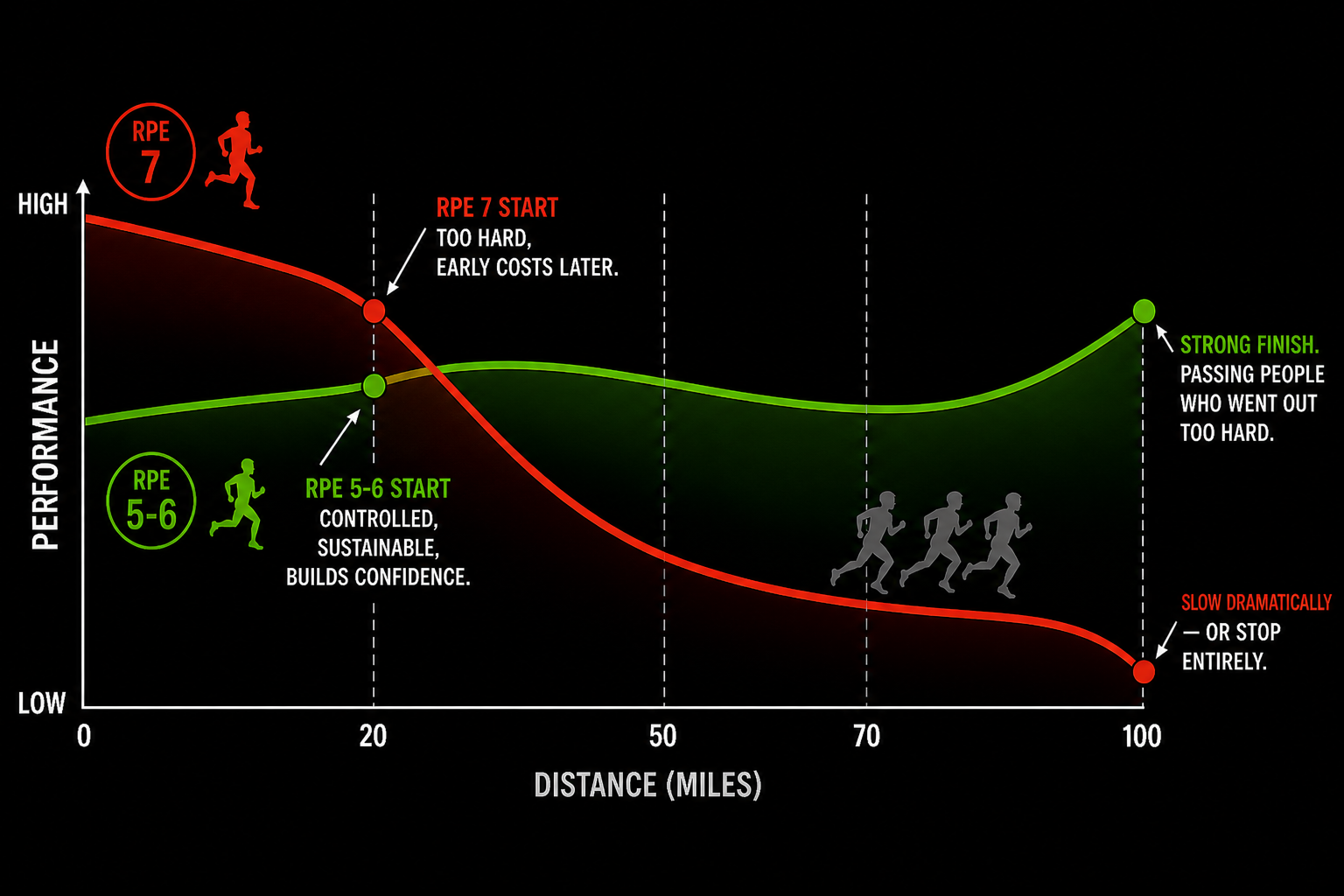
The same principle applies to every training week. Athletes who protect their easy days show up to hard sessions ready for meaningfully strenuous work. And that limited amount of deliberate hard work drives adaptations that increase your capacity to benefit from even more easy running volume.
Enjoying This Article? Get More Free Running Training Tips
Get our coaches' best training advice, delivered straight to your inbox weekly.
The Bottom Line
Your greatest running accomplishments are built on a foundation of very easy runs (80-90% of total training volume) and relatively small amount of time (10-20%) spent going really hard. Runners rarely have any trouble accumulating enough hard work, it’s the easy stuff that trips them up. You’re better off erring on the side of going too easy rather than too hard.
Protect your easy days and remember you want to run easy enough to:
- Recover properly.
- Build your aerobic system.
- Maximize consistency week after week and month after month.
- Absorb hard training from your limited high-intensity sessions.
Over time, the compounding benefits of consistent, frequent, easy runs add up to one of the biggest advantages in ultrarunning.
References:
DE Waal, S. J., Jacobs, S. D., & Lamberts, R. P. (2025). Pacing analysis and comparison of TOP-10 and NOT TOP-10 Ultra Trail Cape Town 100-km finishers. The Journal of sports medicine and physical fitness, 65(2), 218–224. https://doi.org/10.23736/S0022-4707.24.16203-2
Suter, D., Sousa, C. V., Hill, L., Scheer, V., Nikolaidis, P. T., & Knechtle, B. (2020). Even Pacing Is Associated with Faster Finishing Times in Ultramarathon Distance Trail Running-The “Ultra-Trail du Mont Blanc” 2008-2019. International journal of environmental research and public health, 17(19), 7074. https://doi.org/10.3390/ijerph17197074
About the Author
Cliff Pittman
CTS Pro Ultrarunning Coach
Cliff Pittman is the Coaching Development Director for CTS, where he expertly leads the Ultrarunning and Cycling Coaching teams. A passionate ultrarunner and active competitor, Cliff specializes in simplifying complex training concepts into actionable strategies, ensuring athletes at all levels—from beginners to elite competitors—can achieve their goals in prestigious events like the Western States 100 and Leadville 100.