
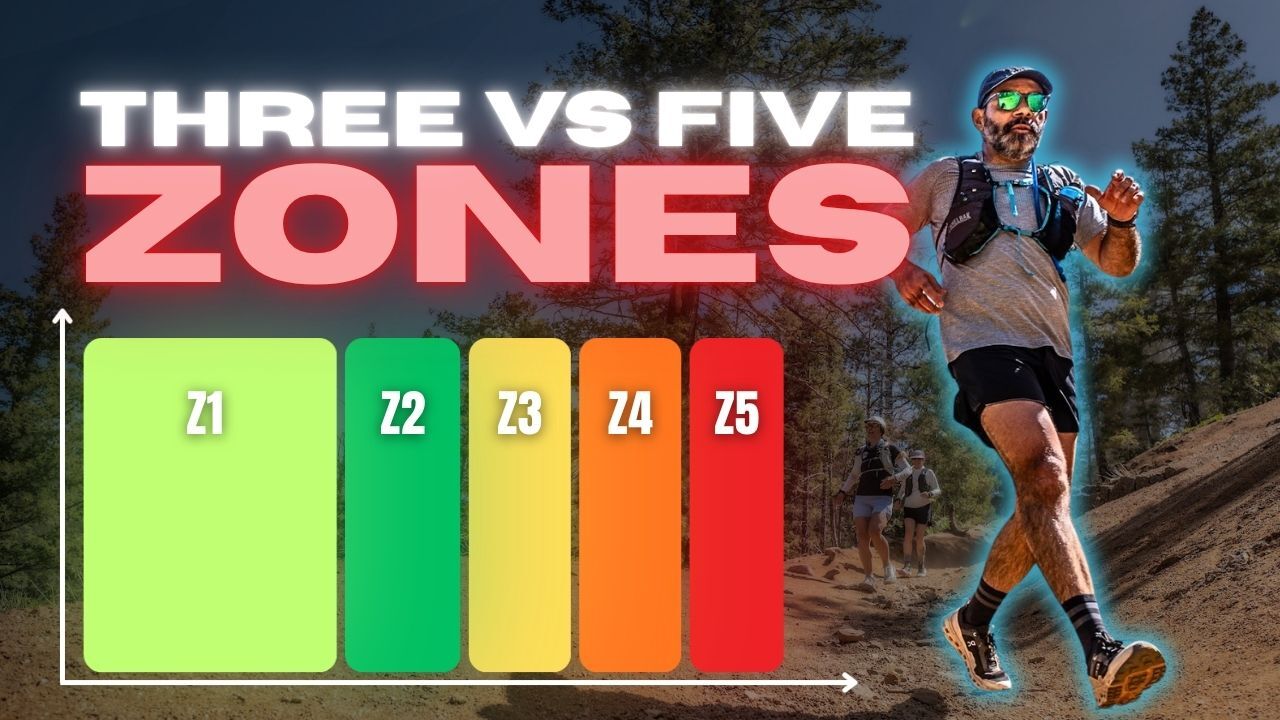
Training Zones for Ultrarunning: Why Are There Five And What Do They Mean?

Updated On
May 6, 2026
CHOOSE YOUR FORMAT
►WATCH THE VIDEO
►LISTEN TO THE PODCAST
►READ THE ARTICLE
Training Zones for Ultrarunning: Why Are There Five And What Do They Mean?
As a runner you’ve almost certainly seen the chart: five columns, color-coded, with heart rate or pace ranges that feel precise and scientific. Zone 2 for fat oxidation. Zone 4 for lactate threshold. Zone 5 for VO2 max. Follow the chart, hit the numbers, get faster. Why five, what do they actually delineate, and why are they different for running compared to other sports?
Start at the Source: The Three-Zone Model
In the beginning there were (and still are) three training zones. This simple model can easily be described as “easy, medium, hard” but it is built around two key physiological breakpoints:
- LT1 (First Lactate Threshold): This is where blood lactate (a byproduct of breaking down carbohydrate into usable energy through anaerobic glycolysis) starts rising above resting baseline. Your body is producing more lactate than at rest, but you’re producing almost of your energy aerobically and most energy is coming from the breakdown of fat, not carbohydrate. This effort level is sustainable for hours.
- LT2 (Second Lactate Threshold): This is where blood lactate accumulation substantially outpaces clearance. On a percentage basis, fat oxidation drops as carbohydrate oxidation rapidly increases. Fatigue accumulates quickly and you can only sustain efforts at and above this intensity for limited periods of time.
These two breakpoints can be used to delineate three training zones.
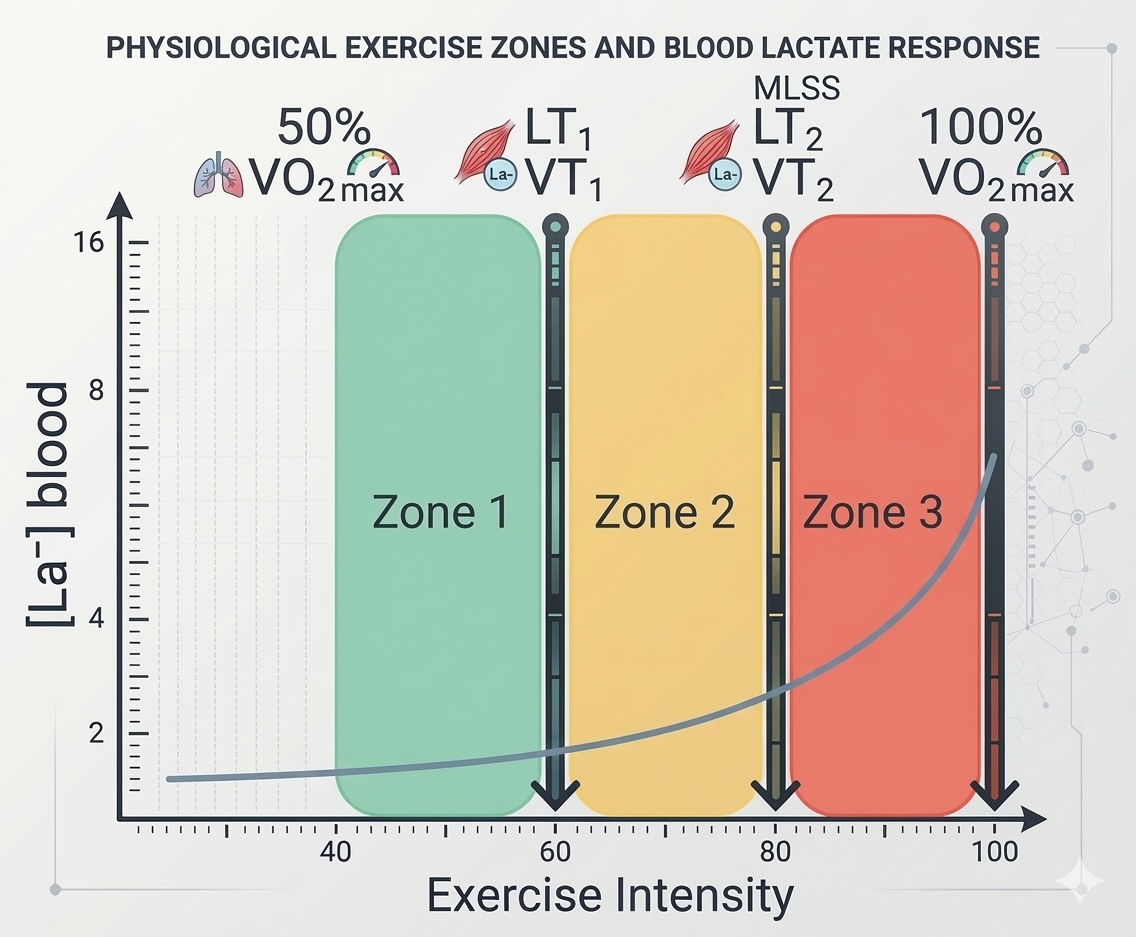
Zone 1 — Below LT1: You’re entirely aerobic and breaking down fat for most of your energy. Your breathing is comfortable, and you can hold a conversation. This is where most of your ultrarunning training should take place. It’s the intensity that stimulates the greatest aerobic adaptations. This is your all-day pace, your long run intensity, and the low end of Zone 1 is your recovery or easy run intensity.
Zone 2 — Between LT1 and LT2: This is where Steadystate and Threshold work happens. You’re still primarily aerobic, but energy demand is high enough that you need to tap into carbohydrate metabolism to produce energy fast enough. Breathing becomes labored, conversations drop to short sentences. Lactate is being produced and cleared fast enough to keep blood lactate levels relatively low and steady. This is where a lot of your specific training intervals sit because this challenging but sustainable (20-60 minutes) intensity stimulates adaptations that increase your aerobic pace and pace at lactate threshold.
Zone 3 — Above LT2: This is where things get really hard. Breathing goes from labored to panting, talking is reduced to grunts and expletives. You’re consuming nearly as much oxygen as your capable of (approaching VO2 max) and blood lactate levels are rising exponentially because almost all energy is coming from the incomplete breakdown of carbohydrate. Time to exhaustion is measured in minutes (usually 2-6 minutes at the most). This intensity can be very impactful for training, even for ultrarunners, but must be used strategically and carefully.
Why Runners Need Five Training Zones (Not Just Three)
Wouldn’t it be easiest to just use the three zones described above to prescribe and analyze a runner’s training? Yes, but the problem is that the three zones are often so broad that the training stimulus changes if you run at the bottom of the zone compared to the top. Practically, we started advising athletes to run “High Zone 1” or “Low Zone 3” to accumulate more specific time-at-intensity. That eventually led to an expansion of the 3-zone system into a 5-zone system.
CTS Training Methodology: Five Training Zones
As you can see in the graphic below, based on the locations of LT1 and LT2, we split Zone 1 to create Zone 2 between 72-80% of Peak Heart Rate. This made the range between LT1 and LT2 into Zone 3, and we added a Zone 4 at LT2
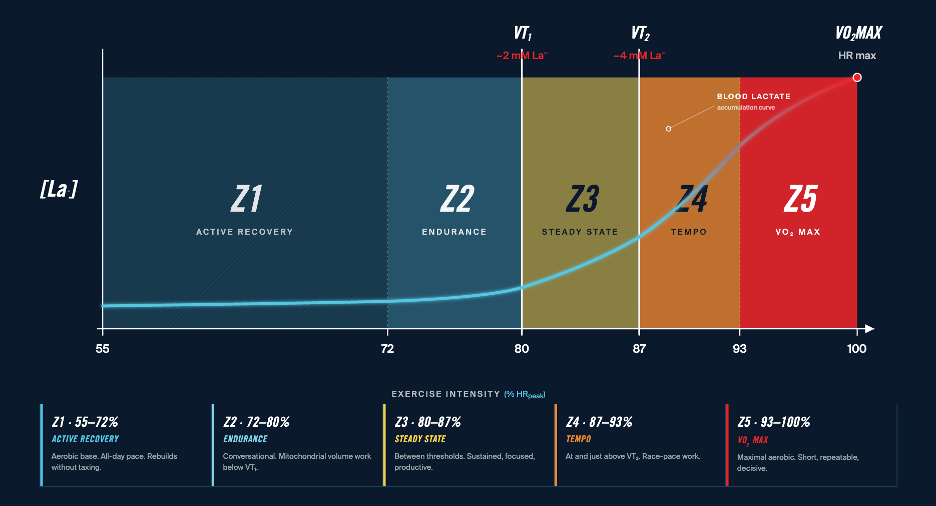
Zone 1 — Recovery (RPE 1–4/10): Below LT1. The value here is easy movement, facilitating circulation. You’re not adding enough stress to improve fitness, but you may be helping prepare your body for exercise sessions that will move the needle.
Zone 2 — Endurance/Aerobic (RPE 5–6/10): Still below LT1, but at the upper end where you can meaningfully stimulate aerobic adaptations. The bulk of your endurance training volume should be completed at this intensity.
► Free Ultrarunning Training Assessment Quiz
Take our free 2-minute quiz to discover how effective your training is and get recommendations for how you can improve.
Zone 3 — Steady State (RPE 7/10): Below LT2, but above your “forever” pace. It’s a challenging aerobic effort, your breathing is labored but deep and controlled, and you can only speak about one sentence at a time. Beware: many athletes spend too much time here. It’s hard enough to accumulate fatigue, but not hard enough to stimulate the adaptations that true threshold work does.
Zone 4 — Tempo / Lactate Threshold (RPE 8–9/10): At or near LT2. Sustained efforts at the upper edge of aerobic work. Breathing is still controlled but quite labored. Speaking is limited to a few words at a time. Nevertheless, this intensity is sustainable for 20–60 minutes depending on the athlete. This is where serious threshold development happens.
Zone 5 — VO2 Max (RPE 10/10): Above LT2. Very hard intervals sustainable for 2–6 minutes. Although this intensity is rarely utilized in ultramarathon races, it is useful in training to increase maximum aerobic capacity, which creates space for greater adaptations in Zones 2-4.
Why Not Seven Training Zones, Like CTS Cycling?
Athletes coming to ultrarunning from other sports, including cycling and triathlon, may be familiar with a seven-zone power-based methodology. This originated from Dr. Andy Coggan and Hunter Allen’s work in cycling, where Zones 6 and 7 subdivide the upper end into anaerobic capacity and neuromuscular power. In cycling, that distinction has real value: power meters support that level of precision, and the sport demands it (sprinting, attacking, bridging gaps).
Ultrarunning doesn’t select for those adaptations. The sport is won and lost in the aerobic and sub-threshold domains. Seven zones exceed both the measurement tools available to trail runners and the actual demands of the sport. Five zones are all we need.
How to Find Your Ultrarunning Training Zones
Knowing the model is all well and good, but to apply the model to your training you must first establish your personal zones.
The most accessible approach is a 30-minute field test:
Enjoying This Article? Get More Free Running Training Tips
Get our coaches' best training advice, delivered straight to your inbox weekly.
- Warm up for 10–15 minutes on a flat surface.
- Run as hard as you can sustain for 30 minutes.
- Record your average heart rate over the final 20 minutes of the effort. You can use a lap timer or create the segment after the test in TrainingPeaks. This is a good estimate of your Lactate Threshold Heart Rate (LTHR).
- Record your average pace over the full 30-minute effort. This approximates your Lactate Threshold Pace (LTP).
- Go to the CTS Running Zone Calculator to calculate your zones.
Should you do a test in a physiology lab? If you have one available, like the CTS Physiology Lab in Colorado Springs, absolutely! The benefit of a lab test is that we can accurately measure blood lactate and observe the shifts in fat/carbohydrate oxidation by analyzing your expired breath. However, the field test above is accessible, repeatable, and well validated. And if you work with a coach, a trained eye can often derive your LTHR and LTP from your existing training and racing data without a formal test.
RPE: The One Metric To Rule Them All
Here’s the real secret to trail running performance: The best use of heart rate and pace training zones is learning to race without them! Heart rate is a lagging indicator, an observation of your response to work you’ve already done. You can see this by sprinting for 15 seconds and watching your heart rate monitor afterward. When you stop your heart rate will have barely moved from the starting value, but it will increase dramatically in response to the sprint as you stand still and catch your breath. Similarly, pace zones on undulating or technical trails can be difficult or useless ways to gauge intensity.
Rating of Perceived Exertion (RPE) is a no-tech way to gauge intensity based literally on how you feel on a scale of 1-10 where 1 is easy and 10 is as hard as you can go. The original RPE scale was the Borg scale from 6-20, and it’s still used in research settings. RPE seems quaint and archaic in an era dominated by powerful sensors, but it is surprisingly accurate. More important, it remains accurate in any terrain, elevation, weather conditions, and in the first or 20th hour of a race.
Your goal as an athlete, and my goal as your coach, is to use training data and your training zones to learn how your physiological targets correlate to your real-time perception of effort. When you can do that, you can adjust your pace to stay in a sustainable effort level or ramp up your effort to threshold level – purely by feel – without pushing yourself over LT2.
The Big Picture
The three-zone system and five-zone system can coexist. The existence of one doesn’t invalidate the other. The three zones illustrate how your physiology works. The five zones add nuance to help you train your physiology effectively.
Above all, recognize that zones are just a way for us to understand and communicate about an intensity continuum. You’re always burning a combination of fat and carbohydrate. You’re always producing lactate. And you’re always producing energy aerobically and anaerobically. What changes are the proportions and the rates as energy demands change. So, don’t get too hung up on the difference between 79% and 80% of LTHR. Focus on the bigger picture of intensity distribution, on training consistently week after week, and creating clear distinctions between meaningful work and purposeful rest.
About the Author
Cliff Pittman
CTS Pro Ultrarunning Coach
Cliff Pittman is the Coaching Development Director for CTS, where he expertly leads the Ultrarunning and Cycling Coaching teams. A passionate ultrarunner and active competitor, Cliff specializes in simplifying complex training concepts into actionable strategies, ensuring athletes at all levels—from beginners to elite competitors—can achieve their goals in prestigious events like the Western States 100 and Leadville 100.