

Zone 2 Intervals vs. Steady Riding: Here’s What Actually Works

Updated On
March 27, 2026
CHOOSE YOUR FORMAT
►WATCH THE VIDEO
►LISTEN TO THE PODCAST
►READ THE ARTICLE
Are Zone 2 intervals just the new trend or are they a training goldmine?
Zone 2 intervals are having a moment. Pro teams are talking about them and cycling media frames them as a training breakthrough that’s superior to steady endurance riding. I’ve been coaching amateur and professional cyclists for more than 20 years and I’ve seen many trends come and go. The question is: Are structured Zone 2 intervals just overcomplicating easy riding, or are there science-backed reasons you should try Zone 2 intervals?
Do Zone 2 Intervals Fit The Framework for Effective Interval Training?
The basic idea of interval training is to alternate between “efforts” and “recovery” to accumulate a targeted amount of time doing the desired effort. The efforts are most often described by intensity zones, like Zone 2 intervals in this case, but interval training can also apply to skill and technique efforts like high-cadence intervals.
To answer whether Zone 2 intervals make sense, let’s first look at the framework I use to justify any type of structured interval training:
Feel Stronger in 6 Weeks — No Matter Your Age
Climbs feel steeper? Recovery slower?
You’re not done getting faster — you just need a smarter plan.
The 6-Week Masters Power Build Coaching Program is designed for cyclists 50+ who want to boost power, recover faster, and ride stronger — all with expert 1:1 coaching.
- Personalized 6-Week Training Plan
- 1:1 Coaching + TrainingPeaks Premium
- Mobility & Strength Bonus Guides
💪 Guarantee: Stronger or free.
Start your 6-week journey for $149- Will intervals accumulate more work in less time? Does breaking the total time-at-intensity into smaller chunks allow an athlete to accumulate more total time-at-intensity within the workout, week, or training block?
- Will intervals target a specific physiological adaptation? Is the specific combination of intensity range, interval duration, and total time-at-intensity meaningful? Will it stress a metabolic pathway differently than a steady effort or another interval structure?
- Will intervals prepare an athlete for specific demands of races or training goals? Fitness is different than performance. Many workouts can target the same physiological adaptation (i.e., fitness), but specific interval workouts may be necessary to prepare athletes for the make-or-break, win-or-lose moments in races and goal events.
Now, let’s apply that framework to Zone 2 intervals:
- More work in less time? Maybe — but not always. If you’re riding outside with natural variations in terrain and traffic, a steady endurance ride and a structured Zone 2 interval session often produce nearly identical total stress and time-in-zone. (See example below.)
- Target a specific adaptation? Yes, but Zone 2 intervals and steady Zone 2 riding train the same system. Normally, the justification for intervals is that rest periods are necessary because an athlete can’t sustain the target intensity for the entire desired time-at-intensity. In the case of Zone 2, the intensity is, by definition, sustainably aerobic. The rest intervals between efforts aren’t creating an additional opportunity.
- Specificity? It’s hard to make the case that planning recovery breaks in Zone 2 rides creates greater event specificity than steady Zone 2 riding where intensity naturally fluctuates with terrain, wind, and group dynamics – like they will during real events.
So that leads to the real question: Are Zone 2 Intervals better than a steady Zone 2 ride?
A Real Coaching Example: Equal Workloads and Outcomes From Zone 2 Intervals and Steady Zone 2 Riding
Recent articles in cycling publications (Velo) frame “structured Zone 2 intervals” as a breakthrough training methodology. I love Zach Nehr’s content and he does a great job presenting the nuanced ways pro teams are utilizing Zone 2 training. But the more you look at the data and the practical outcomes, differences between structured and steady Zone 2 riding all but disappear.
Here’s a real example from a professional rider I coach. His new team wanted him to complete some structured Fat Max intervals. For reference, “Fat Max” is the maximum amount of fat an athlete can per hour, expressed as energy (kcal) or grams (g) per hour. FatMax can also be thought of as the training intensity at which you burn the highest amount of fat. See the graph below from INSCYD:
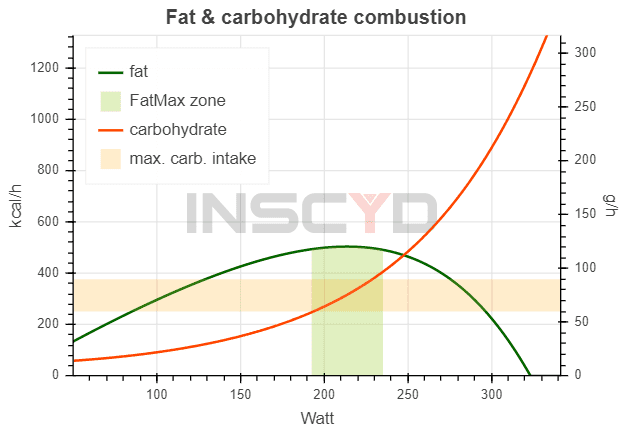 Source and Caption from INSCYD: The green line shows the fat combustion rate. The FatMax is 504 kcal/h (y-axis) and occurs at a FatMax intensity of 214 watt (x-axis). The vertical shaded zone is the FatMax zone (+/- 10% of FatMax intensity).
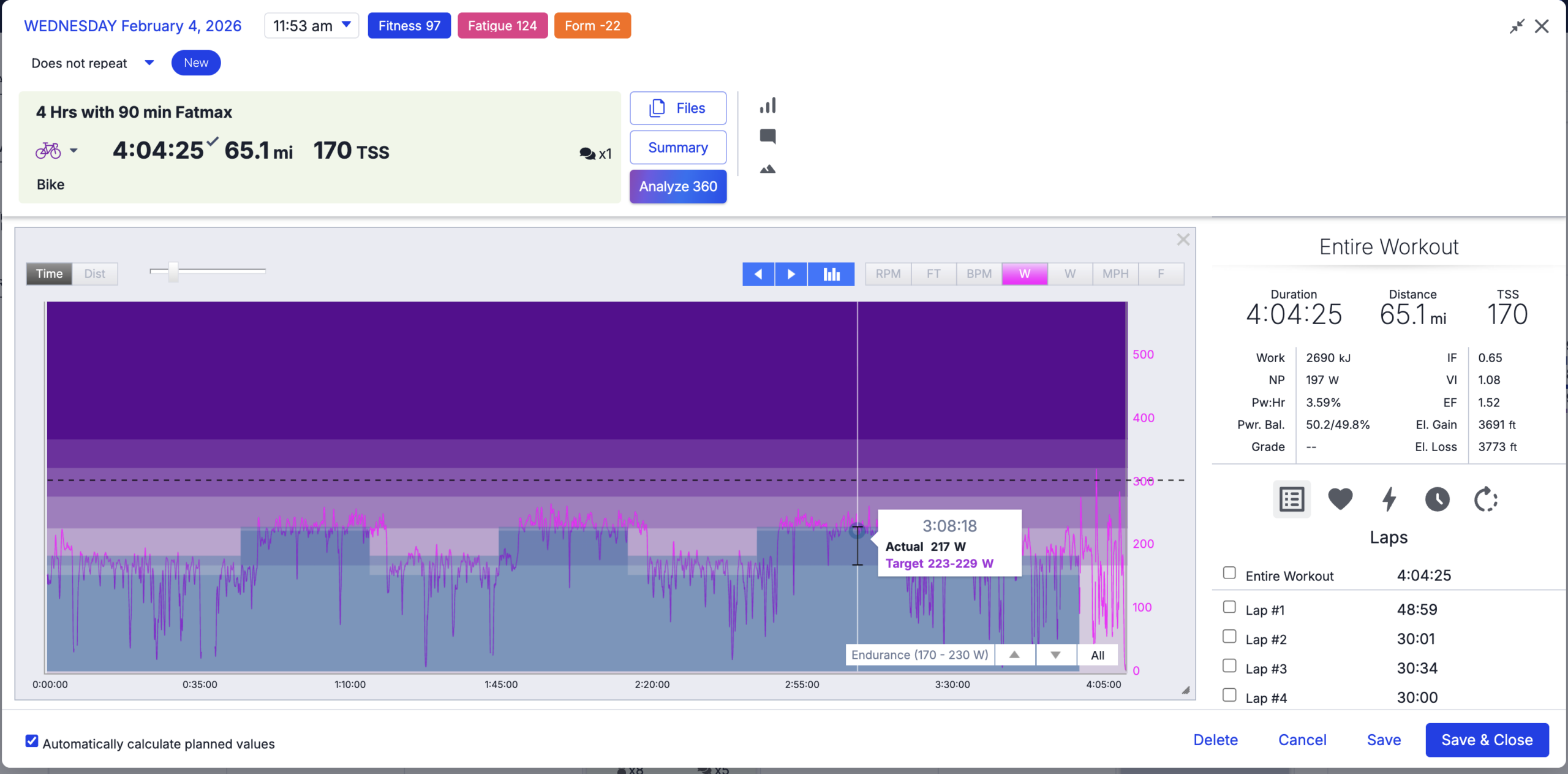
The athlete’s team prescribed a Fat Max interval workout of 3×30 minutes at roughly 65–75% of FTP (the upper end of Zone 2), with easy endurance riding between efforts at around 55–60% FTP. On another day, he did an unstructured endurance ride at his own discretion, staying in a similar power range throughout.
Structured Fat Max Interval Workout:
- Total time: 4:04:25
- Average heart rate: 130 bpm
- Average power: 183W
- Normalized power: 197W
- Kilojoules: 2,690 kJ
- TSS: 170
Unstructured Endurance Ride:
- Total time: 4:05:26
- Average heart rate: 125 bpm
- Average power: 185W
- Normalized power: 197W
- Kilojoules: 2,737 kJ
- TSS: 160
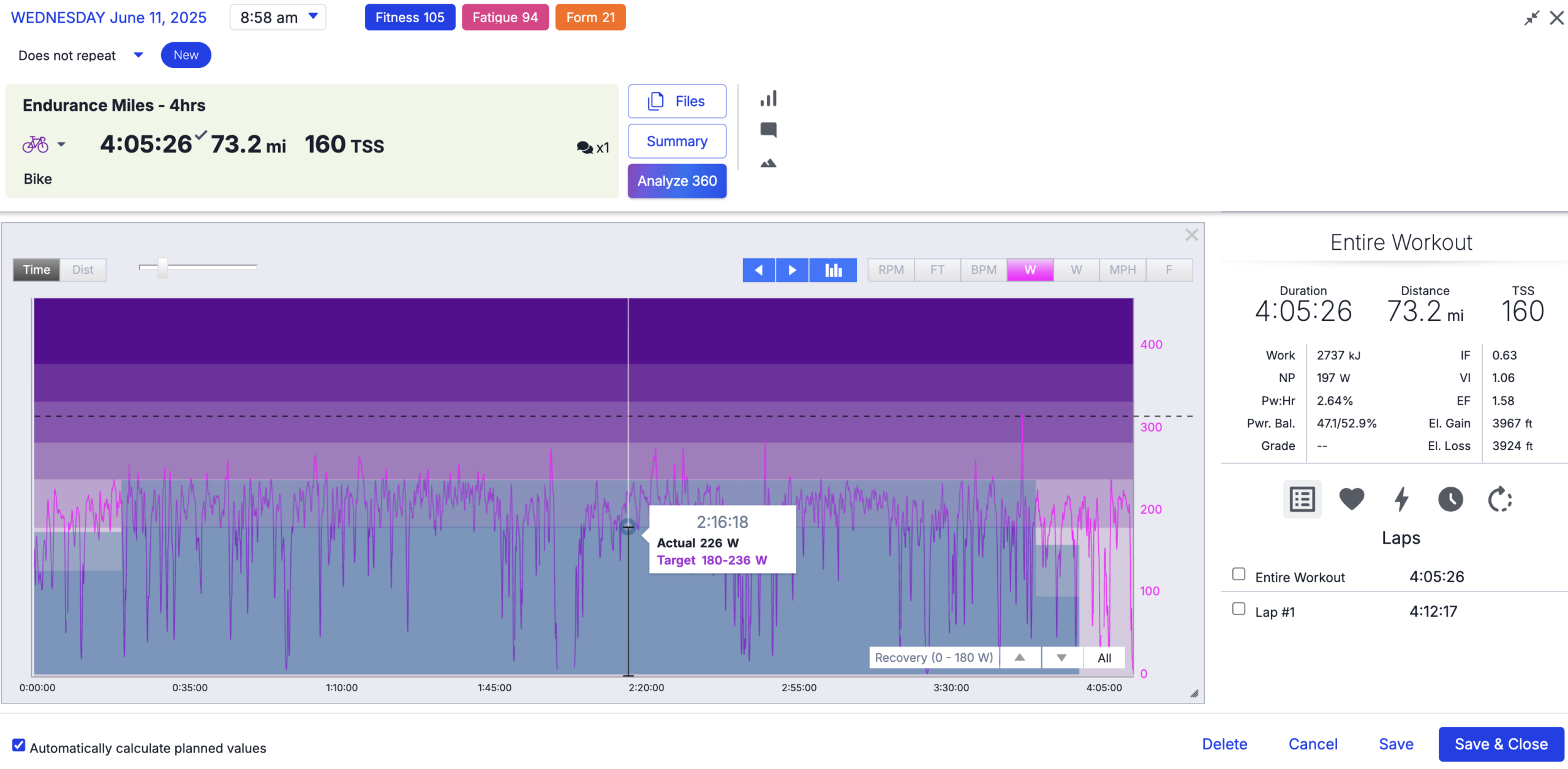
The two rides were nearly identical across every meaningful metric. The normalized power, work output, and training stress were essentially the same. Yes, during the structured ride he spent more time in the upper range of Zone 2, but there are two unknowns.
First, fat max is highly individual, meaning it doesn’t occur at the same percentage of FTP for all athletes, or even for the same athlete at different times of year. So, it’s hard to say the specificity of the Fat Max Interval workout was on target. And second, even if the Fat Max intensity was on target, it’s not clear that more time in the upper range of Zone 2 creates a different or more beneficial adaptation than a varied ride within Zone 2.
The examples above are what I see over and over, across male and female cyclists of different fitness and experience levels. Furthermore, I have not personally seen blocks of structured Zone 2 intervals (i.e., Zone 2 interval workouts like the one above scheduled into multi-week training blocks) yield superior physiological or performance outcomes compared to similar blocks of steady Zone 2 riding.
► Free Cycling Training Assessment Quiz
Take our free 2-minute quiz to discover how effective your training is and get recommendations for how you can improve.
Specific Cases: Zone 2 Intervals Sometimes Make Sense
The difference between sports science and coaching is understanding that we’re coaching humans and not training machines or lab rats. There can be great reasons for athletes to leverage specific methods or tools that make little to no difference in terms of physiology. Structured Zone 2 intervals sometimes help athletes accomplish the objectives of Zone 2 training more effectively, as in the following cases:
When your legs are weaker than your cardiovascular system. In my experience, this is the most underappreciated and most impactful use of Zone 2 intervals. If you’re newer to structured training or returning from time off, your leg muscles may fatigue before your aerobic system gets a meaningful stimulus. Breaking up a 60-minute Zone 2 ride into 5×10-minute efforts with short breaks can yield 50 minutes of quality aerobic work instead of 60 continuous minutes of gradually declining form and power output.
When you’re training indoors or solo. “Intensity creep” happens for a lot of athletes when they train alone or ride indoors without ergometer mode. Structured Zone 2 intervals anchor the session mentally, providing a simple structure like 5×10-minute Zone 2 efforts with 2 minutes easy spinning between them that helps keep you focused on time and intensity.
When terrain or traffic doesn’t allow for sustained effort. Many road or trail environments feature hills or urban areas that make long and continuous Zone 2 efforts difficult. Rather than fight the environment, adapt to it. If there are 20- or 30-minute segments that can be linked together or repeated, create a structured interval workout from them and use the spaces between for recovery.
For targeted Fat Max training. If your goal is to increase your capacity for fat oxidation, riding at or near your fat max intensity has merit. Structured intervals can help you accumulate time at that specific intensity. However, you should first confirm your actual fat max with a lab test so you target the right power zone. And second, realize that years of endurance training has already optimized fat oxidation pretty well, so use that same lab test to determine whether Fat Max training is really going to be a meaningful performance lever.
If you’re just a very organized person. Some athletes thrive on order and structure and detest the uncertainties of unstructured riding. That’s why they tend to love hard interval sessions and often do too many of them. If adding structure to Zone 2 training makes those rides more appealing, that’s great. Just don’t mistake the structure for physiological superiority.
Coach Insights: What Works and What Doesn’t Work
As I’ve said, I coach real people who train in the real world and have real world responsibilities. So, here’s what works for most of the athletes I coach, and the biggest mistake I see:
- For riders in cities or hilly areas where continuous Zone 2 is hard to sustain outside: I recommend riding indoors for 60 to 120 minutes, steady, with no interruptions. They often hit their best aerobic power numbers this way, not by following an interval prescription, but simply by riding.
- For athletes who can get out for 4 to 6 hours: My guidance is simple. Ride in Zone 2 power, keep perceived exertion around 3–5 out of 10, and check your Normalized Power every 30–45 minutes to make sure you’re staying in the mid range of Zone 2.
- The biggest mistake I see is athletes making Zone 2 intervals too short and rest periods too long. Example: 6×10 minutes in Zone 2 with 3–5 minutes of recovery on a 90-minute ride. The intervals are too short so the total recovery time adds up to 15-25 minutes. They’d be better off with longer intervals and shorter recoveries (since the “recovery” time is more structural than metabolically necessary). Better example: 5×15 minutes with 2 minutes recovery. That’s 75 minutes time-at-intensity vs. 60 minutes, and 8 minutes of rest time vs. 15-25 within the same 90-minute workout. Note: there’s knowingly not much warmup/cooldown time in those examples because they’re short workouts at aerobic intensities.
If Pros Use Zone 2 Intervals, Why Shouldn’t I?
Pro athletes have important things working for and against them. Working for them, they have access to in-ride lactate monitoring, lab-confirmed fat max tests, and the time and support infrastructure to train with extreme precision. Working against them is the fact that they’ve already maxxed out the easy-to-capture performance gains and are now fighting diminishing returns to squeeze out ever smaller improvements.
Before you add complexity to your own training, it’s important to recognize that pro training protocols are more complex because they can be and because they sometimes need to be. In this case, attempting to copy their protocols without that time and infrastructure appears to add complexity without adding benefit.
The Bottom Line
Time riding in Zone 2 is important, but for Masters and amateur cyclists, accumulating time in Zone 2 is more important than whether that time is steady or structured. If you want to build a bigger aerobic engine, the proven formula is:
Ride your bike, mostly easy, a little hard. Accumulate work. Stay consistent.
If you want help structuring your training in a way that actually fits your physiology, your schedule, and your goals, that’s exactly what we do at CTS.
Resources:
- Cycling’s Latest Trend: Structured Zone 2 Intervals — VeloNews
- Zone 2 Training to Improve Aerobic Endurance and Fat Burning — CTS
- FatMax: definition, training (zone) and exercise test
► FREE Mini-Course: Learn How to Maximize Your Limited Training Time
Learn step-by-step how to overcome limited training time and get faster. Walk away with a personalized plan to increase your performance.
"*" indicates required fields
About the Author
Adam Pulford
CTS Head Cycling Coach
Adam Pulford is a dedicated coach at CTS with a passion for elevating athletic performance through tailored, measurable strategies and a deep understanding of the “why” behind each athlete's goals. With nearly two decades of experience, a degree in Exercise Physiology, and a successful track record managing professional cycling teams, Adam also shares his expertise as the host of the Time-Crunched Cyclist podcast, providing actionable insights for endurance athletes.
Comments 1
What if the structured intervals are not about the aerobic outcome but about the neuromuscular stress a pro cyclist must handle in Zone 2 since the wattage he produces is much higher than for the average Joe out there? And so, those breaks in Zone 1 give just enough time for reasserting homeostasis in that area, leaving the Pro Cyclist with two things: just enough stimuli from that effort and rested enough for a more intense effort the next day?