

Ultrarunning Training Zones: Training Mistake Most Runners Make

Updated On
March 27, 2026
CHOOSE YOUR FORMAT
►WATCH THE VIDEO
►LISTEN TO THE PODCAST
►READ THE ARTICLE
Many ultrarunners train almost entirely in Zone Two. And that’s exactly why so many of them are so darn slow.
Zone 2 is the bedrock of endurance training and ultramarathon pacing, but if you’re only training at Zone 2 intensity, then you’re leaving a significant amount of performance on the table. Understanding why requires a short dive into exercise physiology, and then I’ll give you a look at the ultrarunning training zones I use within a five-zone system to increase an athlete’s aerobic capacity, which in turn increases pace and durability at the very ultramarathon race-specific Zone 2 intensity.
The Science Behind Ultrarunning Training Zones
In academic endurance physiology, training intensity is often described using a three-zone model across all endurance sports: easy, moderate, and hard. These zones are anchored to two key physiological markers: the first lactate threshold (LT1) and the second lactate threshold (LT2). As you can see in the figure below from a paper by Stephen Seiler, in a three-zone model, LT1 is the lower limit of the “moderate” intensity zone or Zone 2, and LT2 defines its upper limit. Below LT1 is “easy” and above LT2 is “hard”.
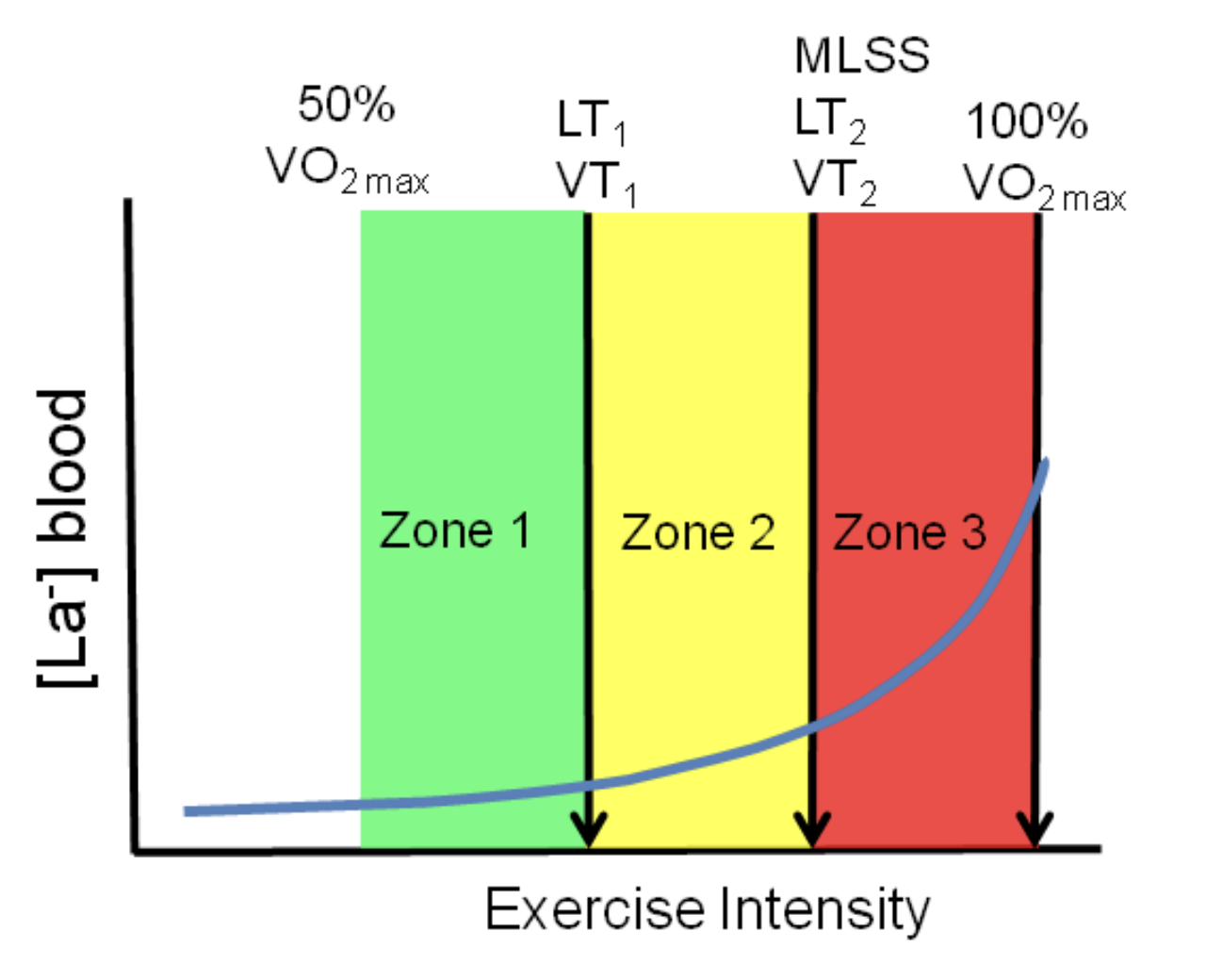
Source: PMID: 20861519
Most endurance training should happen in the easy zone. This is what people refer to when they talk about “80/20” or “Polarized Training”. The idea is that about 80% of total training volume should be completed at an easy intensity. The exact percentages are less important than the concept of creating contrast between easy and hard. One of the biggest mistakes endurance athletes make is spending too much time in the moderate zone. The middle or moderate zone in a three-zone system is hard enough to accumulate fatigue, but not hard enough to drive meaningful adaptation.
As a professional coach and Coaching Development Director, I think there are benefits to expanding the three-zone system to five zones. Five zones allow for greater precision and nuance in prescribing and monitoring real-world training. Five zones don’t produce five different adaptations. They give you a finer resolution for prescribing intensity within the same three physiological domains that science has always recognized. Training the full spectrum of intensities is important for maximizing fitness and race-day performance.
The Five Zones and What They Do
The graph below represents the expansion of the three-zone system above to the five-zone system we use at CTS:
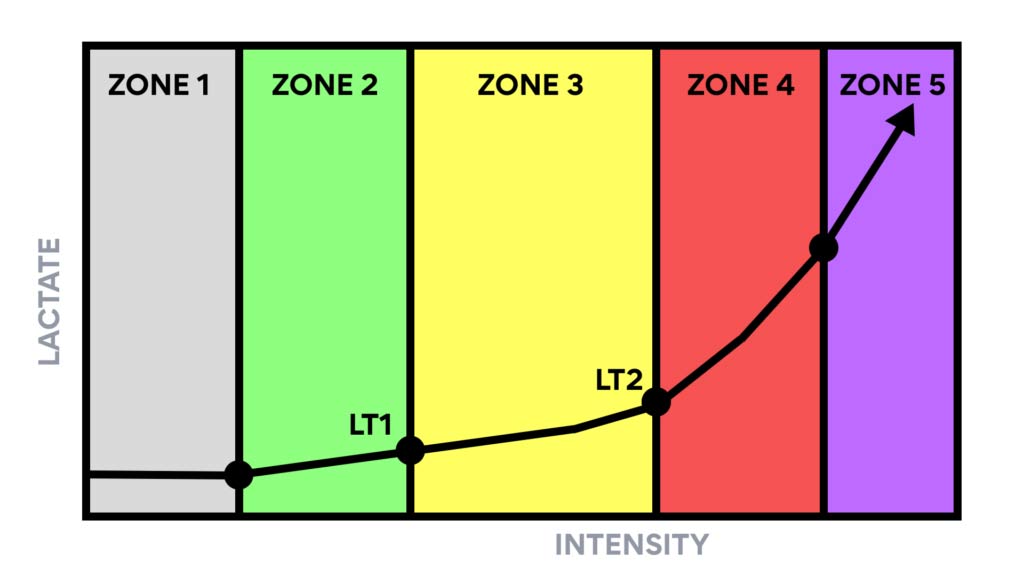
You can see that LT1 and LT2 still define the lower and upper limits of Zone 3. What changes is the “easy” zone is now divided into Zone 1 and Zone 2, and the “hard” zone is now divided into Zone 4 and Zone 5. Here’s how we delineate between the five zones, based on the physiological benefits from time spent in each:
- Zone 1 — Recovery: Low-intensity work that facilitates circulation, reduces soreness, and supports adaptation from harder efforts.
- Zone 2 — Endurance: Aerobic system development, increased mitochondrial density, increased muscle capillarization, improved durability. This is the foundation of all ultra marathon training.
- Zone 3 — High-aerobic: Often referred to as “Steady State” in run training, this challenging aerobic intensity builds durability at a sustained moderate-hard effort.
- Zone 4 — Lactate Threshold: Your highest sustainable aerobic effort. There is a significant anaerobic contribution to energy production at this intensity, and training here increases your ability to process and clear lactate while still maintaining your pace. Raising this is critical for race-day performance.
- Zone 5 — VO2 Max: Develops your maximum aerobic capacity and raises the ceiling for everything below it.
A Real Coaching Example: 30 Seconds Per Mile Faster at the Same Heart Rate
Real people don’t think in terms of graphs and color-coded intensity zones. Here’s what this looks like in real life. I coached a masters ultrarunner who was training six to eight hours per week. He trained very consistently, mostly in Zone 2, with a long run every weekend. It was solid training and he was healthy and durable, but his sustainable pace hadn’t improved in nearly two years. He was stuck.
We didn’t add volume in terms of more hours or miles. Instead, we added one structured intensity session per week, organized in blocks. That means we targeted the same intensity in repeated sessions for a period of weeks. One block focused on intervals targeting VO2 max intensity. Another focused on lactate threshold work. Each block had a clear physiological purpose.
► Free Ultrarunning Training Assessment Quiz
Take our free 2-minute quiz to discover how effective your training is and get recommendations for how you can improve.
Within eight weeks, the athlete’s Zone 2 pace improved by more than 30 seconds per mile, at the same heart rate and perceived exertion.
Nothing about the athlete’s easy running changed. What changed was the height of his aerobic ceiling above his easy pace.
Why Train Harder Than Race Effort?
Here’s a question I’m often asked: if ultras are run at easy to moderate intensity, why train harder than race effort?
During an ultra marathon, average intensity is roughly 60% of VO2 max. You’ll have harder moments on climbs and technical terrain, and easier moments when you’re walking. But you’ll almost never approach maximum aerobic capacity during the race itself.
So why train at high intensity in training? Because of capacity.
When VO2 max increases and lactate threshold rises, the work you can perform at lower intensities also increases. You don’t train in Zone 5 to race in Zone 5. You train in Zone 5 to raise your aerobic ceiling, so the pace you can sustain in Zone 2 becomes faster and you can sustain that faster Zone 2 pace for longer.
How to Structure Intensity Using Block Hybrid Periodization
The core principle behind a block periodization model is that each training block has one primary intensity focus. This means that for a period of a few to several weeks, an athlete’s interval workouts stay focused on a particular zone. If it’s a Zone 4 block, the interval workouts in that block target Zone 4 intensity while endurance runs and recovery activities stay in Zone 2 and Zone 2, respectively.
Enjoying This Article? Get More Free Running Training Tips
Get our coaches' best training advice, delivered straight to your inbox weekly.
At CTS, we call this “block hybrid periodization” because it’s a combination of multiple periodization models, including aspects of Classic and Reverse periodization models. The biggest takeaway is that we don’t mix interval training targets within the same block. We don’t chase all adaptations at once.
Practical Guidelines for Scheduling Interval Workouts
So, how do you put this into practice in your training? Well, here are some of the guidelines I use when scheduling interval workouts for athletes I coach:
- Most ultrarunners do best with 1-2 hard sessions per week, based on training experience, current fitness, and current goals.
- Hard sessions should be separated by at least 48 hours. Adequate recovery between hard sessions improves the quality of interval workouts.
- Days between hard sessions are reserved for total rest, Zone 1, or Zone 2 intensity work.
Annual Periodization for Ultrarunning: Capacity First. Specificity Second.
Annual periodization is something we do a little differently at CTS, compared to a lot of other coaching groups. Early in the season, we prefer to build capacity with blocks focused on VO2 max and lactate threshold blocks. As race day approaches, we shift toward higher volume and race-specific intensity. Capacity first. Specificity second.
This is somewhat opposite of the classic endurance training periodization model that gradually builds from easy aerobic intensity to lactate threshold by mid-season, and then VO2 max and race-specific intensities as race day approaches. The classic model is less effective for ultrarunners because race-specific intensities are relatively low (60% of VO2 max ) but athletes benefit from increasing maximum aerobic capacity farther from their goal event and using that capacity to build durability, deepen aerobic fitness, and increase sustainable pace at lower intensities.
The Bottom Line
Zone 2 is essential. It builds deep aerobic fitness and durability. But too much time in Zone 2 leads fitness to plateau and limits your speed at a sustainable, easy pace. Higher intensity training raises your ceiling, and that’s what creates the space for your sustainable pace to increase.
References:
Seiler S. (2010). What is best practice for training intensity and duration distribution in endurance athletes?. International journal of sports physiology and performance, 5(3), 276–291. https://doi.org/10.1123/ijspp.5.3.276
About the Author
Cliff Pittman
CTS Pro Ultrarunning Coach
Cliff Pittman is the Coaching Development Director for CTS, where he expertly leads the Ultrarunning and Cycling Coaching teams. A passionate ultrarunner and active competitor, Cliff specializes in simplifying complex training concepts into actionable strategies, ensuring athletes at all levels—from beginners to elite competitors—can achieve their goals in prestigious events like the Western States 100 and Leadville 100.