
The Benefits of Adversity Days For Ultrarunners

Updated On
December 4, 2025
Bad weather is one of the most consistent sources of adversity ultramarathon runners face. Maybe you’ve been fortunate to train and race in mostly good weather conditions, but if you’re in this game long enough you’re bound to face challenging conditions. Training through the winter in mountainous areas or high latitudes means cold temperatures, snow, wind, and ice. When the weather gets cold and snowy where I am, my routine training loops take 30-40% longer than normal and included a lot of hiking and post holing. I see a lot fewer people on those snowy and cold runs, too. A lot of trail and ultrarunners decide to catch up on their latest Netflix binge by heading indoors to perform their workouts on treadmills and cycling trainers. Some training is better than skipping your workout altogether, but there are good reasons why should push yourself to get out the door to train in bad weather, at least some of the time.
An Adversity Day Won’t Wreck Long-Term Training
In most locales, bad weather events are a rarity. Big snow dumps, torrents of rain, and sub-hurricane force winds are the anomalies, not the norm. That being the case, you have plentiful days to rack up high quality workouts when you look at your training through the lens of months of preparation. Even a bad day here or there does not break the fitness bank unless you string a few weeks of them together. So, when foul weather is afoot, take a look at the big picture and realize that you will have far more good weather days than bad weather days to contend with.
In addition to this, it is becoming more and more abundantly clear that traditional fitness markers like running economy, VO2max and the like are less spuriously correlated with ultramarathon performance compared to traditional endurance events. Recent research published in the International Journal of Sports Physiology Performance looked at the cardiovascular and performance markers of runners competing in 50k, 80k and 160k races. As the distance went up, the traditional markers of performance correlated less and less with the actual performance of the athletes. The corroborates a framework suggested by Guillaume Millet that states that myriad factors affect ultramarathon performance. The fitness you gain from high quality days is important, but it’s not the only thing to be concerned with.
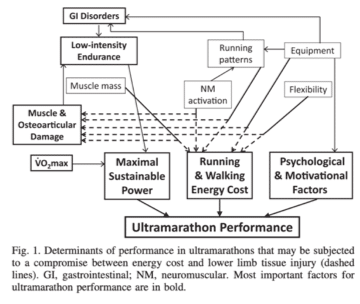
Figure 1- Millet 2012
Adversity Days Are Opportunities
Many runners have relatively few opportunities to intentionally face adversity in training. If you have been in the ultrarunning game long enough you know firsthand that sometimes race day deals you a crappy hand. Sometimes it a copious amount of mud, like the Bighorn 100 is notorious for, or maybe it’s a hailstorm at 12,000 feet like I had to personally contend with during my first Leadville Trail 100. The point is, look at the foul weather days as opportunities to test your gear, get a little cold, and perhaps a smidge uncomfortable. You’ll thank yourself come race day when you have to do the same. To be clear here, I’m not advocating for recklessly going out in hurricane force winds, conditions with high avalanche danger, or anything that would put your personal safety at risk. But, to use a normal snowstorm as an example, for most part it’s just some snow, and with some common sense, planning, and good equipment, an outdoor run or hike could be completed safely.
In addition to this, foul weather days (particularly with snow and rain) give you good opportunities to practice hiking when you might not otherwise. Over the years, my individual analysis of the athletes I work with has revealed that they run too much in training compared to the hiking they will actually do during a race. So much so, that I was inspired to create a data project to get a better handle on the proportion of hiking vs. running in major ultramarathons. Miles are not the only thing that matter, and bad weather days are one of the big reasons I prescribe and monitor training volume by time.
So, the next time the weather is foul, don’t think about the workout you are going to miss, think about the opportunity you have to gain. Adversity and hiking are scarce in most athletes’ training; take advantage of the the opportunities you have!
References
► Free Ultrarunning Training Assessment Quiz
Take our free 2-minute quiz to discover how effective your training is and get recommendations for how you can improve.
Coates AM, Berard JA, King TJ, Burr JF. Physiological Determinants of Ultramarathon Trail-Running Performance. Int J Sports Physiol Perform. 2021 Mar 10:1-8.
Enjoying This Article? Get More Free Running Training Tips
Get our coaches' best training advice, delivered straight to your inbox weekly.
Millet, G. Y., Hoffman, M. D., & Morin, J. B. (2012). Sacrificing economy to improve running performance—a reality in the ultramarathon? Journal of Applied Physiology, 113(3), 507–509.
About the Author
Jason Koop
CTS Head Ultrarunning Coach
Jason Koop is the Head Coach for CTS Ultrarunning and a leading authority in ultramarathon training, known for his science-based methods that have revolutionized athlete preparation for extreme endurance events. With a rich background of coaching ultrarunning elites and mentoring aspiring coaches, Koop's expertise is further amplified by his accomplishments as an accomplished ultrarunner himself and his role as the host of the influential KoopCast podcast.
Comments 4
If us Seattleites didn’t run in the cold rain, we’d never go outside for six months. I grew up in Texas where we would never run in the rain. After 40 years in Seattle, I love an adversity day(s). Great article.
As my fellow swedish Nordic ski Olympic Gold medalist said: ”Worst possible weather today. Perfect! Could be race day conditions. Let’s spend some extra time out there.”
(Fellow in nationality that is, nothing else….)
A debt of gratitude is in order for sharing. As of late, I simply need to set up an indoor bicycle mentor and your post gives me a few thoughts.
Great post Koop! Loved it. We are so attached to our comforts and routines, even the idea of missing a “quality” work out creates anxiety for many runners. It is actually good advice to get uncomfortable during your training and learn how to deal with it. As little as getting your shoes wet on purpose on your training run, or may be get little cold by not wearing this one extra layer of clothing (not to get graphical here) can make us be more flexible during the actual race. And as you pointed it out in your other posts, to those who chose to run Ultras the mental training and resiliency is as important as volume and other fancy metrics we tend to focus on.