
Torque Training for Cycling: How To Do It The Right Way
Updated On
August 25, 2026
CHOOSE YOUR FORMAT
►WATCH THE VIDEO
►LISTEN TO THE PODCAST
►READ THE ARTICLE
Torque Training for Cycling: How To Do It The Right Way
Torque workouts are one of the misconstrued aspects of cycling training. Most athletes think torque training is simply shifting into a heavy gear and grinding along at a low cadence. That’s part of it, but they overlook the importance of force production. The adaptation you’re after is the ability to apply more force to the pedals, and low-cadence intervals aren’t the only way to get that job done. So, let’s take a look at what torque really means for cycling, how you can train and measure its effectiveness, then how to use torque to your advantage on the bike.
How Cyclists Create Torque
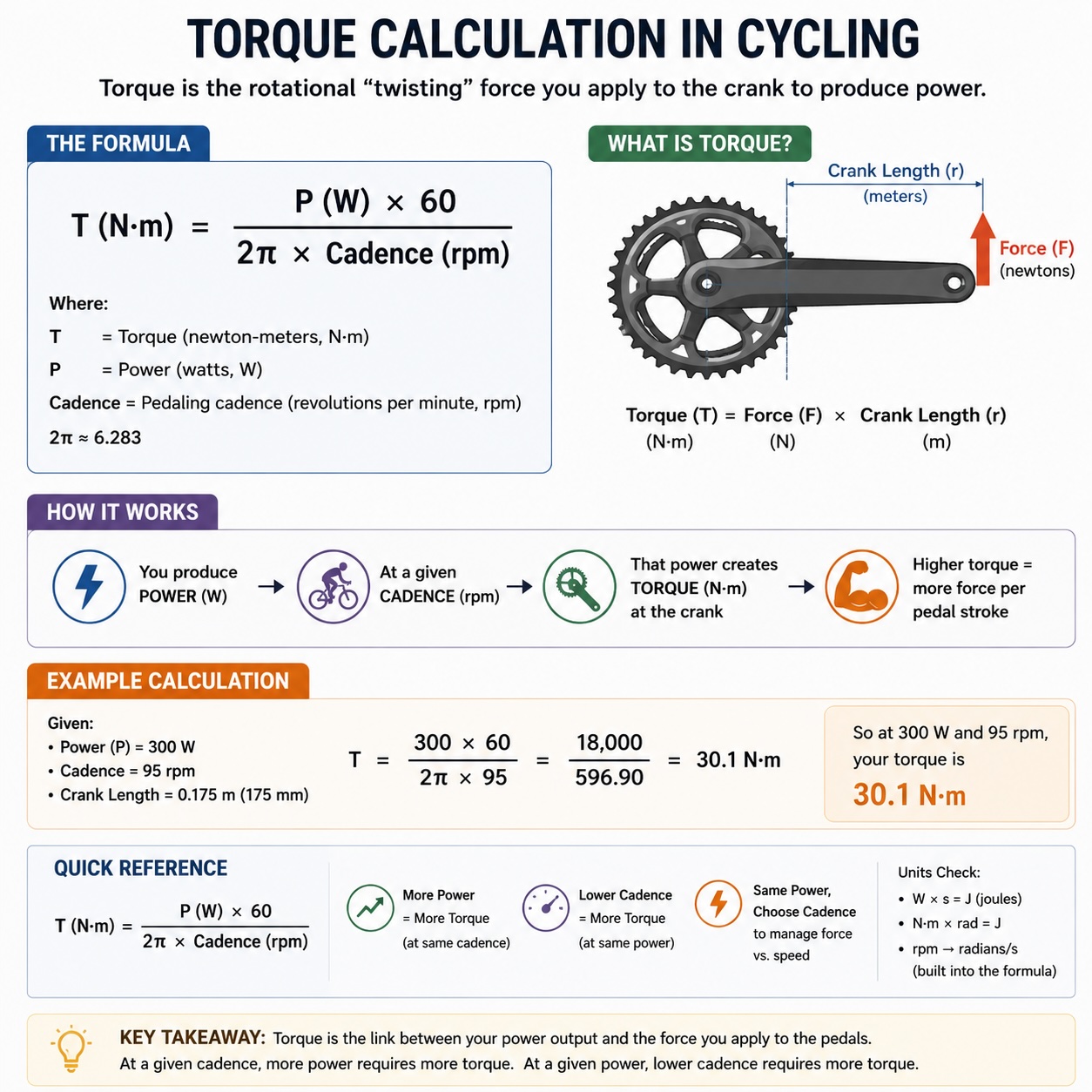
To understand torque training we must first define some terms. When talking about creating torque on the bike, we’re talking about rotational force at the crank. Remember that the simple equation for power is: Power = Force x Velocity. In cycling, we produce power at the crank, which is rotating, so the equation becomes:
Cycling Power = Torque x Angular Velocity
For a more complete look at how torque is calculated in cycling, see the image below.
Here’s the important part people get wrong: Low cadence doesn’t automatically equate to higher torque. Pedaling at a lower cadence gives you more time to apply force during each pedal stroke, but if your maximal force production hasn’t increased, power is unchanged.
Low cadence at low power doesn’t make you stronger or faster. To get a torque benefit from low-cadence intervals, force production must be high! It’s the intensity that makes the difference, and most cyclists don’t execute their on-bike torque training with high enough force to make meaningful improvements in performance.
High Torque Ability is Best Developed Through Strength Training
Force production is the limiting factor for developing torque on the bike. But the bike is not the best place to build your maximum ability to produce force. If your goal is to increase maximal force-producing capacity, the weight room provides a much greater loading stimulus than the bicycle.
The following strength training exercises expose your muscles and nervous system to forces far greater than what you can normally produce on the bike:
- Heavy squats
- Bulgarian split squat
- Weighted step-ups
- Jump squats
- Leg Press
- Anything jumping related
- The list could go on…
These are not the only exercises you can use, but the point is that high-resistance, multi-joint, lower body strength movements develop force production in the quadriceps, hamstrings, hips, buttocks, lower back, and torso. You develop force production in the gym and learn how to express it on the bike.
Fun fact: Crank length doesn’t meaningfully change your torque output for prolonged efforts at a given power output and cadence. Crank length affects peak torque (force x length of the lever arm), but in cycling the lever arm rotates 360 degrees. Your feet must travel a larger circle with a longer crank. You have more leverage, but the larger circle generally slows your cadence. In contrast, shorter cranks result in a smaller circle, less leverage, but faster cadence. Even within an extreme range of crank lengths for cycling (145-195mm), these offsets mean that torque is minimally affected by crank length for sustained cycling efforts (i.e., climbs, time trials, Zone 2 rides, etc.).
Are Low-Cadence Intervals Valuable?
Yes, but not for the reason you might think. Low-cadence intervals are all about sport specificity. They help transfer the strength (force production) you develop in the gym to a cycling-specific movement (turning the pedals). Low-cadence intervals improve your ability to express force while pedaling in real riding conditions.
We can show the value of low-cadence intervals by looking at how athletes produce power.
Data Analysis: The Torque Duration Curve
Many athletes are familiar with the Power Duration Curve, which maps mean maximal power output over the range of effort durations (e.g., 5 seconds, 30 seconds, 1 minute, up to several hours). You can also create a Torque Duration Curve that maps mean maximal torque over time.
A torque duration curve can provide insights on how you produce power, and it’s best illustrated by comparing two different types of cyclists. At first glance, the two cyclists in the image below could appear very similar. They both have an FTP of 320 Watts and they have nearly identical Power Duration Curves.
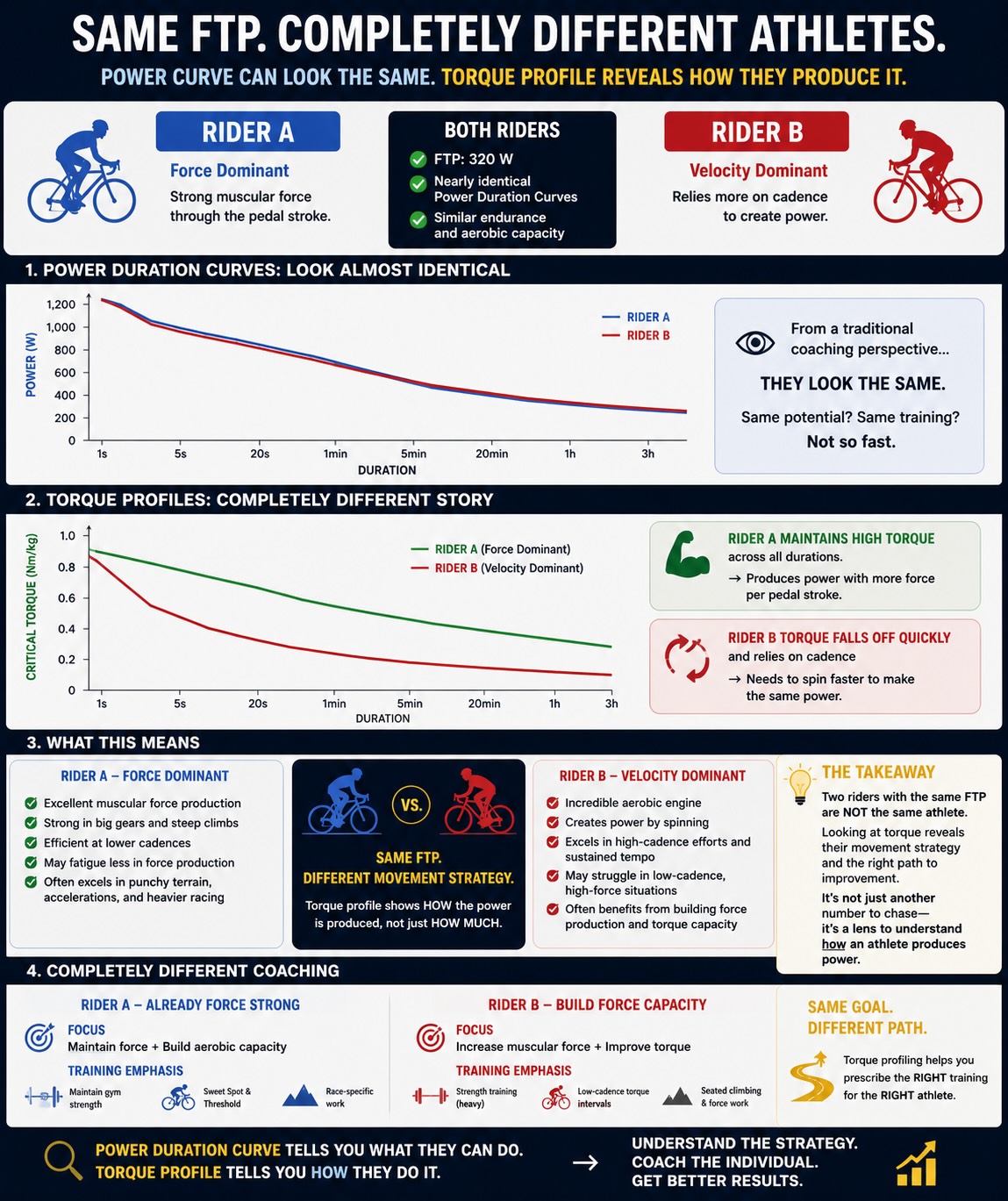
The Torque Profiles for the two athletes reveal an important difference in how they produce power. Rider A is force dominant, meaning they maintain high torque output even as effort durations increase. Rider B is velocity – or cadence – dominant. Their torque output drops off quickly and they must rely on a higher cadence to produce power.
These differences reveal strengths and weaknesses for each rider. Rider A may already have excellent force production. Perhaps the pathway to a higher FTP is further development of their aerobic engine and/or neuromuscular adaptation to increase the cadences they can sustain for prolonged efforts. Rider B may already have a big aerobic engine but relatively low ability to produce muscular force. The opportunity for Rider B might not be related to FTP, but rather increased muscular force for more explosive accelerations.
Critical Torque
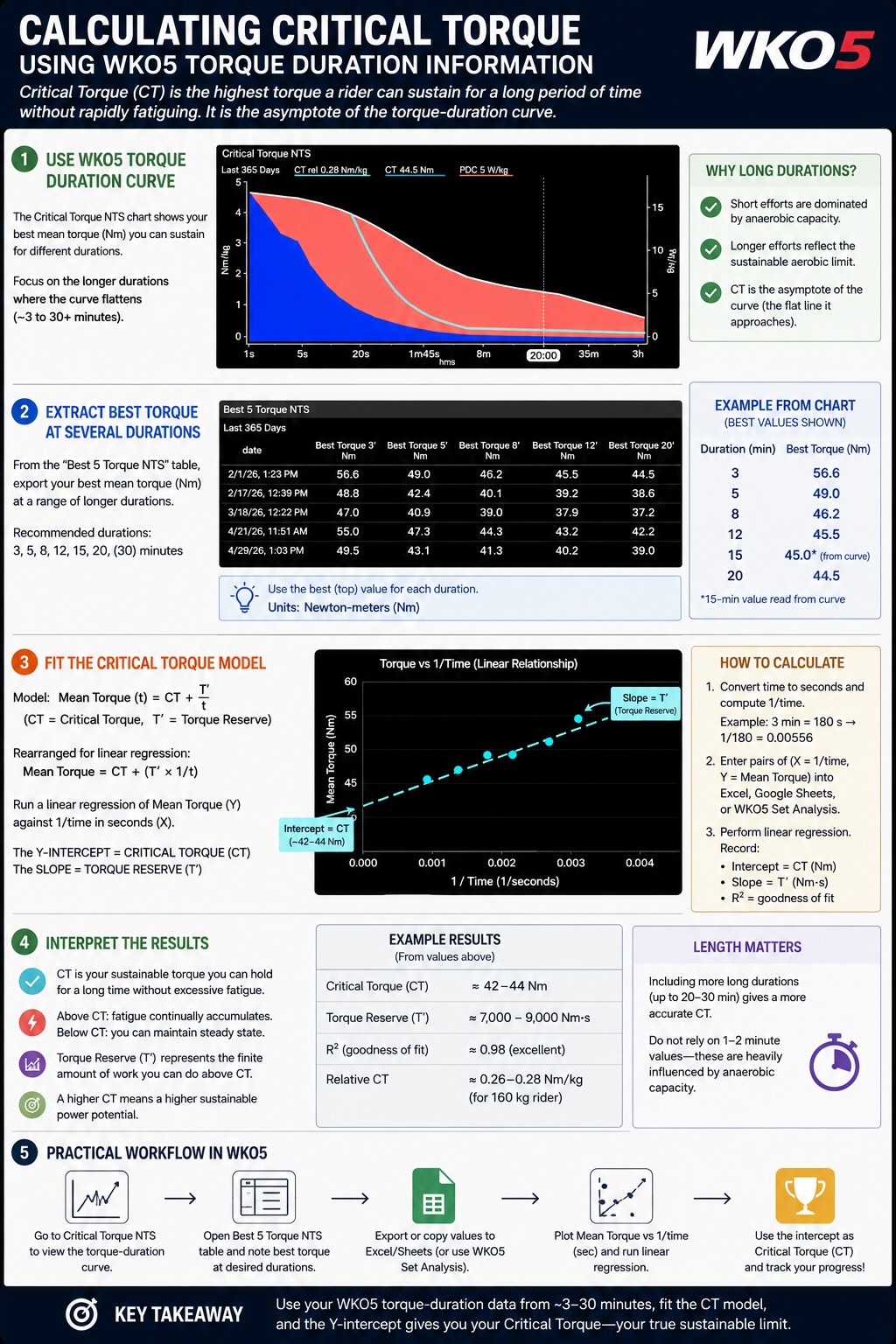
Critical Torque is a similar concept to Critical Power. Critical Torque is the highest torque value a rider can sustain for a period without fatiguing rapidly. It is a metric that’s typically only measured in a lab setting for research, and it’s not a metric that’s currently available in commonly-used training platforms, including TrainingPeaks, Intervals.icu, or Vekta. I measure Critical Torque for some of the athletes I work with. I don’t think Critical Torque or Torque Analysis is necessary for everyone, but if you want to know how I do it, I created the workflow image below to explain it.
► Free Cycling Training Assessment Quiz
Take our free 2-minute quiz to discover how effective your training is and get recommendations for how you can improve.
How and When To Incorporate Torque Training Into Your Annual Plan
Every type of training has its season, so how and when are you supposed to incorporate torque training? Well, there’s an aspect of torque training that fits into your plan throughout the year, but the focus changes with the season.
Torque Training During Base/Foundation Phase
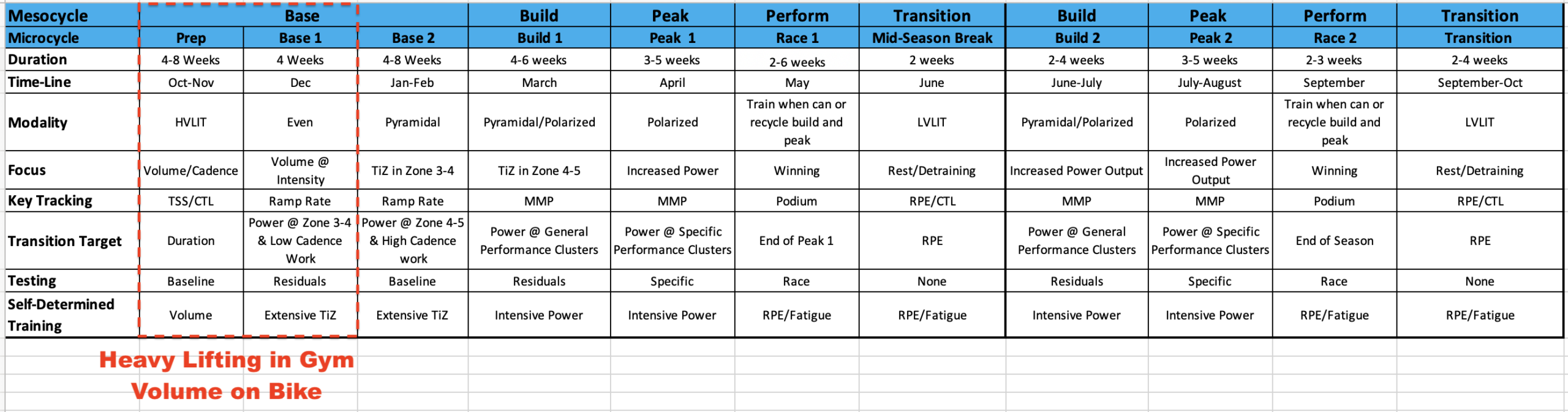
This is where your heavy lifting in the gym is going to be a high priority. While you’re doing mostly aerobic base-building rides and higher volume (i.e., hours) on the road and/or trainer, this is the time to go heavy in the gym. If force production is a key goal for you, this is the most important phase of the year because it’s the period when you can afford to direct significant attention to lifting heavy.
Torque Training During Build/Preparation Phase
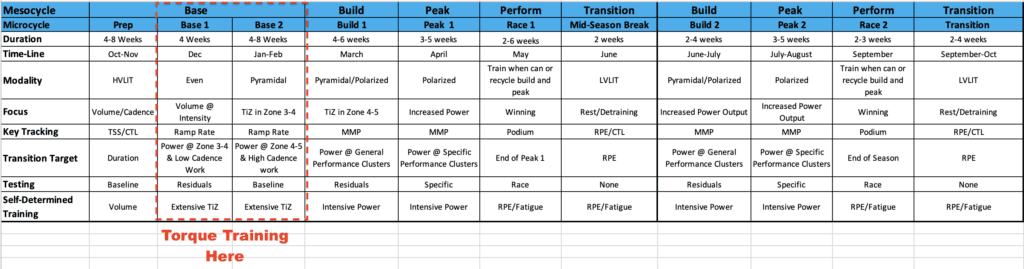
During the build phase you want to start the strength gained in the gym onto the bike with lower cadence and torque-specific intervals. In my coaching practice, I use cadences of 50-65 rpms at intensities of Zone 3-4 to help with this “transfer” to the bike. You only need 1-2 sessions per week for a few weeks. The big difference in how I do this compared to some others is that I believe you should go harder than Zone 2 to get the benefit from low-cadence intervals at this time of the season.
Torque Training Drills and Workouts For Build/Preparation Phase
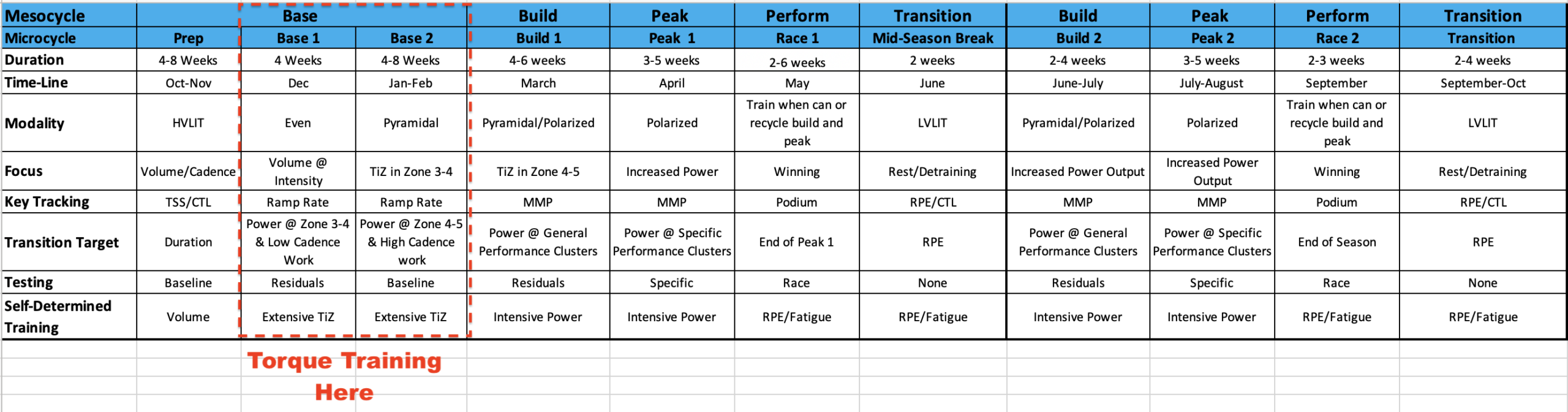
What do the workouts and drills look like for transferring strength from the gym to torque on the bike? I use workouts like Standing Starts, Overgeared Sprints, Low-Cadence Hill Attacks, and regular old Sprints. These drills and workouts ensure that high force production gets translated to the pedals. Notice that these are hard and short efforts rather than long, grinding efforts like an overgeared Tempo interval.
Here are some examples of the structured workouts I use with the athletes I coach:
High Torque Sprints
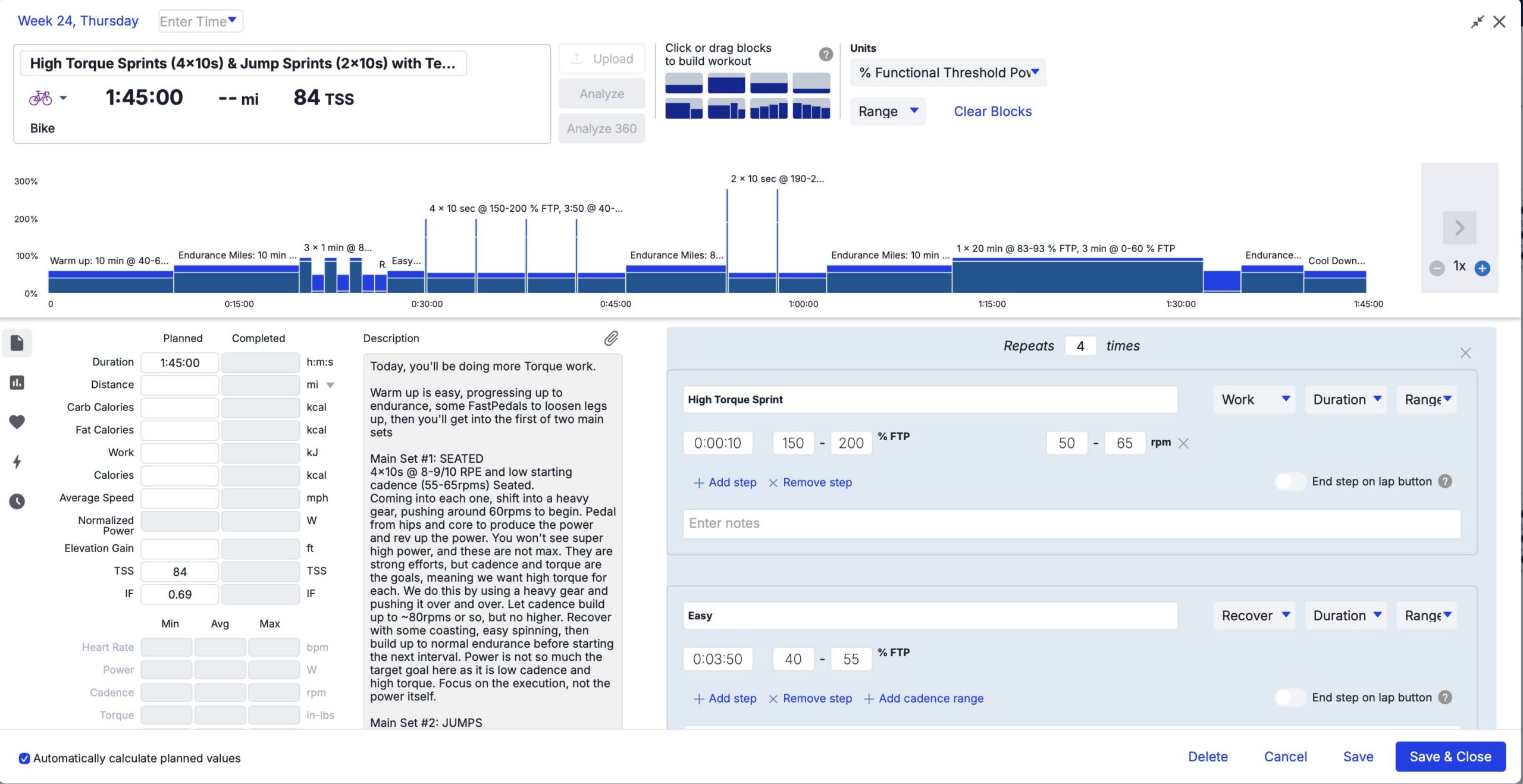
There’s no specific cadence prescribed on these, but you should use heavier gears than you normally would in racing. You should feel overgeard to start the effort, then you should feel like you’re just about getting on top of the gear, at a normal cadence, as you finish each of the 5- to 20-s efforts. These are more drills than intervals, in that I don’t have athletes look at torque, cadence, or power during the efforts. They’re too short. It takes some trial and error to get the gearing and cadence combination right so that you finish the effort on top of the gear. Then we look at the torque and power production post workout.
High Force VO2 Intervals
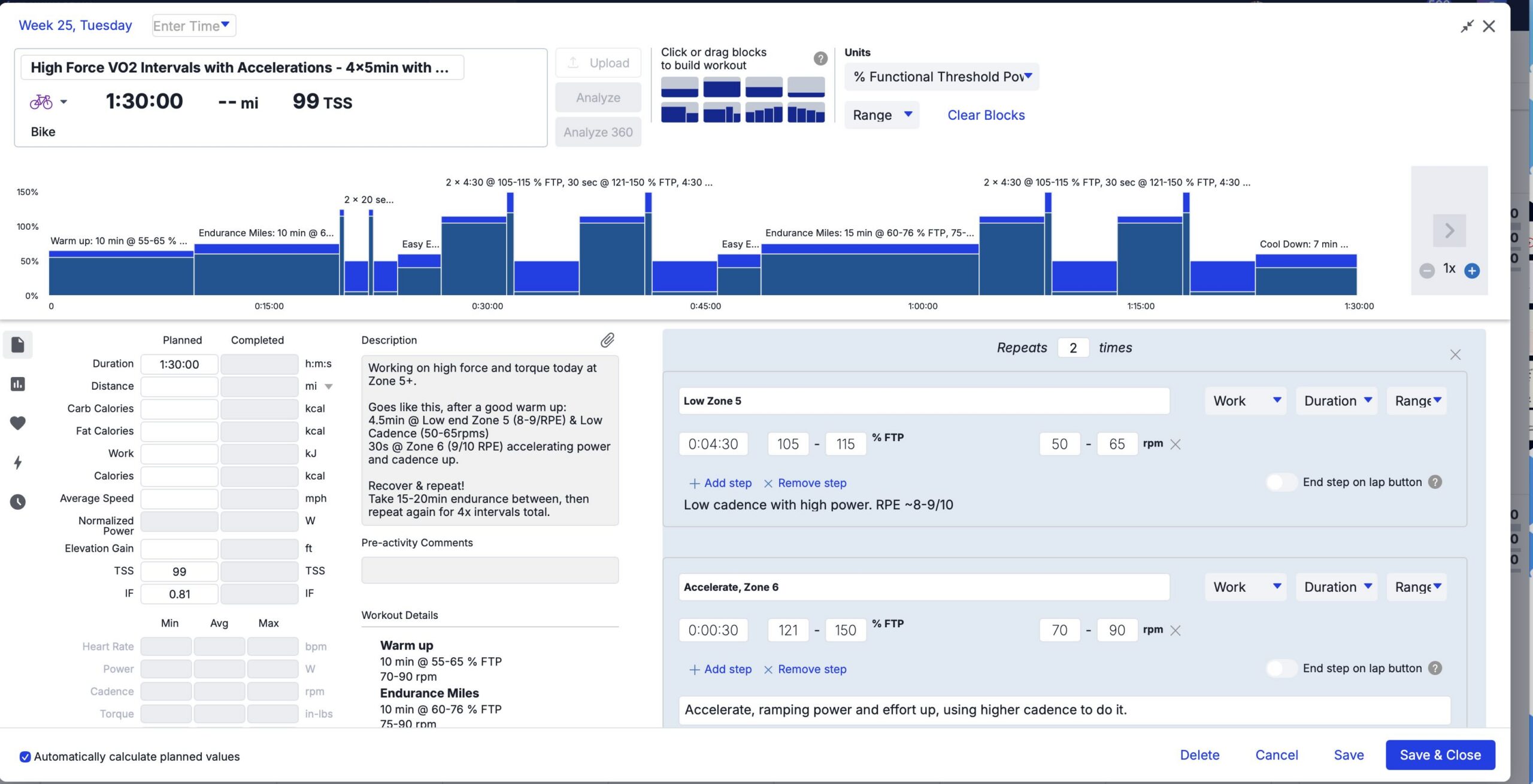
These are great for athletes who need more high force work during the Build phase. A two-week block of low-cadence, high-force VO2 Intervals is a good starting point. Two sessions a week, interval intensity of Zone 5-6 or an RPE of 9/10, and a cadence of 50-60 rpm. Structure the intervals to accumulate a total of 15 minutes time-in-zone, and allow for full recovery between intervals.
How do you know if the torque is high enough? This is where the Torque Duration Curve and Critical Torque can be useful. When I prescribe these intervals, I use power and cadence targets that will result in torque above the athlete’s Critical Torque. This is necessary because that means they are producing a force that will elicit a positive training response. I don’t always have athletes look at torque on their device during the workout, as it can be confusing to some. I look at the data afterward and adjust power and cadence targets for upcoming workouts if necessary.
As a coach, I am prescribing the right power and cadence to get the torque I want or need, and this ensures the athlete is doing it right. For some data curious athletes, I do have them display torque on their devices for these intervals, but I still have them chase the power & cadence, then just check and observe torque. Trying to match all 3 together perfectly can be a perfectionistic person’s nightmare. So keep it simple, but know how to use these tools to work in the right areas to get the adaptation you want.
Torque Training During Race Season
During the race season, I like athletes to continue strength training in the gym. Although the volume of strength work decreases during the race season, they continue with heavy lifts or high resistance. It doesn’t take much stimulus to maintain the gains achieved earlier in the year, but skipping the gym will allow those gains to erode. On the bike, the focus shifts to high power production with FREELY CHOSEN CADENCE. I don’t artificially create scenarios that call for low cadence efforts during the race season. That work was done in the Build/Preparation phase. During the season you need to work on high power production at all cadences and the agility to produce power in the moment.
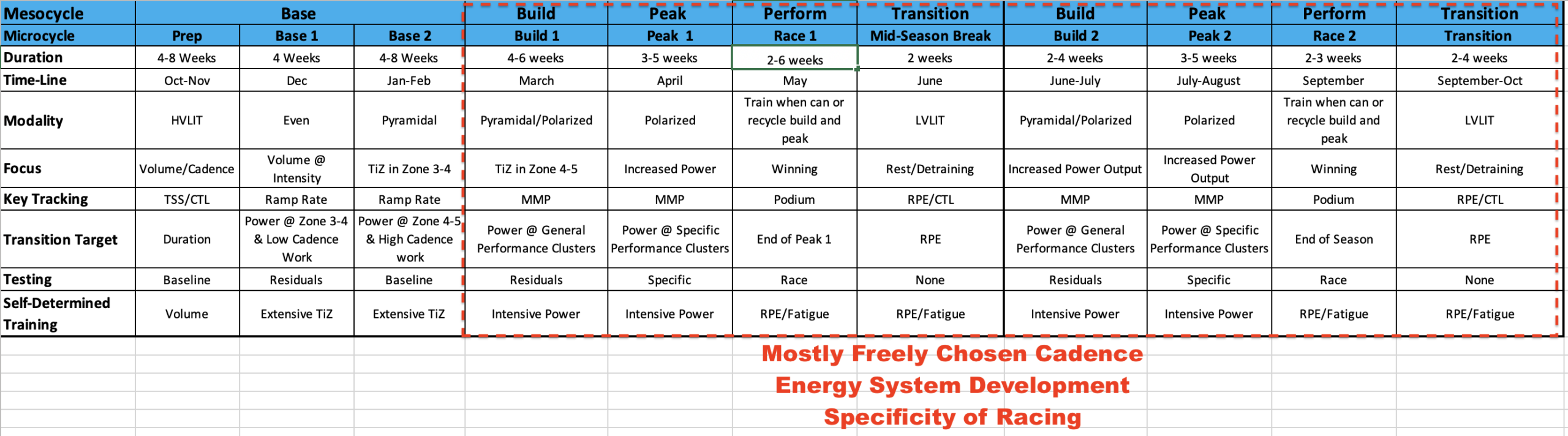
Research has repeatedly shown that freely-chosen cadence is the best strategy for racing and most of a cyclist’s training efforts. This is because there are tradeoffs between the aerobic system and anaerobic system and between your heart and your leg muscles, when it comes to creating power. In the real world of road, gravel, and cross-country mountain biking, agility is more valuable than optimizing power production at a specific cadence. When you use a higher cadence you can use less torque, meaning you have to produce less force per pedal stroke. This can be beneficial for launching or responding to a sprint, attack, or jump when a move happens, and for responding to terrain changes. Using a lower cadence with higher torque allows you to utilize more muscular force when needed, like on steep hill climbs, seated sprints, and making sure you have no weak link your pedal stroke.
The Bottom Line
If you take away just one thing from this long article, I hope it is this: Intensity is the driving factor for torque training in cycling! You must lift heavy in the gym to develop the ability to produce maximum force. The intervals you use on the bike to transfer that strength to a cycling-specific movement must be short and hard so the torque you produce is higher than your Critical Torque. Yes, the cadence is relatively low, but it’s still the intensity that drives the adaptation. Then, during the race season, don’t worry about manipulating cadence during your workouts and races, but continue with high-force, high-power efforts at freely-chosen cadences. If you do these things, you should see your Torque Duration Curve move up and to the right.
Resources and References
- Strength Exercise F-v and P-v Profiles as Predictors of Elite Sprint-Cycling Performance – PubMed
- Power-time, force-time, and velocity-time curve analysis during the jump squat: impact of load – PubMed
- 58. HIGH INTENSITY TORQUE TRAINING CAN INCREASE CYCLING PERFORMANCE
- Effects of Cycling Training at Imposed Low Cadences: A Systematic Review – PubMed
- Effect of Cycling Cadence on Neuromuscular Function: A Systematic Review of Acute and Chronic Alterations – PMC
- Pro Workouts: Torque Efforts with Noemi Rueegg | EF Pro Cycling
► FREE Mini-Course: Learn How to Maximize Your Limited Training Time
Learn step-by-step how to overcome limited training time and get faster. Walk away with a personalized plan to increase your performance.
"*" indicates required fields
About the Author
Adam Pulford
CTS Head Cycling Coach
Adam Pulford is a dedicated coach at CTS with a passion for elevating athletic performance through tailored, measurable strategies and a deep understanding of the “why” behind each athlete's goals. With nearly two decades of experience, a degree in Exercise Physiology, and a successful track record managing professional cycling teams, Adam also shares his expertise as the host of the Time-Crunched Cyclist podcast, providing actionable insights for endurance athletes.
Comments 1
Pingback: Carefully Curated Triathlon News for August 27, 2026 - TriathlonWire