


How to Prepare to Run Rim-to-Rim-to-Rim in the Grand Canyon

Updated On
December 11, 2025
The ability to explore epic routes is one of the biggest benefits to being a trail and ultrarunner, and completing a Rim-to-Rim-to-Rim (R2R2R) route in the Grand Canyon is a bucket-list achievement for many runners and hikers. There is no organized event or race to sign up for, meaning it’s a self-supported adventure and you’re entirely responsible for every step of the planning, gear, navigation, nutrition, hydration, and physical preparation. I’ve completed R2R2R twice and helped many athletes achieve their goals on the trail, too. If you’re up for the adventure of a lifetime, some of the best views on the planet, and an accomplishment you’ll be proud of forever, I hope this guide helps you complete your own R2R2R.
Note: Conditions, regulations, and policies at Grand Canyon National Park can change unexpectedly. There are links to Grand Canyon National Park pages in this article and we recommend you always check their website for up-to-date park information.
My Grand Canyon Rim-to-Rim-to-Rim Journeys
The first time I tackled R2R2R was many years ago, when I was much younger and less experienced. Admittedly, I didn’t know what I was up against. My partner had completed the route several times, so I relied on them to be my guide. I wasn’t too attached to the idea of making the full distance, but I felt quite strong most of the day and we ended up crossing from North to South and back to the North Rim in approximately 17 hours. Not fast by any stretch, but that was the longest single run I had completed to that point. I learned plenty and the experience generated some fun stories. I completed a second R2R2R this past spring. We started from the South Rim this time. I had more experience as an ultrarunning athlete and coach this time, and an even stronger running partner. We completed the route in just over 14 hours, following the direct South Kaibab to North Kaibab route and going back the same way.
What is the Grand Canyon Rim-To-Rim-To-Rim Route?
There are multiple ways to complete a R2R2R run or hike, depending on your starting point (North or South Rim) and your trail choices. To “count”, your route just has to begin at either the South Rim or North Rim of the Grand Canyon, you must make your way across the bottom of the canyon and up the opposite side, and then essentially retrace your steps for an out-and-back. Here are some of the important stats:
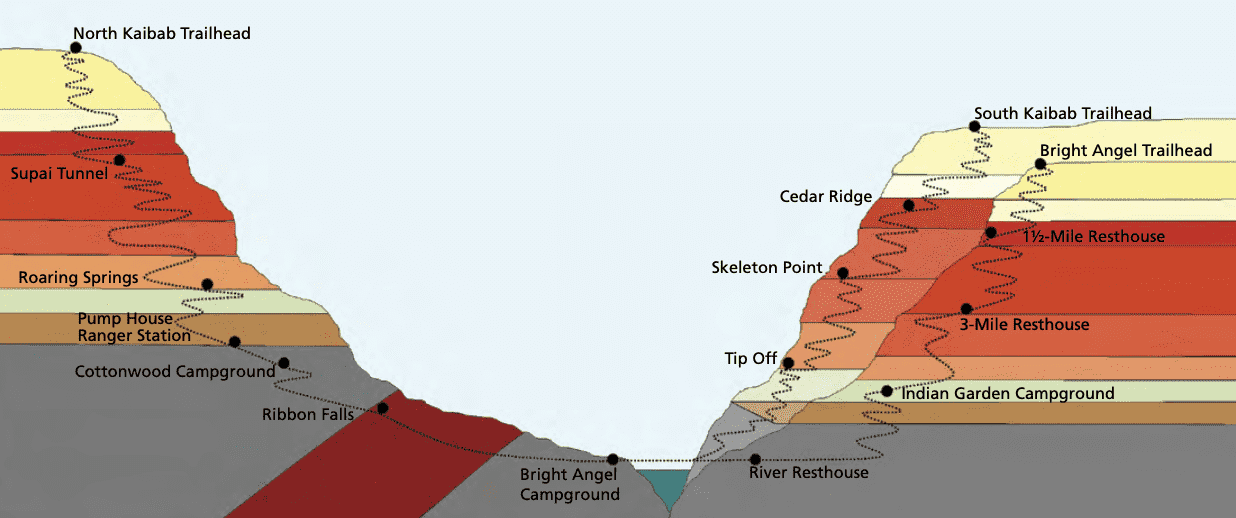
- The Shortest Grand Canyon R2R2R route: South Kaibab Trail to North Kaibab Trail to South Kaibab (SK-NK-SK) is approximately 42.2 miles with 10,580 feet of climbing and total elevation change of over 21,000 feet.
- Elevation of Grand Canyon – South Rim: 7260 ft at the South Kaibab trailhead.
- Elevation of Grand Canyon – North Rim: 8240 ft at the North Kaibab trailhead.
- Elevation at the bottom of the Grand Canyon: 2460 ft at Phantom Ranch.
- Alternate Routes: The Bright Angel Trail is another option on the south side of the Grand Canyon. It is 9.5 miles long (2.5 miles longer than South Kaibab Trail) and starts about 400 feet lower (6840 feet) than the South Kaibab Trailhead. Runners can also use the Tonto Trail to traverse between South Kaibab and Bright Angel trails, approximately halfway between South Rim and the bottom of the canyon. The Tonto Trail is rarely used during R2R or R2R2R attempts. The River Trail connects the two along the bottom of the canyon. The North Kaibab Trail is the only route up and down the north side of this area of the Grand Canyon.
- Bright Angel Trail to North Kaibab Trail to South Kaibab Trail: 45 miles
- South Kaibab Trail to North Kaibab Trail to Bright Angel Trail: 45 miles
- Bright Angel Trail to North Kaibab Trail to Bright Angel Trail: 47.8 miles
- Trail Information/Links
- Permits: Plan to pay for a National Park Day Pass or Annual Park Pass whether you start from the North or South Rim. No reservation or permit is required for day hikes/runs in the Grand Canyon. Permits are required if you plan to camp and may be required if your non-commercial group is between 12-30 people or you plan to hike overnight. For the most up to date permit information, visit the permit/reservations page on the Grand Canyon National Park website.
- How long does R2R2R take? First time runners should expect to spend 15-20 hours in motion, those who are more experienced can typically complete the distance in 11-15 hours and elite level runners will be back at their starting point in less than 10 hours.
Are You Running R2R2R or Hiking?
About 5-6 million people visit the Grand Canyon each year. Fewer than 1% venture below the rim at all. Even fewer hike or run down to the Colorado River at the bottom of the canyon. An even smaller number hike or run Rim-to-Rim. By the time you get to the people who run R2R2R in one effort (as opposed to camping or staying at Phantom Ranch overnight), you’re in a pretty select group.
It’s important to determine your goals for the adventure. Is the objective to soak in the experience for the first time or is it to move relatively fast? For those aiming to complete R2R2R quickly or possibly go for a personal record, you’ll want to plan your timing around temperatures and crowds. You will miss out on some scenery because nighttime in the Grand Canyon features lower temperatures and less trail traffic. But, to move fast, it’s critical to avoid being at the bottom of the canyon when temperatures are warm or hot. This means starting in the evening and doing a majority of the run in darkness. This approach is doubly successful in avoiding the largest crowds and mule trains which deliver supplies to Phantom Ranch, a small outcropping of buildings that provide accommodation for overnight campers as well as food and basic supplies that can be purchased by anyone passing through. The mule trains are generally 10-15 animals total, one following the next, and the mule guides pull over for hikers only at a few select sections of the trail. In other words, getting caught behind a mule train can cost you a chance at a personal record.
Group Size for Efficient Grand Canyon R2R2R Runs
Runners who want the experience of crossing the canyon twice in one go need to consider the size and compatibility of their group. Are fitness levels similar? Does the group have experience covering that distance in a single effort? Is the risk tolerance for each individual similar and does everyone understand how to manage hydration and heat and their capacity for running/hiking in moderately high altitudes? Usually, a group of 2-4 runners who are well matched in the areas mentioned will move the most efficiently. Groups of five or more tend to move slower for various reasons.
What’s the Best Time of Year to Run the Grand Canyon R2R2R?
Late spring and early fall tend to be the most popular times for R2R2R because temperatures are cooler compared to the peak temperatures of summer. On a hot day, temperatures can exceed 100 degrees Fahrenheit (38 C) in the bottom of the canyon. Spring and fall are popular with everyone else for the same reason, so trail traffic is highest in the spring and fall. Runners should expect to see several hundred hikers on the trail in these seasons.
Early spring and late fall can be ideal for running R2R2R because the trail traffic is lower and temperatures are cooler. These times are risky, however, because of the possibility of snow, which I encountered during my most recent R2R2R experience. This made the first few miles a little slick and we needed to carry additional layers, but temperatures were mild all day. We didn’t overheat and we didn’t need to carry as much water (no more than two liters of fluid at any given time).
Winter attempts are possible, though only recommended for highly experienced outdoor adventurers. It’s wise to carry traction and even more layers since you will most likely be traveling through snow for significant portions of the trail. It’s also important to recognize that the North Rim closes for winter, meaning there are no amenities at the top of the North Kaibab Trail in winter. (Note: The North Kaibab Trail is closed for the winter of 2025-2026 due to wildfire damage. Updates on North Rim Status can be found here.)
Logistics for Running the Grand Canyon R2R2R
For those traveling by plane, the two closest international airports are Phoenix, AZ and Las Vegas, NV. There is a regional airport located in St. George Utah. Approximate driving times from each airport to each trailhead are listed below:
- Las Vegas to North Rim: 4-5 hrs
- Las Vegas to South Rim: 4-5 hrs
- Phoenix to North Rim: 7.5 hrs
- Phoenix to South Rim: 3.75 hrs
- George, UT to North Rim: 2.75 hrs
- George, UT to South Rim: 4.75 hrs
Parking and Directions
The North Rim is open mid-May through mid-October most years and the South Rim is open year-round. As of fall 2025, the North Rim and North Kaibab Trail are closed due to wildfire damage. The only option for R2R2R when the North Rim is closed is to begin and end at the South Rim. When starting at the North Rim the singular option for R2R2R North Kaibab trail to Phantom Ranch. When beginning at the South Rim there are a few options:
If parking at The Village, Bright Angel Trailhead is within approximately one-half mile of any location. It descends directly to Phantom Ranch with an elevation change from rim to river of 4460 ft (1360 m), along a 7.8-mile (12.6 km) trail. Note, this option was closed for the 2025 season. In 2025, runners who started at Bright Angel had to take the Tonto Trail at Havasupai Campground, intersect with South Kaibab at Tip-off and continue to Phantom Ranch. This added 4.5 (7.2km) miles to each direction.
The South Kaibab Trail descends 7.3 miles (11.7 km) one-way to Phantom Ranch with an elevation change of 4,800 feet (1,460 m). There is no parking at the South Kaibab Trailhead, you will need to park at either The Village or the Visitor’s Center. From there, take either the Hiker’s Express or the Orange Shuttle to the trailhead. You may also run the Rim Trail to South Kaibab trailhead. The distance from the village to the trailhead is ~6.3 miles (10.1 km) one-way and from the Visitor’s Center it is ~2.1 miles (3.4 kilometers) one-way via the Rim Trail.
How should athletes train for a Grand Canyon R2R2R run?
Running R2R2R is a very difficult challenge and getting ready for the run can, depending on your fitness level, require several months of training. The demands of R2R2R can be daunting. Runners descend between 4-5k’ (1200-1500m) out of the gate, cover about 13 miles of mild grade in the canyon bottom, ascend 4-5k’ (1200-1500m), turn around, descend 4-5k’ (1200-1500m) and then climb that same elevation again.
Several training build cycles are necessary to build enough durability in the legs to handle a minimum of ~10 hrs in motion with this much elevation gain and loss. I also strongly recommend using trekking poles in training and for your R2R2R attempt. Runners should be prepared for the heat either by training in hot temperatures or by integrating a passive heat protocol to help mitigate the effects of the hot temperatures. Being well adapted to the heat can also create physiological adaptations that will lessen the negative impacts of the higher elevations at each rim.
Where Can Runners Find Drinkable Water In The Grand Canyon?
There are water sources along the “corridor trails” (i.e., North and South Kaibab, Bright Angel Trail) but runners need to be aware of which water sources are open and always carry a way to filter/purify water in case you need to fill up in a stream. One of your most important logistical tasks is to plan water stops and decide the amount of fluid to carry between each source. During training, track your sweat rate at intensities and temperatures similar to what you’ll experience in the Grand Canyon. Use this information to your hourly fluid intake for your R2R2R attempt.
Because the water system in the Grand Canyon is rather archaic, there are frequent closures for repairs. There is water available at each trailhead except for North Rim when access to the North Rim is closed. Assuming all water is available at each of the sources, here is a list, including the distance to the nearest trailhead:
► Free Ultrarunning Training Assessment Quiz
Take our free 2-minute quiz to discover how effective your training is and get recommendations for how you can improve.
From South Kaibab Trailhead (open year-round):
- South Kaibab Trailhead-available year round
- South Kaibab Trail-there is NO water along the South Rim Trail. The first option for water is the Colorado River (filter option) which is 6.3 miles from the South Rim and then just after crossing the river on Black Bridge which is 6.6 miles from South Rim Trailhead. This water source is available year-round.
- Phantom Ranch-available year-round. Phantom Ranch is located 7.4 miles from South Kaibab Trailhead.
From Bright Angel Trailhead (open year-round):
- Mile-and-a-Half Resthouse-available mid-May through mid-October located 1.6 miles from Bright Angel Trailhead.
- Three Mile Resthouse- available mid-May through mid-October located 3.1 miles from Bright Angel Trailhead.
- Havasupai Gardens Campground-available year-round located 4.5 miles from Bright Angel Trailhead.
- Bright Angel Campground-available year-round located 7 miles from Bright Angel Trailhead.
- Phantom Ranch- available year-round located 7.4 miles from Bright Angel Trailhead.
From North Rim Trailhead (open mid-May through mid-October):
- Supai Tunnel- available mid-May through mid-October located 1.7 miles from North Rim Trailhead.
- Manzanita Rest Area- available year-round located 5.4 miles from North Rim Trailhead.
- Cottonwood Campground- available mid-May through mid-October located 6.8 miles from North Rim Trailhead
- Phantom Ranch- available year-round located 13.6 miles from North Rim Trailhead
Here is a link to view water sources including if they are currently available. Runners can also filter from the Colorado River, the main river at the bottom of the canyon, as well as Bright Angle Creek, which parallels the trail from Phantom Ranch to Cottonwood Campground. Note that this creek is moderately challenging to access because of overgrowth and steep embankments, so consider this a backup option. At any given segment, runners may need to carry at least two and up to four liters between water access points depending on temperatures, your sweat rate and distance between water sources.
Running Gear Recommendations for the Grand Canyon R2R2R Run
Temperature and trail surface conditions can vary widely from the upper rim sections to the lower canyon. On top of that, you’re embarking on a remote adventure in the desert and it deserves plenty of respect. Runners should have the capacity to carry up to three liters of water at a time, which may include a combination of soft flasks in a vest and/or a hydration bladder.
Depending on the time of year, you should carry a very light emergency layer or e-blanket. If the attempt is done in cool or snowy conditions, add a puffy layer, rain pants, extra socks, light hat and gloves to the list. If icy conditions exist, carry traction devices for your shoes as well as a personal emergency device such as a Garmin inReach or a Spot device.
Pack a blister kit, and your shoe choice should be one that provides stable traction for a mix of sandy trails, intermittent rocks and plenty of water bars. These water bars are spaced to be convenient for mules, which means they end up being awkwardly spaced for people. Although these routes are not considered highly technical, there are some sections that are significantly more challenging or exposed. Runners should have a GPX route downloaded on their phone and/or watch. There are several emergency phones along the route but there is limited cell service along the route. Display an obvious location for emergency contacts for rescue workers in case of a true emergency.
Best R2R2R Tips & Avoiding Common R2R2R Mistakes
Having completed the R2R2R a couple of times, my advice is to train for the elevation change, both up and down, and plan your total training volume of be consistent with what you would need for a 50k or a 50-mile running race. This ends up being at least 6 hours of running per week for at least six weeks prior to your planned adventure date.
Enjoying This Article? Get More Free Running Training Tips
Get our coaches' best training advice, delivered straight to your inbox weekly.
The rate of elevation change is an average of 230-260 feet/mi (43-49 m/km), depending on the route you choose. Trying to roughly match that rate of elevation change is a good target for your long training runs. Having adequate fitness will help mitigate the heat and elevation while knowing how to pace and fuel for a self-supported adventure of at least 10 hours are the key components.
Be conservative on the initial descent. You’ll be feeling fresh and excited, but if you run downhill too fast to start your day, you’ll potentially add many hours to your outing if you create a lot of unnecessary muscle damage.
Understand the symptoms of dehydration, hyponatremia (too much water & not enough sodium), and too much sodium and be able to correct these situations quickly. It’s ideal to be able to separate your calories, sodium and water rather than be forced to consume calories if you only need electrolytes or more fluids if all you need is sodium, and so on. Plan ahead for sodium management, which means carrying sodium capsules, having options for consuming only plain water, and having some low-sodium food choices.
Estimate the total duration and calculate your calorie needs accordingly. At a minimum, this should be about 60 grams of carbohydrate per hour, or 240 calories per hour. Ideally, your gut tolerance should allow for closer to 300-400 calories per hour on average. Carrying a variety of savory, sweet and salty options is wise, because most athletes tire of the same taste after 6-8 hours. As with physical preparation, experimenting in training with a variety of calorie sources will set you up for success. If you anticipate supplementing your calories at Phantom Ranch, be aware their hours are 8am-4pm and 8pm-10pm.
For me, crossing from rim to rim to rim in the Grand Canyon was an empowering and humbling experience. It takes thoughtful preparation in both the short and long term. There are gear considerations, fueling needs, high temperatures and major temperature swings, and timing and physical fitness requirements that should not be overlooked. In the end, the views are stunning and worth every ounce of preparation this adventure requires. Ultimately, crossing the expanse of one of the largest canyons in the world is an accomplishment that’s inspiring, memorable, and life-affirming.
About the Author

Darcie Murphy
CTS Pro Ultrarunning Coach
Darcie Murphy is a seasoned CTS Pro Coach with a deep passion for endurance sports, blending her extensive competitive experience in cycling and trail racing with a degree in Health Education to guide athletes toward their peak performance. With a unique focus on balancing the demands of life with athletic aspirations, she fosters a collaborative coaching environment that empowers individuals to push their limits and thrive both physically and mentally.