
How to Improve Your Open-Water and Pack Swimming Skills

Updated On
March 7, 2025
By Nick White, CTS Premier Coach
Last summer, one of my athletes felt great going into the water at the start of her goal event, a half-Ironman at Buffalo Springs Lake in Lubbock, Texas, only to get stuck behind a pack of slow swimmers. A gap formed between her group and the leaders, but by the time she fought her way into the open water she didn’t have the power to get across to them. And while she ended the day with a new PR, her experience in the water revealed an opportunity for even more improvement. She needed some surge power and a more aggressive outlook on swimming in the pack.
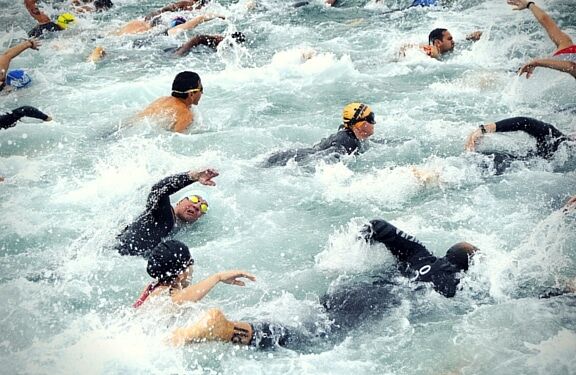
Pack swimming is a relatively rare occurrence for most athletes, and it’s difficult to replicate in a pool. Sure, you can swim laps right on someone’s feet or even at their hip, but there’s little that compares to being smack in the middle of a few hundred swimmers out in open water. So, without much ability to practice, here are some tips for staying out of trouble:
[blog_promo promo_categories=”coaching” ids=”” /]Don’t Get Pushed Around at the Start
Where you stage for the swim has a lot to do how crowded you’ll be in the water. Everyone wants to start in the middle of shoreline to get the shortest distance to the first buoy but remember that all those athletes on the sides are going to be converging in towards the middle as soon as the gun goes off. If you’re not fast enough to get out ahead of them, you’ll end up in the most congested swimming environment you can imagine.
For my medium-speed swimmers – the ones who are in the first half of the pack coming out of the water, I actually recommend lining up more toward the ends of the shoreline. You’ll be able to catch a draft from the pack, but you’ll have fewer swimmers to one side of you, meaning you’ll have room to move around slow people. Yes, you’ll have a little bit farther to swim, but swimming in better conditions often leads to faster swim times anyway.
Protect Your Face
Getting kicked in the face is one of the biggest risks – and the greatest fears – for triathletes. To reduce the risk – and alleviate much of the fear – try swimming “catch-up” style when you’re in the pack.
Catch-up is normally a stroke drill where you leave one hand extended in front of you while the other pulls through a complete stroke. When that hand gets back in front of you, you stroke with the other one. In a tight pack environment, it means that one hand is always in front of your head – like an antenna that will intercept a swimmer’s foot before your head does. When you’re in clearer water, you can go back to a conventional stroke.
Think Before You Surge
Accelerating in the water to pass another athlete takes a lot of energy, so make sure you’re doing it for the right reason. In the middle of the pack, passing one person isn’t going to take you out of the draft, but if you’re in a long line of swimmers you run the risk of pulling out to the side, slowing down because of the drag, and then losing positions as you fight to get back in line.
The most important time to work hard is right at the beginning of the swim. You’ll burn a lot of energy, but getting into a good position in the pack – near the outside and with a group that swims as fast or a little faster than you can – will save you energy in the long run because you’ll be able to do more swimming and less battling.
Of course, to get yourself into the sweet spot within your pack of swimmers, you need the ability to surge in the water, sometimes several times, and then recover while maintaining a strong pace. The final few weeks leading up to your event are a good time to work on this because the workouts are relatively short and fit well into most athletes’ tapering programs. I like to have my athletes perform the following workout twice a week in the 3-4 weeks before a goal event.
[blog_promo promo_categories=”bucket list” ids=”” /]Nick White’s Surge Power Workout:
Warmup (500 Yards)
Drills (400 Yards total)
3×50 yards Catch Up
3×50 yards Kick on side arm out w/fins
100 yards Sighting Drill
Power Interval Set (1600 Yards)
8×200 yards (intervals 1-4: Pull w/ paddles; intervals 5-8 Swim (focus on high elbows and catch))
Sprint Interval Set (900 Yards)
► Free Cycling Training Assessment Quiz
Take our free 2-minute quiz to discover how effective your training is and get recommendations for how you can improve.
9×100 rotating a 50-yard sprint through the set
Interval #1: 50 sprint, 50 race pace
Interval #2: 25 race pace, 50 sprint, 25 race pace
Interval #3: 50 race pace, 50 sprint
Repeat 3 times
Cool Down (150 Yards)
Total Yardage: 3550
Nick White is a Premier Coach for Carmichael Training Systems, Inc. (CTS). He coached Craig Alexander to Ironman World Championships in 2008 and 2009; as well as 2010 Ironman St. George winner Heather Wurtele. To find out about CTS coaching, training camps, and other services, visit www.trainright.com.
Related Articles
Triathlon Training: Tips for Overcoming The Intimidation Factor of the Swim
Triathlon Training: Power Pacing for Winning Performance
► FREE Mini-Course: Learn How to Maximize Your Limited Training Time
Learn step-by-step how to overcome limited training time and get faster. Walk away with a personalized plan to increase your performance.
"*" indicates required fields
About the Author
Nick White
CTS Premier Cycling Coach
Nick White is a CTS Premier Level Coach specializing in triathlon coaching, who uniquely integrates an athlete's life challenges into personalized training programs. With over 13 years of coaching experience and a background in Exercise Physiology, he leverages his own diverse athletic journey and multifaceted pursuits as a firefighter and family man to inspire and guide athletes through their endurance challenges.
Comments 2
Pingback: The 5 Most Common Triathlon Rule Violations and How to Avoid Them - CTS
Would like to participate in a triathlon..
Thank you
Rosabell