

How To Create “Your Year In Cycling” Year-End Data Review

Updated On
December 23, 2025
Spotify has its Wrapped feature and the Strava app will show you Your Year In Sport, but what if you want to create a more detailed and meaningful review of your cycling training for the year? CTS Coaches use TrainingPeaks to create athlete training plans and monitor athlete performance through uploaded power, heart rate, and GPS files. Here are some of the ways you can slice and dice your annual training data to create Your Year in Cycling and gain some insights going into next season.
Note: If you’re not using TrainingPeaks for your cycling data tracking and analysis, similar data and trends referenced below can be found in other training softwares, including Strava.
Step 1: Assess the Big Picture with Chronic Training Load Trends
The Performance Manager Chart below is from my own training in 2025. Chronic Training Load (CTL) is a weighted average of your daily Training Stress Scores, represented by the shaded blue area. In Strava, this would be similar to the Fitness line in the “Fitness and Freshness” chart. Although you can think of CTL as your level of fitness, a more nuanced view is that it’s the level of training stress you’ve been able to sustain. You can create a high CTL from a long training streak with no days off, but you’ll also have a high Acute Training Load (pink line) and a low Training Stress Balance (yellow line).
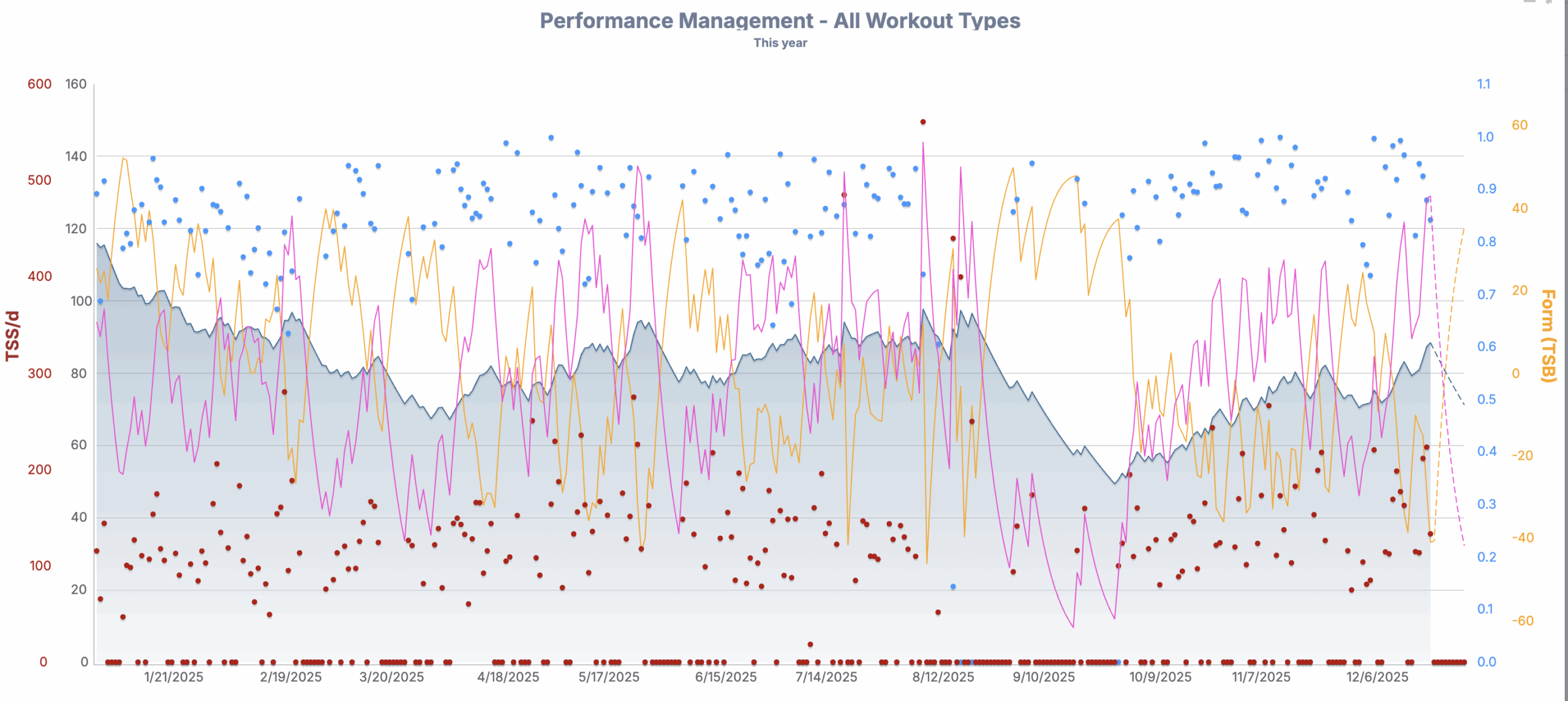
At the beginning of the year I had a CTL of about 116 because of a massive month of training in December 2024. I was exhausted and caught the flu at the beginning of the year. Over the next three months I struggled to train consistently because of illnesses and travel. I got my act together at the end of March and put together two solid build periods between April and August in preparation for the 2025 Leadville 100 MTB and a 50th Birthday trip to ride in the Italian Alps.
The massive drop in CTL from mid-August to the end of September was a much-needed break from training after about two years of consistent work. Notice, the yellow line (TSB or “form”) went way up while Acute Training Load (ATL, pink line) declined sharply. That period indicates significant recovery and rest, after which I’ve rebuilt fitness gradually from October through December.
Look at your Performance Manager Chart or Strava’s Fitness and Freshness chart and observe the macro trends of how your training stress, fatigue, and ability to perform shifted throughout the year. Take note of periods when you struggled to train consistently or missed a significant amount of intended training because of illness, injury, or conflicting priorities. Observe how those periods affected your progress weeks and months later (for better or worse). Also note periods when you put together great training blocks, and notice how those periods affected your performance trajectory weeks and months later.
Step 2: Look up your Peak Power Durations
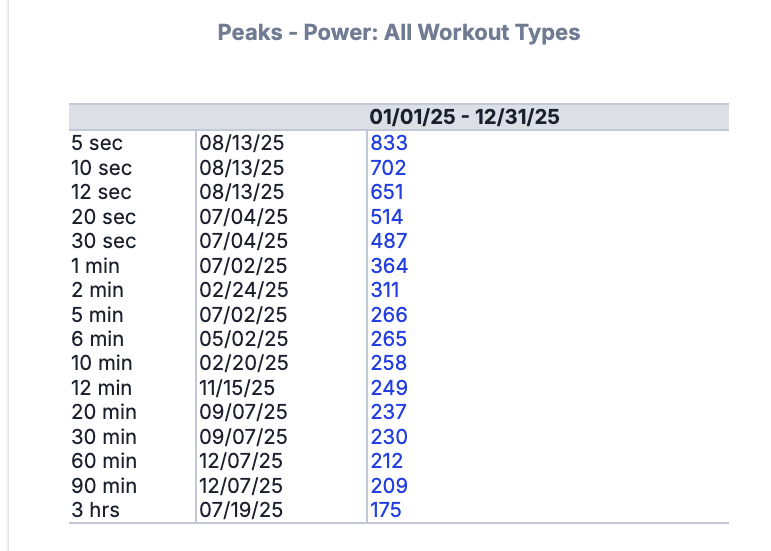
Peak Power Durations are metrics like your Peak 20-second, 5-minute, 20-minute, 60-minute, and 90-minute power outputs. These values are available in the analysis tab of any cycling workout in TrainingPeaks, and you can create a “Peaks” chart in the TrainingPeaks app that displays your best peak power outputs in your choice of durations. I have included my chart as an illustration below.
Feel Stronger in 6 Weeks — No Matter Your Age
Climbs feel steeper? Recovery slower?
You’re not done getting faster — you just need a smarter plan.
The 6-Week Masters Power Build Coaching Program is designed for cyclists 50+ who want to boost power, recover faster, and ride stronger — all with expert 1:1 coaching.
- Personalized 6-Week Training Plan
- 1:1 Coaching + TrainingPeaks Premium
- Mobility & Strength Bonus Guides
💪 Guarantee: Stronger or free.
Start your 6-week journey for $149Once you find your Peak Power Durations, you want to look at when you achieved those performances. For instance, I hit my best power outputs for short efforts (e.g., five seconds to five minutes) in July and August, whereas my power for long efforts (e.g., 12 minutes to 90 minutes) came on strong during my rebuilding phase later in the year. I was training for mountain biking in the mid summer before Leadville, and I was focused on a long endurance block later in the year.
When you look at your Peak Power Durations, you also want to consider how you achieved them (i.e., solo training, group ride, racing, physiological testing). Many times you’ll hit a peak power when you don’t expect it, but it’s good to note the circumstances so you have a reference point for the future. Similarly, try to locate the date of your peak power durations in your Performance Manager Chart so you can note your CTL, ATL, and TSB at the time. This can give you an indication of how your overall conditioning contributed to specific peak power outputs.
Step 3: Determine Functional Threshold Power (FTP) trends for the year
If you formally tested your FTP a few times during the year, look up the values and observe how they trended up or down across the tests. If you didn’t test formally, you can get a sense for your FTP trend by looking at how your 20-minute peak power duration shifted up and down during the season.
Functional Threshold Power is not the be all and end all for fitness or performance. There can be good reasons to let FTP decrease during the season while you addressed more explosive power for race-specific goals. Similarly, FTP may stay stubbornly low during a base aerobic phase because your training intensity is low during that period.
► Free Cycling Training Assessment Quiz
Take our free 2-minute quiz to discover how effective your training is and get recommendations for how you can improve.
FTP is one of the most responsive training metrics in endurance cycling, and a high FTP indicates you have a strong aerobic system that can sustain power output at a relatively high percentage of your VO2 max. You want to note your highest FTP value for the year, when you achieved it, the training you were doing in the two months before achieving it, and what you did with it! When you hit your best FTP, what did you use it for? Were you racing, setting personal bests, powering epic rides?
Step 4: Assess your accomplishments and failures and what led to them
The final step in creating Your Year in Cycling is more subjective. Did you accomplish your goals for the year? You can look back at established, written goals if you committed them to paper or software at the beginning of the year. Even if you didn’t, take a look at what you achieved and assess whether you’re satisfied. Broaden your horizons to include aspects of performance you could control, like your training consistency, annual mileage or hours, diversity of activities, time spent riding with friends, places visited, epic routes completed, etc.
When you identify accomplishments and/or areas where you fell short of expectations, look back at your Performance Management Chart and the data trends above to correlate a snapshot of your fitness with the timeframe of your accomplishment or perceived failure. What were your CTL, ATL, and TSB around the time of your best performances? What did your training look like in the months when your performances didn’t meet your expectations?
Using my data and experiences as an example, I can tell you that in 2025 I had my best days on the bike when my CTL was between 85 and 95. During 2025 I felt worst in March because repeated illnesses, travel, and inconsistent training led my CTL to drop to 69. I built back up to the 80s and 90s by August, which enabled me to create wonderful memories from great days at the Leadville 100 and on big climbs in Italy (where I never even looked at training data). Then, following a 6-week period of deep recovery in late summer, I built back to a CTL in the 80s in late November into December and then set several long-segment peak power durations (12-90 minutes) for the year.
Step 5: Learn for the future
The best reason to create Your Year in Cycling is to learn how to make your next year in cycling even better. And if you do this every year you’ll start to see patterns for what worked, what didn’t, what you changed on purpose, and what changes happened outside your control (e.g., shifts in job or family priorities, injuries, new interests, etc.).
One of the important things to learn is your sustainable level of training, whether that’s by monthly/annual hours or distance, or by weekly training stress, or an optimal range for your CTL. For instance, although many athletes take a “bigger is better” approach to their CTL value, pushing for a higher CTL can backfire because it means riding more or riding harder to keep your daily Training Stress Scores high. This doesn’t allow for adequate recovery, so even if the CTL number is high, you’ll also be tired and you won’t adapt to the training stress.
When you were feeling your best in 2025, how much were you training? How much were you resting? What did that balance of training and rest look like in the weeks before you felt your best on the bike? And in contrast, what happened when you rode significantly less or more than that?
Special thanks to Coach Adam Pulford for his input and contributions to this post.
► FREE Mini-Course: Learn How to Maximize Your Limited Training Time
Learn step-by-step how to overcome limited training time and get faster. Walk away with a personalized plan to increase your performance.
"*" indicates required fields
About the Author
Jim Rutberg
CTS Pro Endurance Coach
Jim Rutberg is a seasoned coach and endurance athlete with over two decades of experience, having co-authored ten influential books on training and nutrition, including “The Time-Crunched Cyclist”, "Training Essentials for Ultrarunning", and "Ride Inside." His unique blend of academic knowledge, elite racing experience, and hands-on coaching at CTS positions him as a leading expert in endurance sports, dedicated to helping athletes reach their highest potential while balancing family life and personal passion for cycling.
Comments 1
What a GREAT, informative article! I’m a CTS Coached athlete, this information confirms the “why’s, and when’s” my coach has me doing specific training for different events. This article mentions the liability of High TSS & CTL, and sickness that can occur if you are not recovering from training. So be prepared in planning your season.