
How to Increase Functional Threshold Power (FTP): A Simple Framework That Works for Every Athlete

Updated On
July 6, 2026
CHOOSE YOUR FORMAT
►WATCH THE VIDEO
►LISTEN TO THE PODCAST
►READ THE ARTICLE
How to Increase Functional Threshold Power (FTP): A Simple Framework That Works
Many athletes think raising their Functional Threshold Power (FTP) just means doing more FTP intervals. That’s not entirely wrong but it’s not the whole story, either. You can increase your threshold power, which is essentially the maximum power output you can sustain for an hour, a number of ways. This flexibility is important because it increases your workout options and allows different athletes, at different stages of training, and with different goals, to personalize their FTP training. Keep reading to learn the simple framework and tools that will increase your FTP, no matter where you’re starting.
Key Concept: FTP Can Be “Pushed Up” or “Pulled Up”
Conceptually, there are only two ways to raise your FTP: push it up, or pull it up.
- Pushing FTP up means increasing FTP mostly through aerobic training, Zones 1 through Low Zone 4. These zones are all below lactate threshold (i.e., LT2, VT2, FTP).
- Pulling FTP up means increasing FTP through high intensity training, including workouts that target anaerobic capacity and maximum aerobic capacity (VO2max). These workouts feature intensities in High Zone 4, Zone 5, and a bit of Zone 6.
“Push” and “pull” are just coach-speak for how FTP and VO2 max training actually work. There’s not magical workout that perfectly targets adaptations that increase FTP, not even spending more time at your current FTP intensity. Physiology doesn’t adapt the same way as skill or technique. If you want to get better at “the thing”, you don’t just do more of “the thing”. You do more of the work that builds your capacity to do more of “the thing”!
Feel Stronger in 6 Weeks — No Matter Your Age
Climbs feel steeper? Recovery slower?
You’re not done getting faster — you just need a smarter plan.
The 6-Week Masters Power Build Coaching Program is designed for cyclists 50+ who want to boost power, recover faster, and ride stronger — all with expert 1:1 coaching.
- Personalized 6-Week Training Plan
- 1:1 Coaching + TrainingPeaks Premium
- Mobility & Strength Bonus Guides
💪 Guarantee: Stronger or free.
Start your 6-week journey for $149When you think of increasing FTP as “the thing”, the work that builds your capacity at FTP would be deepening your aerobic fitness (i.e., increased mitochondrial density, improved capillarization, greater capacity for fax oxidation, more efficient lactate clearance, etc.) and increasing your maximum aerobic capacity (i.e., increasing the amount of oxygen you can deliver and use per minute). Those two things don’t necessarily happen when you spend a ton of time at FTP, or at least, time at FTP is not the best way to improve either aerobic fitness or VO2 max.
“Pushing FTP Up” Works Because FTP Is Mostly Aerobic
Athletes often overemphasize the role of lactate in “lactate threshold”, which is the physiological inflection point FTP generally quantifies. When you reach your threshold (whether it’s called lactate threshold, FTP, LT2, or VT2), you are demanding energy so fast that your mitochondria can’t process lactate and hydrogen ions quickly enough to prevent them from accumulating in your bloodstream. As a result, you experience fatigue and after a relatively short time above threshold, you are forced to slow down to let mitochondria catch up (process the lactate for energy) and to bring blood pH back up by buffering the hydrogen ions. What gets lost in all that biochemistry is that your aerobic system is the foundation of energy production when you’re at or near FTP.
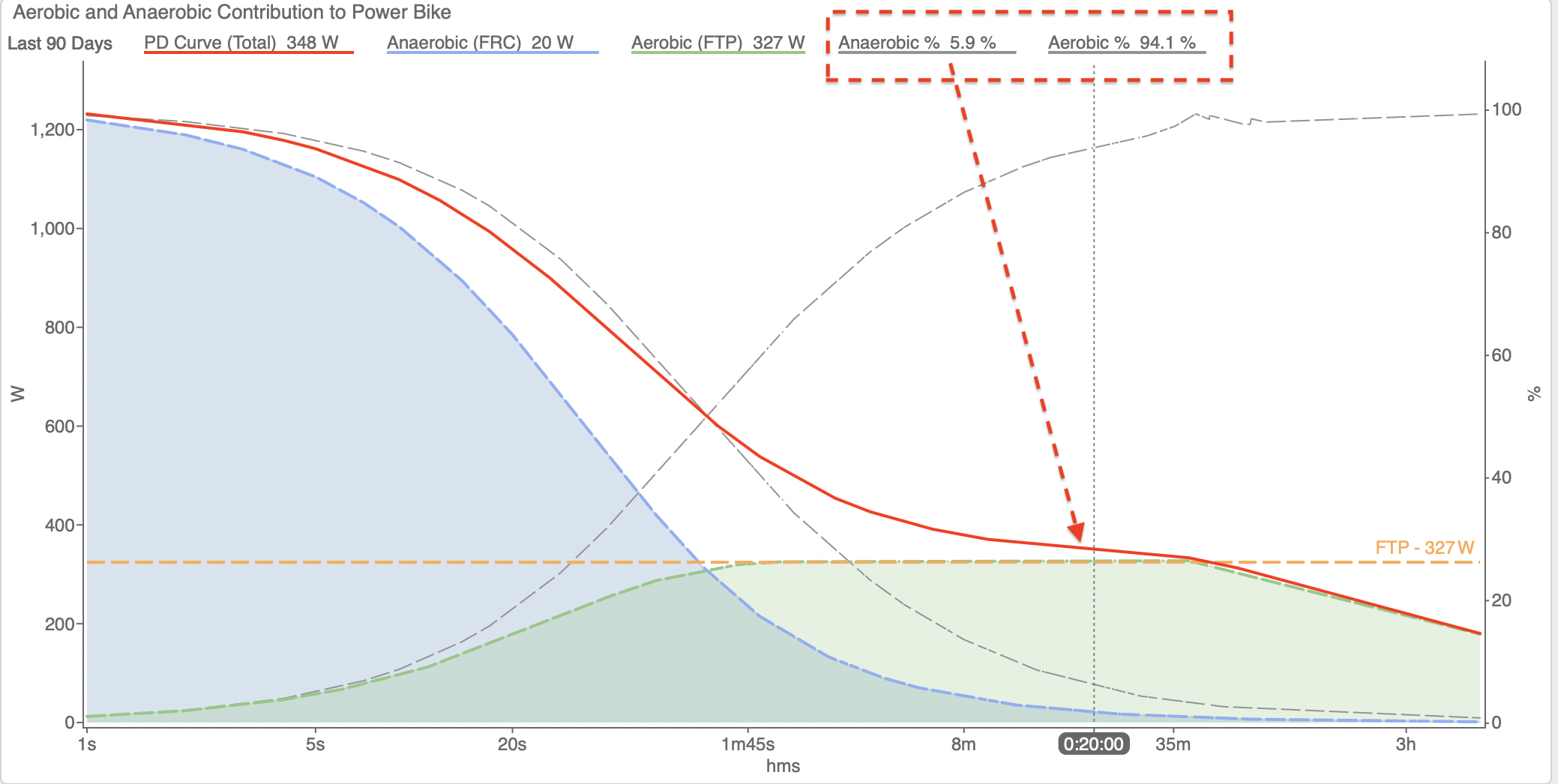
As you can see from the graph below, when you’re doing traditional FTP workouts, like 12- to 20-minute threshold intervals and climbing repeats, or sub-threshold workouts like 30- to 40-minute SweetSpot Tempo intervals, only about 4-6% of the total energy comes from anaerobic sources. Yes, it’s important to work on boosting that anaerobic contribution, but a big foundation of easy aerobic training essentially pushes threshold power up from below.
“Pulling FTP Up” Works Because VO2 max Raises The Ceiling
One of the biggest lessons CTS Coaches learned from working with ultramarathon runners was that a high lactate threshold was meaningless if VO2 max was too low. Elite ultrarunners tested in our performance lab with lactate thresholds at 95-97% of their VO2 max values. To put that in a cycling context, elite bike racers might be see lactate threshold values at 85-87% of VO2 max. It wasn’t that the runners were more fit. It was that they never trained VO2 max! Their aerobic ceiling was low and their lactate threshold was bumping up against it.
High-intensity training, meaning anaerobic capacity work and VO2 max training, pulls FTP up by raising the ceiling or creating more room for FTP to grow.
FTP Training Must Include Both “Push” and “Pull”
When you understand that, conceptually, your FTP is the result of your aerobic system pushing up from the bottom and your maximum aerobic capacity pulling up from the top, it becomes clear that both types of training are essential. Too much aerobic training, or event too much time at your current FTP, is a dead end for FTP development because your progress will eventually be limited by your VO2 max. Focusing too much on high intensity training is also a dead end for FTP development. Not only is too much high intensity training exhausting and difficult to recover from, but your aerobic foundation eventually starts to erode underneath you from neglect
How to Balance “Push” and “Pull” Training To Increase FTP
The proven intensity distribution that leads to sustainable and progressive improvement in endurance performance favors a large volume of easy aerobic training (80% of annual training time in Zone 1 and 2) and a small percentage of time (10-12% of total annual traning hours) spent in Zones 4+. The remaining time (8-10%) is devoted to Zone 3 and Low Zone 4, like Tempo, SweetSpot, and longer FTP intervals. In practical terms, this means spending most of the season pushing up with aerobic works, then layering in a few key periods of high intensity to pull FTP up by increasing anaerobic threshold and max aerobic capacity.
The art of endurance training is figuring out when to layer in the medium and hard work to build event-specific fitness, and when to double down on easy aerobic work to build as big a foundation as possible.
Two Ways To Build Interval Workouts: Extensive vs. Intensive Intervals
Once you understand push versus pull, the next layer is how to structure the actual intervals:
- Extensive intervals are longer, lower-power efforts. You’re extending the time-at-intensity so you can sustain efforts longer. Because the intervals are longer, your pacing must be a bit slower. This is why we have “intensity zones”. An “extensive FTP workout” would be 2×20 minutes at Low Zone 4 power output (88-95% of FTP), with 5-8 minutes of recovery between efforts.
- Intensive intervals are shorter, higher-power efforts. You’re intensifying the effort so you can produce more power at the given effort level. Because the intervals are shorter, you can reach for a higher power output. An “intensive FTP workout” could be 4×8 minutes at High Zone 4 power output (100-106% of FTP), with 4 minutes of recovery between efforts.
Applying this concept to VO2 max intervals, an extensive VO2max workout could be 5×5 minutes at 107-117% of FTP with 5 minutes of recovery between efforts, whereas an intensive VO2max workout could be 8×2 minutes at 115-125% of FTP with 2 minutes of recovery between intervals.
► Free Cycling Training Assessment Quiz
Take our free 2-minute quiz to discover how effective your training is and get recommendations for how you can improve.
Data Analysis: Mapping Interval Durations To Your Power Duration Curve
There’s a very helpful chart in TrainingPeaks that models your best Mean Max Power outputs across all time ranges (seconds to minutes to hours) over a given timeframe (90 days, 365 days, etc.). The result is a sigmoidal curve that illustrates how your best power outputs drop off as efforts get longer. The shape of the curve can indicate your strengths and weaknesses and provide insights on how your fitness aligns with your goals or the demands of your goal events.
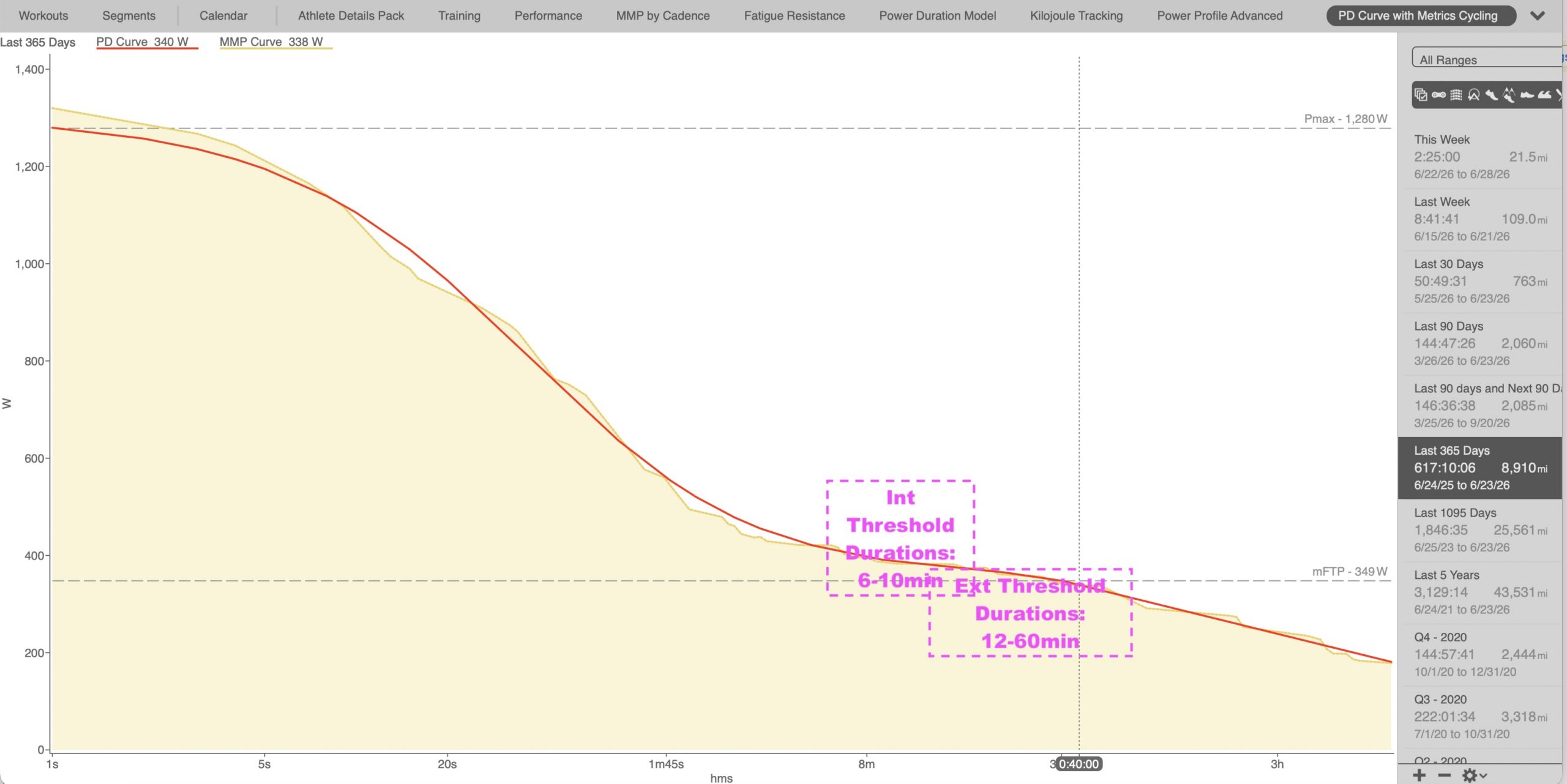
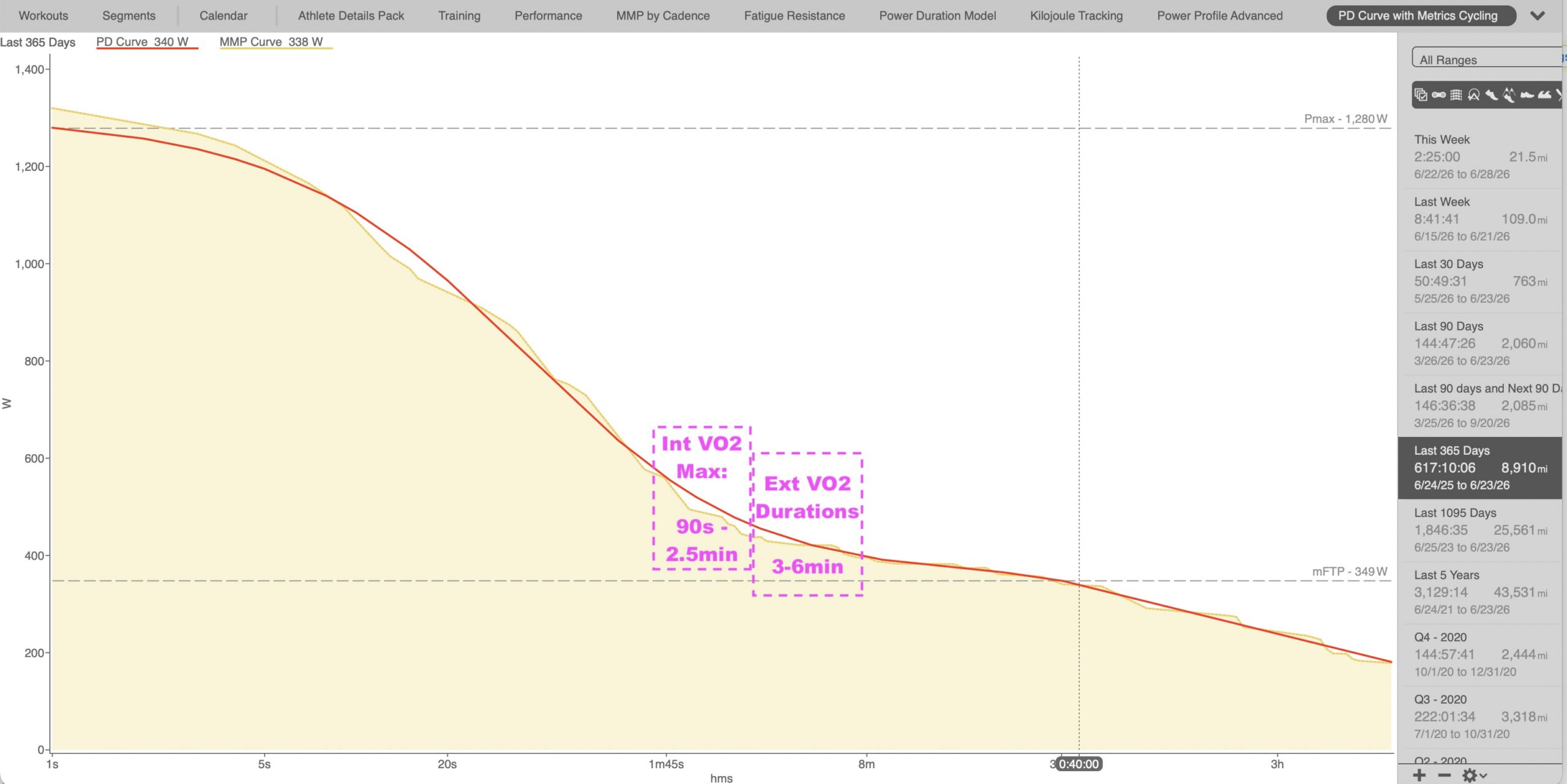
The red line in the graph below is the Power Duration Curve, representing a modeled view of the athlete’s mean maximal power based on data from the past 365 days. The yellow line or area represents the exact best mean maximal power outputs at the given durations over the past 365 days. The point noted as “mFTP – 348 W” indicates that the athletes mathematically-modeled FTP is 348 Watts based on this curve, and the athlete can sustain that effort for 40 minutes.
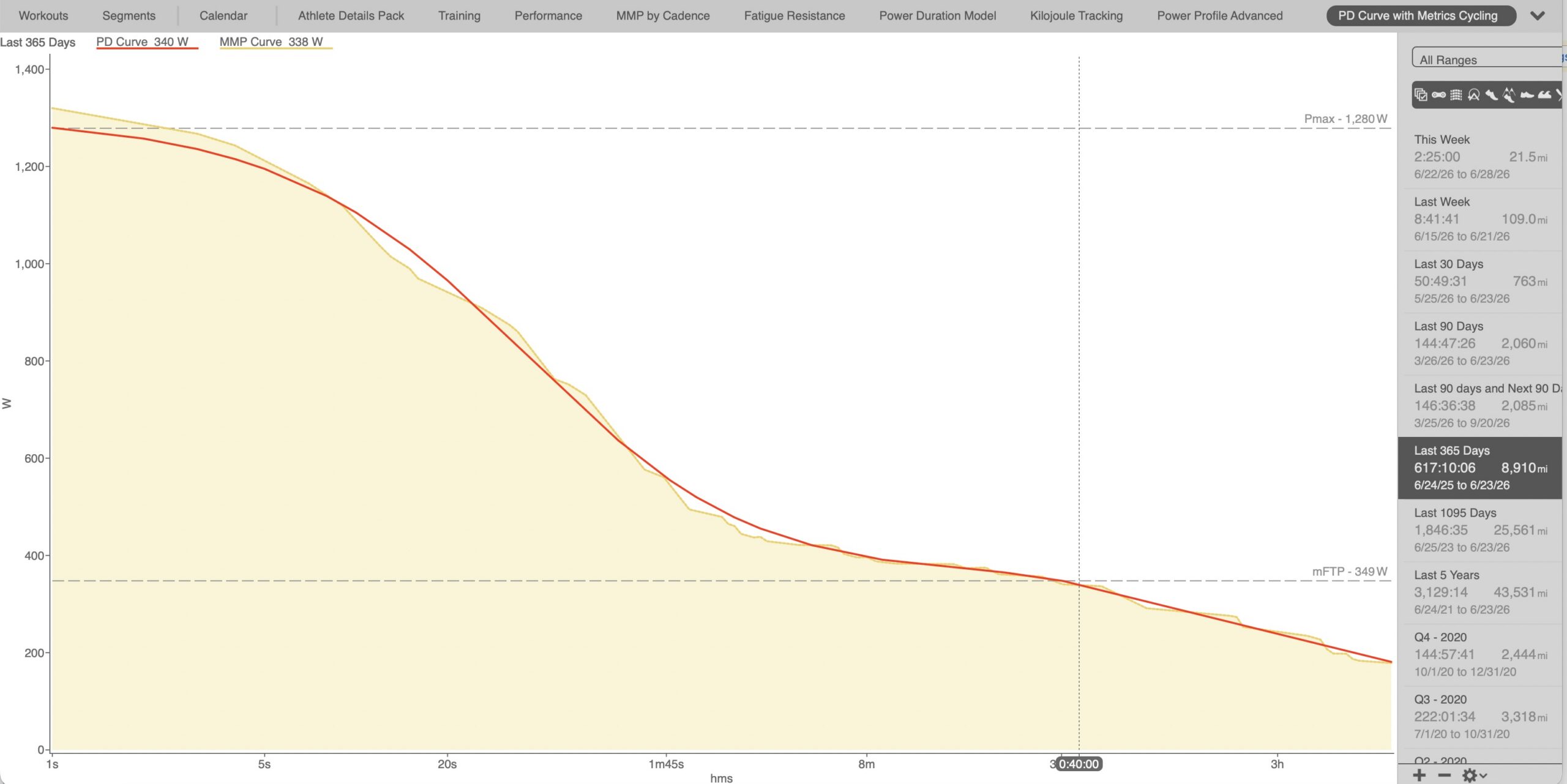
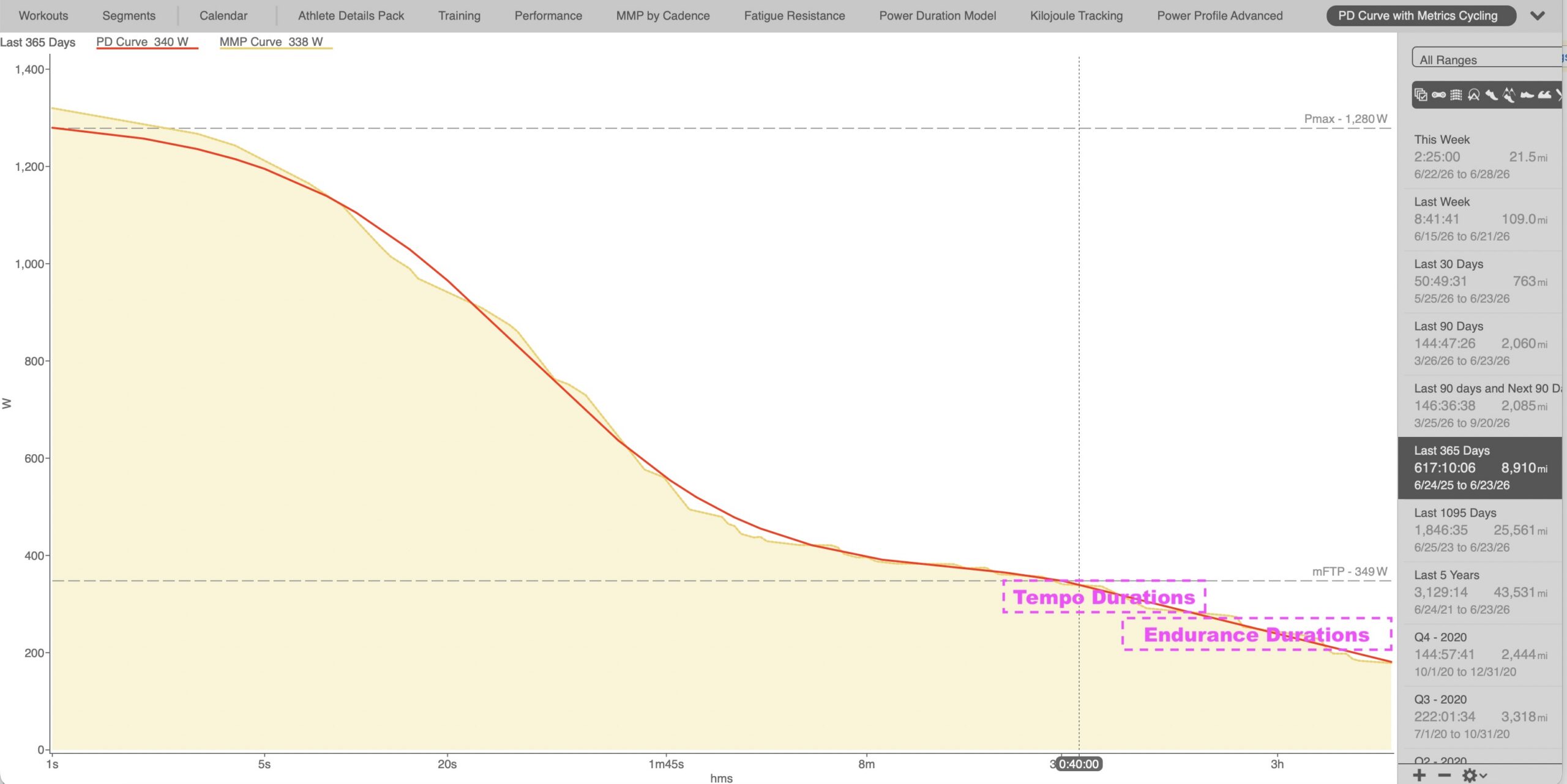
The images below illustrate how Tempo, Threshold, and VO2 max interval workouts can be mapped to this athlete’s Power Duration Curve, and specifically how to apply the “intensive vs. extensive” concept. Remember, the range of durations for intervals are determined by the physiological target. You can’t do 20-minute VO2max intervals because, by definition, VO2max intensity cannot be sustained for that long.
Endurance and Tempo Efforts:
- Zone 1–2 endurance rides: As short as an hour, as long as needed. This area is the far right side of the curve, denoted by longer durations at lower power.
- Zone 3 tempo work: Typically 15–30 minutes, sometimes up to 60, or targeted as a time-in-zone goal.
Threshold Intervals:
- Extensive threshold intervals: as short as 12 minutes, up to 60 minutes.
- Intensive threshold intervals: as short as 6 minutes, up to 10 minutes, at higher than 100% FTP.
VO2 max Intervals:
- Intensive VO2 max intervals: roughly 90 seconds to 2.5 minutes
- Extensive VO2 max intervals: roughly 3 to 6 minutes.
What About Efforts Shorter Than 90 Seconds?
That’s the truly intensive end of the curve, the steep area on the left side. This is where you find deep anaerobic or functional reserve capacity (FRC) work. It’s important to work on because it governs the amount of energy you can produce once you’re above FTP, but you must be careful with the amount and timing of FRC work. Too much of it can bring FTP down, which is a topic covered in this article
Putting It All Together to Maximize FTP
If you want your highest possible FTP, you need both push and pull. In practice, that looks like:
- Several months of progressive aerobic riding — building volume and intensity with some sub-threshold interval work.
- 6–8 weeks out from a key race: a 3–4 week block of focused VO2 max work.
- A 2-week taper to freshen up before your event.
Use the extensive vs. intensive framework to dial in the right interval prescriptions along the way. And don’t overcomplicate it beyond that. There is already enough complication with the training, good recovery, proper fueling, quality sleep, and stress reduction.
The Bottom Line
There is no magic workout that increases FTP. There never has been, and there never will be. But once you understand the concepts of pushing and pulling FTP up, along with extensive vs. intensive interval structure, then you have a framework flexible enough to apply to your schedule, your goals, and at any point in the season.
Additional Resources
- Tim Cusick: Periodization, Training Modalities, And Getting Your Training Rhythm Right – CTS
- How To Improve Your Cycling FTP (Functional Threshold Power) – CTS
► FREE Mini-Course: Learn How to Maximize Your Limited Training Time
Learn step-by-step how to overcome limited training time and get faster. Walk away with a personalized plan to increase your performance.
"*" indicates required fields
About the Author
Adam Pulford
CTS Head Cycling Coach
Adam Pulford is a dedicated coach at CTS with a passion for elevating athletic performance through tailored, measurable strategies and a deep understanding of the “why” behind each athlete's goals. With nearly two decades of experience, a degree in Exercise Physiology, and a successful track record managing professional cycling teams, Adam also shares his expertise as the host of the Time-Crunched Cyclist podcast, providing actionable insights for endurance athletes.