
Vitamin K2: The Bone-Saving Vitamin You’ve Never Heard Of
Updated On
March 2, 2026
Lifelong cyclists can have a greater risk for low bone density, which is especially dangerous for Masters and Grand Masters (60+ years old) who are already fighting gradual bone loss. Many cyclists try addressing the problem by increasing intake of Vitamin D and Calcium, either through diet or supplementation or both. But there’s a third micronutrient you’ve probably never heard of and most likely don’t consume enough of – Vitamin K2 – that is absolutely essential for maintaining or increasing bone density.
The Bone Density Triad: Calcium + Vitamin D3 + Vitamin K2
Most people understand the need to consume adequate calcium to promote healthy and strong bones. Calcium is a key mineral that’s directly related to the density and hardness of bones. Vitamin D helps the body absorb calcium in the gut, so more of what you eat ends up in your body.
Vitamin K2 plays a critical role directing calcium in the bloodstream to your bones! Calcium plays numerous roles in the body, including muscle contraction, blood vessel constriction and dilation, nerve signal transmission, blood clotting, and more. All of those functions are important, but without adequate Vitamin K2, your bones don’t get their fair share of calcium!
How Vitamin K2 Supports Bone Health
Throughout your life, bones are constantly remodeled based on mechanical stress, nutritional status, lifestyle stress, and many other variables. Osteoblasts within your bones work to create new bone tissue while osteoclasts break down bone tissue. Within osteoblasts, there’s a protein called osteocalcin which promotes calcification or the binding of calcium into the bone matrix. Vitamin K2 activates osteocalcin.
How Vitamin K2 Supports Cardiovascular Health
Vitamin K2 has a second, perhaps even more important role. By activating Matrix Gla protein (MGP), Vitamin K2 prevents calcium from depositing in artery walls and soft tissues. For athletes over 50, this should start sounding familiar. Some lifelong endurance athletes develop vascular calcification (artery hardening), potentially from bouts of elevated blood pressure during high-intensity exercise over the course of decades. This can lead to an elevated coronary artery calcification (CAC) score, which is a traditional risk factor for cardiovascular disease.
Normally, the risk associated with a high CAC score is that the calcified plaques can eventually clog your arteries or break off and cause a blockage. Current research indicates that the vascular calcification in endurance athletes results in more stable plaques and that endurance athletes with higher CAC scores (>100 Agatston units) still have lower risks for cardiovascular disease than sedentary people with lower CAC scores (Defina et al. 2019; Aengevaeren et al, 2023).
Nevertheless, we want more calcium in bones and less in arterial walls, and Vitamin K2 activates the protein that prevents calcium from depositing into artery walls.
The Two Forms of Vitamin K: Vitamin K1 and Vitamin K2
There are two forms of Vitamin K. In short, K1 is more important for blood clotting, whereas K2 is strongly associated with bone mineralization and directing calcium to the bones. They also come from considerably different sources.
Vitamin K1 (Phylloquinone)
- Main role: blood clotting
- Sources: Found primarily in leafy green vegetables, including kale, spinach, broccoli, Brussels sprouts, collard greens, turnip greens, and lettuce.
Vitamin K2 (Menaquinone)
- Main roles: bone mineralization and directing calcium to bones
- Subtypes: MK-4 and MK-7
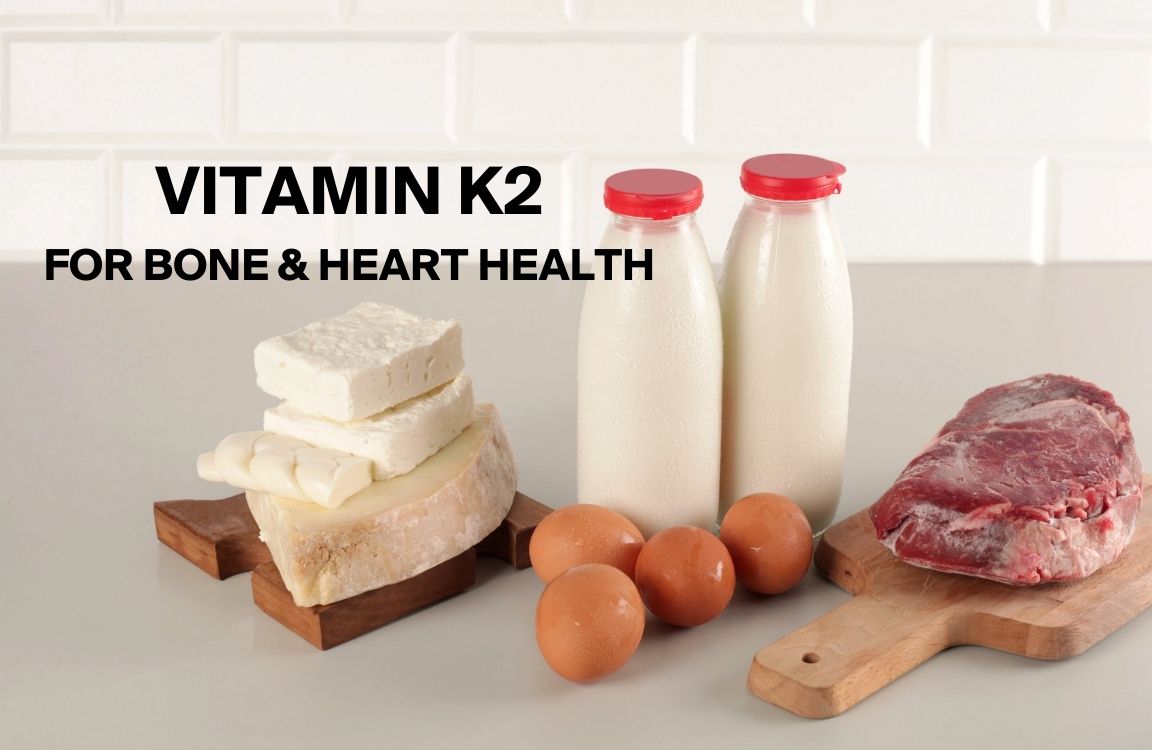
- Sources: Found in fermented foods and animal products. Good sources of Vitamin K2 include:
- fermented soybeans (Natto)
- Hard cheeses (Gouda, Edam)
- Soft cheeses (Brie)
- Egg yolks
- Chicken thighs
- Organ meats
How Much Vitamin K Do You Need?
There is currently no distinction between Vitamin K1 and K2 in the Recommended Daily Allowance (RDA) for Vitamin K. The RDA for total Vitamin K is 120 mcg/day for men and 90 mcg/day for women. However, bone-health studies on K2 typically use 100-180 mcg/day of K2 (particularly the MK-7 subtype found in high concentrations in fermented soybeans).
Some people may struggle to consume enough Vitamin K2 through diet alone, particularly if you don’t eat fermented foods. The best source is fermented soybeans, where just 18 grams provides 180 mcg of Vitamin K2 MK-7. To get the same amount from a soft cheese like brie, you’d have to consume about 16 ounces (448 grams)!
Do you need a Vitamin K2 supplement?
Not necessarily. People who consume fermented foods (yogurt, kefir, kimchi, miso, tempeh, natto, sauerkraut, kombucha), aged hard and soft cheeses, egg yolks, and meat can obtain enough K2 through diet. Plant-based athletes may have a harder time consuming enough K2, although they can often obtain enough K1 through green leafy vegetables like kale, spinach, broccoli, Brussels sprouts, collard greens, turnip greens, and lettuce.
If you choose to take a supplement to increase Vitamin K intake, consult your physician first. Both forms of Vitamin K are part of a select group of fat-soluble vitamins: A, D, E, and K. Unlike water-soluble vitamins like Vitamin C, fat soluble vitamins can build up in your body because they are stored in your liver and fatty tissues. Although it is rare, excessive consumption of fat-soluble vitamins can be toxic. Vitamins can also interfere with medications or work against them. For instance, people taking anti-coagulants (e.g., Warfarin) should consult their physicians because of Vitamin K’s role in blood clotting.
► Free Cycling Training Assessment Quiz
Take our free 2-minute quiz to discover how effective your training is and get recommendations for how you can improve.
Special Bone Density Considerations for Athletes Over 50
Cyclists over 50 need to make a concerted effort to combat declining bone mineral density. It’s likely that decades of non-weight bearing sport have not been kind to your bones. First step, have your bone mineral density checked and work with a physician and a dietitian to take steps to mitigate bone loss and potentially increase bone density. A bone density-oriented nutritional strategy often focuses on obtaining Calcium, Vitamin D, and Vitamin K (both forms) through dietary choices. Typically, these recommendations include:
- Calcium: 1000-1200 mg/day
- Vitamin D: Up to 30 minutes of sun exposure and/or 1500-2000 IU of Vitamin D (600–800 IU/day is the RDA)
- If supplementing with K2: Aim for 100-180 mcg/day (RDA for combined Vitamin K is 90-120 mcg/day)
Total energy intake is also important for supporting bone health. Athletes who chronically restrict calorie intake to remain excessively lean have a harder time building or maintaining bone density, and this is a concern for athletes in any sport where there’s a competitive advantage to being lightweight.
In addition to consuming adequate total energy and obtaining enough Calcium, Vitamin D, and Vitamin K, endurance athletes over 50 need to commit to strength training and more weight-bearing activities like running, hiking, tennis, etc. Bones remodel based on the stress applied to them, the bone-building materials available, and your total energy balance.
References:
Aengevaeren, V. L., Mosterd, A., Bakker, E. A., Braber, T. L., Nathoe, H. M., Sharma, S., Thompson, P. D., Velthuis, B. K., & Eijsvogels, T. M. H. (2023). Exercise Volume Versus Intensity and the Progression of Coronary Atherosclerosis in Middle-Aged and Older Athletes: Findings From the MARC-2 Study. Circulation, 147(13), 993–1003. https://doi.org/10.1161/CIRCULATIONAHA.122.061173
DeFina, L. F., Radford, N. B., Barlow, C. E., Willis, B. L., Leonard, D., Haskell, W. L., Farrell, S. W., Pavlovic, A., Abel, K., Berry, J. D., Khera, A., & Levine, B. D. (2019). Association of All-Cause and Cardiovascular Mortality With High Levels of Physical Activity and Concurrent Coronary Artery Calcification. JAMA cardiology, 4(2), 174–181. https://doi.org/10.1001/jamacardio.2018.4628
Myneni, V. D., & Mezey, E. (2017). Regulation of bone remodeling by vitamin K2. Oral diseases, 23(8), 1021–1028. https://doi.org/10.1111/odi.12624
Skalny, A. V., Aschner, M., Tsatsakis, A., Rocha, J. B. T., Santamaria, A., Spandidos, D. A., Martins, A. C., Lu, R., Korobeinikova, T. V., Chen, W., Chang, J. S., Chao, J. C. J., Li, C., & Tinkov, A. A. (2024). Role of vitamins beyond vitamin D3 in bone health and osteoporosis (Review). International journal of molecular medicine, 53(1), 9. https://doi.org/10.3892/ijmm.2023.5333
van Ballegooijen, A. J., Pilz, S., Tomaschitz, A., Grübler, M. R., & Verheyen, N. (2017). The Synergistic Interplay between Vitamins D and K for Bone and Cardiovascular Health: A Narrative Review. International journal of endocrinology, 2017, 7454376. https://doi.org/10.1155/2017/7454376
► FREE Mini-Course: Learn How to Maximize Your Limited Training Time
Learn step-by-step how to overcome limited training time and get faster. Walk away with a personalized plan to increase your performance.

About the Author
Jim Rutberg
CTS Pro Endurance Coach
Jim Rutberg is a seasoned coach and endurance athlete with over two decades of experience, having co-authored ten influential books on training and nutrition, including “The Time-Crunched Cyclist”, "Training Essentials for Ultrarunning", and "Ride Inside." His unique blend of academic knowledge, elite racing experience, and hands-on coaching at CTS positions him as a leading expert in endurance sports, dedicated to helping athletes reach their highest potential while balancing family life and personal passion for cycling.