

Time-Crunched? Here’s the Training Week Framework That Works
Updated On
March 16, 2026
How to Structure a Training Week for Real Life (and Real Results)
Static and one-size-fits-all training plans rarely work for cyclists because they don’t align well with your real life. You might be able to stick to a static or even AI-generated/adjustable training plan for eight to 12 weeks leading up to a specific goal event, but only because you’re willing to compromise your lifestyle for a limited period of time. Effective long-term training plans work because they are harmonious with the other priorities and rhythms of your life. I’ve worked one-on-one with cyclists ranging from beginners to World Tour pros and shift workers to CEOs, and here’s how I build great cycling training plans that fit seamlessly into a cyclist’s life.
The Problem: Why One-Size-Fits All Training Doesn’t Work
I know what you’re thinking. This seems like a perfect use case for artificial intelligence. Plug in your variables, what days and hours you have available, and let the Black Box figure it out. The problem is that the output just mimics the most commonly used patterns available in large data sets. Everything regresses to the middle, looks the same, sounds the same, results in the same. When was the last time that ceding your individuality worked well for you?
Real life is all about the variables, and yours are unique to you. Work stress. Family obligations. Travel. Sleep. Energy. Mood. Unexpected curveballs. Following a pre-written training week shows compliance but not necessarily wisdom. Learning how to adjust your training is almost always more important than knowing what specific workout to do on any given day.
The best solution is to create a training rhythm that is harmonious with your normal life. That means your hard efforts align with days – and even times of day – when you have the most energy. Your rest days naturally align with times when other priorities take precedence. And the total energy output of your training week is in balance with the total amount of rest and recovery you can achieve within a given time period.
Here’s my step-by-step method for creating the cycling training plan that works best for you.
Step 1: Find Your Rhythm
When I say “find your rhythm,” I mean establish the training frequency and duration that results in realistic consistency.
Feel Stronger in 6 Weeks — No Matter Your Age
Climbs feel steeper? Recovery slower?
You’re not done getting faster — you just need a smarter plan.
The 6-Week Masters Power Build Coaching Program is designed for cyclists 50+ who want to boost power, recover faster, and ride stronger — all with expert 1:1 coaching.
- Personalized 6-Week Training Plan
- 1:1 Coaching + TrainingPeaks Premium
- Mobility & Strength Bonus Guides
💪 Guarantee: Stronger or free.
Start your 6-week journey for $149Start by asking yourself honest questions:
- Can you actually ride six days per week?
- Does your job allow it?
- Is your family on board?
- Can you get it done and still enjoy your life?
Would a five-day training week be more sustainable? Perhaps four days a week as a foundational schedule, with the option for a bonus day if you have some free time? Be real with yourself. Don’t train a certain way because it worked for your friend or because a pro can handle it. Your training must fit your life.
How Do You Determine How Many Days Per Week You Should Train?
As a starting point that works for most athletes, I suggest the following formula:
- Designate at least 1 day completely off the bike per week.
Aim for this to be the same day every week. Training 7 days per week doesn’t make you tougher than the rest, it leaves you exhausted and weak. Rest is essential for physical improvement and it’s restorative for your mind, muscles, immune system, and much more.
Now you’re down to six potential training days per week.
- Evaluate the realistic implications of training six days per week.
Just because you can doesn’t mean you should. Do you even want to ride or train six days per week? It’s okay if you don’t. What would you have to give up to ride this much, and are the gains worth the cost? Can your schedule handle six training sessions per week consistently, or is six-days-per-week only possible in the best of circumstances?
If your answer is that six days per week isn’t realistic, repeat the exercise with five days per week.
The solution that works best for most athletes I work with is to decide the maximum number of weekly training days you can handle, then subtract one. So, if you can handle six days per week when the weather is great and your job is reasonably under control and your kids are healthy and your spouse or partner is happy, let’s build a training plan for five days per week.
You can always add a bonus day if you have the opportunity, or scale up if you’re consistently able to add another day, but the foundation of your training plan should be built on the number of days per week you can sustain week in and week out, even when life gets busy.
Step 2: Be Realistic About Time Per Session
Now let’s talk about time. The biggest mistake athletes make with “training time per session” is failing to account for pre- and post-workout activities. You have to change clothes, fill bottles and pump up your tires. After the workout you have to shower and eat. A 90-minute ride is actually a 2-hour commitment, at minimum.
Again, let’s start with a formula:
- Total Time – (Setup Time + Shower Time + Food Time) = Workout Time.
How much total time do you have between other obligations? If you have 2-hour windows of time, then 75- to 90-minute workouts might be most realistic. If you have 90 minutes total, aim for 60-minute training sessions. You can take steps to make your pre- and post-workout routines more efficient so you can lengthen your workouts within those windows, or seek to broaden the windows to accommodate longer workouts. - What days do you have more or less schedule flexibility?
Where are your opportunities to add time to workouts if necessary or to consistently schedule longer workouts? Just as important, define the days with hard stops and rigid schedules, and remember that real-world workouts include their own variables. If you have to pick up your kid at 4:00pm, riding indoors from 2:30-3:30pm might be a good idea because there’s no chance for a flat tire to make you late.
Getting realistic about time-per-session is how most amateur athletes arrive at 60- to 90-minute weekday rides inside 90- to 120-minute total time windows. Longer rides are typically scheduled for weekends, but with highly variable personal and work schedules these days, the “weekend” isn’t always Saturday-Sunday.
Step 3: Structure Your Training Week Using Hard Days As Anchor Points
Your weekly training structure or pattern needs to prioritize hard days and protect easy days. The best way to do this is to anchor your training week by your hard days and fill in the easier endurance rides and rest days accordingly.
- What do you define a “hard day” vs. “easy day”?
We can evaluate by comparing Training Stress Score (TSS) to Chronic Training Load (CTL), which means comparing how hard today’s ride is compared to the weighted average of your past six weeks of training.
- Easy: TSS 10-25% BELOW CTL
- Moderate: TSS 25%-50% ABOVE CTL
- Hard: TSS 50-100% ABOVE CTL
So, if your CTL is currently 50, a “hard day” could be a structured interval workout, group ride, race, or even a long Zone 2 ride where the TSS is 75-100 or higher.
- How many hard days should you schedule per training week?
Two hard days per week is a great starting point. This is where quality matters more than quantity. Scheduling two hard days per week leaves adequate time between hard sessions for enough recovery to make each hard session truly hard and effective. The more energy you have for high-quality hard workouts, the more effective they are. - Use advanced strategies to add intensity for focused periods of time
Two hard sessions per week is a solid strategy for year-round training. During high-focus training periods leading up to races or when you’re targeting specific adaptations, you can use advanced strategies to add intensity. These include adding a third hard day to your training schedule or concentrating workload with back-to-back days of hard training. There are examples of this in the sample schedules in the next section.
The important thing to remember is that back-to-back training blocks and 3-plus days of intensity per week should only be temporary training interventions, used with specific training targets in mind, and they should be balanced with increased recovery time.
Sample Weekly Training Plans
The sample weekly training schedules below are presented to illustrate effective training patterns within standard 7-day weeks.
5-Day and 4-Day Training Week Patterns
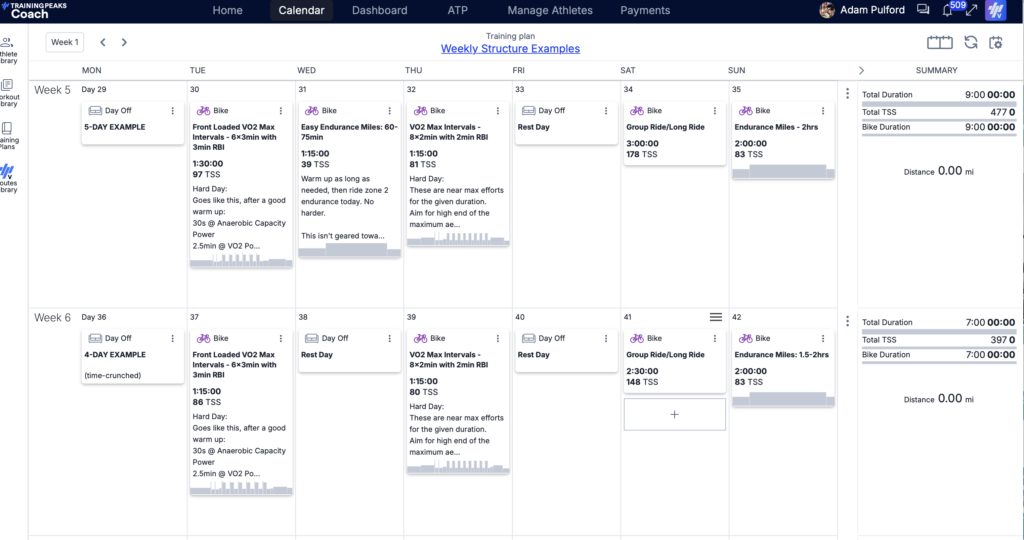
I typically recommend anchoring 4- and 5-day training patterns with structured interval days on Tuesday and Thursday and the potential for a hard day on Saturday in the form of a group ride or long solo ride. For the 5-day training pattern, add an endurance ride on Wednesday, which is a rest day on the 4-day pattern.
The pattern is more important than the specific days of the week, so if you want to offset the pattern by a day so it’s Wednesday and Friday intervals with a Sunday group ride or race, that works, too.
These patterns, illustrated in the image below, work well for people balancing career and family life with their cycling. Dissociating your training week from the calendar week can be a useful training strategy (i.e., a 9-day training pattern with hard days separated by two easy or endurance days), but only if you can accommodate the fact your interval days will keep landing on different days of the calendar week.
► Free Cycling Training Assessment Quiz
Take our free 2-minute quiz to discover how effective your training is and get recommendations for how you can improve.
6-Day Training Patterns
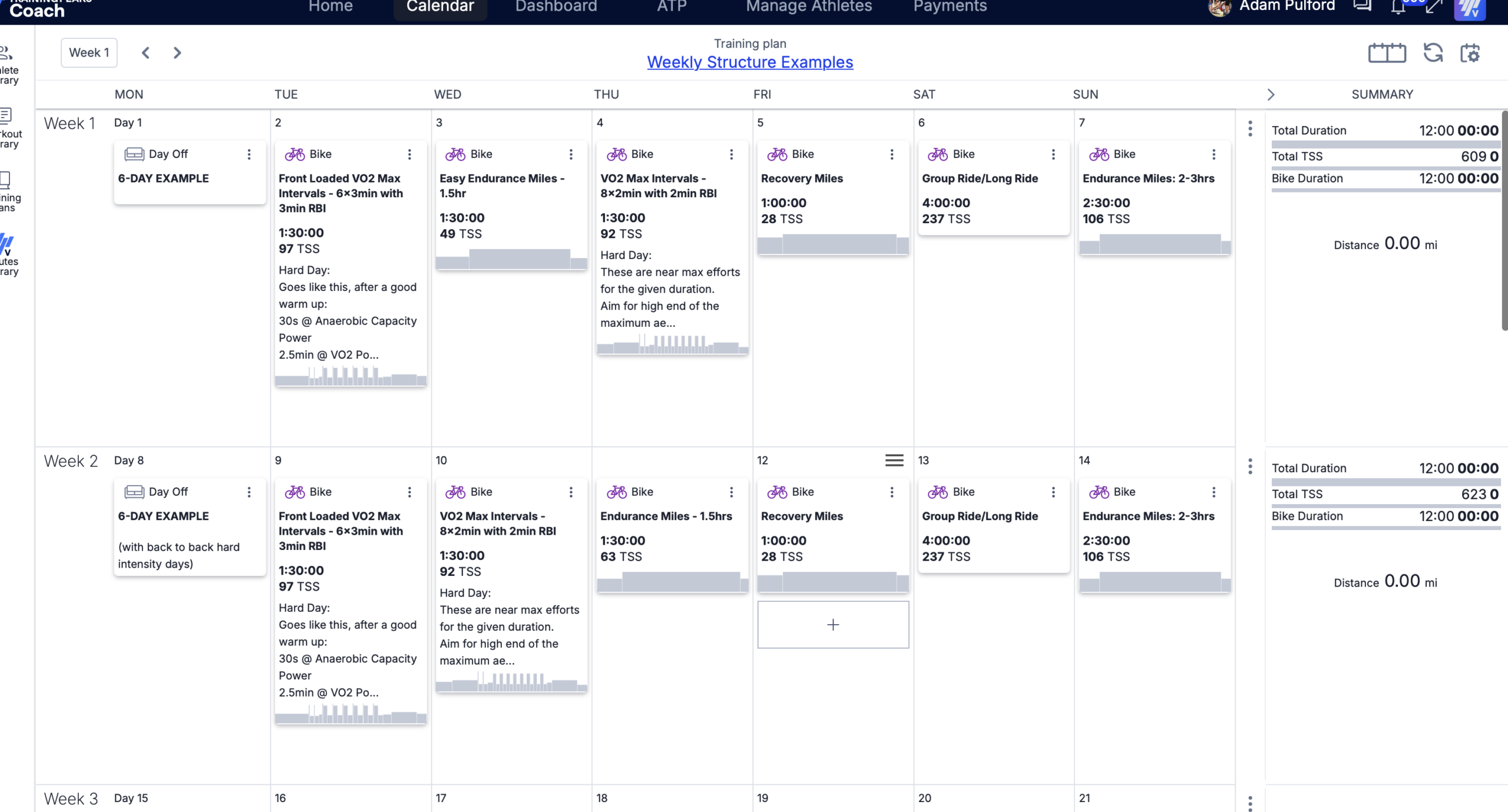
The first six-day training pattern described in the image below features a “standard” six-day training pattern anchored by Tuesday and Thursday structured interval days, a Wednesday endurance ride, Friday short spin, and two weekend rides followed by a Monday rest day.
The second six-day training pattern is more advanced and features a two-day back-to-back training block on Tuesday and Wednesday, followed by an endurance ride and recovery ride before your two rides on the weekend. This strategy can be useful for concentrating training workload when you want to drive greater adaptation from the same number of total weekly training hours.
Weekly Training Plan FAQ
The method above works for most cyclists most of the time, but people have questions. Here are a few of the frequently asked questions I hear from athletes and coaches.
What should you do if you miss a cycling workout?
Let’s say the work week explodes, you’re stressed, energy is low, and you just can’t get to a workout. Do you shuffle the week or just let it go? If it’s an isolated incident, I almost always let it go and just move forward with the schedule. No individual training session is the singular key to your success or failure. You have to take the long view and remember that training is cumulative and an extra day of rest is almost never a bad thing (especially when something stressful is causing the missed workout anyway).
Not all workouts are missed because of stressful circumstances. If you manage to get a bit more rest during the workweek because you missed an interval workout, sometimes I’ll move the interval workout to Saturday and combine it with your longer endurance ride, or I’ll encourage riders to give more effort than usual to the group ride.
Does time of day matter in terms of scheduling workouts?
I haven’t seen compelling evidence for a universally optimal time of day for training. However, in my experience coaching athletes for more than 20 years, there are absolutely athletes who have more energy and enthusiasm for workouts at certain times of day. You probably have your own “best time to train” based on your sleep pattern, what and when you eat, the daily fluctuation in your hormone levels, and the other priorities you direct focus toward.
Whenever possible, I encourage athletes to honor their personal rhythm and align their workouts with times of day when they have the most energy, feel fresh and strong, and can focus on the task. That’s not possible every single day, so prioritize doing hard workouts at your personal best time to train.
How important is a weekly long ride, and how long should it be?
Long rides build aerobic depth and are great for working on nutrition/hydration strategies, bike fit issues that only manifest after a few hours, and mental fortitude. They are also important for developing “durability”, which is a training buzzword for the ability to sustain power and pace with minimal dropoff after a few or several hours of riding.
Long rides are important, but they do not need to happen every week. Plenty of strong and fast cyclists ride two long rides per month. And “long” is relative. If you train 4-6 total hours per week, a 2-3 hour ride is plenty long. If you’re training 10-15 hours per week, long rides of 4-6 hours would be more appropriate for creating the depth of fitness you need.
I prefer to schedule cyclists’ long rides on Saturdays, followed by an easier ride on Sunday before a rest day on Monday. If the Saturday ride is epic (i.e., super long or really hard), this creates more opportunity for resting on Sunday and Monday so you’re still ready to go for a Tuesday interval workout.
What if my schedule is all over the place, totally unpredictable?
Consistency is your superpower and time is your friend. If your schedule doesn’t accommodate a predictable training pattern, it’s time to get creative. In the long term, the goal is to stack multiple weeks of similar training hours, even if the days of the week and the times of day vary wildly. So, if 8 hours of riding is the goal, see if you can stack weeks at that training volume. Then, when it comes to intensity, just try to get one hard day per week to begin with, and do it whenever you feel best. The rest of the rides can be Zone 2 or recovery. If you get to the point you can do two hard days per week, just try to separate them by at least one full day.
Outside of training, unpredictable schedules are often hard on eating and hydration habits, sleep schedules, and stress management. Combined, focusing on eating healthy foods (and enough food), staying hydrated, getting several hours of uninterrupted sleep on most nights, and dealing with your career and lifestyle stress all make unpredictable schedules easier to live with.
Weekends don’t work for long rides for me. What can I do?
Many of the working parents I coach have kids’ soccer games or dance recitals to go to on the weekends. Or people have house projects or would rather spend weekends with their partner/spouse. I’ve had success scheduling mid-week long rides for some athletes. Obviously, this only works if your job is flexible enough to accommodate it, but leaving work early for a Wednesday afternoon long ride can be a solution, or starting very early in the morning and getting to work a little late.
The Bottom Line
Building a great cycling training plan isn’t about finding the perfect workout — it’s about building a sustainable rhythm you can return to week after week, year after year.
The athletes who improve most aren’t always the ones training the hardest; they’re the ones training consistently. Start with an honest look at your life, anchor your week around two quality hard efforts, protect your recovery, and give yourself permission to adapt when real life intervenes.
Do that, and the fitness will follow.
► FREE Mini-Course: Learn How to Maximize Your Limited Training Time
Learn step-by-step how to overcome limited training time and get faster. Walk away with a personalized plan to increase your performance.
"*" indicates required fields
About the Author
Adam Pulford
CTS Head Cycling Coach
Adam Pulford is a dedicated coach at CTS with a passion for elevating athletic performance through tailored, measurable strategies and a deep understanding of the “why” behind each athlete's goals. With nearly two decades of experience, a degree in Exercise Physiology, and a successful track record managing professional cycling teams, Adam also shares his expertise as the host of the Time-Crunched Cyclist podcast, providing actionable insights for endurance athletes.